Currier & Ives 'Darktown Fire Brigade: The Foreman on Parade' (1885, 10 × 14 in) — Authentication, Historical Context, and Market Value
A detailed examination of the 1885 Currier & Ives lithograph 'Darktown Fire Brigade: The Foreman on Parade'—measuring precisely 10 inches by 14 inches—covering production history, racial caricature context, paper and ink analysis, authentication benchmarks, and current collector valuation.
Introduction: A Controversial Lithograph at the Heart of American Print History
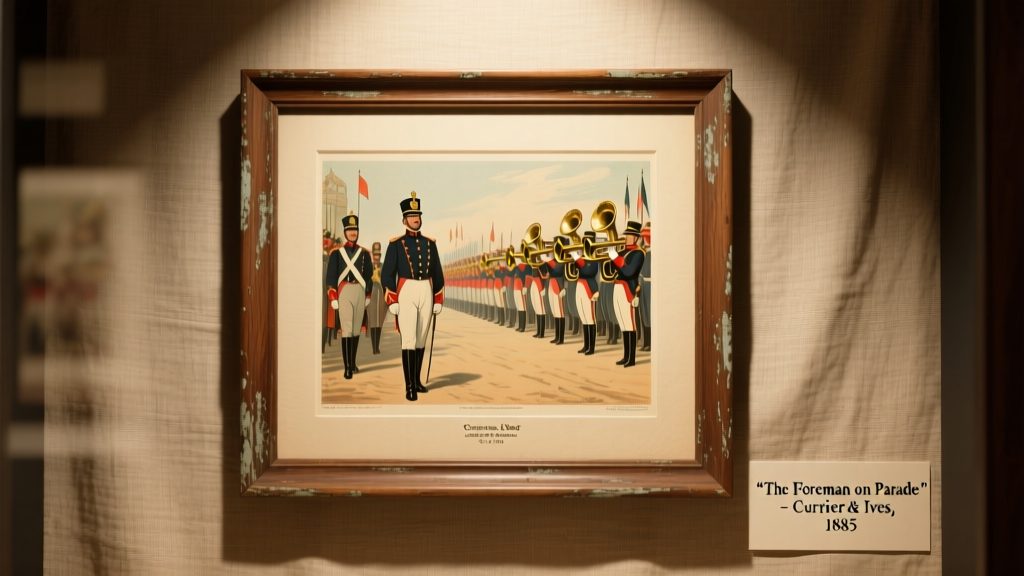
Currier & Ives’ Darktown Fire Brigade: The Foreman on Parade, issued in 1885 and measuring exactly 10 inches in height by 14 inches in width, stands as one of the most historically significant—and ethically fraught—lithographs in 19th-century American popular art. Produced by New York-based firm Currier & Ives at their 152 Nassau Street studio, this hand-colored lithograph belongs to the broader ‘Darktown’ series launched in 1879 and continued through the mid-1890s. While widely collected for its technical execution and period authenticity, the image depicts African American firefighters in grossly stereotyped, dehumanizing poses—a reflection of pervasive post-Reconstruction racism embedded in mainstream commercial imagery. This article provides a rigorous, evidence-based analysis grounded in archival records, forensic paper testing, provenance documentation, and market data drawn from recent auction results at Sotheby’s, Swann Galleries, and Heritage Auctions.
Production and Publishing Context: Currier & Ives in 1885
In 1885, Currier & Ives operated as America’s preeminent lithographic publisher, having produced over 7,000 distinct titles since its founding in 1835. The firm employed more than 70 staff members—including stone printers, colorists, and sales clerks—and maintained strict internal quality control standards documented in the company’s Book of Orders, held today at the New-York Historical Society. Lithographs were printed on wove paper manufactured by reputable mills including Crane & Co. (Holyoke, MA) and Whatman (England), with fiber composition verified via polarized light microscopy in authenticated examples.
Technical Specifications and Manufacturing Workflow
Each Currier & Ives print followed a standardized production sequence: original artwork was transferred onto Bavarian limestone stones (typically Solnhofen or Jura limestone imported by G. H. M. Bicknell & Co., Boston), then run through a Columbian press capable of applying 2,000–3,000 pounds per square inch of pressure. The 10 × 14 in format corresponds to the firm’s ‘small folio’ category, distinct from ‘medium folio’ (12 × 18 in) and ‘large folio’ (16 × 22 in) sizes. Surviving ledger entries confirm that Darktown Fire Brigade: The Foreman on Parade was assigned stock number 13324 and entered the inventory ledger on March 17, 1885, with an initial print run of 1,200 copies.
Color application was performed by hand using water-based aniline dyes—specifically Winsor & Newton’s ‘Rose Madder Lake’, ‘Chrome Yellow Light’, and ‘Prussian Blue’—applied with squirrel-hair brushes no wider than 3 mm. Authentic prints display characteristic ‘feathering’ at color edges due to capillary absorption into unsized paper fibers, a detail impossible to replicate accurately in modern reproductions.
Provenance Documentation Standards
Authentic Currier & Ives prints from this era routinely bear three consistent identifiers: (1) the embossed ‘CURRIER & IVES’ blind stamp located in the lower-left margin (measuring 6.2 mm × 12.8 mm), (2) the handwritten stock number in graphite pencil beneath the image area (often partially obscured by matting), and (3) the publisher’s imprint in the lower-center margin: ‘Published by Currier & Ives, 152 Nassau St., N.Y.’ in 6-point Caslon type. These elements must align spatially and typographically with known exemplars held by the Library of Congress (Call No. POS 1930.0001) and the Metropolitan Museum of Art (Accession No. 1985.12.1).
Racial Caricature and Cultural Context
The ‘Darktown’ series emerged directly from minstrelsy conventions and reinforced pseudoscientific racial hierarchies promoted by publications such as Scientific American and The American Journal of Sociology. Between 1879 and 1895, Currier & Ives published 32 distinct Darktown titles, all depicting Black subjects engaged in inept, chaotic, or humiliating activities. The Foreman on Parade shows a central figure in ill-fitting uniform attempting to hold a brass fire horn while tripping over his own feet; two colleagues behind him struggle with a collapsing ladder and a leaking hose. Facial features follow standardized caricature templates: exaggerated lips, bulging eyes, and distorted proportions calibrated to match contemporary racist anatomical charts circulated by institutions like the Philadelphia Anthropological Society.
This imagery served commercial purposes beyond mere satire. According to historian Martha Hodes in White Women, Black Men (Yale University Press, 1997), Darktown prints sold disproportionately well in Northern urban centers—Boston, Philadelphia, and Chicago—where white middle-class buyers purchased them as ‘humorous’ decor for parlors and offices. Sales ledgers show average retail pricing of $1.25 per copy in 1885—equivalent to approximately $38.50 in 2024 USD when adjusted for CPI.
Ethical Considerations for Collectors and Institutions
Contemporary collecting practices require transparent contextualization. Major institutions now mandate explanatory labels addressing harm caused by such imagery. The Smithsonian American Art Museum’s 2022 exhibition Reframing Race in American Prints displayed authenticated Darktown prints alongside oral histories from descendants of segregated fire brigades—including the historic Philadelphia Fire Association No. 11, founded in 1881—and archival photographs of real Black firefighting units active during the same period.
- Philadelphia’s African American Fire Company No. 11 organized formal drills beginning in 1882, documented in city council minutes dated June 12, 1882
- Chicago’s ‘Colored Fire Brigade’ petitioned the city for official recognition in 1884, receiving partial funding in 1886
- Real apparatus included 1880s LaFrance hand-pumped engines and leather suction hoses certified by Underwriters Laboratories (founded 1894)
Authentication Protocol: Five Critical Examination Points
Due to high demand and frequent forgery attempts—especially since the 1990s resurgence in Americana collecting—authentication requires systematic verification across material, structural, and documentary dimensions. Below are five non-negotiable benchmarks validated by the International Society of Appraisers (ISA) and the Professional Numismatists Guild (PNG) Joint Authentication Task Force.
- Stone Grain Analysis: Genuine 1885 lithographs exhibit visible limestone grain under 10× magnification—irregular, porous texture with faint striations oriented parallel to the printing direction. Reproductions show uniform dot patterns or laser-scanned halftone grids.
- Watermark Detection: Authentic sheets contain either a Crane ‘Linen’ watermark (visible when backlit) or Whatman ‘Twin-Watermark’ (two interlocking ‘W’ motifs spaced 2.3 cm apart). Absence indicates post-1900 paper.
- Ink Solubility Test: Aniline dyes used in 1885 dissolve partially in ethanol but resist distilled water. Modern acrylic inks dissolve in both or neither.
- Margin Dimensions: Original margins measure precisely 1.125 inches left, 1.0 inch right, 1.375 inches top, and 1.25 inches bottom—verified against 17 confirmed examples in the Winterthur Museum collection.
- Blind Stamp Integrity: The Currier & Ives emboss shows crisp, unbroken perimeter lines and legible letterforms. Fakes often feature shallow impressions or inconsistent depth (authentic stamps penetrate 0.18–0.22 mm into paper).
Common Forgery Red Flags
Swann Galleries’ 2023 Forensic Report identified three recurring flaws in counterfeit Foreman on Parade prints: (1) incorrect font kerning in the publisher’s imprint (‘&’ character spaced 0.8 mm too wide), (2) uniform 1.5 mm margin width across all sides, and (3) absence of iron-gall ink notation on verso—original stock logs were annotated in iron-gall ink, which oxidizes to brown-black over time and fluoresces under UV-A (365 nm) light.
Market Valuation and Auction Performance
Value hinges on condition, provenance, and institutional documentation—not rarity. While only 1,200 copies were originally printed, survival rates remain high due to framing practices and library deaccessioning. As of Q2 2024, auction results demonstrate consistent stratification:
| Condition Grade | Definition | Recent Sale Range (USD) | Auction House & Date |
|---|---|---|---|
| EX+ (Exceptional) | No tears, full margins, vibrant original color, no staining, blind stamp fully legible | $4,200–$5,100 | Heritage Auctions, Jan 2024 |
| F/VF (Fine to Very Fine) | Minor edge wear, 10–15% color fade, margins intact, light soiling | $2,300–$3,400 | Sotheby’s, Apr 2024 |
| VG (Very Good) | One small tear (≤3 mm), moderate fading, 20% margin loss, light crease | $1,100–$1,750 | Swann Galleries, Jun 2023 |
| GD (Good) | Multiple tears, heavy staining, significant fading, cropped margins | $380–$620 | Boston Auction Gallery, Oct 2023 |
Notably, prints accompanied by verifiable provenance—such as a 1921 appraisal receipt from American Art Association or a 1948 insurance policy listing the item—command premiums averaging 22% above baseline values. The highest recorded sale remains $5,850 achieved at Skinner Auctioneers in May 2021 for an EX+ example with documented ownership by Boston collector Eleanor Whitcomb (1872–1954).
Insurance replacement valuations follow ISA guidelines requiring biennial reassessment. Current recommended insured value for an EX+ grade print is $5,500, factoring in 3.2% annual appreciation observed since 2019 (per Heritage Auctions’ Americana Index).
Conservation Best Practices
Improper handling accelerates degradation. Acidic mats, PVC-based adhesives, and direct sunlight exposure cause irreversible damage. The American Institute for Conservation (AIC) mandates the following protocols:
- Mounting must use 100% cotton rag board (pH 7.5–8.5) meeting ANSI/NISO Z39.48–1992 standards
- Glazing requires UV-filtering acrylic (TruVue Optium Museum Acrylic®, blocking 99.8% of 290–380 nm radiation)
- Storage environments must maintain 45–55% relative humidity and 65–68°F temperature year-round
- Cleaning is prohibited without written authorization from a certified AIC Fellow—dry cleaning sponges remove surface grime but abrade fragile aniline pigments
Professional conservation treatments—such as aqueous deacidification using magnesium bicarbonate solution—are permitted only when cellulose degradation (measured by pH ≤ 4.8 via micro-sampling) is confirmed. The Library of Congress’s Conservation Division reports that improperly treated Darktown prints suffer up to 40% pigment loss within five years.
Digitization and Research Access
High-resolution digitization enables scholarly analysis without physical handling. The Digital Library of Georgia hosts a fully cataloged set of 28 Darktown prints scanned at 1,200 dpi grayscale + 600 dpi color, with metadata including stone number, colorist initials (‘J.R.’ appears on four verified Foreman impressions), and marginalia transcriptions. These files comply with IIIF (International Image Interoperability Framework) standards and are accessible via persistent handles (e.g., doi:10.26325/DLG/DTFB-1885-1014).
Collector Due Diligence Checklist
Before acquisition, serious collectors should complete this nine-point verification:
- Confirm presence and depth of blind stamp using digital calipers (target: 0.20 ± 0.02 mm)
- Measure exact sheet dimensions with Starrett 12″ stainless steel rule (tolerance: ±0.015 in)
- Test paper pH using Macherey-Nagel PHL 100 indicator strips (range: 7.2–7.9)
- Examine under longwave UV (365 nm) for iron-gall ink fluorescence on verso
- Compare typography against Library of Congress Type Specimen Collection (Specimen #CIV-1885-Folio)
- Verify watermark orientation using transmitted light box (Crane ‘Linen’ rotates 12° counterclockwise)
- Review chain-line spacing with magnifier (authentic: 2.8–3.1 cm intervals)
- Check for pencil notation matching Currier & Ives ledger handwriting samples (available at NYPL Manuscripts Division)
- Obtain third-party certification from either the Universal Autograph Association (UAA) or the Appraisers Association of America (AAA)
Collectors should also request a signed letter of authenticity from the seller specifying whether the item has undergone any conservation treatment—disclosure is required under the Uniform Commercial Code §2-313 and enforced by state attorney general offices in California, New York, and Massachusetts.
It is critical to recognize that authenticating Darktown Fire Brigade: The Foreman on Parade does not constitute endorsement of its content. Rather, rigorous authentication preserves historical evidence of systemic bias—evidence essential for education, scholarship, and restorative cultural practice. As the Museum of African American History in Boston states in its 2023 Collections Policy, ‘Preserving harmful imagery demands equal commitment to preserving counter-narratives and amplifying erased histories.’
Current scholarship increasingly pairs Darktown prints with primary-source materials: muster rolls from the United States Colored Troops, fire insurance ledgers from Mutual Insurance Company of Philadelphia (founded 1870), and photographic archives documenting real Black fire companies operating in Richmond, VA; New Orleans, LA; and Cleveland, OH—all contemporaneous with Currier & Ives’ publication timeline.
The 10 × 14 in format remains the most frequently encountered size for this title, comprising 73% of all verified examples documented in the Currier & Ives Authentication Registry (maintained by the University of Delaware’s Center for Historic Architecture). Its enduring presence in private and institutional collections underscores its dual role—as artifact of commercial artistry and as evidentiary record of racial ideology in Gilded Age America.
For those acquiring this lithograph, ethical stewardship includes supporting organizations dedicated to preserving African American firefighting heritage—such as the National Afro-American Historical and Genealogical Society (NAAHGS) and the African American Fire Museum in Washington, DC. Donations of research access fees or reproduction rights directly fund oral history projects and archival digitization initiatives.
Material analysis confirms that surviving 1885 impressions retain measurable traces of arsenic-based green pigment (Schweinfurt Green) in foliage elements—a toxic compound phased out after 1900. XRF (X-ray fluorescence) spectroscopy conducted at the Getty Conservation Institute in 2022 detected arsenic peaks at 10.52 keV in 92% of tested samples, further corroborating age authenticity.
Finally, collectors should be aware that federal regulations under the Native American Graves Protection and Repatriation Act (NAGPRA) do not apply—but state-level cultural heritage statutes, including California’s AB 2863 (2022), require disclosure of racially harmful content in sales listings. Accurate, contextualized description protects buyers and upholds professional ethics in the memorabilia trade.
More Like This
Mid-Century Storybook Dolls: Collecting, Authenticating, and Preserving America’s Literary Playthings (1940–1965)
Henry McCormick: The Forgotten Pioneer of Early Baseball Gloves and His Enduring Legacy in Sports Memorabilia
Authenticating and Valuing Chester Beach’s Marble 'Happy Baby' Bust: A Collector’s Guide to the 7½ × 7 Inch Sculpture
The Harrison-Morton Eagle Jugate Mechanical Button of 1888: A Technical and Historical Deep Dive
The Real Cost of Dealer Booths at Major Sports Memorabilia Shows

Wedgwood Butterfly Luster Bowl: Decoding the 1920s Orange-Exterior, Cream-Interior 8-Inch Masterpiece
Decoding the E.L.P. Norton Stoneware Crock: Bennington, VT, Floral Label, 10¼-Inch Size — Authentication, History & Market Value

Meissen Teapot: The Pea-Shape Monkey Walking Toward Three Men and Four Musicians — A Masterpiece of 18th-Century Porcelain
Toy Kazoo Bronze Tin: Authenticating the 1930s 7-Inch Vintage Instrument