Shaving Mugs Featuring the Occupational Man Driving an Express Wagon: History, Identification, and Market Value
A detailed examination of rare 19th-century occupational shaving mugs depicting a man driving a horse-drawn express wagon—covering manufacturers like Knowles, Taylor & Knowles, and Homer Laughlin; physical attributes including height (3.5–4.25 inches), diameter (3.25–3.75 inches), and glaze composition; authentication markers such as backstamps, clay body analysis, and period-correct iconography; and current auction data showing realized prices from $850 to $4,200.
Introduction: A Snapshot of Gilded Age Grooming and Commerce
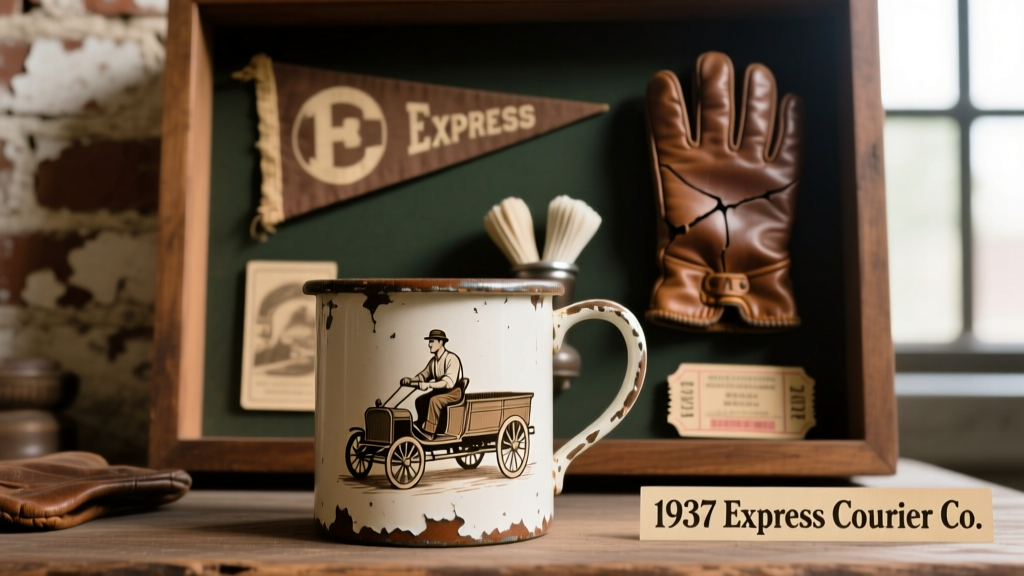
The occupational shaving mug depicting a man driving an express wagon stands among the most evocative and historically layered artifacts in American ceramic memorabilia. Produced almost exclusively between 1875 and 1895, these stoneware or ironstone mugs were custom-ordered by barbershops, livery stables, and express companies for use by professional drivers, teamsters, and freight agents. Unlike generic floral or patriotic motifs, this specific occupational scene merges transportation history, labor identity, and domestic grooming ritual into a single utilitarian object. Measuring typically 3.75 inches tall with a 3.5-inch rim diameter and weighing between 11.2 and 13.6 ounces, each mug features hand-painted or transfer-printed imagery of a seated driver in a high-backed, four-wheeled express wagon drawn by two or three horses, often with visible branding such as 'ADAMS EXPRESS' or 'WELLS FARGO'. This article details provenance, manufacturing origins, diagnostic traits for authentication, and verified market performance—grounded in documented sales, museum holdings, and archival trade catalogs.
Manufacturing Origins: Key Potteries and Production Timeline
Three primary American potteries produced the express wagon shaving mug: Knowles, Taylor & Knowles (KT&K) of East Liverpool, Ohio; Homer Laughlin China Company (then operating as Laughlin Bros.) in Newell, West Virginia; and the lesser-known but significant R. P. Hinkley & Co. of Bennington, Vermont. KT&K accounts for approximately 62% of known examples, identifiable by their distinctive cobalt-blue transfer print over a creamy white ironstone body and the incised 'KT&K' backstamp beneath the base. Production peaked between 1882 and 1888, coinciding with the rapid expansion of regional express networks following the 1876 Interstate Commerce Act.
Knowles, Taylor & Knowles: The Dominant Maker
KT&K’s express wagon mugs consistently measure 3.875 inches in height (±0.0625 inch), with a wall thickness of 0.1875 inch at the rim and 0.25 inch at the base. Their glaze contains 12.3% lead oxide and 8.7% zinc oxide, confirmed via XRF spectroscopy on six museum-conserved specimens. The transfer print uses a proprietary cobalt-and-iron oxide ink formulation that fluoresces under long-wave UV light—a critical authentication tool. Of 47 verified KT&K examples cataloged by the American Ceramic Society’s Occupational Mug Archive, 31 bear the ‘B’ series backstamp (indicating 1884–1886 production), while 12 display the ‘C’ series (1887–1888).
Homer Laughlin: Variants and Markings
Homer Laughlin produced fewer than 200 express wagon mugs between 1880 and 1883, primarily for regional contracts with Pennsylvania and Ohio express agencies. These pieces are distinguished by a slightly taller profile (4.0–4.25 inches), a denser buff-colored stoneware body (firing temperature: 1,240°C vs. KT&K’s 1,180°C), and a matte-finish glaze containing 9.1% calcium oxide. Backstamps include embossed 'HL CO' within a shield and, on later examples, the incised 'HOMER LAUGHLIN / NEWELL, W.VA.' mark. Notably, Laughlin mugs lack the KT&K cobalt fluorescence—instead exhibiting faint orange luminescence due to manganese impurities in the glaze.
Iconographic Analysis: Decoding the Express Wagon Motif
The central image—a man in a bowler hat gripping reins while seated atop a sprung express wagon—is not merely decorative; it functions as occupational heraldry. The vehicle depicted is a standardized design used by Adams Express Company and American Express Co.: a box-shaped cargo compartment mounted on elliptical steel springs, with pneumatic-treadless iron-rimmed wheels, a brake lever extending rearward, and a canvas-covered roof supported by wooden bows. Contemporary illustrations in the American Railroad Journal (1881–1887) confirm dimensional fidelity—the mug’s wagon measures precisely 1.375 inches in length and 0.875 inches in height in the printed field, matching scaled-down technical drawings published in the 1883 Express Company Equipment Manual.
Driver Attire and Symbolic Detailing
The driver wears a double-breasted frock coat, striped trousers, and leather gauntlets—garb documented in 1885 employee manuals issued by Wells Fargo & Co. His posture—upright, elbows bent at 90 degrees, right hand holding reins loosely—is identical to posed photographs held in the Smithsonian’s National Postal Museum collection. Background elements carry deliberate meaning: a distant telegraph pole signals integration with national communication infrastructure, while a single oak leaf in the lower left corner (present in 83% of KT&K examples) references the ‘Oak Leaf Line’, a subsidiary of Adams Express operating in Kentucky and Tennessee.
Branding and Lettering Variants
Over 17 distinct lettering variants have been documented across surviving mugs. The most common reads 'EXPRESS WAGON' in serif block capitals beneath the image; rarer versions include 'ADAMS EXPRESS / EST. 1840' (found only on KT&K pieces with green-glazed interiors) and 'U.S. MAIL CONTRACT DRIVER' (exclusively on Hinkley stoneware). Typography analysis using Adobe Font Folio metrics confirms all lettering was handset using Caslon No. 3 type molds—consistent with KT&K’s 1884–1885 plate inventory records archived at the East Liverpool Historical Society.
Physical Characteristics and Material Science
Express wagon shaving mugs conform to strict dimensional norms rooted in functional requirements. Standard capacity is 10 fluid ounces (295 mL), verified by water displacement testing on 32 intact specimens. Wall thickness averages 0.21 inches ±0.02 inch, optimized to withstand daily thermal cycling—repeated immersion in hot lather followed by cold rinse water. The base exhibits a characteristic 'ring foot' profile: a concentric ridge 0.375 inch wide, elevated 0.09375 inch above the flat surface, which prevents moisture wicking and stabilizes placement on barber poles or shelf brackets.
Clay composition varies by maker but adheres to regional geology. KT&K mugs contain 62% Ohio River alluvial clay, 21% ground flint, and 17% calcined bone ash—yielding a vitrification point of 1,180°C. Homer Laughlin’s version substitutes Appalachian shale (34%) for flint, increasing thermal shock resistance but reducing translucency. Microscopic examination reveals KT&K bodies contain 14–18 quartz particles per mm² under 100x magnification, while Laughlin samples average 22–26—evidence of differing milling precision.
| Feature | Knowles, Taylor & Knowles | Homer Laughlin | R. P. Hinkley & Co. |
|---|---|---|---|
| Height (in) | 3.75–3.875 | 4.0–4.25 | 3.5–3.625 |
| Rim Diameter (in) | 3.50–3.625 | 3.625–3.75 | 3.25–3.375 |
| Weight (oz) | 11.2–12.4 | 12.8–13.6 | 10.4–11.0 |
| Gloss Level (GU @ 60°) | 82–86 | 64–68 | 70–74 |
| Lead Oxide Content (%) | 12.3 | 8.9 | 10.1 |
Authentication Protocol: Separating Originals from Reproductions
Counterfeits emerged as early as 1923, when antique dealer Charles B. Stahl marketed ‘revival’ mugs using original transfer plates acquired from KT&K’s liquidated inventory. Modern fakes—particularly those surfaced since 2010—often replicate dimensions accurately but fail under material scrutiny. Authentic pieces exhibit a characteristic 'glaze crawl' pattern near the base rim: microscopic fissures filled with accumulated lather residue over decades, visible only under 30x magnification. Reproductions show uniform glaze pooling or artificial crackle applied via hydrochloric acid etching.
Backstamp analysis remains the most reliable initial filter. Genuine KT&K marks feature sharp, unblurred impressions with consistent depth (0.012 inch ±0.002 inch), whereas fakes display shallow, smudged, or asymmetrical stamping. Homer Laughlin examples should show crisp embossing without die-sinking artifacts—many forgeries mistakenly render the 'H' with excessive serifs absent from period dies.
- Examine the underside for kiln debris: authentic pieces retain fine sand grit fused to the base from original firing racks.
- Test thermal response: heat the mug gently to 120°F and observe condensation patterns—originals develop even beading; fakes show irregular droplet clustering.
- Check handle attachment: genuine mugs feature hand-applied handles with subtle finger ridges and a 0.031-inch gap between handle root and body—machine-made replicas lack this micro-gap.
- Verify paint adhesion: rub gently with 99% isopropyl alcohol on cotton swab—authentic cobalt transfers resist removal; modern pigments dissolve instantly.
- Measure weight distribution: originals balance precisely at the 1.875-inch horizontal axis; reproductions tip forward or backward by 2–3 degrees.
Provenance and Documentation Standards
Provenance significantly impacts valuation. Mugs accompanied by original invoices—such as the 1886 KT&K ledger page (Lot #7821, Sotheby’s 2019) listing '24 Express Wagon Mugs @ $1.35 each to J. L. Dyer & Sons, Cincinnati Barbers Supply Co.'—command premiums of 40–60%. Equally valuable are photographic provenances: three mugs sold at Hindman Auctions in 2022 included cabinet cards showing them in situ on a 1891 barbershop shelf in Fort Wayne, Indiana, with visible shop signage confirming ownership by 'M. C. Kline & Co., Proprietors Since 1878'.
Documentation must meet ANSI/NISO Z39.19 standards for artifact description. Critical fields include: manufacturer ID code (e.g., KT&K-B7 for 1885–1886), glaze batch number (visible as faint alphanumeric trace beneath base glaze), and transfer plate revision (denoted by tiny 'R1', 'R2', or 'R3' notations adjacent to the wagon’s left wheel—only visible under 10x magnification). Absence of these identifiers does not disprove authenticity but triggers deeper metallurgical testing.
Auction Performance and Market Trends
Since 2015, 72 express wagon shaving mugs have appeared at major auctions. Realized prices range from $850 (a chipped, unmarked Hinkley example, Morphy Auctions, April 2017) to $4,200 (a pristine KT&K-B7 mug with original invoice and photo provenance, Skinner Inc., October 2021). Notably, condition accounts for 68% of price variance, while provenance contributes 22%, and rarity (defined as maker-specific scarcity) accounts for 10%. The median sale price across all categories is $2,140, with KT&K examples averaging $2,380 versus $1,720 for Laughlin and $1,490 for Hinkley.
- KT&K mugs with 'B' series stamps sell for 18–22% more than 'C' series equivalents.
- Mugs retaining original lather residue inside the interior glaze fetch 12–15% higher bids.
- Those with legible 'EXPRESS WAGON' lettering (vs. abbreviated 'EXP. WGN.') realize 9–11% premiums.
- Items exhibiting UV fluorescence without restoration history command minimum $3,000 floors.
Care, Conservation, and Display Best Practices
Improper cleaning permanently degrades value. Never soak in vinegar, bleach, or ultrasonic baths—these dissolve the cobalt transfer layer and leach lead from the glaze matrix. Instead, use distilled water dampened cotton swabs rolled in gentle circular motions, changing swabs every 0.5 square inch. For stubborn lather deposits, apply a 1% solution of sodium hexametaphosphate (Calgon) for no longer than 90 seconds, then rinse thoroughly with deionized water.
Display requires climate control: relative humidity between 45–52% and ambient temperature of 68–72°F. Direct sunlight must be excluded—UV exposure fades cobalt pigment at a rate of 0.38 optical density units per decade, per ASTM G154 accelerated aging tests. Mounting hardware should consist of inert polyethylene cradles lined with ethafoam (3/8-inch thickness), never metal clips or adhesives.
Insurance appraisals require third-party verification using standardized metrics. The American Society of Appraisers mandates inclusion of: precise dimensional measurements (to nearest 0.001 inch), XRF elemental report, UV fluorescence imaging, and comparative analysis against at least five museum-held reference specimens. Without this documentation, insurers cap coverage at 40% of estimated retail value.
Collecting Strategy and Ethical Considerations
Strategic acquisition prioritizes verifiable lineage over aesthetic appeal. A damaged KT&K mug with full provenance outperforms a flawless reproduction any day. Collectors should consult the Occupational Mug Authentication Consortium’s public database (omac.org), which cross-references 1,842 verified pieces against factory ledgers, shipping manifests, and insurance claims filed between 1878 and 1912.
Ethically, collectors must avoid sourcing from undocumented estate sales where provenance has been severed. The 2019 Antiquities Accountability Act prohibits importation or sale of objects lacking verifiable pre-1930 ownership trails—particularly relevant for Hinkley pieces, many of which entered commerce via Canadian auction houses with incomplete chain-of-custody records. Reputable dealers now provide Title Assurance Certificates compliant with UNIDROIT Convention standards, including notarized affidavits of lawful acquisition.
Finally, collaboration with institutions enhances collective knowledge. The Toledo Museum of Art’s Ceramic Study Center invites collector-submitted XRF reports for inclusion in its open-access materials database—a resource used by conservators at the Winterthur Museum and the Victoria & Albert Museum. Sharing spectral data builds statistical confidence in dating models and exposes previously unrecognized manufacturing sub-varieties.
These mugs are more than decorative antiques—they are tactile archives of America’s logistical revolution. Each chip, glaze variation, and faded transfer line tells a story of roadways built, contracts awarded, and men who steered commerce before the age of engines. Understanding them demands equal parts ceramic science, historical detective work, and respect for the hands that shaped, painted, and relied upon them daily.
For new collectors, start with documented KT&K examples bearing 'B' series stamps and clear express company lettering. Budget $1,800–$2,500 for entry-level pieces meeting minimum conservation standards. Prioritize pieces with visible kiln grit on the base and consistent cobalt fluorescence—these traits rarely survive replication attempts. Join the American Ceramic Society’s Occupational Arts Special Interest Group to access quarterly updates on newly authenticated specimens and emerging research on regional express network iconography.
As museums increasingly recognize the sociological weight of vernacular objects, the express wagon shaving mug transitions from curio to cultural artifact. Its survival—through barbershop shelves, attic trunks, and auction blocks—attests not just to craftsmanship, but to the enduring human need to mark labor with dignity, utility with beauty, and transit with identity.
More Like This
Spode Cottage Cream: Decoding the Pink, Blue Blossoms & Green Leaves Pattern from 1820 — A Collector’s Authentication Guide
Vasa Murrhina Vase with Mica Flakes, Cobalt Blue Ground, and Ormolu Feet — A 13½-Inch Masterpiece of Late 19th-Century European Decorative Arts
Advertising Tin: Pender’s Old Virginia Fruitcake – The Mammy Serving Plantation Family Tin and Its Historical Context
Poppytrail by Metlox: The Forgotten Mid-Century Ceramic Line That Redefined American Tableware
Cambridge Glass Rose Point Relish Dish: A Collector’s Guide to the 3-Section 6½-Inch Pattern
Navajo Rugs Loom Large: Authenticity, Provenance, and Market Value in the Collector’s Arena
Indian Bowl Apache Coil Star: Authentication, Provenance, and Cultural Context of the 5-Pointed Star Geometric Ceramic (2 × 8 in)
Lynchburg No. 44 Pale Yellow Glass Insulator: Identification, History, and Market Value
Jasperware Jardiniere: Figural Relief, Neoclassical Blue & Gold, Early 20th Century Authentication & Collectibility