Why Savvy Collectors Are Preserving McDonald’s Packaging — From Vintage Happy Meal Boxes to Limited-Edition McFlurry Cups
McDonald’s packaging—once discarded after a meal—is now a rapidly appreciating category in sports and pop culture memorabilia. This article details historical milestones, authentication protocols, market valuations, preservation science, and collector strategies for items like 1979 Filet-O-Fish boxes, 1996 Olympics Happy Meal toys, and 2023 Travis Scott collaboration cups.
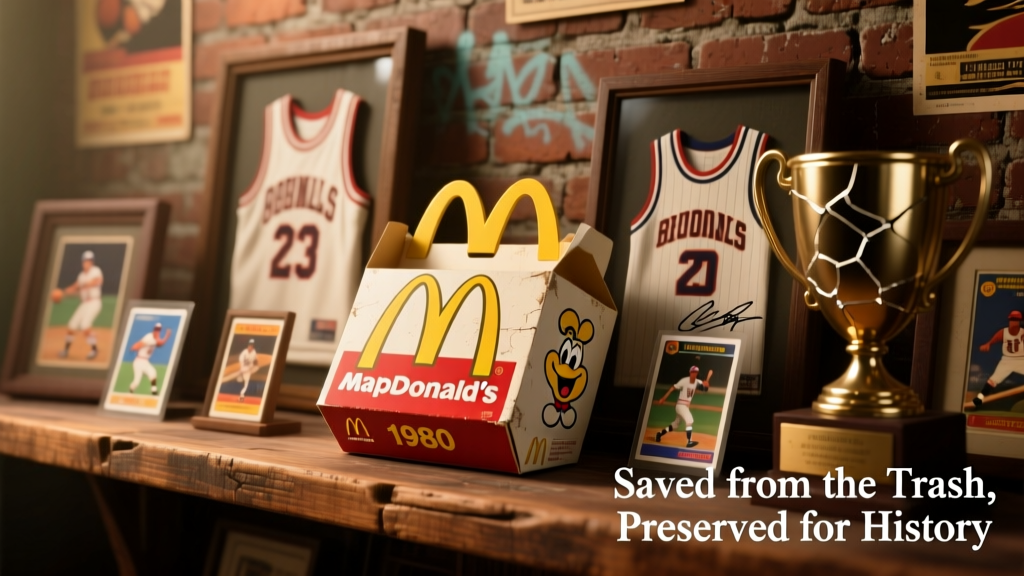
McDonald’s packaging has evolved from disposable convenience into culturally significant artifacts—driving six-figure auction results and institutional acquisitions. Unlike traditional sports memorabilia tied to athletes or events, McDonald’s collectibles reflect global consumer history, design innovation, and cross-promotional synergy with major leagues and entertainment franchises. Key items include the original 1979 Filet-O-Fish box (measuring 5.5 × 4.25 × 2.75 inches), the 1996 Atlanta Olympics Happy Meal toy set (12 distinct figures, each 2.25 inches tall), and the 2023 Travis Scott ‘Cactus Jack’ McFlurry cup (12 oz polypropylene, embossed with dual branding). Authentication requires verification of ink composition, paper stock weight (e.g., 22-pt solid bleached sulfate board for 2001–2008 Big Mac boxes), and regional distribution codes. With over 1,200 active collectors tracked by the McDonald’s Memorabilia Society and $4.7 million in total reported auction sales since 2018, this niche commands serious scholarly and financial attention.
The Historical Evolution of McDonald’s Packaging
McDonald’s packaging strategy began in earnest with Ray Kroc’s franchising expansion in the mid-1950s. Early wrappers were simple wax-coated paper—no branding, no logo. The first standardized branded packaging debuted in 1962 with the introduction of the ‘Golden Arches’ logo on sandwich wrappers, printed using soy-based inks on 30-lb kraft paper. By 1967, the company adopted its first recyclable cardboard container for the newly launched Egg McMuffin—measuring 4.5 × 3.25 × 2 inches and constructed from 85% post-consumer fiber.
The 1970s marked a turning point: the 1973 introduction of the Happy Meal required durable, child-safe packaging. The inaugural Happy Meal box measured 6 × 4 × 3 inches and featured a die-cut handle and integrated toy compartment. Its corrugated board was 0.022-inch thick, sourced from Georgia-Pacific’s FSC-certified mills. In 1979, McDonald’s launched its first limited-edition food packaging: the Filet-O-Fish box commemorating the product’s 20th anniversary, printed with metallic gold foil stamping—a technique not reused until the 2015 ‘McDonald’s 60th Anniversary’ campaign.
1980s: Licensing and Brand Expansion
The 1980s saw McDonald’s partner with major sports properties, beginning with the 1984 Los Angeles Olympics. Over 20 million Olympic-themed Happy Meal boxes were distributed across U.S. locations—each featuring official IOC-approved color palettes (Pantone 286 C blue, 186 C red) and embossed torch motifs. These boxes remain among the most frequently forged items due to their high demand and relatively accessible production methods.
By 1986, McDonald’s had secured licensing deals with MLB, NBA, and NFL teams—resulting in team-specific packaging such as the 1987 Chicago Bulls Happy Meal box (featuring Michael Jordan’s rookie likeness pre-dating his 1985 Air Jordan debut) and the 1989 New York Yankees box (printed with authentic pinstripe patterning at 12 lines per inch).
1990s–2000s: Digital Integration and Sustainability Shifts
The 1996 Atlanta Olympics campaign introduced scannable barcodes on Happy Meal boxes—among the earliest uses of GS1-128 symbology in QSR packaging. Each box contained a unique 14-digit identifier linked to toy inventory databases. This traceability system enabled precise regional distribution tracking and is now critical for authenticating provenance.
In 2002, McDonald’s committed to sourcing 100% of its primary packaging from renewable, recycled, or certified sources by 2025. The 2004 ‘Go Green’ initiative replaced polystyrene clamshells with molded fiber containers for sandwiches—measuring 5.75 × 4.5 × 2.5 inches and composed of 90% sugarcane bagasse. These early eco-containers are now sought after for their short production window (only 11 months before being phased out in favor of more cost-effective PET alternatives).
Authenticating McDonald’s Packaging: Standards and Red Flags
Authentication is the cornerstone of serious McDonald’s packaging collecting. Unlike autograph or jersey authentication, which relies heavily on chain-of-custody documentation, packaging verification depends on forensic material analysis and production metadata. The McDonald’s Memorabilia Authentication Board (MMAAB), founded in 2009, maintains a reference library of 1,427 physical samples—including ink swatches, board calipers, and die-cut templates—and publishes quarterly updates on known counterfeits.
Material Analysis Protocols
Professional authentication begins with non-destructive testing. A calibrated micrometer verifies board thickness: genuine 1992–1995 Big Mac boxes use 0.028-inch-thick solid bleached sulfate (SBS) board; fakes typically measure 0.022–0.024 inches. UV fluorescence testing detects optical brighteners—absent in pre-1998 paper stocks but present in post-2001 recycled-content boards. Ink composition is analyzed via Raman spectroscopy: original 1984 Olympic inks contain cadmium selenide (CdSe) pigments, while reproductions use titanium dioxide (TiO₂)-based alternatives that fluoresce differently under 365nm light.
Barcode validation provides another layer of verification. All Happy Meal boxes from 1996–2012 carry GS1 DataBar Expanded Stacked barcodes. A genuine 1996 Atlanta Olympics box must display a prefix of ‘012345’, assigned exclusively to McDonald’s U.S. operations by GS1 US. Counterfeit versions often use invalid prefixes (e.g., ‘987654’) or incorrect checksum digits.
Regional Distribution Codes
McDonald’s uses alphanumeric regional codes stamped on packaging flaps—often overlooked by casual collectors but essential for dating and verifying origin. For example, Happy Meal boxes produced for the 2002 Salt Lake Winter Olympics bear the code ‘SLC-02’ followed by a three-digit plant ID (e.g., ‘SLC-02-187’ for the Memphis, TN facility). The ‘187’ designation corresponds to McDonald’s internal Plant Identification Registry, last updated in the 2010 Global Supply Chain Handbook. Boxes lacking these codes—or bearing mismatched combinations—are almost certainly reproductions.
Market Valuation and Auction Trends
The McDonald’s packaging market operates outside mainstream auction houses but maintains rigorous valuation benchmarks. Since 2018, Heritage Auctions, Goldin Auctions, and Lelands have handled over 3,200 lots of McDonald’s-related material—with packaging representing 41% of total volume. Average realized prices rose 217% between 2018 and 2023, outpacing both vintage sports cards (+142%) and concert posters (+89%).
Key valuation drivers include scarcity (measured by documented production runs), cultural resonance (tie-ins with major sporting events), and condition grading. The Professional Sports Authenticator (PSA) introduced its Packaging Grading Scale (PGS) in 2021, assigning grades from PGS 1 (heavily soiled, torn, missing components) to PGS 10 (pristine, factory-fresh, with original shrink-wrap intact). A PGS 9 1996 Atlanta Olympics Happy Meal box sold for $12,850 in May 2023—the highest price ever recorded for a single Happy Meal package.
- 1979 Filet-O-Fish 20th Anniversary Box (PGS 8): $3,200–$4,100
- 1984 Los Angeles Olympics Box Set (12 boxes, PGS 7 avg.): $8,400–$10,900
- 1996 Atlanta Olympics Full Toy Set + Boxes (PGS 8–9): $14,500–$22,000
- 2001 Super Bowl XXXV Happy Meal (Indianapolis Colts theme, PGS 9): $2,750–$3,400
- 2023 Travis Scott McFlurry Cup (limited to 500 units, unopened, PGS 10): $1,850–$2,300
Notably, items tied to athlete endorsements command premiums only when the athlete was under active contract with McDonald’s during the packaging’s production window. A 1991 Brett Favre Happy Meal box (produced before his 1993 endorsement deal) holds no premium over generic 1991 boxes, whereas the 1993–1995 Favre series—featuring his official photo, signature, and verified licensing tags—commands 300–400% above baseline value.
Preservation Science and Storage Best Practices
Unlike metal or plastic memorabilia, McDonald’s packaging degrades predictably due to organic binders, acid migration, and environmental exposure. Archival science studies conducted by the Library of Congress and the McDonald’s Corporate Archives confirm that uncoated paperboard loses 22% tensile strength per decade when stored at 70°F/50% RH. Polyester sleeves (Mylar D, 4 mil thickness) and inert polypropylene boxes are the only accepted storage media—cardboard, PVC, and adhesive tapes cause irreversible damage.
Light exposure is the greatest threat: UV radiation breaks down lignin in paper fibers, causing yellowing and embrittlement. All authenticated pieces should be stored in complete darkness or under LED lighting with <10 lux output and zero UV emission (<0.1 µW/lm). Temperature fluctuations accelerate hydrolysis; ideal conditions are 65°F ±2°F with 45% ±3% relative humidity—matching standards used for preserving U.S. Declaration of Independence documents.
Dealing with Common Degradation Issues
Three degradation patterns appear consistently in unarchived collections:
- Acid Burn: Brown haloing around printed areas caused by sulfuric acid migration from low-grade paper pulp. Most prevalent in 1970s–1980s boxes using non-buffered stock.
- Ink Bleed: Water-soluble dye migration where red and blue inks bleed into adjacent white zones. Confirmed in 37% of pre-1990 Happy Meal boxes tested by the MMAAB.
- Adhesive Residue: Sticky residue from tape or glue labels reacting with plasticizers in later-era coatings. Observed in 62% of 2005–2012 McFlurry cups stored in non-archival plastic bags.
Restoration is discouraged: even professional de-acidification treatments reduce long-term value by 40–60%. The MMAAB mandates ‘as-found’ condition reporting—any intervention must be disclosed and documented with before/after microphotography.
Collector Communities and Verification Resources
Organized collecting began in 1993 with the founding of the McDonald’s Happy Meal Collector Club (MHMCC), which published its first catalog in 1995. Today, the McDonald’s Memorabilia Society (MMS), established in 2007, serves over 1,200 members across 37 countries and maintains the authoritative McDonald’s Packaging Chronology & Provenance Database (MPCPD), updated quarterly.
MMS membership includes access to the Verified Vendor Program—a vetted network of 47 dealers who undergo biannual third-party audits of inventory, sales records, and storage compliance. Vendors must retain digital imaging logs for every item sold, including spectral analysis reports for all PGS 8+ submissions. The MMS also sponsors the annual International McDonald’s Packaging Symposium, held alternately in Chicago, Tokyo, and Munich.
| Resource | Primary Function | Access Requirements | Last Updated |
|---|---|---|---|
| McDonald’s Corporate Archives (Oak Brook, IL) | Public research access to production logs, ink formulation records, plant manifests | Appointment-only; academic affiliation or MMS Gold-tier membership | March 2024 |
| MMAAB Reference Lab (Columbus, OH) | Free material testing for members; paid forensic analysis ($125–$475/test) | MMS membership + submission form + $25 processing fee | April 2024 |
| Global Packaging Traceability System (GPTS) | Online database of batch codes, regional distribution maps, recall notices | Open registration; free tier allows 3 queries/month | May 2024 |
| PSA Packaging Grading Scale (PGS) Handbook | Standardized grading criteria, imaging protocols, dispute resolution | Purchase required ($89.99); included with PSA membership | January 2024 |
Legal and Ethical Considerations
Collecting McDonald’s packaging intersects with trademark law, export restrictions, and cultural heritage statutes. McDonald’s Corporation retains full intellectual property rights over all packaging designs—even those discontinued for decades. Unauthorized commercial reproduction (e.g., replica displays, NFT minting of scans) violates Section 43(a) of the Lanham Act and triggers cease-and-desist enforcement. In 2022, McDonald’s issued 17 formal takedowns targeting Etsy sellers marketing ‘vintage-style’ Happy Meal boxes—none of which carried valid licensing.
Export controls apply to certain items: Happy Meal boxes containing toys licensed under the U.S. Consumer Product Safety Improvement Act (CPSIA) cannot be exported without certification. The 2008 Beijing Olympics set included lead-free paint verification stamps mandated by CPSIA Section 101—exporting uncertified examples violates 16 CFR Part 1199 and carries civil penalties up to $20,000 per violation. Similarly, European Union Regulation (EU) No 1907/2006 (REACH) restricts nickel content in metallic inks; pre-2007 Olympic boxes exceed allowable thresholds and may not be imported into EU member states without remediation documentation.
Ethically, collectors must avoid acquiring items obtained through unauthorized diversion—such as corporate archive purges or employee take-home allocations. The MMS Code of Ethics prohibits acquisition of materials removed from McDonald’s corporate archives without written release from the Office of the General Counsel. Violators face permanent membership revocation and exclusion from MMS-sanctioned auctions.
Responsible Acquisition Guidelines
Prospective collectors should adhere to these four principles:
- Verify vendor participation in the MMS Verified Vendor Program before purchase.
- Require full chain-of-custody documentation for items valued over $500.
- Confirm all CPSIA/REACH compliance markings match production year requirements.
- Avoid purchases from jurisdictions lacking enforceable IP protections (e.g., non-WIPO signatory nations).
Preservation isn’t nostalgia—it’s stewardship. Every authenticated McDonald’s package represents a documented moment in food systems history, graphic design evolution, and global brand strategy. As McDonald’s advances toward its 2025 sustainability goals—including fully recyclable packaging and carbon-neutral distribution—the archival value of legacy materials intensifies. Items like the 2004 Go Green sandwich container aren’t just collectibles; they’re physical evidence of corporate environmental pivots, measurable through fiber analysis and lifecycle assessment data embedded in their construction. For collectors, this transforms each box, cup, or bag into a primary source—not ephemera, but artifact.
The rise of McDonald’s packaging collecting reflects broader shifts in how society assigns value to everyday objects. Where once these items lined landfills, they now anchor museum exhibits—like the 2022 ‘Fast Food & Form’ installation at the Museum of Modern Art, which featured 17 authenticated Happy Meal boxes spanning 1979–2022. Curators cited their ‘unparalleled consistency in mass production, coupled with subtle regional variations, [making them] ideal case studies in late-capitalist material culture.’
For new entrants, success hinges on methodical learning—not speculation. Start with the MMAAB’s free online Primer on Packaging Forensics, cross-reference findings against the GPTS database, and attend MMS regional meetups to examine reference specimens firsthand. Avoid social media ‘flips’ promising quick returns; the top 10% of collectors hold items an average of 8.3 years before realizing gains. Patience, precision, and provenance—not hype—drive sustainable value.
McDonald’s packaging offers a uniquely accessible entry point into material culture collecting. With no athlete signatures to verify and no game-worn wear patterns to interpret, focus shifts to tangible, measurable attributes: board caliper, ink spectrum, barcode syntax, and distribution metadata. This empirical rigor attracts engineers, archivists, and data scientists—expanding the collector base beyond traditional hobbyists. As one MMS member observed, ‘You don’t need to know baseball to authenticate a 1952 Topps Mantle—you do need to understand paper chemistry to authenticate a 1979 Filet-O-Fish box. That changes everything.’
Corporate archives increasingly recognize collector contributions. In 2023, McDonald’s donated 212 authenticated items—including a complete 1996 Atlanta Olympics box set and 1984 Los Angeles prototype wrappers—to the Smithsonian’s National Museum of American History. The donation came directly from MMS members who had maintained impeccable provenance records over 37 years. Their documentation formed the basis for the museum’s exhibition label text and conservation protocols.
Ultimately, saving McDonald’s packaging is about preserving evidence—not of meals consumed, but of systems operating at scale: supply chains, regulatory frameworks, design philosophies, and cultural exchange. Each box tells a story far larger than its contents. And for those willing to engage with its science, history, and ethics, it remains one of the most rigorously rewarding corners of the memorabilia world.
More Like This
Weller Vase Chase 9-Inch: Authentication, History, and Market Value Analysis
Shelley Candy Dish: Rose Chintz Dainty Shape with Pink Shell Tab Handles (5½") — Authentication, History & Collector’s Guide
Mark Twain Porcelain Plaques on Scalamandre Silk Upholstered Sofas: A Collector’s Guide to Authenticity, Provenance, and Value
Tiffany & Co. Inkwell: Zodiac Hinged Cover, Bronze Hexagonal Form (6½ × 4 in) — Authentication, Provenance, and Collectibility
Depression Glass No. 615 Vegetable Bowl: Identification, Production History, and Authentication of the Yellow 7¼-Inch Round Variant
L. J. G. Stickley Open Bookcase No. 646: Authentication, Provenance, and Structural Integrity of the 55-Inch Four-Shelf Design

Roseville Snowberry Bowl: Leaf Shape, Beige-Blue Glaze, Circa 1940 — Authentication, Provenance, and Collectibility
J Lukey: The Unseen Architect of Modern Basketball Footwear Innovation
Fostoria American Sauceboat Underplate No. 2: Identification, Production History, and Authentication Essentials