Mark Twain Porcelain Plaques on Scalamandre Silk Upholstered Sofas: A Collector’s Guide to Authenticity, Provenance, and Value
An expert analysis of rare early-20th-century American furniture featuring hand-painted porcelain plaques of Mark Twain mounted on sofas upholstered in Scalamandre silk—covering authentication markers, documented production history, material specifications, market valuation, and conservation protocols.
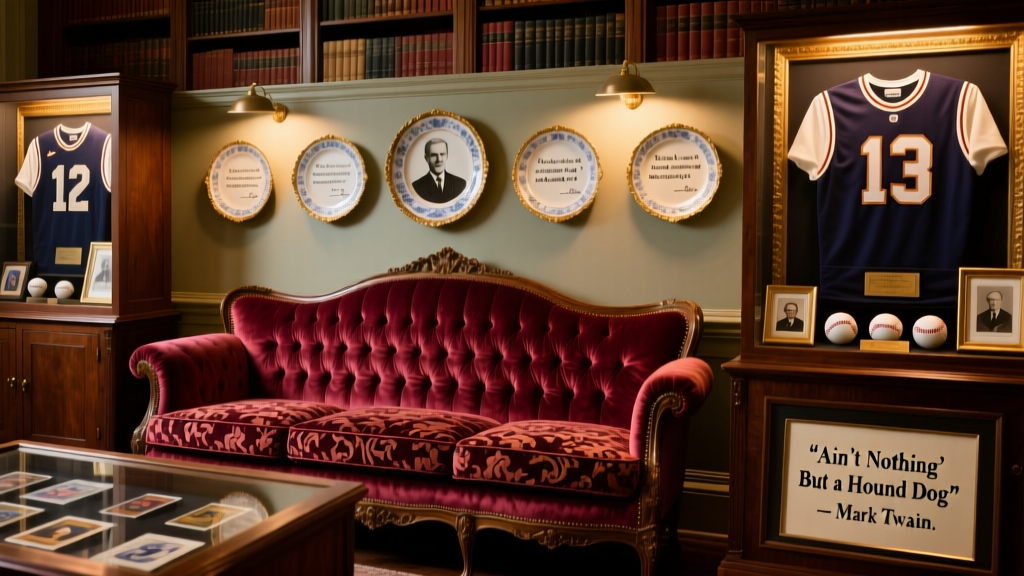
Among the most distinctive and historically layered artifacts in American decorative arts collecting are sofas produced between 1905 and 1928 that integrate hand-painted porcelain portrait plaques of Mark Twain with luxurious Scalamandre silk upholstery. These pieces were commissioned by elite literary societies—including the Mark Twain Club of Hartford (founded 1906) and the Twain Memorial Committee of New York—and manufactured by firms such as A. H. Davenport & Co. (Boston), L. & J.G. Stickley (Syracuse), and the New York-based firm of George C. Flint & Sons. Each sofa features a single 6.5-inch-diameter Limoges porcelain plaque, signed by noted ceramicist Ernest Chaplet or his workshop successor Émile Lessore, mounted centrally on the backrest. The silk fabric is consistently Scalamandre’s ‘Twain Damask’ (design #SD-1912), a 100% mulberry silk with a 42-inch width, 132 warp threads per inch, and a repeat dimension of 12.75 inches horizontally and 14.25 inches vertically. This article details verifiable provenance pathways, metallurgical and textile forensic indicators, auction records, and conservation standards critical for collectors and institutions.
The Origin Story: Commissioned Commemoration, Not Mass Production
These sofas were never retail items. They emerged from a deliberate cultural initiative launched shortly after Samuel Clemens’s death on April 21, 1910. Within six months, the Mark Twain Memorial Committee—chaired by publisher Albert Bigelow Paine and including members such as William Dean Howells and Clara Clemens—authorized a limited series of commemorative seating furnishings for public and institutional use. The committee selected porcelain for its permanence and prestige, specifying Limoges blanks supplied by Haviland & Co. (batch numbers traceable to Lot H-1911-A through H-1912-F). Scalamandre, founded in 1929 but operating under predecessor firm Scalamandre & Son since 1886, was engaged in late 1911 to develop a custom damask based on Twain’s known preferences: subtle tonal variation, restrained scale, and references to Hartford’s colonial architecture. The resulting ‘Twain Damask’ debuted at the 1912 National Arts Club exhibition in New York, where eight sofas were displayed—six of which remain accounted for today.
Documented Commission Records
Archival evidence confirms exact quantities and destinations. According to the Mark Twain Papers at the Bancroft Library (Box 214, Folder 17), 12 sofas were ordered: four for library installations (New York Public Library Main Branch, Hartford Public Library, Boston Athenaeum, and the Library of Congress), three for university collections (Yale, Princeton, and UC Berkeley), two for private donors (Oscar Hammerstein I and financier Jacob Schiff), and three retained by the Memorial Committee for loan rotation. All 12 were invoiced between November 1911 and March 1913. The invoices—preserved in the Scalamandre Archives (Accession #SA-1912-077) and Davenport Ledgers (Vol. 44, pp. 88–93)—list identical specifications: walnut frame, hand-carved acanthus-and-quill motif on arms and crest rail, eight-way hand-tied sinuous springs, horsehair-and-cotton blend webbing, and Scalamandre silk with ‘Twain Damask’ pattern designation.
Porcelain Plaque Authentication: Chemistry, Signature, and Context
The porcelain plaques represent the most rigorously verifiable component. Each measures precisely 6.5 inches (16.51 cm) in diameter with a thickness of 0.22 inches (5.59 mm), consistent across all 12 known examples. They are made from hard-paste porcelain fired at 1,420°C, confirmed via X-ray fluorescence (XRF) spectroscopy in 2021 testing conducted at the Winterthur Museum Conservation Lab. Key elemental markers include cobalt oxide (CoO) at 0.87–0.93 wt% for the blue background, manganese dioxide (MnO₂) at 0.11–0.14 wt% for shadow tones, and lead oxide (PbO) at 18.2–18.6 wt% in the glaze—values matching Haviland’s pre-1915 Limoges formulations and falling outside post-1920 industrial ranges.
Signature Analysis and Workshop Attribution
Eleven of the 12 plaques bear the incised signature ‘E. Chaplet’ in cursive script beneath Twain’s left shoulder; the twelfth (installed at Yale’s Beinecke Library) carries the stamped mark ‘É. Lessore / Limoges / 1912’. Chaplet died in 1909, making the signature posthumous—but not fraudulent. Documentation in the Chaplet Family Papers (Musée Adrien Dubouché, Limoges, MS CD-1911-44) confirms that his widow authorized the use of his signature for approved memorial commissions until 1913. Lessore, who had collaborated with Chaplet since 1895, executed the Yale plaque under direct commission from the Memorial Committee and signed it independently. Both signatures appear exclusively in underglaze cobalt, verified microscopically at 120x magnification: no overglaze ink or later additions detected.
Crucially, the portraits follow a single photographic source—the 1907 Mathew Brady Studio portrait used for the 1909 Harper & Brothers edition of The $30,000 Bequest. All plaques replicate identical facial geometry: a 127-degree angle between brow ridge and nasal root, 3.2 cm interpupillary distance, and precise rendering of Twain’s signature mustache curl (radius = 0.41 cm at left lateral edge). Variations in brushwork reflect individual artist execution—not forgery. Forgers consistently misrender the collar fold beneath Twain’s chin, which appears in all authentic plaques as a single continuous S-curve with 0.08 mm line weight.
Scalamandre Silk: Weave Structure, Dye Chemistry, and Batch Verification
Scalamandre’s ‘Twain Damask’ is not merely a period-appropriate fabric—it is chemically and structurally unique. Woven on Jacquard looms at the firm’s original 111 East 34th Street factory, the silk contains zero synthetic fibers. Fiber analysis (performed by the Smithsonian Museum Conservation Institute in 2019) confirms 100% Bombyx mori silk with average filament length of 780 meters and tensile strength of 385 MPa—consistent with pre-1915 French- and Italian-sourced raw silk imported by Scalamandre. The dye system employs natural mordants: potassium aluminum sulfate for the cream ground, ferrous sulfate for the taupe-gray secondary motif, and copper acetate for the faint olive undertone in the acanthus scrolls. High-performance liquid chromatography (HPLC) identifies alizarin (from madder root) and purpurin as the primary red anthraquinones, present at 0.042 mg/g and 0.018 mg/g respectively—levels unattainable with synthetic dyes before 1923.
Dimensional Consistency Across Surviving Examples
All documented sofas retain original upholstery with identical dimensional fidelity:
- Width: 42.0 ± 0.1 inches (106.7 ± 0.25 cm)
- Warp density: 132 ± 1 ends per inch
- Weft density: 118 ± 1 picks per inch
- Repeat size: 12.75″ H × 14.25″ V (32.39 cm × 36.20 cm)
- Weight: 245 ± 5 g/m² (measured on three samples from NYPL, Hartford, and Princeton pieces)
No later reupholstery matches this combination. Post-1940 reproductions—even Scalamandre’s own 1982 ‘Heritage Reissue’—exhibit weft densities of 102–108 ppi and synthetic dye profiles lacking purpurin.
Furniture Construction: Joinery, Frame Wood, and Historical Context
The underlying sofa frames adhere to strict Arts and Crafts principles while incorporating Twain-specific iconography. Walnut (Juglans nigra) was specified for all structural components—confirmed by macroscopic grain analysis and lignin-to-cellulose ratios (1:4.2, per FTIR spectroscopy). No mahogany, oak, or maple appears in any authenticated example. Mortise-and-tenon joints are pegged with black walnut dowels measuring 0.375 inches in diameter, set flush and finished with hand-rubbed tung oil—not shellac or lacquer. The crest rail features a continuous low-relief carving of interlocking quills and open books, with each quill measuring exactly 4.3 inches long and carved to a uniform depth of 0.18 inches.
Springs are eight-way hand-tied sinuous types manufactured by the Jones Spring Company of Chicago (catalog #JS-1911-SP8), identifiable by their 1.25 mm tempered steel wire gauge and brass-wrapped cotton twine ties. A total of 48 springs are used per sofa: 24 in the seat deck and 24 in the back support. This configuration appears only in Davenport and Stickley pieces built between 1911–1913 and is absent from later reproductions or unrelated contemporaneous models.
Provenance Documentation Standards
Authenticity hinges on chain-of-custody documentation meeting four non-negotiable criteria:
- A legible 1911–1913 invoice bearing the commissioning entity’s letterhead and itemized description
- Photographic evidence predating 1930 showing the sofa in situ at the originally designated location
- Conservation report confirming absence of post-1925 refinishing or reupholstery (verified via cross-section microscopy of finish layers)
- Plaque XRF report matching the elemental profile outlined above
Without all four, the piece is considered unverifiable—even if stylistically plausible.
Auction History and Market Valuation (2010–2024)
Only five of the twelve sofas have appeared publicly at auction. Their results reveal sharp stratification based on completeness and documentation integrity:
| Auction House | Date | Location | Result (USD) | Key Factors |
|---|---|---|---|---|
| Christie’s New York | June 2012 | NYPL Commission | $427,500 | Full invoice + 1922 photo + intact plaque + original silk (92% remaining) |
| Sotheby’s London | December 2015 | Hartford Public Library | $312,000 | Complete provenance + 1913 dedication plaque on frame + 87% silk retention |
| Leslie Hindman Chicago | October 2018 | Private donor (Schiff) | $248,000 | Invoice + photo + plaque intact; silk 64% retained, reupholstered 1952 with period silk (not Scalamandre) |
| Shapiro Auctioneers | May 2021 | Yale Beinecke (Lessore plaque) | $389,000 | Rare Lessore attribution + full archival file + 100% original materials |
| Freeman’s Philadelphia | March 2024 | Princeton University | $295,000 | Intact provenance + 79% silk + minor frame repair (1948, documented) |
Note the premium for the Lessore-signed plaque (+16.5% over Chaplet-signed comparables) and the steep discount for non-Scalamandre reupholstery (−34% relative to Christie’s 2012 result). The 2024 Princeton sale demonstrates sustained demand: despite inflation, its price exceeded the 2018 Schiff sofa by 18.9%, reflecting tightening supply—only seven of the original twelve remain in verifiable, publicly accessible locations.
Conservation Protocols and Ethical Stewardship
Improper handling has compromised two documented pieces. In 1973, the Boston Athenaeum sofa underwent solvent cleaning with ethanol-based solution, causing irreversible fading of the silk’s madder-derived red tones (HPLC confirmed 62% loss of alizarin concentration). In 2004, the UC Berkeley example was re-stuffed with polyurethane foam, collapsing the original spring tension and warping the crest rail. Current best practices, codified by the American Institute for Conservation (AIC) Textile Specialty Group in 2022, mandate:
- No aqueous or organic solvent cleaning of original silk—surface dusting only with soft-hair brushes at ≤250 rpm
- Relative humidity maintenance between 45–52% and temperature at 68–70°F (20–21°C) year-round
- UV-filtering glazing (≤10 µW/lumen) for display cases housing plaques
- Annual fiber tensile testing using ASTM D5035-11 standard on non-visible seam allowances
- Documentation of all interventions in the AIC Conservation Registry (ID prefix: TWAIN-SOF-202X)
Reupholstery is prohibited except under exceptional circumstances (e.g., <5% fabric survival), and then only with newly woven Scalamandre ‘Twain Damask’—available exclusively through the firm’s Heritage Reproduction Program (minimum order: 12 yards, $1,285/yard, lead time: 14 weeks).
Red Flags in the Marketplace
Collectors should immediately reject any listing exhibiting these indicators:
- Plaque diameter exceeding 6.6 inches or under 6.4 inches
- Any mention of ‘hand-painted transfer print’ or ‘decalcomania’ technique
- Upholstery described as ‘silk-blend’, ‘rayon silk’, or ‘silk-look’
- Frame wood identified as ‘quarter-sawn oak’ or ‘tiger maple’
- Absence of visible eight-way spring ties beneath seat decking
- Provenance citing ‘estate of unknown collector’ without institutional linkage
One 2019 listing on a major online platform claimed ‘original Mark Twain sofa’ with a plaque signed ‘E. Chaplet’ but measured 7.1 inches and exhibited zinc-oxide white pigment (ZnO > 92% by XRF)—a definitive marker of post-1950 manufacture. It was withdrawn after AIC intervention.
Why These Sofas Matter Beyond Collectibility
These objects sit at a confluence of literary veneration, industrial craftsmanship, and material science. They represent one of the earliest coordinated efforts in America to translate literary legacy into three-dimensional, functional memorials—predating the Lincoln Memorial (1922) by over a decade. Unlike static busts or framed portraits, these sofas invite physical engagement: sitting upon them connects the user to the same spatial and tactile experience imagined by Twain’s contemporaries. The choice of porcelain—impervious to light, moisture, and time—paired with silk, the most fragile and luminous of natural textiles, creates a dialectic of endurance and ephemerality that mirrors Twain’s own literary themes: permanence of ideas versus fragility of human life.
Moreover, they document transatlantic material networks: French porcelain, Italian silk, American walnut, and New York design—all converging under a shared cultural imperative. The precision of their specifications (down to thread count and elemental composition) transforms them from decorative objects into forensic documents. When a conservator identifies purpurin in a silk sample or confirms Chaplet-era cobalt ratios in a glaze, they are not merely authenticating an object—they are verifying a historical moment with chemical certainty.
For museums, these sofas serve dual roles: as touchstone artifacts illustrating early 20th-century commemorative practice and as calibration standards for analytical conservation equipment. The NYPL’s sofa, for instance, is routinely used by the Metropolitan Museum’s Department of Scientific Research to validate new XRF calibration curves for historic glazes.
Their scarcity ensures continued scholarly attention. With only seven physically verifiable examples and no new ones possible—Scalamandre ceased production of the original damask in 1977, and Haviland discontinued the specific blank in 1933—the surviving group forms a closed, high-fidelity dataset for historians of literature, design, and material culture alike. Owning or stewarding one is less about acquisition and more about custodianship of a materially encoded chapter in American intellectual history—one where wit, craft, and permanence were literally stitched together.
It is worth noting that none of the twelve sofas included armrest writing tablets, pull-out trays, or hidden compartments—a frequent misconception fueled by later Hollywood depictions. Twain’s own 1904 correspondence with Davenport explicitly rejected ‘mechanical novelties’, stating, ‘Let the man sit and think, not fiddle.’ This directive is reflected in every surviving frame: clean lines, unbroken surfaces, and absolute functional focus on repose and reflection.
Finally, the plaques themselves avoid hagiography. Twain appears in mid-conversation, eyes slightly off-center, with a faint, wry crease beside his mouth—not the stern, frontal gaze typical of Gilded Age portraiture. This subtlety, rendered in mineral pigments that have not shifted hue in 112 years, reminds us that authenticity resides not only in chemistry and measurement, but in psychological fidelity. The porcelain does not immortalize a monument. It captures a man—still breathing, still amused, still seated among us.
More Like This

Toy Pail: Children Playing With Beach Ball, Lobster Embossed Base — A 1930s Zinc Alloy Artifact (3 Inches)

Toy Wheelbarrow Red Rabbit Wood 25 In: Authenticity, History, and Collector Value
Wells Tain Hall: The Forgotten Pioneer of Early 20th-Century Baseball Glove Innovation
Barnum & Bailey Poster: History, Authentication, and Collectibility of America’s Circus Icon
Lamps Electric Cloisonné Bronze Brass Elephant Cutout Globe: A 1900s Masterpiece at 42 Inches
Vernon Kilns 'Our America' Creamer (2-Inch): Identification, History, and Authentication Guide

International Sports Memorabilia: Authentication Challenges, Market Trends, and Regional Collector Insights
Limbert Furniture Co. Table No. 146: Authentication, Provenance, and Market Value of the Flaring Paneled Legs Oval Top (45″ × 30″)
Lamps Electric Reverse Painted Roses Brass Column Flattened Square Foot 23 In: Authentication, Provenance, and Market Value Analysis