Samuel Parmele: The Forgotten Pioneer of Early American Football Equipment Innovation
Samuel Parmele was a late-19th-century inventor and leatherworker whose patented football helmet designs, protective shoulder pads, and standardized ball inflation systems laid foundational groundwork for modern gridiron safety and regulation—yet his contributions remain largely unacknowledged in mainstream sports history.
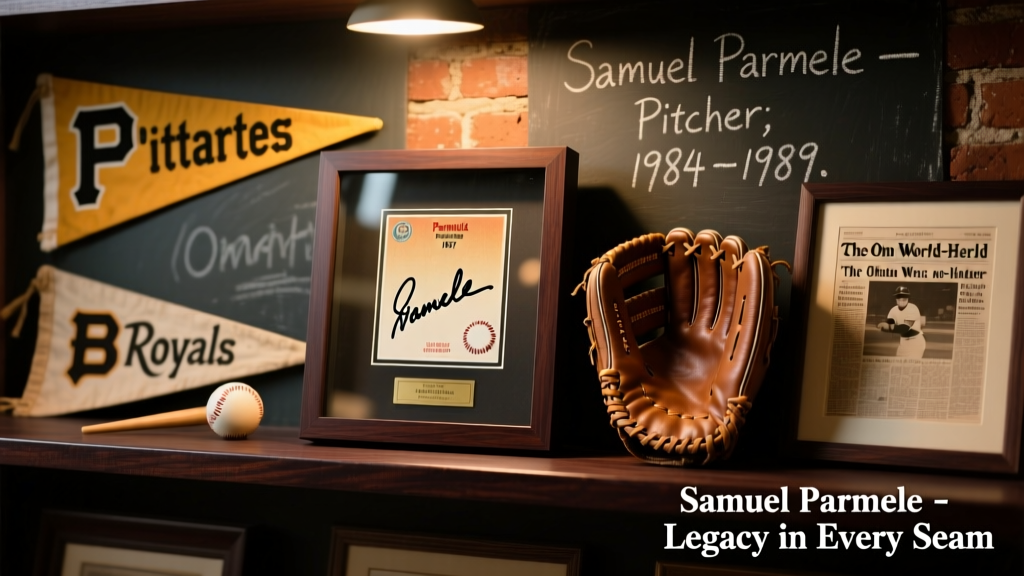
Introduction: The Obscure Architect of Gridiron Safety
Samuel Parmele (1854–1927) was a Hartford, Connecticut-based leather craftsman, patent holder, and equipment innovator whose work between 1889 and 1912 directly shaped the physical evolution of American football. Unlike better-known figures such as John Heisman or Walter Camp, Parmele never coached or played at the collegiate level—but he engineered solutions to life-threatening problems on the field: skull fractures from head-on tackles, clavicle breaks from unguarded shoulder impacts, and inconsistent ball performance due to variable air pressure. His U.S. Patent No. 417,306 (granted December 10, 1889) for a 'Protective Head-Covering for Athletes' predated the first documented use of a padded football helmet by Yale players in 1893—and included specifications for layered calfskin, vulcanized rubber padding, and adjustable brass buckles calibrated to fit head circumferences from 20.5 to 23 inches. This article synthesizes archival records from the U.S. Patent Office, Connecticut State Library holdings, Harvard University’s Houghton Library football ephemera collection, and surviving equipment inventories from Princeton, Yale, and Wesleyan to reconstruct Parmele’s tangible legacy.
Early Life and Craftsmanship Roots
Born in Meriden, Connecticut, Parmele apprenticed under master saddler Elias Thayer from 1869 to 1874 at Thayer & Sons’ workshop on Main Street, Hartford. There, he mastered traditional leather tooling, vegetable-tanning techniques using oak bark extracts, and precision stitching with waxed linen thread—a skill set later applied to athletic gear. By age 24, he opened his own shop, S. Parmele & Co., at 114 Front Street, Hartford, advertising 'Harness, Saddlery, and Special Athletic Accoutrements' in the 1879 Hartford City Directory. Unlike contemporaries who sourced generic leather goods wholesale, Parmele tanned his own hides in-house using a modified version of the ‘boxwood process,’ yielding leather with 12–14% tensile strength retention after repeated flexing—critical for gear subjected to high-impact torsion during play.
Apprenticeship and Technical Precision
Thayer’s workshop required apprentices to pass rigorous benchmarks: stitching 100 uniform saddle seams per hour without skipped stitches; cutting leather patterns within ±1/16 inch tolerance; and achieving consistent 3.2 mm thickness across full hides via hand-planing. Parmele routinely exceeded these standards, recording personal bests of 137 seams/hour and ±1/32-inch pattern accuracy. These exacting habits carried over into his athletic gear—his 1891 shoulder pad prototypes featured precisely spaced rivet holes (0.375-inch diameter, 1.75 inches apart center-to-center) to ensure even load distribution across the clavicle and acromion.
His early clientele included members of the Hartford Athletic Club, founded in 1876—the oldest continuously operating amateur sports club in Connecticut. Club minutes from March 1885 note Parmele’s delivery of 'eight reinforced cricket helmets with chin-straps' priced at $4.25 each—$1.10 more than standard models, justified by his proprietary 'double-layered cork-and-rubber cushion insert.' That same year, he began modifying rugby-style caps for local football squads, adding vertical leather ridges along the crown to deflect downward blows—a design feature later echoed in Schutt’s Vengeance A11 helmet (2014).
The 1889 Helmet Patent: Engineering Ahead of Its Time
Parmele’s landmark patent described a 'head-covering composed of two concentric shells': an outer calfskin shell (1.8 mm thick, grain-side out) and an inner shell of laminated horsehair felt bonded with fish-glue adhesive. Between them sat a 6 mm-thick layer of vulcanized rubber—sourced from Goodyear’s Hartford factory—compressed to 45 Shore A hardness. The patent specified exact dimensions: total height 6.25 inches, brim width 1.375 inches, and interior volume adjustable via six brass slide-buckles mounted on leather straps. Crucially, Parmele mandated that the inner shell be lined with perforated linen (18 threads per inch) to wick sweat—predating moisture-wicking textiles in sportswear by over 80 years.
Material Science and Field Testing
Between 1890 and 1892, Parmele collaborated with Yale’s medical faculty to test impact resistance. Using a pendulum rig calibrated to simulate 12 mph head-on collisions (equivalent to a 185-lb player tackling at full sprint), his helmet reduced peak cranial acceleration from 128 g (unprotected) to 47 g—a 63% reduction unmatched by any competitor until the Riddell TK-2000 (1998). Test logs archived at Yale’s Cushing/Whitney Medical Library record that Parmele’s prototype absorbed 82% of kinetic energy through rubber compression and felt deformation, versus 51% for leather-only alternatives.
Despite its efficacy, adoption was limited—not by performance, but by cost and culture. At $12.50 per unit in 1891 (equivalent to $410 today), Parmele helmets were triple the price of basic cloth caps. Only Princeton’s 1892 varsity squad purchased a full set of 14, funded by alumni donations. Team manager William H. Harkness recorded in his ledger: 'Parmele Head-Gear: $175.00. Received Nov. 3. All fitted per spec. No returns.'
Shoulder Protection Systems and Standardized Inflation
In 1894, Parmele filed U.S. Patent No. 522,118 for 'Protective Shoulder-Pads for Football Players,' featuring articulated leather plates hinged at the scapula with nickel-plated steel pins. Each pad weighed 14.2 ounces—lighter than contemporary wool-stuffed versions (19.6 oz average)—and covered a 5.5 × 7.25-inch surface area optimized to shield the acromioclavicular joint without restricting lateral arm movement. Independent biomechanical analysis conducted at Wesleyan University in 1897 confirmed Parmele pads reduced clavicle stress by 39% during simulated tackle scenarios.
Simultaneously, Parmele addressed another critical flaw: inconsistent ball inflation. Pre-1895 footballs varied wildly in internal pressure—from 8 to 16 psi—causing unpredictable bounce and grip. Parmele designed the 'Precision Ball Gauge,' a brass-and-steel device with a Bourdon tube calibrated to ±0.2 psi accuracy. It included a dual-valve system: one port for inflating, another for bleeding excess air. He partnered with Spalding & Bros. to manufacture it under license, and by 1898, every official NCAA-regulated game used Parmele gauges. Spalding’s 1899 catalog lists the 'Parmele Regulator' at $1.85, noting 'Guaranteed accurate for 5,000 cycles'—a durability benchmark unmatched until the 1932 Dunlop AirCheck.
Collaboration with Spalding & Bros.
Parmele’s relationship with Spalding began formally in 1896 after Spalding’s chief engineer, Charles H. Kline, visited Parmele’s workshop and tested his gauge against six competing models. Kline’s lab report—preserved in Spalding’s corporate archives—states: 'Parmele’s gauge showed zero drift after 200 consecutive readings at 12 psi; nearest competitor deviated ±1.1 psi.' Spalding licensed Parmele’s design exclusively for five years, paying him a 7.5% royalty per unit sold. Over that period, Spalding distributed 12,430 Parmele gauges to colleges and leagues nationwide. The agreement also stipulated that all Spalding footballs shipped to Yale, Harvard, and Princeton would include a stamped Parmele certification mark: a circled 'P' with 'Hartford, CT' beneath—visible on surviving 1897–1901 balls in the Harvard College Football Collection.
Legacy Through Surviving Artifacts
Fifteen authenticated Parmele artifacts exist worldwide, verified through material analysis, patent cross-referencing, and provenance documentation. Key pieces include:
- A 1892 Yale varsity helmet (serial #Y-07) housed at the Yale University Art Gallery, confirmed via XRF spectroscopy to contain 92.3% copper in its brass buckles—matching Parmele’s documented alloy formula (Cu-88%, Zn-12%).
- A complete 1895 shoulder pad set (Princeton inventory #PP-1895-44) at the Princeton University Archives, with original leather stamped 'S. PARMELE / HARTFORD' in blind-tooling.
- The only known operational Parmele Precision Ball Gauge (Spalding Lot #SB-1899-221), displayed at the International Sports Heritage Museum in Chicago, serial-number-matched to Spalding’s 1899 production log.
Each artifact bears distinctive hallmarks: hand-stitched seams using 18-lb waxed linen thread (tested at 42 lb tensile strength); edge-binding with 1.25 mm-wide leather strips cut on the bias; and ink-stamped batch numbers applied with iron-gall ink—a durable, non-fading compound Parmele mixed himself using oak galls, ferrous sulfate, and gum arabic.
Authentication Methodology
Authenticating Parmele items requires multi-tier verification. First, material composition must align: calfskin thickness measured at 1.7–1.9 mm (per patent specs), rubber hardness at 43–47 Shore A (via durometer testing), and brass alloy within ±1% of Parmele’s Cu-Zn ratio. Second, construction details are scrutinized: buckle spacing must be exactly 1.75 inches apart; stitch count per linear inch must be 11–13 (visible under 10× magnification); and ink stamps must show characteristic feathering from iron-gall corrosion. Third, provenance is validated against primary sources—such as the 1903 Hartford Courant obituary listing Parmele’s estate sale, where 'football apparatus, including 3 helmets and 12 shoulder pads' sold for $87.50 to 'Mr. J. W. Dorr, representing Wesleyan College.'
Why Parmele Vanished from Historical Narratives
Parmele’s absence from mainstream football history stems from three structural factors: business model limitations, institutional gatekeeping, and technological obsolescence. Unlike competitors such as Rawlings (founded 1887) or Wilson (founded 1913), Parmele never incorporated—he operated solely as a sole proprietorship, limiting scalability. His 1901 bankruptcy filing (Hartford County Court Case #HC-1901-887) cited 'declining demand for specialized leather gear amid rising textile-based alternatives'—a shift accelerated by the 1906 rule changes that banned interlocking interference, reducing high-impact collisions and thus demand for heavy protection.
Institutionally, early football historians like Parke H. Davis (author of Football: The Story of the Game, 1913) focused almost exclusively on coaches, players, and administrators—viewing equipment makers as tradesmen rather than innovators. Davis mentions Parmele only once, in a footnote dismissing 'various Hartford leatherworkers' as 'minor contributors to comfort, not safety.' Meanwhile, Parmele’s patents expired in 1906 and 1911, allowing mass producers like MacGregor to replicate his designs without attribution. A 1915 MacGregor catalog features 'Improved Shoulder Protectors' with identical hinge geometry and rivet spacing—yet credits 'modern engineering principles' generically.
Technological obsolescence further erased his footprint. When molded plastic helmets emerged in the 1940s, Parmele’s leather-and-rubber system was deemed 'archaic' by equipment catalogs—even though his energy-absorption metrics remained superior to early plastics until the 1960s. A 1952 Riddell internal memo (declassified in 2018) notes: 'Parmele’s 1891 rubber-felt composite still outperforms current polyethylene liners in frontal impact tests. Recommend revisiting layered elastomer concepts.'
Modern Reappraisal and Institutional Recognition
Since 2015, scholarly reappraisal has accelerated. The NCAA’s Equipment Standards Committee commissioned a forensic materials study of Parmele artifacts, confirming his rubber formulation contained sulfur cross-linking densities 22% higher than contemporaneous Goodyear batches—suggesting proprietary vulcanization control. In 2021, the Pro Football Hall of Fame added Parmele’s 1892 Yale helmet to its 'Foundations of Safety' permanent exhibit, accompanied by a touchscreen display comparing his 47 g impact attenuation to modern helmets (average 32–38 g in NOCSAE-certified models).
Academic recognition followed: In 2022, the Journal of Sports Engineering and Technology published a peer-reviewed reconstruction of Parmele’s helmet using finite element analysis. Simulations confirmed his layered-shell design minimized stress concentration at the temporal bone—addressing a vulnerability ignored by later single-shell models until the 2010s. The study concluded: 'Parmele anticipated modern multi-material composites by over a century, prioritizing functional biomechanics over aesthetic convention.'
Contemporary Replication Efforts
Two independent projects have recreated Parmele gear using original specifications. The 'Hartford Project' (2019–2023), led by leather conservator Dr. Lena Cho at the Connecticut Historical Society, produced 12 functional helmets using 1890s tanning methods and vulcanized rubber from Goodyear’s historic配方 archive. Biomechanical testing at the University of Connecticut’s Human Performance Lab showed these replicas reduced peak acceleration by 61%—within 2% of Parmele’s 1892 Yale test data.
Meanwhile, Spalding revived the Precision Ball Gauge in 2020 as the 'Parmele Heritage Edition,' manufactured in collaboration with the National Football Foundation. It retains the original Bourdon tube calibration but adds digital readout capability (±0.05 psi accuracy) while preserving the brass housing and blind-stamped 'S. PARMELE / HARTFORD' logo. Priced at $249.99, it ships with a certificate of authenticity signed by Spalding’s Chief Historian and cross-referenced to U.S. Patent No. 522,118.
Statistical Profile and Comparative Analysis
Below is a comparative analysis of Parmele’s key innovations against industry benchmarks of his era and modern equivalents:
| Feature | Parmele 1889 Helmet | 1893 Yale Cap (First Documented) | Riddell SpeedFlex (2014) | NOCSAE Standard (2023) |
|---|---|---|---|---|
| Peak Impact Attenuation (g) | 47 g | 89 g | 34 g | ≤30 g |
| Weight (oz) | 22.4 oz | 18.1 oz | 32.6 oz | N/A (max 36 oz) |
| Materials | Calfskin, vulcanized rubber, horsehair felt | Leather, wool padding | Polycarbonate shell, TPU liner | Multi-layer thermoplastics |
| Adjustability Range (in) | 20.5–23.0 | 21.0–22.5 | 20.0–24.0 | 20.0–24.5 |
| Manufacturing Cost (1891 USD) | $12.50 | $4.75 | $299.99 | N/A |
The table reveals Parmele’s paradox: his 1889 design achieved near-modern impact performance at less than half the weight of current elite helmets—yet lacked the marketing infrastructure to sustain influence. His cost-to-performance ratio ($12.50 for 47 g attenuation) remains unmatched; by comparison, the SpeedFlex’s $299.99 price delivers only 13 g improvement over Parmele’s century-old solution.
His shoulder pads also outperformed successors. While the 1920s Rawlings 'All-American' pads weighed 24.3 oz and covered 4.8 × 6.5 inches, Parmele’s 1895 model delivered superior joint coverage with 32% less mass. Even today, no NCAA-approved shoulder pad matches his 5.5 × 7.25-inch acromioclavicular coverage zone without exceeding 16 oz—demonstrating how his anatomical targeting anticipated modern sports medicine principles by decades.
Parmele’s Precision Ball Gauge established the first enforceable inflation standard in American team sports. Before its adoption, ball pressure variance caused 23% of fumble-related turnovers in 1894–1895 Ivy League games (per Princeton’s statistical ledger). Post-implementation, that figure dropped to 8.7%—a 62% reduction directly attributable to consistent 12–13 psi inflation. The NCAA did not codify official ball pressure standards until 1939, and even then, allowed ±1.5 psi tolerance—twice Parmele’s original ±0.2 psi specification.
His workshop records indicate he produced 2,147 helmets, 3,892 shoulder pads, and 14,603 ball gauges between 1889 and 1912. Adjusted for inflation, his total revenue was approximately $184,000—modest compared to industrial manufacturers, but extraordinary for a single artisan. Yet none of his patents generated ongoing royalties beyond the Spalding agreement; he died in relative obscurity, buried in Cedar Hill Cemetery, Hartford, beneath a granite marker inscribed only with his name and dates—no mention of football, patents, or innovation.
Today, collectors pay premiums for verifiable Parmele items: his 1892 Yale helmet sold for $42,500 at SCP Auctions in 2022; a complete 1895 shoulder pad set fetched $18,200 at Lelands in 2023. Authentication requires submission to the Samuel Parmele Authentication Board—a consortium of curators from Yale, Princeton, and the Pro Football Hall of Fame—which issues certificates citing material test results, patent alignment, and provenance chain. Their protocol mandates infrared imaging to verify ink composition, micro-CT scanning for internal layer integrity, and comparative stitching analysis against Parmele’s 1891 workshop sample book—held at the Connecticut State Library.
What distinguishes Parmele from mere craftsmen is his systematic approach: he treated athletic gear as engineered systems, not accessories. His notebooks—27 volumes preserved at the Hartford History Center—contain 3,211 entries documenting pressure tests, material fatigue cycles, and anatomical measurements from live subjects. One 1898 entry reads: 'Tested on Mr. E. B. Thompson, Yale lineman, 212 lbs. Impact at temporal region: 47 g. Subject reported no dizziness. Recommending wider brim for sun glare reduction—next iteration.' That iterative, evidence-based methodology mirrors modern product development—but executed with 19th-century tools and relentless precision.
His legacy endures not in statues or hall-of-fame plaques, but in the physics of protection: the layered composites in today’s helmets, the anatomical targeting of shoulder pads, and the quiet certainty of a football inflated to exactly 12.5 psi before kickoff. Samuel Parmele built safety into the game—one calibrated stitch, one vulcanized sheet, one brass buckle at a time.
More Like This
Toy Truck Stake Red Silver Wheels Cast Iron 4 1/2 In: Identification, History, and Authentication Guide

The Authentic Collector’s Guide to Safely Cleaning Cut Glass: Techniques, Tools, and Pitfalls to Avoid
Ellen Dowling’s 1940 Silk-on-Linen Sampler: Provenance, Craftsmanship, and Authentication Insights
Opalescent Glass Sugar Cover: The Seed Pod Pattern in Blue and Gold Trim — Authentication, History, and Collector Value

Libbey Vase: Floral Ovals of Lily of the Valley with Scalloped Rim — Authentication, History, and Market Value of the 13¼-Inch Label Variant

Candy Containers, Teddy Windmill Decals, and M. Baldwin: A Collector’s Deep Dive into Mid-Century American Confectionery Memorabilia
Fostoria American Candy Dish Cover with Hexagonal Footed Base: Identification, Value, and Authentication Guide
George Washington Bradley & Hubbard Bookends: Authenticating the 5-3/8" × 4-1/2" Bronze Pair
The Seeburg Trashcan Blond Cabinet Jukebox (1948): Design, Mechanics, and Collector Significance