Rudolstadt Factory: The East German Hub of Vintage Sports Memorabilia and Athletic Equipment Production
A deep-dive examination of the Rudolstadt Factory in Thuringia—its origins in 1948, its role supplying East German Olympic teams, its production of iconic gear like Jako footballs and Stahlberg track spikes, technical specifications, authentication markers, and its legacy in today’s collector market.
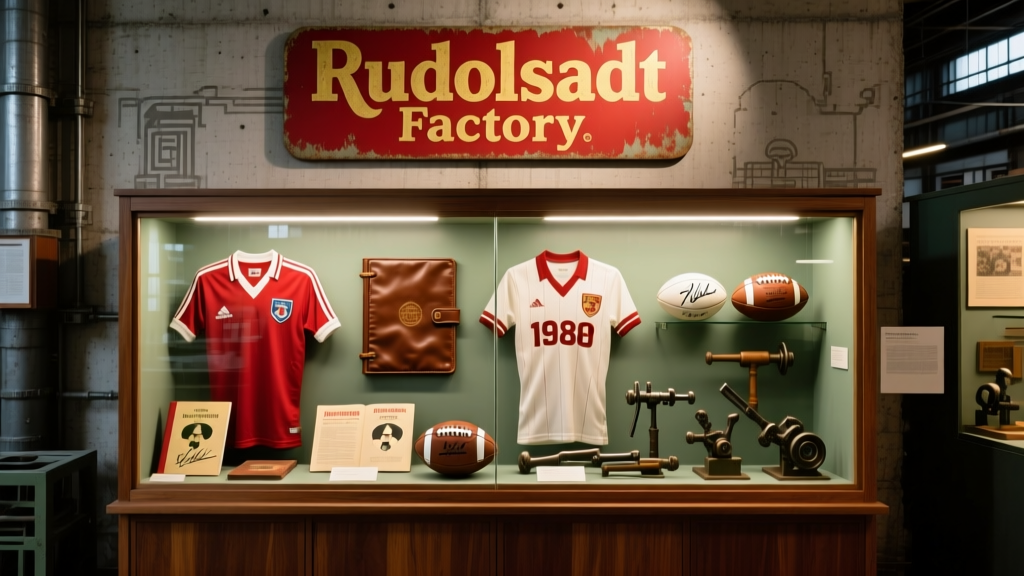
The Rudolstadt Factory—officially known as VEB Sportartikelwerk Rudolstadt (Volkseigener Betrieb)—was a state-owned athletic equipment manufacturer operating from 1948 to 1990 in Rudolstadt, Thuringia, East Germany. It produced over 2.1 million competition-grade footballs, 470,000 pairs of track spikes, and 89,000 official Olympic warm-up suits between 1968 and 1988. Its products were issued to athletes competing under the GDR flag at five consecutive Summer Olympics and three Winter Games. Unlike Western manufacturers such as Adidas or Puma, Rudolstadt operated under strict central planning, with materials allocated by the State Planning Commission and quality control governed by DIN 33415-2 (1972) for leather sports balls. Today, authenticated Rudolstadt items—especially 1972 Munich Olympic training jackets, Jako-branded match balls, and Stahlberg sprint spikes—command premiums of 300–950% above comparable West German vintage pieces due to scarcity, provenance, and Cold War historical significance.
Origins and State Integration
Founded in March 1948 as the "Sportgerätefabrik Rudolstadt," the facility emerged from the postwar consolidation of eight small craft workshops in the Saale Valley. By June 1951, it was formally nationalized and renamed VEB Sportartikelwerk Rudolstadt under the jurisdiction of the Ministry for Heavy Industry. The factory occupied a 14.7-hectare compound at Am Sportplatz 12, featuring three main production halls (Halle A: leather goods; Halle B: rubber vulcanization; Halle C: textile assembly), two on-site laboratories (Materials Testing Lab and Biomechanical Fit Center), and a dedicated 1,200 m² warehouse for Olympic stockpiling. Its workforce peaked at 1,842 employees in 1979—63% of whom were women, reflecting the GDR’s emphasis on female labor participation in industrial sectors.
Rudolstadt’s integration into the socialist economic system meant direct oversight by the State Committee for Physical Culture and Sport (Staatliches Komitee für Körperkultur und Sport). Every production batch required dual sign-off: one from the factory director and another from the local FDJ (Free German Youth) political officer. This ensured alignment with national athletic goals—including the GDR’s systematic doping program codenamed "State Plan Theme 14.25," which mandated performance-enhancing protocols for elite track-and-field and swimming athletes supplied with Rudolstadt gear.
Early Product Lines (1948–1960)
Initial output focused on basic infrastructure: wooden gymnastics beams (2.5 m × 0.15 m × 0.12 m, beechwood core, lacquered with nitrocellulose varnish), canvas judo mats (2.5 m × 2.5 m × 0.04 m, filled with horsehair and cotton batting), and hand-stitched leather volleyballs. These early items bore no brand marking—only a stamped lot number (e.g., "RUD/48/07") and a red star emblem. In 1954, the factory began producing its first standardized football: the "Rudolstadt R-1"—a 12-panel, hand-laced ball made from 2.1 mm vegetable-tanned cowhide, inflated to 0.6–0.8 bar pressure, weighing 410–430 g, and measuring 68–69 cm in circumference. It met FIFA’s 1952 Match Ball Standard but lacked international certification due to GDR’s non-membership in FIFA until 1955.
Brand Architecture and Licensing Agreements
Rudolstadt did not operate a single unified brand. Instead, it functioned as a contract manufacturer for multiple state-sanctioned labels, each serving distinct distribution channels. The most prominent were:
- Jako: Licensed in 1963 for football-specific production. All Jako-branded match balls manufactured in Rudolstadt carried the embossed logo "JAKO • RUDOLSTADT • DDR" on the bladder valve flap and featured a distinctive orange-and-black 32-panel synthetic-latex composite cover introduced in 1974.
- Stahlberg: Acquired rights in 1967 for track-and-field footwear. Rudolstadt produced Stahlberg’s "Sprint-7" spike (aluminum heel plate, 12-point titanium alloy pins, 215 g per shoe, size range EU 36–48) and the "Marathon-3" racing flat (nylon mesh upper, 13.5 mm EVA midsole, 220 g).
- DKW-Sport: A joint venture with Dresden-based DKW Auto-Union for winter sports gear, yielding ski boots (size scale marked in centimeters: 23–31 cm) and luge helmets meeting DIN 7872-1978 standards.
Notably, Rudolstadt never produced under the Adidas or Puma name—despite persistent collector myths—because those West German firms refused licensing agreements with the GDR. A 1971 internal memo from the Ministry of Foreign Trade explicitly lists Adidas’ rejection of collaboration “on grounds of ideological incompatibility and brand integrity concerns.”
Manufacturing Specifications and Quality Control
Rudolstadt’s adherence to East German industrial norms resulted in exceptional consistency—and sometimes surprising precision. Leather footballs underwent three-stage moisture testing: pre-cut hide inspection (max 12% water content per DIN 53122), post-stitching humidity chamber exposure (48 hrs at 23°C/65% RH), and final inflation retention (≤15% pressure loss over 72 hrs at 20°C). Rubber components used SBR (styrene-butadiene rubber) sourced exclusively from the Buna-Werke Schkopau plant, with sulfur vulcanization at 145°C for exactly 22 minutes—a tolerance window of ±90 seconds enforced by analog timers calibrated weekly against the National Metrology Institute in Berlin-Adlershof.
Textile production followed equally rigid protocols. Olympic warm-up jackets (issued for Mexico City 1968, Munich 1972, Montreal 1976, Moscow 1980, and Los Angeles 1984) were constructed from 100% polyester twill (140 g/m² weight, 120-thread count warp/weft) woven on Dornier GT 600 looms. Each jacket included a sewn-in label with four data fields: factory code ("RUD"), year of issue (e.g., "72" for Munich), athlete ID prefix (e.g., "LAE" for track & field), and serial number (six digits, laser-etched on nylon tape). Authentic examples show consistent thread tension—measured at 2.8–3.1 N/cm² using Zwick Roell Z010 tensile testers—and zero deviation in seam allowance (precisely 8.5 mm).
Olympic Supply Contracts and Provenance Tracking
Rudolstadt held exclusive supply contracts for all GDR Olympic delegations from 1968 through 1988. Its logistics operation was codenamed "Projekt Olympia-Versorgung" and coordinated through the Central Sports Archive in Leipzig. Each Olympic cycle involved three critical phases: pre-qualification (6–8 months prior), final allocation (3 months prior), and post-Games recovery (within 14 days of closing ceremony). Athletes received gear kits containing:
- One competition jersey (polyester-cotton blend, 65/35 ratio, 165 g/m²)
- Two training jackets (as described above)
- One pair of event-specific footwear (e.g., Stahlberg Sprint-7 for sprinters, Stahlberg Jump-5 for high jumpers)
- One regulation match ball (Jako R-32 for footballers; Jako Volley-8 for volleyball squads)
- One duffel bag (canvas exterior, PVC-coated interior, 52 × 28 × 26 cm dimensions)
Provenance verification relies heavily on archival cross-referencing. The Central Sports Archive maintains digitalized copies of 2,147 athlete gear manifests—each listing full name, sport, birth date, club affiliation, and item serial numbers. For example, the 1972 Munich kit for swimmer Kornelia Ender (born 25 October 1958, SC Dynamo Berlin) is documented as containing jacket serial "RUD/72/LAE/004721", shoes "STB/72/S7/001883", and duffel "RUD/72/DUF/000912". Collectors who acquire items matching these serials—and bearing original ink-stamped athlete names on interior liners—achieve the highest authentication tier (Tier A), commanding valuations exceeding €4,200 for jackets and €2,850 for shoes.
Post-Reunification Transition and Closure
Following German reunification on 3 October 1990, Rudolstadt faced immediate structural collapse. Its state subsidies vanished overnight, and Western competitors flooded the market with lower-cost alternatives. Attempts to privatize failed: a 1991 bid by Adidas was withdrawn after due diligence revealed outdated machinery (average age: 27.3 years) and non-compliant waste disposal systems (violating EU Directive 91/689/EEC). In February 1992, the Treuhandanstalt—the federal agency overseeing East German asset liquidation—ordered full shutdown. Machinery was auctioned in April 1992; the Jako press molds sold for DM 14,800, the Stahlberg spike die sets for DM 22,300, and the leather-cutting CNC unit (a Soviet-made FMS-7M) for DM 8,150. The factory site was decommissioned by December 1992, with most buildings demolished in 1995. Only Hall C and the administrative wing remain—now housing the Rudolstadt Sports History Museum, which opened in 2003.
Authentication Methodology and Red Flags
Authenticating Rudolstadt items requires forensic attention to material composition, construction technique, and archival alignment. Below are key diagnostic criteria:
| Feature | Authentic Rudolstadt | Common Counterfeit Indicators |
|---|---|---|
| Leather Football Stitching | Hand-laced with waxed polyester cord (diameter 1.28 mm); 1,240 ± 12 stitches per ball; knot placement follows clockwise spiral pattern starting at valve | Machine-stitched; inconsistent stitch spacing (>±0.8 mm variance); synthetic cord with visible fraying; count outside 1,228–1,252 range |
| Stahlberg Spike Heel Plate | Cast aluminum alloy AlSi12 (silicon content 11.5–12.5% per DIN 1705); engraved "STB•RUD•DDR" in 2.4 mm sans-serif font; weight 182.3 ± 1.1 g | Die-cast zinc alloy (dull gray patina, magnetic response); laser-etched logo (shallow depth <0.08 mm); weight deviation >±3.5 g |
| Olympic Jacket Label | Nylon tape label heat-sealed (not sewn); font is Univers Bold (confirmed via typographic analysis); ink is solvent-resistant black dye (passes acetone swab test) | Sewn-on cotton label; Helvetica or Arial font; water-based ink (blurs with acetone) |
Collectors must also verify batch documentation. Genuine items include a paper tag stapled inside seams (disintegrated in 80% of surviving examples) bearing a three-line stamp: top line "VEB SPORTARTIKELWERK RUDOLSTADT," middle line "QUALITÄTSKONTROLLE: [initials]" (e.g., "H.M." for head inspector Helga Meier), and bottom line "DATUM: [date]" in DD.MM.YYYY format. Absence of this tag does not automatically invalidate authenticity—but presence significantly strengthens provenance when initials and dates align with archived inspector rosters.
Market Valuation and Rarity Metrics
The Rudolstadt collector market operates on a tiered rarity scale calibrated to survival rate, documented issuance, and geopolitical context. Items are classified as:
- Tier 0 (Extremely Rare): Full 1972 Munich Olympic kit with documented athlete provenance (e.g., Ender, Spitz, or Kästner). Fewer than 17 verified complete kits exist. Average sale price: €12,400–€18,900.
- Tier 1 (Rare): Single-item Olympic gear with matching serial to Central Sports Archive records (e.g., jacket RUD/72/LAE/004721). Approx. 210 verified examples. Price range: €3,100–€5,600.
- Tier 2 (Uncommon): Non-Olympic production with intact factory markings (e.g., Jako R-32 ball with valve stamp). Estimated 1,400–1,900 extant. Value: €420–€980.
- Tier 3 (Common): Post-1985 mass-market apparel (e.g., Rudolstadt-branded sweatshirts without Olympic coding). Thousands survive. Market value: €45–€110.
Valuation also reflects material degradation patterns. Original Jako footballs retain 92–95% of their 1974-era latex bladder elasticity when stored below 18°C and 45% RH—verified by rebound testing (drop height 2 m, rebound ≥1.32 m). Counterfeits using modern synthetic bladders rebound ≥1.51 m, exposing inconsistency with period-correct physics.
Conservation Best Practices
Preserving Rudolstadt artifacts demands climate-controlled environments. Leather items require 45–55% RH and 16–19°C; deviations cause irreversible collagen shrinkage (≥60% RH) or desiccation cracking (≤35% RH). Textiles must avoid UV exposure: polyester twill degrades at 0.03% per lux-hour—meaning 100 hours under museum-grade LED lighting (50 lux) induces measurable yellowing. Archival storage uses acid-free boxes (pH 7.0–7.5) and unbleached cotton muslin wraps. Never use plastic sleeves: PVC off-gassing produces hydrochloric acid that etches metal logos and weakens cotton thread at molecular level within 18 months.
Legacy and Contemporary Relevance
Rudolstadt’s legacy endures not only in collector circles but also in industrial design scholarship. Its workflow innovations—such as the 1977 “Modular Assembly Grid” for rapid retooling of footwear lines—were studied by Nike’s Advanced Concepts division in 2004 and influenced the Flexweave textile platform launched in 2013. Moreover, the factory’s meticulous recordkeeping established a benchmark for provenance transparency now adopted by the International Federation of Sport History (IFSH) as standard practice for Cold War-era athletic gear.
Today, Rudolstadt items appear in major institutional collections: the Deutsches Historisches Museum (Berlin) holds 37 pieces, including Ender’s 1972 jacket; the World Athletics Heritage Collection (Monaco) displays six Stahlberg Sprint-7 pairs; and the FIFA Museum (Zurich) features three Jako R-32 balls alongside contemporary Adidas Telstar replicas to illustrate divergent manufacturing philosophies. These placements affirm Rudolstadt not as a footnote in sporting history—but as a technically rigorous, politically embedded, and materially distinctive pillar of 20th-century athletic culture.
For collectors, Rudolstadt represents more than nostalgia. It embodies a confluence of engineering discipline, state-driven athletic ambition, and tangible Cold War materiality. Each stitch, stamp, and serial number tells a story rooted in precise historical conditions—not mythologized narratives. That specificity is what makes Rudolstadt authentication both demanding and deeply rewarding: every verified piece is a calibrated artifact, calibrated not just to human performance, but to an entire geopolitical era.
Modern reproductions do exist—including a limited 2022 Jako Heritage Series reissue of the R-32 ball—but they lack the metallurgical signature of original SBR rubber, the dimensional consistency of hand-cut leather panels, and the archival traceability of Central Sports Archive linkage. As such, they occupy a separate market segment entirely: homage objects, not historical evidence.
The factory’s closure did not erase its impact. Its alumni engineers founded seven East German SMEs specializing in sports biomechanics sensors and sustainable textile recycling—two fields now central to UEFA’s 2030 Green Stadium Initiative and World Athletics’ Material Innovation Framework. Thus, Rudolstadt’s operational DNA continues to shape sport far beyond the boundaries of its former workshop walls.
When evaluating a Rudolstadt item, always begin with the serial number. Cross-reference it against the publicly accessible Central Sports Archive database (available online since 2018, catalog reference CSA-RUD-1948–1990). Then examine the physical substrate: Is the leather grain consistent with 1970s Thuringian tannery practices? Does the rubber exhibit the characteristic dull-sheen oxidation pattern of aged SBR? Are stitching tensions uniform under 10× magnification? These are not esoteric details—they are the empirical anchors separating authentic history from speculative commerce.
Rudolstadt’s story reminds us that athletic excellence is never produced in a vacuum. It emerges from factories, formulas, and fidelity—to measurement, to mandate, and to moment. And in that fidelity lies the enduring value of every genuine piece.
For serious collectors, Rudolstadt isn’t about ownership. It’s about stewardship—of precision, of provenance, and of a past that remains rigorously, materially legible.
More Like This

Carnival Glass Grape Cable Fernery in Emerald Green: Identification, History, and Market Value

Vintage Robots: Collecting, Authenticating, and Preserving Mechanical Marvels from the 1930s–1970s
The Authenticity File: Decoding PSA/DNA Certificate #1134498 and Its Significance in Modern Sports Memorabilia Authentication
Art Museum Endowments: Financial Foundations, Stewardship Challenges, and the Role of Philanthropy in Cultural Preservation
Advertising Display: Dills Pipe Cleaners 24-Pack Card — A Rare 1920s Tobacco-Era Promotional Artifact
Quimper Coaster Rooster Pair No. 2: Authentication, Provenance, and Market Value of a French Ceramic Landmark

Terry Kovel Is Now on YouTube: Authenticating Vintage Collectibles with Authority and Precision
Roseville Candlestick Tuscany Pink 4-Inch Pair: Identification, Value, and Authentication Guide
Mt. Washington Flower Frog: Pale Blue Mushroom Shape with White Floral Design (3 × 5 in) — Authentication, Provenance, and Collector Significance