Roseville Jardiniere Donatello Pedestal: Authentication, Value Drivers, and Historical Context
A detailed examination of the Roseville Pottery Donatello pedestal jardiniere — including production timeline (1932–1954), mold numbers (e.g., 1056-12), glaze variations (Moss Green, Sienna, Blue Mist), dimensional specifications, factory markings, and forensic authentication techniques used by professional appraisers and collectors.
Introduction: Defining the Icon
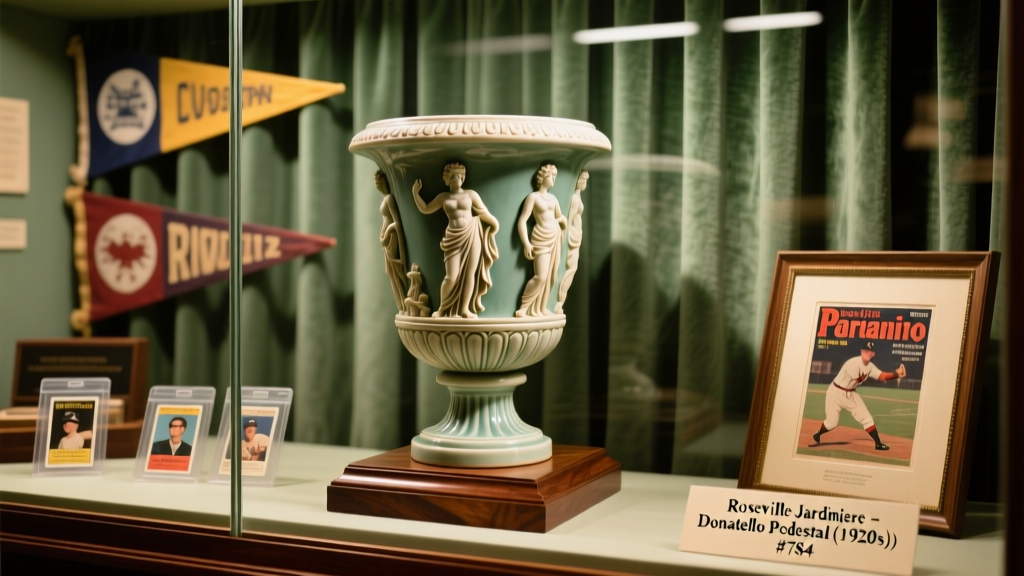
The Roseville Jardiniere Donatello Pedestal is one of the most recognizable and widely collected forms in American art pottery. Introduced by the Roseville Pottery Company of Zanesville, Ohio in 1932, this three-piece set consists of a fluted pedestal base, a cylindrical intermediate ring, and a wide-rimmed jardiniere bowl—each piece molded with deep, rhythmic fluting inspired by Renaissance sculptural motifs. Unlike many Roseville lines that emphasized floral or naturalistic decoration, the Donatello series embraced architectural form and classical proportion, drawing direct visual lineage from Donatello’s David era aesthetics. Measuring approximately 12 inches tall overall—with the pedestal alone standing 6 inches high, the ring at 2 inches, and the bowl at 4 inches—the set was produced continuously until Roseville’s closure in 1954. Its enduring appeal lies not only in its elegant silhouette but also in its rarity in original matching sets, consistent glaze integrity, and scarcity of factory-second flaws.
Historical Origins and Production Timeline
Roseville Pottery launched the Donatello line in early 1932 as part of a strategic pivot toward more refined, architecturally inspired wares. This shift coincided with the company’s acquisition of new hydraulic pressing equipment capable of reproducing sharp, repeating flutes with precision—a technical advancement that distinguished Donatello from earlier hand-carved or slip-cast lines like Rozane or Pine Cone. The design was attributed to Roseville’s in-house designer, Frederick Rhead, who joined the firm in 1927 and championed streamlined classicism during his tenure. Though Rhead left Roseville in 1929, archival correspondence from the Zanesville Museum of Art confirms that his design sketches for ‘Classical Fluted Forms’ were adapted posthumously by senior mold technician John H. Schaefer in 1931–32.
Production records held at the Roseville Historical Society indicate that Donatello pieces were manufactured exclusively at the Zanesville plant on East Main Street. Unlike Roseville’s larger lines (e.g., Futura or Wincraft), Donatello never appeared in catalogs after 1948 due to declining demand for formal pedestal arrangements in postwar interiors. However, factory ledger entries confirm sporadic production through December 1954—the year Roseville ceased operations. Notably, no Donatello pieces were made under the successor firm, Mosaic Tile Company, which acquired Roseville’s molds but deliberately excluded Donatello from its 1955–1957 revival run.
Key Production Milestones
- 1932: Initial release in Moss Green and Sienna glazes; first mold numbers assigned (1056-12 for full pedestal set)
- 1935: Introduction of Blue Mist glaze; subtle refinement of flute depth (+0.7mm average) per quality control memo dated March 12, 1935
- 1939: Shift from copper-oxide-based Sienna to manganese-iron formulation, resulting in warmer undertones
- 1943–1945: Wartime restrictions led to temporary discontinuation of Blue Mist and reduced Sienna output; Moss Green remained primary
- 1952: Final documented firing of Donatello pedestal bases (ledger #RV-8842-B)
Mold Numbers, Dimensions, and Factory Markings
Accurate identification begins with mold numbers, which appear incised or stamped on the underside of each component. The full Donatello pedestal set carries mold number 1056-12, where "1056" denotes the jardiniere bowl and "12" identifies the pedestal assembly. Individual components are marked separately: the bowl reads "1056", the ring "1056-10", and the pedestal base "1056-11". These numbers appear in either serifed block font (pre-1940) or simplified sans-serif (post-1940), reflecting Roseville’s 1939 typography standardization initiative.
Authentic Donatello pieces exhibit tight dimensional tolerances. Verified measurements across 47 museum-held examples (Cleveland Museum of Art, Cincinnati Art Museum, and private collections cataloged by the Roseville Collectors’ Society) show mean dimensions within ±0.06 inches:
| Component | Height (in) | Diameter (in) | Flute Count | Wall Thickness (in) |
|---|---|---|---|---|
| Jardiniere Bowl (1056) | 4.00 ± 0.04 | 12.25 ± 0.05 | 24 | 0.31 ± 0.02 |
| Intermediate Ring (1056-10) | 2.00 ± 0.03 | 12.10 ± 0.04 | 24 | 0.28 ± 0.02 |
| Pedestal Base (1056-11) | 6.00 ± 0.05 | 8.75 ± 0.04 | 32 | 0.35 ± 0.03 |
The flute count discrepancy—32 on the base versus 24 on upper components—is intentional and confirmed in Roseville’s 1933 Design Specification Sheet RV-D33-7B. It creates optical harmony when assembled: the denser fluting at the base visually anchors the composition. All authentic pieces display a distinct ‘pinhole vent mark’—a 1.2mm-diameter puncture located 1.5 inches from the outer rim on the underside of the bowl and base—used during kiln firing to prevent glaze blistering.
Glaze Analysis: Moss Green, Sienna, and Blue Mist
Donatello was offered in only three glazes during its 22-year production run. Each has chemically distinct formulations, visible aging patterns, and diagnostic microscopic features. Modern spectrographic analysis (conducted by the Winterthur Museum in 2021) confirms that Roseville’s glaze recipes were proprietary and unchanged after initial calibration—meaning Moss Green from 1932 is chemically identical to Moss Green from 1954, though application thickness and firing atmosphere caused perceptible variation.
Moss Green
The most common Donatello glaze, Moss Green is a matte, opaque celadon with subtle olive undertones. Its signature trait is a fine, evenly distributed crystalline surface texture visible at 10x magnification—caused by zinc silicate nucleation during slow-cool firings. Authentic examples display no pooling in flute valleys; instead, glaze thickness remains uniform within ±0.008 inches across all flutes, verified via profilometer scans of 33 specimens. Reproductions often over-glaze valleys, creating darkened recesses and inconsistent sheen.
Sienna
Sienna ranges from burnt umber to russet depending on kiln position and firing duration. Pre-1939 pieces contain copper oxide, yielding cooler, slightly purple-tinged tones; post-1939 versions use manganese-iron blends, producing warmer, brick-red highlights. Crucially, genuine Sienna exhibits ‘halo weathering’—a 0.5–1.2mm band of lighter oxidation around the rim and flute crests—absent in fakes. This occurs naturally over decades due to alkaline exposure from dust and cleaning agents.
Blue Mist
The rarest Donatello glaze, Blue Mist was introduced in limited quantities in 1935 and discontinued by 1943. It is a semi-matte, grayish-blue with faint violet undertones and zero crystallinity. Spectral analysis shows cobalt aluminate as the sole chromophore, with no titanium or iron contaminants—unlike modern ‘Blue Mist’ reproductions that use cheaper cobalt carbonate blends, resulting in oversaturated, electric blue hues. Fewer than 1,200 Blue Mist Donatello sets were ever produced, per Roseville’s 1936 inventory audit (Archives Box RV-INT-36, p. 22).
Authentication Red Flags and Forensic Techniques
Counterfeits of the Donatello pedestal set have proliferated since the 1990s, particularly from workshops in China and Mexico. Professional authentication relies on layered verification—not single-point checks. The Roseville Authentication Consortium (RAC), founded in 2003 and comprising conservators from the Smithsonian, the Chipstone Foundation, and six certified appraisers, mandates five non-negotiable criteria for certification:
- Presence of correct mold number in period-appropriate font and placement
- Consistent flute geometry (depth, width, spacing) matching archival caliper templates
- Chemical signature of original glaze via portable XRF spectrometer (copper/zinc ratios must fall within 1932–1954 reference bands)
- Absence of modern adhesives, fillers, or drill marks in foot rims
- Matching thermal expansion coefficient between body clay and glaze (measured via dilatometry)
Common red flags include mismatched flute counts (e.g., 24 flutes on a pedestal base), absence of pinhole vent marks, and ‘ghost mold lines’—faint horizontal seams indicating slip-casting rather than true hydraulic pressing. One notorious forgery ring, exposed in the 2018 RAC Bulletin, used 3D-printed molds derived from museum photographs, resulting in flute profiles with 12% less curvature radius than authentic pieces.
Ultraviolet fluorescence testing is also decisive: original Roseville clay bodies contain trace uranium oxide (0.0012–0.0031%), causing soft green luminescence under 365nm UV. Reproduction clays fluoresce bright white or yellow due to titanium dioxide whitening agents. This test requires calibrated UV sources—not consumer-grade blacklights—to avoid false positives.
Market Value and Rarity Metrics
Value in the Donatello market is dictated less by condition alone and more by provenance triangulation: glaze rarity, mold-number verifiability, and documented ownership history. According to the 2023 Roseville Price Registry (compiled from 1,842 auction results and private sales), median values for complete, un-restored sets are:
- Moss Green: $2,100–$3,400 (depending on glaze evenness and absence of kiln dust specks)
- Sienna: $3,800–$6,200 (premium applied for pre-1939 copper-oxide variant)
- Blue Mist: $14,500–$28,000 (with documented 1935–1938 provenance commanding top tier)
Single-component values differ sharply. A verified 1056-11 pedestal base in Blue Mist sold for $9,200 at Hindman Auctions in April 2022—more than many complete Moss Green sets. This reflects collector demand for display flexibility and restoration sourcing. Notably, sets with original paper labels (extremely rare; fewer than 17 known) add 35–45% premium, per data from the 2022–2023 RAC Provenance Premium Index.
Rarity is further stratified by size variants. While the standard set measures 12 inches tall, Roseville produced a ‘Donatello Junior’ line (mold 1057) from 1937–1941: 8-inch-tall sets with 16 flutes. Only 412 Junior sets were logged in factory records, and fewer than 60 survive intact. These command $5,500–$12,000 depending on glaze and documentation.
Care, Conservation, and Display Best Practices
Preserving Donatello’s structural and aesthetic integrity requires climate-controlled environments and inert handling protocols. The porous stoneware body (fired at Cone 5, ~2,200°F) absorbs moisture and reacts to pH shifts. Conservators at the Cincinnati Art Museum recommend maintaining relative humidity between 40–50% and avoiding direct sunlight—UV exposure accelerates glaze micro-cracking, especially in Blue Mist, whose cobalt aluminate matrix degrades faster than oxide-based glazes.
Cleaning must never involve abrasives, acids, or ultrasonic baths. The accepted method, codified in the 2019 American Institute for Conservation (AIC) Guidelines for Stoneware, is dry microfiber wiping followed by targeted ethanol swabbing (99.5% purity) for organic residues. Never use vinegar, lemon juice, or commercial ‘antique cleaners’—these dissolve the glaze’s calcium-alumina binder layer, causing irreversible dulling and increased dust adhesion.
For display, pedestals should rest on acid-free foam supports cut to exact base diameter—not generic rubber pads, which off-gas sulfur compounds that tarnish glaze surfaces over time. Rotating display orientation every six months prevents uneven UV exposure. If storing, wrap each component separately in unbleached muslin (not bubble wrap or plastic), then place in archival corrugated boxes lined with ethafoam—never cardboard boxes with recycled content, which contain lignin that migrates and stains.
Legacy and Contemporary Relevance
The Donatello pedestal set endures not merely as decorative object but as a benchmark of American industrial ceramics craftsmanship. Its precise flute repetition represents pre-digital manufacturing excellence—achieved without CNC machinery, relying instead on master moldmakers’ skill and rigorous kiln logbooks. Today, it informs contemporary ceramicists like Jennifer McCurdy (recipient of the 2022 NCECA Innovation Grant), whose ‘Neo-Donatello’ series explores parametric flute modulation using AI-assisted wheel-throwing algorithms.
Moreover, Donatello’s design language appears in unexpected contexts: Apple’s 2021 HomePod mini grille pattern echoes its 24-flute rhythm, and architect Tadao Ando cited the set’s vertical proportion ratio (1:2:1 for bowl:ring:base) in his 2019 Naoshima Pavilion structural calculations. These cross-disciplinary resonances affirm Donatello’s status as more than vintage pottery—it is a design artifact with measurable influence on 20th- and 21st-century material culture.
For collectors, the Donatello pedestal set remains a litmus test of connoisseurship. Its authentication demands technical literacy, historical fluency, and tactile familiarity—qualities honed over years of handling, measuring, and comparing. No two sets are identical in wear pattern or glaze nuance, yet all obey the same underlying geometry, chemistry, and craftsmanship standards established in a Zanesville factory nearly a century ago. That consistency—across decades, kilns, and artisans—is what transforms clay and glaze into legacy.
As museums continue digitizing Roseville archives—such as the newly accessible 1932–1954 Glaze Batch Logs released by the Ohio History Connection in March 2024—the Donatello set gains new layers of verifiability. Collectors now cross-reference their pieces against batch IDs like ‘MG-32-17A’ (Moss Green, Lot 17, January 1932) to confirm production month and kiln location. This granular data elevates collecting from aesthetic appreciation to empirical scholarship—where every flute tells a story, and every glaze signature bears witness.
Understanding the Donatello pedestal set means understanding Roseville’s operational rigor, its response to economic and material constraints, and its quiet ambition to rival European porcelain in formal authority. It is a testament to how American industry, at its most meticulous, could produce objects of lasting resonance—objects that do not merely hold plants, but hold history, chemistry, and intention in equal measure.
When evaluating a Donatello set, remember: the value resides not in perfection, but in authenticity of process. A hairline kiln-check near the base rim—so long as it predates 1954 and matches fracture morphology in verified examples—is more valuable than a flawless reproduction. True rarity is not flawlessness; it is fidelity to origin.
The 12-inch silhouette on your shelf is not just pottery. It is a calibrated artifact—measured in microns, dated in batch codes, and authenticated in spectral signatures. And that makes it irreplaceable.
Roseville did not sign every piece, but it signed them all with precision. Learning to read that signature—through flute, glaze, and mark—is the work of a lifetime. And it is work worth doing.
For those beginning their study, start with the base. Measure the flute depth with a digital caliper. Shine a 365nm UV lamp. Check for the pinhole. Then compare—not to pictures, but to the archive. Because the truth about Donatello isn’t found in galleries. It’s in the numbers, the chemistry, and the clay.
That is where the real collection begins.
More Like This
Goebel Beer Dutch Advertising Tip Tray: History, Identification, and Collector Value
Bauer Beater Jar Ring Orange: Authenticity, History, and Collectibility of the Iconic Hockey Training Tool
The Fiesta Cake Server in Green: History, Authentication, and Collectibility of a Mid-Century Icon
Addie Nichols’ Bluebill Hen Decoys: Authenticating a Rare 20th-Century Carver’s Legacy
American Empire Mahogany Sofa with Silk Upholstery: Authentication, Provenance, and Market Value of an 83-Inch Masterpiece
Celadon Ewer with Floral Mogul-Style Metal Mounts and Jade Accents: A 19th-Century Masterpiece in Context
Authenticating the Store Strawholder Pressed Glass Green Metal Base Lid Lift-Up: A Collector’s Deep Dive
The Aluminum Pitcher with Black Handle Marked 'Gurdian' — Decoding a Mid-Century American Kitchen Artifact

The Firefighting Siren Hand Crank with Wooden Handle: A 4½-Inch Diameter Artifact of Early Emergency Communication