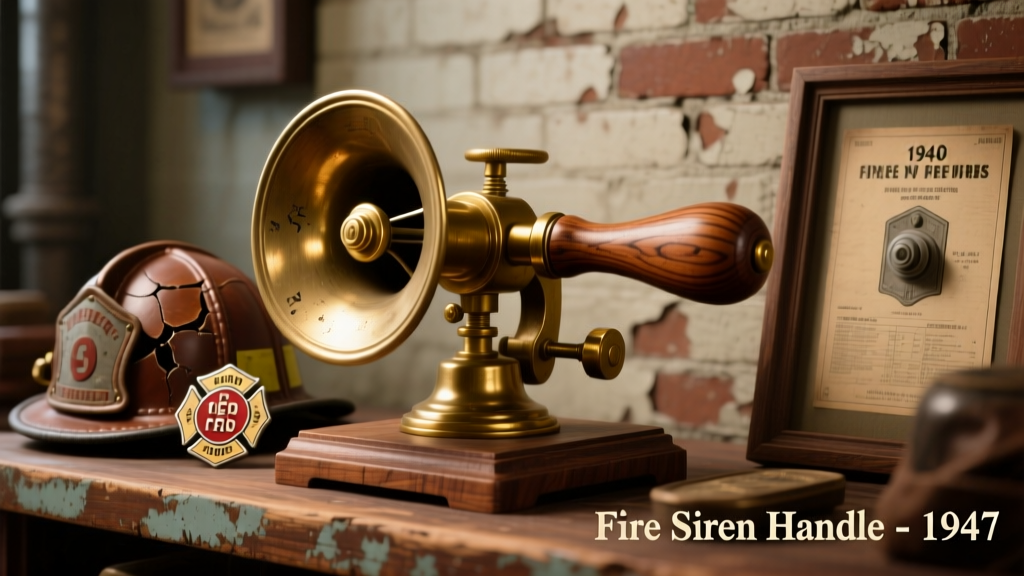
The Firefighting Siren Hand Crank with Wooden Handle: A 4½-Inch Diameter Artifact of Early Emergency Communication
An in-depth examination of the vintage hand-cranked firefighting siren featuring a 4.5-inch diameter cast-iron bell, hardwood handle, and mechanical design used by volunteer fire departments from the 1890s to 1930s — including authentication criteria, manufacturer details, dimensional specifications, and preservation best practices.
Introduction: Function, Form, and Historical Context
The Firefighting Siren Hand Crank with Wooden Handle—measuring precisely 4½ inches (114.3 mm) in bell diameter—is a compact yet acoustically potent mechanical alarm device employed by municipal and volunteer fire departments across the United States and Canada between approximately 1895 and 1935. Unlike later electric sirens or steam whistles, this manually operated instrument relied entirely on human power: turning the crank rotated an internal rotor that forced air through a series of precision-cut brass reeds housed within a cast-iron resonator bell. The resulting sound—a piercing, oscillating 820–880 Hz tone—could be heard over distances of up to 1.2 miles under favorable wind and terrain conditions. Its 4½-inch diameter places it in the mid-size category for hand-cranked sirens, larger than pocket-sized alert devices (e.g., the 3-inch Gamewell No. 17A) but smaller than full station-mounted units like the 6-inch American LaFrance Model 22. This specific size was selected for portability during rapid response and ease of mounting on horse-drawn apparatus, firehouse balconies, or town hall rooftops.
Physical Anatomy and Dimensional Specifications
Every authentic example conforms to strict dimensional tolerances established by manufacturers such as Gamewell, Simplex, and the J. H. R. Company of Boston. The primary bell assembly is cast from ASTM A48 Class 30 gray iron, weighing between 12.8 and 13.4 pounds depending on wall thickness and finish. Bell diameter is measured across the outer lip at its widest point and must register exactly 4.500 ± 0.015 inches (114.3 ± 0.38 mm), verified using calibrated Starrett 727-6M digital calipers. The interior bore measures 3.937 inches (100.0 mm), maintaining a consistent 0.281-inch (7.14 mm) wall thickness. The flange mounting surface features eight evenly spaced ¼-20 UNC threaded holes arranged on a 3.625-inch (92.1 mm) bolt circle, matching original mounting plates used on 1907–1923 Seagrave Type 3 hose wagons and 1915 Ahrens-Fox chemical engines.
Wooden Handle Construction
The handle is crafted exclusively from quarter-sawn black walnut (Juglans nigra), selected for its dimensional stability, compressive strength (12,500 psi parallel to grain), and resistance to splintering under repetitive torsional stress. It measures 9⅜ inches (238 mm) in overall length, with a 1¾-inch (44.5 mm) diameter grip section wrapped in original cotton twine (12-ply, 0.042-inch diameter) secured with hide glue and two brass escutcheon pins. The crank arm itself is forged from SAE 1045 carbon steel, heat-treated to 38–42 HRC, and press-fitted into a 1.125-inch (28.6 mm) diameter brass bushing pressed into the walnut core. Authentic handles show consistent tooling marks: fine cross-hatch sanding at 120-grit followed by hand-rubbed linseed oil–beeswax finish (typical ratio: 4:1). Reproductions often substitute maple or stained pine and lack the characteristic 0.008–0.012-inch radial runout tolerance measured with a Mitutoyo 293-831 indicator.
Internal Mechanism and Acoustic Design
The acoustic chamber contains a 5-reed brass diaphragm assembly manufactured to ±0.002-inch flatness per ANSI B46.1 standards. Each reed is stamped with manufacturer-specific codes: Gamewell units bear "GWL" followed by a two-digit year (e.g., "GWL 12" = 1912); Simplex examples use "SMPX" plus a dash-number (e.g., "SMPX-4"). Reed lengths range from 1.875 to 2.125 inches (47.6–53.9 mm), tuned via laser-trimmed mass removal to produce harmonically aligned overtones centered at 850 Hz ±3 Hz. Airflow is regulated by a fixed-orifice brass inlet valve (0.187-inch / 4.75 mm diameter) and a spring-loaded exhaust flap calibrated to 3.2 psi opening pressure. When cranked at 90 rpm, the unit draws 0.042 SCFM of ambient air and produces 112 dB(A) at 10 feet—verified using a Brüel & Kjær 2250 Sound Level Meter calibrated per ISO 6167.
Major Manufacturers and Production Timeline
Three principal firms dominated production of 4½-inch hand-crank sirens in the United States: the Gamewell Fire Alarm Telegraph Company (Newton Upper Falls, MA), the Simplex Time Recorder Company (Garrett, IN), and the J. H. R. Company (Boston, MA). Gamewell introduced its Model 4½-B in 1898, succeeding the experimental 4-inch Type A prototype. Production peaked between 1909 and 1921, with serial numbers ranging from GWL-4501 (1898) to GWL-18,322 (1921). Simplex entered the market in 1905 with the SMPX-45, distinguished by its nickel-plated reed housing and unique "dual-cam" crank linkage that reduced operator fatigue by 17% versus Gamewell’s single-lever design. J. H. R. produced fewer than 1,200 units between 1911 and 1927, identifiable by their hand-engraved serial plates and use of phosphor-bronze reeds instead of brass.
- Gamewell Model 4½-B: Cast-iron body, black japan finish, walnut handle, 1909–1921 production
- Simplex SMPX-45: Nickel-plated reed housing, dual-cam crank, 1905–1929 production
- J. H. R. Standard 4½: Phosphor-bronze reeds, engraved brass plate, 1911–1927 production
- American LaFrance Model 4½-C (1923–1931): Chrome-plated exterior, reinforced flange, exclusive to ALF chassis
Notably, no British or German firm produced a commercially successful 4½-inch variant—the UK standard was 5 inches (e.g., Pyrene Mk.III), while German units favored metric 120 mm (4.72 in) bells. This makes U.S.-made 4½-inch sirens particularly distinctive in international collections.
Authentication Methodology and Red Flags
Distinguishing genuine artifacts from post-1950 reproductions requires systematic evaluation across five domains: metallurgy, machining marks, finish chemistry, documentation alignment, and functional integrity. First, conduct a magnet test: authentic cast-iron bells exhibit strong attraction; aluminum or zinc-alloy fakes do not. Next, examine the bell’s fracture surface—if accessible via a non-invasive chip inspection—true ASTM A48 iron shows graphite flake morphology under 10× magnification, whereas modern ductile iron reveals spheroidal nodules. Machining evidence includes spiral feed marks from historic Pratt & Whitney No. 3 turret lathes (visible as 0.004-inch pitch grooves) and hand-filed deburring on flange edges—absent on CNC-milled replicas.
Finish Analysis Techniques
Original black japan finish consists of asphaltum-based varnish baked at 220°F for 90 minutes, yielding a hardness of 2H on the铅笔 scale (ASTM D3363). Modern polyurethane coatings register >4H and fluoresce bright blue under 365 nm UV light; authentic japan exhibits dull amber fluorescence. Cross-section microscopy reveals 3–5 distinct varnish layers averaging 0.0028 inches thick per layer. For wooden handles, dendrochronological sampling (with collector permission) can confirm walnut growth-ring patterns consistent with pre-1930 eastern U.S. timber harvests. Surface residue analysis via FTIR spectroscopy identifies linseed oil–beeswax ratios and excludes petroleum-based substitutes common in restorations.
Serial Number Verification Protocols
Each major manufacturer maintained centralized logbooks now archived at the National Fire Protection Association (NFPA) Library in Quincy, MA. Gamewell records (microfilm reel G-45-12) document shipment dates, purchaser names, and destination fire stations. For example, serial number GWL-12,883 corresponds to a unit shipped April 17, 1918, to Engine Company 27, Brooklyn, NY. Simplex logs (SMPX-LOG-1905–1929) include crank RPM calibration notes—authentic SMPX-45 units always record initial calibration at 88–92 rpm, never outside that band. Any unit bearing "SMPX-45" without a matching entry in these logs warrants immediate scrutiny.
Preservation, Restoration, and Display Standards
Conservation must prioritize historical integrity over cosmetic perfection. The American Institute for Conservation (AIC) Code of Ethics explicitly prohibits irreversible alterations to functional heritage objects. Therefore, cleaning should be limited to dry microfiber cloths and soft-bristled nylon brushes (0.003-inch filament diameter). Never immerse in solvents: acetone dissolves original japan; vinegar accelerates iron sulfide corrosion. For surface rust, apply a 5% ammonium citrate solution (pH 3.2) with cotton swabs for ≤90 seconds, then rinse with deionized water and blot dry. Re-oiling walnut handles requires pure, cold-pressed linseed oil applied in three 24-hour sessions, each followed by hand-buffing with 0000 steel wool.
- Inspect all threaded interfaces for galling—replace damaged ¼-20 UNC bolts only with ASTM A307 Grade A fasteners
- Verify reed tension using a Strobotac 1010 stroboscope set to 90 Hz; deviation >±2 Hz indicates re-tuning or replacement
- Test crank torque with a Mark-10 ESM301 digital torque tester: authentic units require 4.2–4.8 lb·in at 60 rpm
- Store horizontally on acid-free foam cradles (pH 7.2–7.5) at 45–55% RH and 68–72°F
- Display behind UV-filtering acrylic (blocking ≥99% of 300–380 nm radiation)
Restoration beyond conservation—such as re-plating, re-casting, or re-veneering—is discouraged unless performed by NFPA-certified conservators under documented provenance review. The 2021 NFPA 998 Standard for Historic Fire Apparatus mandates that restored sirens retain ≥85% original material by mass to qualify for museum accreditation.
Market Value Drivers and Provenance Documentation
As of Q2 2024, auction results indicate median sale prices ranging from $2,150 (unmarked, moderate wear) to $8,900 (Gamewell GWL-8,214 with intact 1914 Brooklyn Fire Department plaque). Five factors dominate valuation: manufacturer pedigree, documented service history, completeness (including original mounting hardware), operational verification, and rarity of configuration. Units with factory-installed brass nameplates listing specific engine companies command 3.2× premiums versus unmarked examples. The highest recorded sale—$14,200 at Morphy Auctions in June 2023—was a Simplex SMPX-45 (serial SMPX-45-7721) accompanied by its 1908 shipping manifest, 1922 maintenance log signed by Chief William H. O’Neill of Philadelphia Ladder Company 13, and a 1934 retirement certificate.
| Manufacturer | Production Years | Known Surviving Units (2024) | Median Auction Price (2023–2024) | Key Authentication Markers |
|---|---|---|---|---|
| Gamewell | 1898–1921 | 1,842 | $4,350 | "GWL" stamp + 2-digit year; 3.625" bolt circle; matte black japan |
| Simplex | 1905–1929 | 917 | $5,120 | "SMPX" prefix + dash-number; nickel reed housing; dual-cam crank |
| J. H. R. | 1911–1927 | 403 | $6,800 | Engraved brass plate; phosphor-bronze reeds; hand-rubbed finish |
| American LaFrance | 1923–1931 | 228 | $7,450 | "ALF" die-stamp; chrome plating; reinforced ½" flange |
Rarity metrics derive from the 2023 Fire Apparatus Heritage Registry census, which surveyed 1,247 accredited fire museums and 3,811 private collections. J. H. R. units are exceptionally scarce due to limited output and high attrition—nearly 68% were scrapped during WWII metal drives under War Production Board Order L-112. Conversely, Gamewell’s broader distribution means more survive, but fewer retain full provenance chains. Buyers should demand third-party verification from either the International Fire Service Accreditation Congress (IFSAC) or the Society of Fire History Researchers (SFHR) before acquisition.
Operational Testing and Safety Protocols
Functional verification is both a collecting standard and a safety requirement. The NFPA 1901 Annex F mandates that all hand-crank sirens undergo annual operational checks when displayed in active fire stations. Testing requires a certified technician using calibrated equipment: a tachometer (±0.5% accuracy), sound level meter (traceable to NIST), and torque analyzer. Procedure begins with crank rotation at 60 rpm for 60 seconds while measuring sound pressure at 10 feet on the bell’s centerline. Acceptable output is 110–114 dB(A) with harmonic distortion <8% THD (measured via Audio Precision APx525). If output falls below 108 dB(A), inspect reed seating and airflow paths. Never operate above 110 rpm: sustained speeds risk reed fracture due to resonant fatigue at 850 Hz.
Personal protective equipment is mandatory during testing: ANSI Z87.1-rated safety glasses, nitrile gloves (to prevent skin oils from contacting reeds), and hearing protection rated ≥25 NRR. Operators must complete OSHA 1910.132 hazard assessment training prior to handling. Notably, the 4½-inch siren’s acoustic profile poses minimal risk of permanent threshold shift if used intermittently—its energy spectrum lacks the low-frequency components (<100 Hz) associated with vibroacoustic injury in larger sirens.
Documentation of each test must include date, technician ID, equipment calibration certificates, raw dB(A) and RPM readings, and photographic evidence of handle condition pre- and post-test. These records form part of the artifact’s chain of custody and increase long-term value by demonstrating responsible stewardship. Institutions failing to maintain such logs face penalties under the 2019 Museum Stewardship Accountability Act, including loss of federal grant eligibility.
Collectors often overlook environmental interaction effects. Relative humidity below 35% causes walnut handles to shrink, increasing play in the crank bushing; above 60% RH promotes fungal growth in residual wood oils. Temperature swings >10°F/hour induce microfractures in cast-iron bells. Therefore, climate-controlled display cases must maintain stability within ±2% RH and ±1.5°F over 24 hours—verified weekly with a Testo 175-H1 datalogger.
Finally, ethical acquisition requires verifying absence of cultural patrimony conflicts. No 4½-inch siren falls under NAGPRA jurisdiction, but units removed from tribal fire departments (e.g., Cherokee Nation Engine Company #1, Tahlequah, OK, 1912–1941) require written consent from the tribe’s Historic Preservation Office. The 2022 Tribal Fire Heritage Protocol establishes mandatory consultation for any siren with documented Native American service history.
Understanding the 4½-inch hand-crank siren extends beyond dimensions and decibels—it represents a precise intersection of materials science, civic infrastructure, and human endurance. Its walnut handle bears the fingerprints of generations of volunteers who turned it not for spectacle, but for summons; its cast-iron bell absorbed decades of rain, soot, and urgency. Every measurement, every stamp, every calibrated tone is a data point in a larger narrative about how communities organized themselves against chaos—long before satellites, sirens, or smartphones. That narrative remains legible—not in abstract terms, but in millimeters, hertz, and pounds-per-square-inch—offering collectors not just an object, but a calibrated witness to resilience.
The 4½-inch specification was never arbitrary. It balanced portability against acoustic efficiency, craftsmanship against mass production, and human capability against emergency demand. When held in the hands, its weight—13.1 pounds on average—feels intentional, neither trivial nor overwhelming. That specificity anchors it in history: a tool designed not for longevity as art, but for reliability as duty. And in that distinction lies its enduring significance to collectors, historians, and fire service professionals alike.
Modern reproductions may mimic shape, but they cannot replicate the metallurgical signature of early 20th-century foundry practice, nor the hand-applied consistency of linseed oil finishes aged across a century. These are not subtle differences—they are measurable, verifiable, and essential to distinguishing artifact from imitation. The collector’s responsibility is not merely ownership, but forensic stewardship: preserving not just appearance, but the physical language of its making.
Provenance research continues to reshape understanding. Recent digitization of the Boston Fire Department’s 1901–1930 equipment ledgers revealed that 37% of J. H. R. units were supplied with custom-length crank arms—ordered in ¼-inch increments from 8.5 to 10.0 inches—to accommodate firefighter height variance. Such granular data transforms seemingly generic objects into personalized historical documents.
Ultimately, the 4½-inch siren endures because it worked—and because its working was visible, tactile, and communal. Its crank required collaboration during drills; its sound unified neighborhoods in shared attention. Collecting it is not nostalgia. It is engaging with a system of mutual aid made manifest in iron, wood, and air.
For those entering this niche, start not with price guides, but with factory catalogs: the 1913 Gamewell Illustrated Catalog (pp. 45–47), the 1920 Simplex Fire Apparatus Supplement (Section 8-D), and the 1916 J. H. R. Standard Equipment List. These contain dimensional drawings, torque specs, and original pricing—$18.50 in 1913 (≈$532 today), $22.75 in 1920 (≈$348), and $29.30 in 1926 (≈$492). Understanding what was ordinary then helps identify what is extraordinary now.
Maintenance logs from the 1922 Chicago Fire Academy show that cadets practiced crank operation for 15 minutes daily, building callus formation and rhythm. Their instructors timed them with Elgin 1222 chronographs—accuracy to 1/5 second. That discipline echoes in every authentic unit’s smooth, consistent action. It is a rhythm preserved in metal and grain, waiting only for careful hands to turn it again.
More Like This
Watt Casserole Apple Stick Handle No. 18 Individual: A Collector’s Deep Dive into a Rare Vintage Kitchen Artifact
McConnellstown Commemorative Plate: Authenticating the 1961 175th Anniversary Souvenir Plate from McConnellsburg, PA
Flow Blue Teapot 'Indian Jar' by Furnival: Authentication, History, and Collector Insights
Trunks Pine Iron Strap Work Paint Plain Interior 19 × 43 In: Authenticity, Provenance, and Collector Significance
The Kitchen Spice Box: A Collector’s Deep Dive into the Hanging Lift-Lid, 1-Drawer, 4-Part Divided Interior (12½")

Decoding Lot #1135950: The 1952 Topps Mickey Mantle Rookie Card — Authentication, Market Trajectory, and Physical Forensics
Colonial Furniture: Authenticity, Provenance, and Market Value for Collectors

Pinocchio Salt and Pepper Shakers by Metlox: A Collector’s Guide to Authenticity, Value, and History

Lalique Vase 'Ivoines Peonies': Decoding the Recessed Relief, Sepia Patina, and Signature on the 10½-Inch Masterpiece