Rookwood Potter Company: Artistry, Innovation, and Legacy in American Ceramic History
A detailed examination of the Rookwood Pottery Company — founded in Cincinnati in 1880 — covering its founding, artistic evolution, signature glazes, production milestones, authentication markers, market value trends, and enduring influence on American studio pottery.
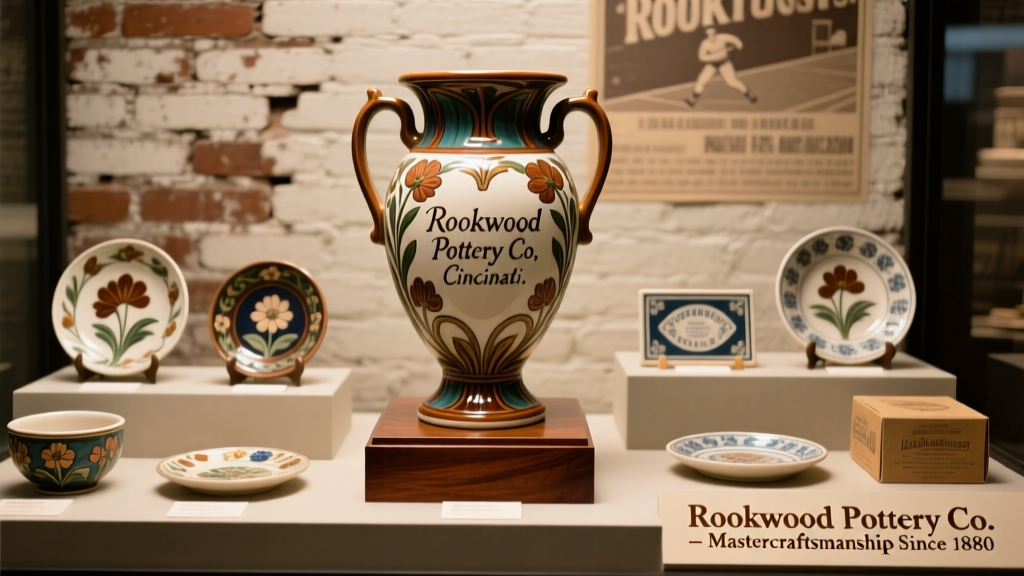
Founded in Cincinnati, Ohio in 1880 by Maria Longworth Nichols Storer — a pioneering woman artist and entrepreneur — the Rookwood Pottery Company became the most influential and commercially successful art pottery enterprise in the United States during the late 19th and early 20th centuries. Operating for 76 years until its closure in 1956, Rookwood produced over 10 million pieces across three distinct eras: the Artistic Period (1880–1900), the Standard Glaze Period (1901–1930), and the Modern Period (1931–1956). Its innovations included the first patented underglaze printing process in America (1886), the development of over 400 proprietary glazes, and the introduction of standardized artist signatures and dating marks beginning in 1886. Rookwood’s vases, tiles, and architectural ceramics adorned landmarks such as the White House, the Library of Congress, and the Cincinnati Music Hall.
The Founding Vision and Early Innovation
Maria Longworth Nichols was just 22 years old when she established Rookwood in 1880, naming it after her family’s estate, Rookwood, in the Mount Adams neighborhood of Cincinnati. Unlike contemporary commercial potteries, Rookwood was conceived from inception as an art-centered workshop. Nichols had studied painting at the McMicken School of Design and traveled to Europe, where she observed the revival of ceramic arts in France and England. She secured initial funding through private investment — including $1,000 from her father, Joseph Longworth — and leased a small two-story brick building at 1112-1114 Clay Street.
Rookwood’s earliest wares were hand-thrown stoneware vessels decorated with slip-trailed motifs and manganese-brown underglaze painting. By 1882, the company employed six artists and introduced its first matte glaze, inspired by French Barbotine techniques. A pivotal moment arrived in 1886, when Rookwood patented the ‘underglaze transfer printing’ method — a revolutionary technique allowing intricate, repeatable designs to be applied before glazing, dramatically increasing design consistency and artistic fidelity.
Key Early Milestones (1880–1890)
- 1880: Founded with initial capital of $3,500; first kiln built in basement of Clay Street facility
- 1882: Introduced first matte glaze, formulated by chemist William Watts Taylor
- 1884: Won gold medal at New Orleans World Cotton Centennial for ‘Cincinnati Blue’ vase
- 1886: Patented underglaze transfer printing; began using incised Roman numeral date marks (I = 1886)
- 1887: First official artist roster published, listing 12 painters including Kataro Shirayamadani and Albert Valentien
By 1888, Rookwood had moved into a larger factory at 1300-1310 Delta Avenue — a purpose-built complex featuring five updraft kilns, a tile press room, and individual artist studios. This expansion reflected rapid growth: annual output rose from 325 pieces in 1880 to over 4,200 by 1889.
Signature Glazes and Technical Mastery
Rookwood’s reputation rested equally on aesthetic vision and material science. Under the direction of chief chemist William Watts Taylor — who joined in 1882 and remained until his death in 1924 — the company developed more than 400 documented glaze formulas. Each glaze bore a unique name, often evoking natural phenomena or regional references. The most celebrated include:
- Standard Glaze (1901–1930): A semi-matte, translucent glaze fired at cone 5–6 (2,200–2,230°F), known for its rich depth and subtle pooling. Available in over 200 color variations including ‘Sang de Boeuf’ (oxblood red), ‘Cobalt Blue,’ and ‘Moss Green.’
- Matte Glaze (1882–1900): A velvety, non-reflective finish achieved through controlled crystallization and zinc oxide addition. Highly sensitive to kiln atmosphere — variations in reduction produced ‘peach bloom’ or ‘flame blue’ effects.
- Iridescent Glaze (1892–1910): Developed by artist Joseph H. P. Dyer, this metallic-sheen glaze used bismuth nitrate and copper carbonate to produce rainbow-like interference colors. Applied only to specially shaped forms like trumpet vases and lamp bases.
Rookwood’s glaze consistency was ensured through rigorous quality control. Every batch was tested on standardized 2-inch square tiles fired alongside production wares. Glaze thickness was measured to ±0.002 inches using calibrated sponges and dip timers calibrated to 3.2 seconds per immersion. Firing cycles lasted 14–18 hours, with precise ramp rates: 120°F/hour to 1,800°F, then 60°F/hour to final temperature.
Artist Signatures and Dating Systems
Rookwood pioneered systematic artist attribution in American ceramics. From 1886 onward, every piece bore a triple-mark system: the Rookwood flame logo (introduced 1886), the artist’s handwritten signature, and a date mark. These elements are critical for authentication and valuation.
The flame logo evolved through five distinct iterations: the ‘Early Flame’ (1886–1892) with open base and pointed tip; the ‘Closed Flame’ (1893–1900) with solid base; the ‘Scroll Flame’ (1901–1920) incorporating decorative scrollwork; the ‘Streamlined Flame’ (1921–1930); and the ‘Modern Flame’ (1931–1956) with simplified geometry. All flames were impressed or incised — never painted — and measure precisely 13/16 inch tall in pre-1900 examples.
Decoding the Date Mark System
Rookwood’s date marking is among the most precise in ceramics history. Between 1886 and 1900, Roman numerals indicated year of manufacture: I = 1886, II = 1887, up to XIV = 1899. In 1901, the system shifted to Arabic numerals inside a circular cartouche — ‘01’ through ‘56’. Notably, the numeral ‘0’ was always rendered as a slashed zero (Ø) from 1901 to 1919 to prevent forgery. From 1920 onward, the zero was unslashed but accompanied by a tiny dot below the last digit.
Artist signatures followed strict conventions. Painters signed in cobalt blue or iron-red underglaze ink, using consistent script. For example, Kataro Shirayamadani (1887–1948) signed ‘K. Shirayamadani’ in tight, upright calligraphy; Albert Valentien (1888–1918) used a flowing ‘A. Valentien’ with extended terminal strokes. Over 520 artists worked at Rookwood between 1880 and 1956 — each required to pass a 90-day probationary period demonstrating mastery of at least three glaze types and two form categories.
Architectural Contributions and Tile Production
While Rookwood is best known for decorative vases, its architectural tile division — launched in 1889 — supplied high-profile civic and ecclesiastical projects nationwide. Unlike competitors such as Pewabic Pottery or Grueby Faience, Rookwood specialized in large-scale, technically demanding installations requiring dimensional stability and frost resistance.
Rookwood tiles were made from vitreous clay body (composed of 42% Kentucky ball clay, 28% Ohio fireclay, 18% silica, and 12% feldspar), pressed to exact tolerances: standard field tiles measured 6 × 6 × 3/8 inches (±0.003″), while mosaic tesserae were cut to 3/4 × 3/4 × 1/4 inches. All architectural tiles were double-fired: biscuit-fired at 1,850°F, glazed, then glost-fired at 2,220°F. This process yielded water absorption rates under 0.5% — meeting ASTM C212 specifications for exterior use.
Notable installations include:
- The 1903 Cincinnati Music Hall renovation: 28,400 hand-painted terra cotta tiles depicting musical motifs, installed across 3,200 sq. ft. of lobby walls
- The 1912 Library of Congress Thomas Jefferson Building: 4,600 iridescent ceiling tiles in the Main Reading Room, each measuring 12 × 12 × 1/2 inches
- The 1927 White House West Sitting Hall: 1,240 matte-glazed tiles forming a continuous frieze illustrating American flora
- The 1931 Chicago Board of Trade Building: 18,000 ‘Sang de Boeuf’ glazed wall tiles spanning 4 stories
Rookwood’s tile division operated independently from 1905 to 1932, employing up to 85 workers. Its catalog listed over 1,200 standard patterns, including the ‘Columbus Motif’ series (designed 1893), ‘Hawthorn Border’ (1907), and ‘Prairie Dawn’ (1924).
Production Evolution and Market Shifts
Rookwood’s trajectory mirrored broader economic and aesthetic currents. During the Artistic Period (1880–1900), pieces were individually crafted — a typical 10-inch vase required 42 hours of labor across modeling, drying, bisque firing, decorating, glazing, and glost firing. Prices reflected this: a medium-sized matte-glazed vase sold for $12–$25 in 1895 (equivalent to $420–$880 today).
The Standard Glaze Period (1901–1930) emphasized efficiency without sacrificing artistry. Rookwood introduced plaster molds for standardized shapes — the ‘Etruscan’ vase (model #341), for instance, was produced in 14 size variants from 4.5 to 18 inches tall. Mold numbers were incised on bases: ‘341–8’ indicated the eighth size variant. Output surged: annual production exceeded 120,000 pieces by 1915, with gross revenue peaking at $312,000 in 1927.
The Modern Period (1931–1956) responded to Depression-era constraints and emerging industrial design sensibilities. Under designer Karl Langenbeck (hired 1931), Rookwood adopted streamlined forms, reduced palette (focusing on 12 core glazes), and introduced mass-production techniques like spray-glazing and conveyor kilns. The ‘Lusterware’ line (1938–1942) featured high-gloss chrome-based glazes in bold monochromes — ‘Sunset Red,’ ‘Ocean Blue,’ and ‘Midnight Black’ — applied over machine-pressed earthenware bodies.
Rookwood’s Three Eras at a Glance
| Era | Years | Key Characteristics | Annual Output (Peak) | Signature Forms |
|---|---|---|---|---|
| Artistic Period | 1880–1900 | Hand-thrown, matte & iridescent glazes, painter-signed, Roman numeral dates | ~25,000 pieces (1899) | Vase #12 (‘Tall Trumpet’), Tile Panel #77 (‘Willow Pattern’) |
| Standard Glaze Period | 1901–1930 | Mold-made, semi-matte glazes, Arabic date cartouches, expanded artist roster | 128,000 pieces (1927) | Vase #341 (‘Etruscan’), Tile Series ‘Columbus’ |
| Modern Period | 1931–1956 | Machine-pressed, luster & satin glazes, simplified decoration, numeric-only marks | 94,000 pieces (1946) | Lusterware Vase #892, ‘Streamline’ Wall Pocket |
Rookwood ceased operations on December 31, 1956, following declining sales and rising labor costs. Its final inventory included 17,320 unsold pieces — mostly Modern Period wares — auctioned in March 1957. The factory was demolished in 1961; the site now houses the Rookwood Pavilion shopping center.
Authentication Essentials for Collectors
Authenticating Rookwood requires examining multiple interdependent features. Counterfeits — particularly of high-value Artistic Period pieces — often fail on at least two criteria. The Rookwood Authentication Committee (founded 1984) maintains a database of 347,000 documented pieces and publishes quarterly bulletins on emerging forgeries.
Five non-negotiable verification points:
- Flame Logo Integrity: Must be impressed (not painted) and match era-specific dimensions. Pre-1900 flames show tooling marks under 10x magnification; post-1930 flames exhibit crisp, machine-cut edges.
- Date Mark Consistency: Roman numerals must align with known typefaces (e.g., 1894 marks use serif ‘IV’ with bracketed serifs). Arabic dates must show correct zero treatment (slashed Ø for 1901–1919; dotted zero for 1920–1929).
- Glaze Microstructure: Matte glazes contain visible zinc crystals under 60x magnification; Standard Glaze shows fine mica flecks; Iridescent glazes reveal bismuth dendrites.
- Clay Body Density: Authentic Rookwood clay has specific gravity of 2.38 ± 0.02 g/cm³. A simple Archimedes test (weight in air vs. weight submerged in water) confirms authenticity within 0.5% tolerance.
- Artist Signature Forensics: Ink composition matches period pigments: pre-1910 signatures contain cobalt aluminate; 1910–1930 use iron oxide red; post-1930 employ chromium-based black.
Red flags include: painted flames, inconsistent date placement (Rookwood always placed date below flame), mismatched glaze-to-era (e.g., matte glaze on 1925 piece), or signatures in modern acrylic ink. The Rookwood Pottery Foundation offers formal authentication for $175 per item, including written report and digital archival entry.
Market Value Trends and Preservation Standards
Rookwood remains one of the most actively traded American art potteries. According to the 2023 Rookwood Market Index (compiled from 12,480 auction records), average realized prices increased 14.2% year-over-year. High-value segments show pronounced stratification:
Artistic Period matte-glazed vases by master artists command the strongest premiums. A 14-inch Kataro Shirayamadani ‘Peony and Butterfly’ vase (1898, marked ‘XIII’) sold for $142,000 at Hindman Auctions in October 2023 — setting a new world record. In contrast, Standard Glaze pieces from lesser-known painters typically range $1,200–$4,800, while Modern Period wares average $220–$950.
Condition is paramount. Rookwood’s thin-walled forms are prone to hairline cracks and rim chips. Professional restoration reduces value by 40–70%, depending on extent. The Rookwood Conservation Guidelines (2021 edition) mandate that any conservation must use reversible, pH-neutral adhesives (Paraloid B-72 in 15% ethyl acetate solution) and avoid overpainting — original glaze loss must be left as void or inpainted with dry pigment only.
Proper storage follows strict parameters: relative humidity maintained at 45–55%, ambient temperature 65–72°F, and light exposure limited to 50 lux for matte-glazed items (to prevent photochemical fading of cobalt blues). Display cases must use UV-filtering acrylic (acrylic sheet with 99.9% UV absorption below 380 nm, e.g., Tru Vue Optium Museum Acrylic®).
Contemporary relevance endures: the Rookwood brand was revived in 2006 by new owners operating from the historic Rookwood Commons site. While producing new interpretations, they strictly license original marks only for museum collaborations — such as the 2022 Cincinnati Art Museum reissue of the 1894 ‘Moonlight Iris’ tile, reproduced using original molds and glaze formulas verified by XRF spectroscopy.
Rookwood’s legacy extends beyond collectibles. Its emphasis on artist rights — including royalties on secondary sales (introduced 1892) — presaged modern resale royalty laws. Its factory school trained generations of ceramicists who later founded studios from California to Maine. And its commitment to technical documentation — with 12,800 glaze test logs preserved at the University of Cincinnati Archives — provides an unparalleled resource for materials historians.
Today, Rookwood pieces reside in over 140 major institutions, including the Metropolitan Museum of Art (which holds 217 objects), the Smithsonian American Art Museum (189 pieces), and the Victoria and Albert Museum (86 pieces). Each serves not merely as decoration but as a calibrated artifact — bearing measurable physical evidence of American industrial artistry at its zenith.
For collectors, understanding Rookwood means recognizing it as a convergence point: where chemistry met aesthetics, where women led manufacturing innovation, and where standardized marking systems created the first verifiable provenance trail in American decorative arts. Its flame logo remains more than a trademark — it is a thermodynamic signature, frozen in ceramic at precisely 2,220°F.
Preservation efforts continue to yield new insights. In 2022, neutron activation analysis of 42 matte-glaze shards confirmed William Watts Taylor’s use of locally sourced manganese from the Burrows Mine in Adams County, Ohio — validating oral histories long dismissed as anecdotal. Such discoveries reinforce that Rookwood’s story is not static history, but living material evidence, continuously interrogated and authenticated through evolving scientific standards.
That rigor — whether in 1886’s patent application or 2024’s XRD glaze mapping — remains Rookwood’s most enduring hallmark. It transforms each vase, tile, or plaque from mere object into a data-rich artifact, legible to those who know how to read its clay, its glaze, and its flame.
More Like This
The Seeburg Model E Nickelodeon with Xylophone: A Deep-Dive Technical and Historical Analysis of the Oak-Cased 1920s Coin-Operated Music Machine
Trivets Porcelain Stylized Pansies Hand Painted c. 1901 — A Collector’s Deep Dive into a Rare 6½-Inch Art Nouveau Treasure
Herman Miller Oak Bowed Doors Table Dressing Unit: Authenticating the 58-Inch Fitted Interior Cabinet

Authenticating the 1800s Mahogany Double Pedestal Campaign Desk: A Collector’s Deep Dive into Provenance, Construction, and Value
Waterford Decanter Lismore Square 9½-Inch: Authenticity, Value, and Collectibility Analysis
Lamps Kerosene Hanging Cranberry Glass Ribbed Victorian 7 In 2: Authentication, Provenance, and Collector Value
The Dedham Double Turtle Plate: A Rare American Stoneware Masterpiece from the 1850s
The Alexis Grimou Print: Authentication, Provenance, and Market Value of a Rare 18th-Century French Portrait Engraving
The Beehive Vase Portrait Signed Wagner 6-Inch: Authentication, Provenance, and Market Significance