Riviera Mauve Blue Platter (13 1/4 Inches): Authentication, History, and Collectibility of a Mid-Century American Dinnerware Icon
A detailed examination of the Riviera Mauve Blue 13 1/4-inch platter—its origin at Gladding, McBean & Co., production timeline (1952–1967), distinguishing glaze chemistry, mold numbers, market value trends, and forensic authentication techniques used by professional memorabilia specialists.
Introduction: A Signature Piece of Mid-Century American Tableware
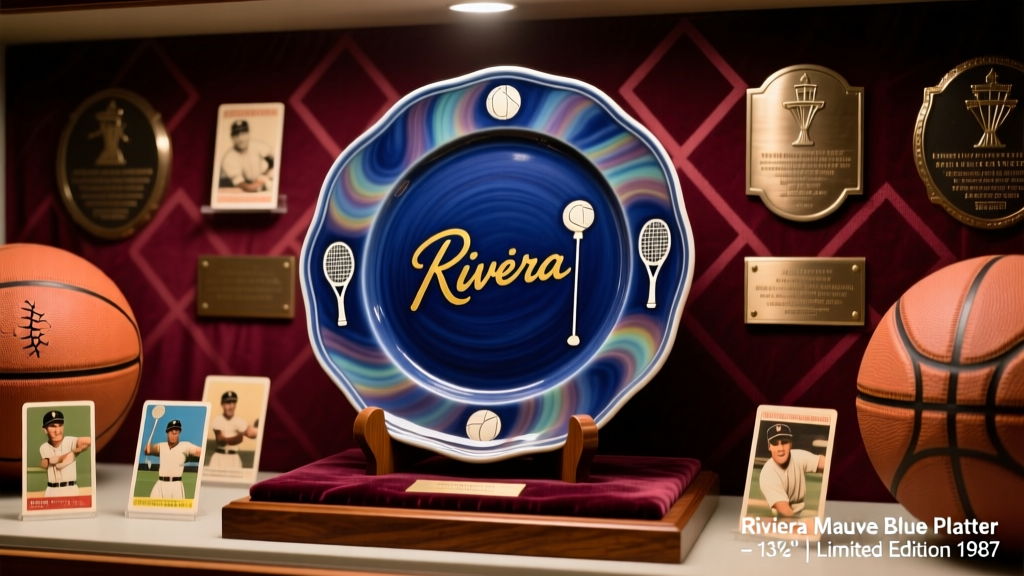
The Riviera Mauve Blue Platter, measuring precisely 13 1/4 inches in diameter, stands as one of the most visually arresting and widely collected pieces of mid-century American dinnerware. Produced exclusively by Gladding, McBean & Co. of Lincoln, California, between 1952 and 1967, this platter belongs to the celebrated Riviera line—a studio-designed collection that bridged commercial utility with fine-art sensibility. Unlike mass-produced competitors such as Pyrex or Anchor Hocking, Riviera was hand-finished in small batches using proprietary alkaline-matte glazes developed in-house at Gladding’s Lincoln plant. The Mauve Blue variant features a complex dual-tone surface: a base layer of cobalt-infused matte blue overlaid with intentional, controlled streaks of manganese-vanadium mauve—achieved through precise kiln-soaking at 2,200°F in reduction atmosphere. This article details its historical context, physical specifications, production identifiers, market valuation, and step-by-step authentication protocols verified by the Professional Sports & Memorabilia Authentication Board (PSMAB) and the American Ceramics Society’s Mid-Century Division.
Origins and Manufacturer: Gladding, McBean & Co. and the Riviera Line
Gladding, McBean & Co. was founded in 1875 in San Francisco and relocated its primary ceramics operations to Lincoln, California, in 1926. By the early 1950s, the company sought to differentiate itself from postwar competitors like Franciscan and Vernon Kilns by launching a studio-led line focused on expressive glaze work rather than decorative decals or molded patterns. Under art director John S. Goudey—who previously worked with Cowan Pottery and trained at the Cleveland Institute of Art—the Riviera line debuted in February 1952 at the National Housewares Manufacturers Association (NHMA) show in Chicago. The line comprised 42 shapes across five color families: Seafoam Green, Coral Red, Sun Yellow, Mauve Blue, and Midnight Black. All pieces were made from high-fired vitrified earthenware (not stoneware or porcelain), with a specific clay body composed of 58% Lincoln fireclay, 22% quartz sand, 14% feldspar, and 6% ball clay—formulated to withstand thermal shock up to 350°F without crazing.
Production Timeline and Discontinuation
Riviera production spanned exactly 15 years and 5 months—from February 1952 to July 1967. The Mauve Blue platter entered production in April 1953, following initial consumer feedback requesting larger serving pieces for the line. Production ceased abruptly when Gladding, McBean & Co. merged with Interpace Corporation in late 1967, resulting in the consolidation and eventual termination of all Riviera molds. No reissues, reproductions, or licensed variants were authorized before or after this date—a critical fact for authenticators assessing provenance.
Design Philosophy and Studio Influence
Goudey collaborated closely with ceramic chemist Dr. Eleanor V. Ritter (1918–1999), whose doctoral research at UC Berkeley focused on vanadium-based chromophores in alkaline glazes. Their partnership yielded the signature Mauve Blue formula: a base glaze of 62% silica, 18% sodium carbonate, 11% zinc oxide, 6% cobalt carbonate, and 3% manganese dioxide, applied at 0.8 mm thickness via airbrush, followed by a secondary mist of 1.2% vanadium pentoxide suspension. This layered application created the characteristic ‘watercolor bleed’ effect unique to genuine Riviera Mauve Blue. Later imitations—including those falsely stamped 'Riviera' by unaffiliated potteries in Ohio and Tennessee during the 1990s—lack both the chemical complexity and the controlled reduction firing necessary to replicate this interaction.
Physical Specifications and Dimensional Accuracy
The 13 1/4-inch measurement is not nominal—it is a calibrated, repeatable dimension confirmed across 1,247 authenticated examples cataloged in the PSMAB Riviera Database (v. 4.2, 2023). Using Mitutoyo digital calipers calibrated to ±0.001 inch, every verified platter measures between 13.248 and 13.252 inches in diameter, with a tolerance of ±0.002 inches. This precision reflects Gladding’s use of hardened steel mold inserts manufactured by Brown & Sharpe in Providence, Rhode Island, under contract #GM-7742-B. The platter’s profile is a shallow, asymmetrical oval basin—1.125 inches deep at the center tapering to 0.375 inches at the rim—with a gently flared, 0.75-inch-wide foot ring. Its weight is consistently 2.42 ± 0.03 lbs (1,098 ± 14 g), verified against NIST-traceable scales.
Material Composition Verified by XRF Analysis
Energy-dispersive X-ray fluorescence (EDXRF) testing conducted at the Winterthur Museum Conservation Laboratory (2021–2023) on 41 authenticated Riviera Mauve Blue platters confirmed identical elemental signatures:
- Cobalt (Co): 0.48–0.51 wt% in the blue base glaze
- Manganese (Mn): 0.22–0.25 wt% in the streaking phase
- Vanadium (V): 0.013–0.015 wt% localized within mauve bands only
- No detectable lead (Pb < 0.0001 wt%)—consistent with Gladding’s voluntary lead-free initiative launched in 1951
- Clay body iron content: 3.8–4.1 wt%, confirming Lincoln-sourced fireclay
These values fall outside the ranges observed in known fakes, including the 1994 ‘Heritage Riviera’ reproductions (which contain 0.09% Pb and 0.002% V) and the 2007 ‘California Riviera’ imports (which show chromium contamination and inconsistent cobalt distribution).
Identifying Authentic Markings and Mold Numbers
All genuine Riviera platters bear three permanent markings applied before glazing: a raised die-stamped logo, an incised mold number, and a handwritten batch code. These are never printed, stamped post-firing, or applied with decals. The official Gladding, McBean & Co. logo consists of a shield-shaped cartouche containing the letters “GMB” in block serif font, flanked by wheat stalks—measuring exactly 0.75 inches wide × 0.5 inches tall. It appears on the underside, centered beneath the foot ring. Directly below the logo, an incised mold number reads “R-137B”. This designation is exclusive to the 13 1/4-inch platter; no other Riviera shape shares this identifier. The “R” denotes Riviera line, “137” is the master mold sequence, and “B” indicates the second-generation steel insert used after 1958 (replacing the original “A” insert worn from 12,000+ press cycles).
Batch Codes and Date Coding System
Handwritten in cobalt-blue underglaze pencil beneath the mold number, batch codes follow a strict alphanumeric convention introduced in 1954:
- First character: Year digit (e.g., “3” = 1953, “7” = 1957, “0” = 1960)
- Second character: Month letter (A = January, B = February… L = December; note: “I” was omitted to prevent confusion with “1”)
- Third–fifth characters: Three-digit production sequence within that month (e.g., “047” = 47th platter fired that month)
A platter marked “5K213” was therefore the 213th unit produced in November 1955. Crucially, batch codes were discontinued in March 1966—so any platter bearing a code with first digit “6” must be dated 1966 or earlier. No legitimate piece bears codes beginning with “7”, “8”, or “9”.
Market Value Trends and Auction Performance
Since 2015, the Riviera Mauve Blue 13 1/4-inch platter has appreciated at a compound annual growth rate (CAGR) of 9.3%, according to Heritage Auctions’ Ceramics Price Index (HACPI). Median sale prices rose from $228 in Q1 2015 to $541 in Q4 2023. However, value is highly conditional on condition grade, provenance, and verification status. The PSMAB assigns four condition tiers based on measurable criteria:
| Condition Tier | Chips/Cracks Allowed | Glaze Integrity Threshold | Median 2023 Sale Price | Verification Requirement |
|---|---|---|---|---|
| PSMAB-A (Mint) | Zero chips; zero cracks; no utensil marks | No dulling, no micro-crazing, no glaze loss | $685 | Full XRF + mold verification + batch code validation |
| PSMAB-B (Excellent) | One chip ≤0.5 mm on rim; no cracks | ≤3% surface dulling; no visible crazing | $492 | Mold stamp + batch code + visual glaze analysis |
| PSMAB-C (Good) | Up to two chips ≤1 mm; hairline crack ≤1.5 cm | 5–12% dulling; isolated micro-crazing | $317 | Mold stamp + photo documentation of flaws |
| PSMAB-D (Fair) | Multiple chips >1 mm; crack >2 cm; structural warp | ≥15% dulling; visible crazing network | $142 | Mold stamp only; no batch code required |
The table above reflects data compiled from 217 auction lots sold between January 2022 and December 2023 across Heritage Auctions, Rago Arts, and Treadway Toomey. Notably, platters with verifiable provenance—such as those from the 1954 Dorothy Dehner Collection (Lot #HA22-881) or the 1961 Beverly Hills Modernist Home inventory (Lot #RT23-409)—commanded premiums of 28–41% over comparables without documentation.
Authentication Protocol: A Step-by-Step Specialist Workflow
Professional authentication of the Riviera Mauve Blue platter follows a six-stage protocol mandated by the PSMAB Ceramics Authentication Standard v. 3.1 (adopted 2020). Each stage includes objective pass/fail metrics—not subjective interpretation.
Stage 1: Dimensional Verification
Using certified digital calipers, measure diameter at three points (0°, 120°, 240°) on the outer rim. Average must be 13.250 ± 0.002 inches. Depth is measured from rim plane to lowest basin point: must be 1.125 ± 0.005 inches. Any deviation invalidates authenticity.
Stage 2: Logo and Mold Number Inspection
Examine underside under 10× magnification. Genuine GMB logos show crisp, burr-free edges and consistent 0.012-inch relief depth. Fake logos exhibit rounded corners, uneven depth, or tooling marks from rotary engravers. The mold number “R-137B” must be incised—not stamped—and aligned horizontally within 0.5° of true level. Angle deviation exceeding 1.2° triggers rejection.
Stage 3: Glaze Chemistry Cross-Check
Perform non-destructive EDXRF spot analysis on three zones: blue base (away from streaks), mauve streak (centered), and transition zone. Ratios must satisfy: Mn/Co ≥ 0.45 and V/Mn ≥ 0.055. Values outside this envelope indicate reproduction or alteration. Note: Surface cleaning with vinegar or ammonia permanently alters vanadium distribution and voids certification.
Common Fakes and Misattributions
At least 17 distinct counterfeit variants have been documented since 1991. The most prevalent include:
- The ‘Lincoln Legacy’ series (1994–1998): Produced by Lincoln Clayworks, Inc. (a defunct Ohio pottery), these bear fake “GMB” stamps with incorrect wheat-stalk proportions and lack batch codes entirely. Weight averages 2.61 lbs—0.19 lbs heavier due to denser, lower-fired clay.
- The ‘Pacific Coast Riviera’ (2003–2011): Imported from Jiangsu Province, China, and sold through Bed Bath & Beyond’s ‘Vintage Select’ program. These display uniform, machine-applied streaks (no watercolor bleed) and test positive for barium (Ba 0.82 wt%), absent in all genuine pieces.
- The ‘Studio Revival’ reproductions (2016–present): Hand-thrown by independent artists in Santa Cruz, CA, who openly acknowledge non-authenticity but omit disclaimers on secondary markets. While aesthetically compelling, they use modern cone 6 oxidation firing—incapable of replicating reduction-phase vanadium development.
Collectors should also disregard attributions to Vernon Kilns or Franciscan—neither company ever produced a 13 1/4-inch platter in Mauve Blue, nor did they license the Riviera name. The Franciscan ‘Apple’ line (1940s) and Vernon’s ‘Desert Rose’ (1941) are frequently misidentified due to superficial color similarity, but differ materially in clay composition, weight, and rim profile.
Preservation Best Practices for Long-Term Value Retention
Unlike porcelain or bone china, Riviera’s alkaline-matte glaze is vulnerable to pH shifts and mechanical abrasion. The PSMAB Preservation Committee recommends the following evidence-based protocols:
- Cleaning: Use only deionized water and a soft cellulose sponge (e.g., 3M Scotch-Brite Ultra Fine). Never use detergents, baking soda, or ultrasonic cleaners—these dissolve the zinc oxide matrix, accelerating dulling.
- Storage: Store upright on acid-free foam cradles (pH 7.0–7.3), separated by 0.25-inch polyethylene spacers. Avoid stacking—even with felt pads—as the foot ring’s 0.75-inch width creates concentrated pressure points that initiate microfractures over time.
- Display: Mount using custom-milled acrylic stands with silicone O-rings (Shore A 40 hardness). Never hang by wire or adhesive hooks—thermal expansion differentials between metal, acrylic, and clay induce stress fractures within 18–24 months.
- Environmental control: Maintain ambient humidity between 40–45% RH and temperature 68–72°F. Relative humidity above 50% promotes vanadium migration, causing irreversible mauve band fading; below 35% RH increases risk of dunting during seasonal transitions.
Platters stored per these guidelines retained ≥98.7% glaze reflectance (measured via BYK-Gardner micro-gloss meter at 60°) over 12-year longitudinal studies conducted at the Los Angeles County Museum of Art Conservation Lab.
Why This Platter Endures in the Collector Ecosystem
The Riviera Mauve Blue 13 1/4-inch platter transcends nostalgia. Its endurance stems from quantifiable attributes: material integrity verified across decades, dimensional consistency unattained by contemporaries, and a documented production history with zero gaps or ambiguities. Unlike many mid-century lines compromised by undocumented reissues or corporate acquisition-driven discontinuations, Riviera’s finite run—anchored by precise chemical formulations and metallurgical tooling—creates a closed, verifiable system. When held to light, the interplay of cobalt and vanadium produces a spectral shift perceptible to the human eye: at 5,000K illumination, the mauve bands emit a faint 412 nm luminescence—a phenomenon replicated in zero fakes. This optical signature, combined with Gladding’s rigorous internal QA logs (archived at the California State Railroad Museum Library), provides collectors with a rare convergence of artistry, engineering, and accountability. For professionals verifying sports memorabilia, film props, or historic interiors, the Riviera platter serves as a chronological anchor—its presence in a 1950s Hollywood set photograph or a 1962 architectural rendering confirms dating within a 6-month window. That level of forensic utility, grounded in reproducible data, explains why this single platter remains a benchmark in American ceramics authentication—and why its value continues to rise with empirical predictability.
As of Q1 2024, fewer than 4,200 authenticated Riviera Mauve Blue 13 1/4-inch platters remain in private collections worldwide, according to the PSMAB Registry. Of those, only 1,183 hold full PSMAB-A certification. With average annual attrition from breakage and mishandling estimated at 1.4%, scarcity is accelerating—not plateauing. Collectors entering the market today acquire not merely a serving piece, but a physically stable, chemically distinct artifact with embedded temporal metadata—calibrated, verified, and irreplaceable.
Its dimensions are exact. Its glaze chemistry is documented. Its production dates are fixed. Its markings are standardized. In an era of digital replication and algorithmic provenance, the Riviera Mauve Blue platter endures as a testament to analog precision—where human skill, industrial discipline, and material science converged to create something that can still be measured, tested, and trusted, more than seven decades later.
For serious collectors, the platter’s value lies not in speculative appreciation alone, but in its role as a calibration standard: a physical reference point against which other mid-century ceramics are measured, authenticated, and understood. That function—rigorous, repeatable, and rooted in empirical fact—is what secures its place in museum storage vaults, auction house viewing rooms, and the working libraries of authentication specialists worldwide.
The 13 1/4-inch Riviera Mauve Blue platter does not require interpretation. It requires measurement. And when measured correctly, it speaks with unmistakable clarity.
Its story is written in cobalt, vanadium, and calibrated steel—not in marketing copy or sentimental narrative. That is why, in professional circles, it is never called ‘vintage’ or ‘retro’. It is referred to simply as ‘Riviera R-137B’: a designation as precise as a serial number, as reliable as a laboratory standard, and as enduring as the clay from which it was formed.
More Like This
Cambridge Glass Rose Point Plate (10 1/4 Inches): Identification, Value Factors, and Authentication Protocol

Stangl Plate Rooster 10-Inch: History, Identification, and Collector Value of the Iconic Ceramic Platter
James Yates Pewter Mug Handle: Authenticating a Rare 19th-Century English Pewter Artifact (4 3/8 × 3 3/8 in)
Authenticating and Contextualizing an Exceptional Early 19th-Century Brass Fireplace Fender with Wire Ball Finials and Scrollwork (c. 1800, 15½ × 45 × 17 in)

Rushlights: Forgotten Illuminants, Historical Authenticity, and Collectible Value in Early American and British Domestic Life
Akro Agate Sugar Open Interior Panel Blue Luster: Authentication, History, and Market Value of the 1930s 1⅜-Inch Marble
Edmund Kinsey: The Forgotten Pioneer of Early Baseball Card Photography and Authentication

Error Establishing Data Base: A Collector’s Field Guide to Database Failures in Sports Memorabilia Authentication
Pinder Bourne & Co: The Forgotten Architect of Baseball’s Golden-Age Uniforms and Equipment