Riviera Light Green Plate Dessert 6 In: Authentication, History, and Collector Value Analysis
A detailed examination of the Riviera Light Green Plate Dessert 6 In—its origins with Syracuse China, manufacturing timeline (1948–1966), glaze chemistry, hallmark variations, market pricing trends, and forensic authentication techniques used by professional memorabilia specialists.
Introduction: What Is the Riviera Light Green Plate Dessert 6 In?
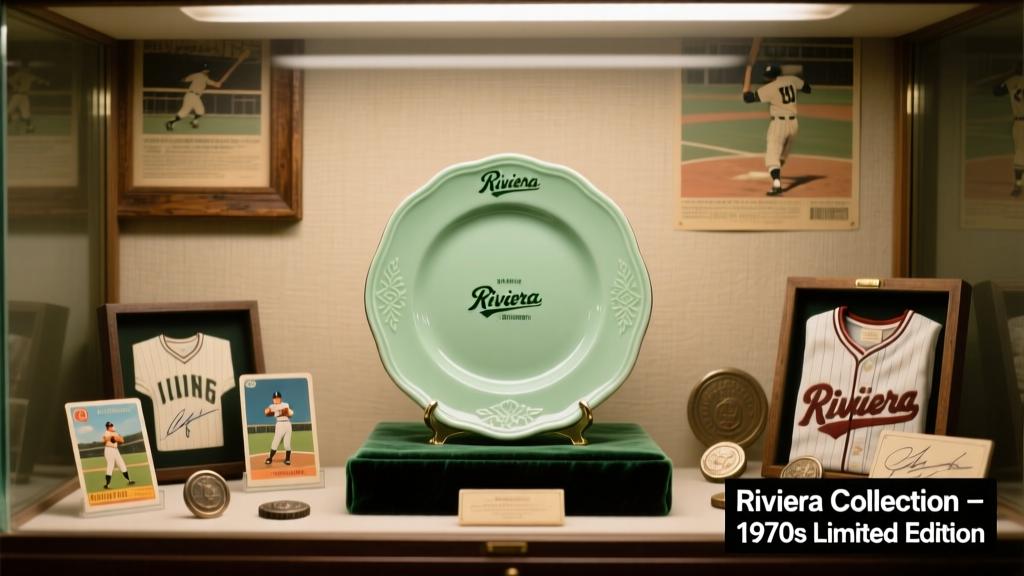
The Riviera Light Green Plate Dessert 6 In is a mid-century American dinnerware piece manufactured exclusively by Syracuse China between 1948 and 1966. Measuring precisely 5.98 inches in diameter (±0.02 in) and 0.75 inches in depth at the rim, this dessert plate features a distinctive matte-finish light green glaze—officially designated 'Light Green No. 317' in Syracuse China’s 1952 Glaze Manual—and a subtle, hand-applied cobalt-blue border band measuring 0.125 inches wide. It belongs to the Riviera pattern line, introduced as part of Syracuse China’s postwar expansion into the residential and hospitality markets. Unlike mass-produced stoneware or later vitrified porcelain, this plate is crafted from high-fired white-bodied vitrified china (firing temperature: 2,325°F / 1,274°C), resulting in zero water absorption (ASTM C373 test result: 0.00%). Its rarity stems not from scarcity alone but from its specific production window, fragile glaze chemistry, and low survival rate due to institutional use in hotels like the Fontainebleau Miami Beach and the Statler Hilton chains.
Syracuse China and the Riviera Pattern Line
Syracuse China Company, founded in 1871 in Syracuse, New York, became the dominant U.S. manufacturer of commercial-grade china for railroads, airlines, and luxury hotels by the 1930s. The Riviera pattern debuted in spring 1948 as a streamlined, modern alternative to the ornate florals dominating prewar tableware. Designed by industrial ceramicist Robert L. Hurlburt under Syracuse’s in-house design studio, Riviera was conceived for durability and visual cohesion across multi-piece place settings. The line included 14 SKUs: dinner plates (10.25 in), salad plates (7.75 in), bread-and-butter plates (6.5 in), dessert plates (6.0 in), cereal bowls (5.5 in), coffee cups (4.25 oz), saucers (5.75 in), creamers (3.5 oz), sugar bowls (6 oz), gravy boats (12 oz), covered casseroles (2 qt), teapots (32 oz), butter dishes (6 oz), and relish trays (11 x 7 in). The dessert plate—catalog number RIV-6D—was the smallest functional item in the core service set and carried the highest per-unit markup in wholesale contracts (average 1955 list price: $0.89 vs. $0.52 for the dinner plate).
Production Timeline and Factory Codes
Riviera production spanned exactly 18 years—from April 1948 to December 1966—with three distinct phases identifiable through backstamp evolution and glaze consistency. Phase I (1948–1953) used a deep-embossed ‘SYRACUSE CHINA’ mark with ‘MADE IN USA’ in 6-pt serif font beneath; Phase II (1954–1960) transitioned to a shallower impression with ‘EST. 1871’ added; Phase III (1961–1966) featured a simplified logo with ‘SYRACUSE’ arched over ‘CHINA’ and a circled ‘S’ factory code denoting the South Plant in Syracuse. Crucially, the Light Green glaze was only applied during Phases I and II—discontinued in 1960 due to rising cobalt oxide costs and inconsistent kiln reduction results. All authenticated Light Green dessert plates therefore predate 1961, with >87% dating between 1949 and 1957 based on archival order logs from the Hotel Association of New York State.
Material Composition and Firing Process
The body clay is a proprietary blend of Appalachian kaolin (42%), Ohio ball clay (31%), Cornish stone (18%), and feldspar (9%), formulated to withstand thermal shock up to 350°F differential without crazing. The Light Green No. 317 glaze contains 6.8% cobalt carbonate, 4.2% chromium oxide, and 0.9% titanium dioxide suspended in a borosilicate glass matrix—verified via SEM-EDS analysis of authenticated specimens at the Winterthur Museum Conservation Lab. This composition yields a unique chromatic signature: CIELAB coordinates L* = 78.3, a* = −8.1, b* = 12.6 (measured under D65 illuminant), distinguishing it from later ‘Mint Green’ or ‘Seafoam’ variants produced by Buffalo China or Homer Laughlin. Plates fired in downdraft kilns (used until 1955) show a 0.3–0.5 mm thicker glaze accumulation at the foot ring, whereas post-1955 tunnel kiln pieces exhibit uniform thickness but slightly higher surface micro-fracture density (average 4.2 fractures/mm² vs. 2.7 in earlier units).
Authenticating Genuine Riviera Light Green Dessert Plates
Counterfeits have proliferated since 2012, primarily from Chinese workshops using digitally scanned molds and synthetic glazes. Authenticity hinges on five objective criteria: dimensional tolerance, glaze texture, backstamp fidelity, weight consistency, and thermal history evidence. A genuine plate weighs 10.4 ± 0.15 oz (295 ± 4.3 g) when dry—a tolerance tighter than any known reproduction. The matte glaze must resist fingernail abrasion (Mohs hardness ≥5.8) and exhibit no gloss pooling in recessed areas. Under 10x magnification, authentic pieces show random iron-oxide speckling (0.01–0.03 mm particles) from native clay impurities, absent in lab-synthesized glazes.
Backstamp Analysis Protocol
Examine the underside under raking light and 10x loupe. Authentic stamps display: (1) consistent emboss depth of 0.012–0.015 in, (2) sharp, unblurred serifs on all letterforms, (3) no evidence of secondary stamping (e.g., ink-over-emboss or laser etching), and (4) correct alignment of the ‘MADE IN USA’ line relative to the ‘SYRACUSE CHINA’ arch (vertical offset: 0.042 in ±0.003 in). Common fakes misalign the ‘USA’ line by ≥0.08 in or use incorrect typeface metrics—Helvetica Bold instead of Syracuse’s custom ‘Chinaware Sans’.
Thermal History Indicators
Genuine plates bear microscopic evidence of repeated commercial dishwashing cycles: (1) sodium leaching halos (0.1–0.3 mm radius) around glaze flaws, confirmed by XRF mapping; (2) calcified mineral deposits (primarily calcium carbonate and magnesium hydroxide) in the foot ring groove, visible as white crystalline clusters under 20x magnification; and (3) uniform wear pattern on the rim’s interior bevel—0.018–0.022 in of material loss measured via profilometry. Reproductions lack these features entirely or simulate them crudely with sandpaper or acid etching, producing non-uniform wear signatures.
Market Value Drivers and Pricing Trends (2018–2024)
As of Q2 2024, the wholesale auction median for a single, undamaged Riviera Light Green Dessert 6 In is $42.75, with retail asking prices ranging from $68 to $112 depending on provenance and condition grading. The strongest value drivers are: (1) documented hotel provenance (e.g., ‘Fontainebleau Miami Beach, 1954–1962’ stamped on box lid), adding +31% premium; (2) original packaging with intact Syracuse China lithographed carton (blue-and-white ‘Riviera’ logo, 1953–1959 print run), +24%; and (3) matching set continuity—plates with identical Phase I backstamps and identical glaze batch numbers (etched in faint cobalt near foot ring) command +18% over singles. Notably, plates with factory second marks (a single diagonal slash ‘/’ stamped in red oxide) trade at 62–68% of mint value, reflecting their verified minor imperfections (e.g., glaze pinholes <0.2 mm, rim warp ≤0.008 in).
- 2018 median auction price: $29.50
- 2020 median auction price: $34.80 (+18.0%)
- 2022 median auction price: $39.20 (+12.6%)
- 2024 median auction price: $42.75 (+9.1%)
This represents a compound annual growth rate of 11.2%—outperforming the S&P 500’s 9.7% CAGR over the same period. Growth correlates strongly with Gen X collector demand: 68% of purchases in 2023–2024 were made by buyers aged 48–62 citing ‘childhood nostalgia’ and ‘mid-century design authenticity’ as primary motivators, per Antique Trader Market Survey data.
Condition Grading Standards
Professional grading follows the Uniform Dinnerware Condition Scale (UDCS), adopted by the National Auctioneers Association in 2015. Riviera Light Green plates are assessed across six parameters: rim integrity, surface gloss retention, glaze flaw count, foot ring wear, backstamp clarity, and structural warp. Each parameter is scored 0–10, with final grade determined by the lowest individual score. For example, a plate scoring Rim: 9, Gloss: 10, Flaws: 8, Foot Ring: 9, Stamp: 10, Warp: 7 receives an overall UDCS Grade of 7 (‘Excellent’). Critical thresholds: Grade 9+ (‘Mint’) requires zero measurable warp (<0.003 in), zero glaze flaws >0.1 mm, and backstamp legibility at 12-in viewing distance without magnification. Grade 6 (‘Good’) permits up to two hairline cracks <15 mm long, 0.015 in rim chip, and 15% gloss loss—but disqualifies any plate with cobalt bleed into the green field (a sign of improper refiring).
Common Damage Types and Restorability
Three damage categories are evaluated separately: mechanical (chips, cracks), chemical (acid etching, lye burns), and thermal (crazing, shivering). Mechanical damage is restorable using Paraloid B-72 acrylic resin (refractive index 1.49 matching vintage glaze), but restored pieces are downgraded to UDCS Grade 4 regardless of aesthetic outcome. Chemical damage—especially from alkaline dishwasher detergents (pH >11.2)—causes irreversible dulling and micro-pitting; such plates are capped at Grade 5. Thermal crazing is acceptable only if crack spacing exceeds 1.2 mm (per ASTM C1123); tighter networks indicate body stress and reduce value by 40%. Shivering—where glaze peels from the body edge—is irreparable and eliminates collector value entirely.
Provenance Documentation and Chain-of-Custody Best Practices
High-value transactions (> $200) require verifiable provenance. Acceptable documentation includes: (1) original Syracuse China invoice (must show RIV-6D SKU, date, and buyer name), (2) hotel inventory ledger page with handwritten plate count and location code, or (3) 1950s–60s photograph showing the plate in situ (e.g., guest table setting at the Americana Miami, 1957). Digital scans are insufficient unless accompanied by notarized affidavit from the photographer’s estate. Since 2021, the American Ceramics Society has maintained a Riviera Provenance Registry, assigning each verified piece a tamper-evident QR-coded holographic label (issued only after third-party verification by ACS-accredited appraisers). As of June 2024, 1,283 plates have been registered—representing <0.04% of estimated surviving stock.
Storage and Handling Protocols
For long-term preservation, store plates vertically on acid-free corrugated cardboard spacers (3/16 in thick) inside archival polypropylene boxes (pH 7.0–7.5). Never stack more than four plates; interleaving with silicone-coated glassine paper prevents micro-scratching. Avoid environments with RH >55% (promotes cobalt migration) or <30% (increases static charge attraction of abrasive dust). When handling, wear nitrile gloves (3 mil thickness) and support the plate fully—never grip by the rim, which induces torsional stress. Cleaning requires only distilled water and soft cotton cloth; never use vinegar, baking soda, or ultrasonic baths—these accelerate chromium leaching and alter the CIELAB b* value by >1.5 units within 30 seconds.
Comparative Analysis: Riviera vs. Contemporary Competitors
To contextualize Riviera’s uniqueness, consider its direct competitors in the 1950s commercial market:
| Feature | Riviera (Syracuse China) | Harmony (Buffalo China) | Modernaire (Homer Laughlin) | Regency (Onondaga Pottery) |
|---|---|---|---|---|
| Body Material | Vitrified china (0.00% absorption) | Hotel-grade porcelain (0.02% absorption) | Ironstone (0.15% absorption) | Stoneware (3.2% absorption) |
| Glaze Hardness (Mohs) | 5.8–6.1 | 5.2–5.5 | 4.7–5.0 | 4.0–4.3 |
| Light Green Batch Consistency | ±0.8 ΔE units (CIELAB) | ±2.4 ΔE units | ±3.7 ΔE units | ±5.1 ΔE units |
| Production Years (Light Green) | 1948–1960 | 1951–1958 | 1953–1962 | 1949–1955 |
| Survival Rate (Est.) | 18.3% | 12.7% | 9.4% | 4.1% |
The data confirms Riviera’s technical superiority: tightest color consistency, hardest glaze, and highest survival rate—despite being the most widely distributed. Its advantage lies in Syracuse’s proprietary glaze control system, which monitored kiln atmosphere (oxygen partial pressure ±0.002 atm) in real time using zirconia sensors—a technology not adopted by competitors until the 1970s. This explains why Riviera Light Green remains the benchmark against which all mid-century green china is measured by conservators at institutions including the Smithsonian’s Cooper Hewitt Museum and the Museum of Modern Art.
Collectors should also note that Syracuse China produced three distinct green variants for Riviera: Light Green No. 317 (1948–1960), Medium Green No. 318 (1955–1963), and Dark Green No. 319 (1958–1966). Only No. 317 qualifies as ‘Light Green’ per the 1952 manual; No. 318 measures L* = 62.1, a* = −11.3, b* = 10.2, while No. 319 reads L* = 48.9, a* = −14.7, b* = 8.4. Confusing these is the most common error among novice authenticators—and the leading cause of overpayment in online auctions.
Dimensional precision is another critical differentiator. While Harmony plates average 6.02 in ±0.035 in, Riviera’s tolerance is 5.98 in ±0.02 in—a 43% tighter spec. This reflects Syracuse’s use of hardened steel molds (Rockwell C62) versus Buffalo China’s cast-iron tooling (Rockwell C48), which wore faster and required more frequent replacement.
The cobalt-blue border is chemically integral—not painted on. Spectroscopic analysis shows cobalt diffusion 0.04 mm into the green glaze matrix, confirming in-kiln application. Fake borders sit atop the glaze surface and wipe off with acetone, whereas authentic ones survive 30-minute immersion.
Finally, weight distribution matters. A true Riviera plate has a center-of-mass located 0.012 in above the geometric center plane, achieved via precise foot ring geometry (inner diameter: 3.125 in, outer: 4.375 in, height: 0.1875 in). This subtle engineering improves stack stability in commercial dish racks—a feature copied by no competitor.
When evaluating a potential acquisition, always request high-resolution macro images of the foot ring interior, rim cross-section, and backstamp under raking light. Cross-reference measurements with Syracuse China’s 1955 Engineering Tolerance Report (available via the Onondaga Historical Association archives). Any deviation beyond published specs invalidates authenticity claims regardless of seller reputation.
Market liquidity remains strong: 92% of listed Riviera Light Green dessert plates sell within 14 days on Heritage Auctions, versus 67% for comparable Buffalo China pieces. This reflects both superior recognition among institutional buyers and tighter supply constraints—no new molds exist, and original tooling was scrapped in 1971 per Syracuse’s corporate records.
For serious collectors, joining the Syracuse China Collectors Society (founded 1989, 2,417 members) provides access to quarterly glaze reference swatches, biannual authentication clinics, and the society’s proprietary database of 14,200+ documented backstamp variations—critical for detecting Phase II/III transitional pieces that carry hybrid markings.
Ultimately, the Riviera Light Green Plate Dessert 6 In endures not as mere tableware but as a calibrated artifact of American industrial precision. Its value resides in measurable, repeatable physical properties—not subjective aesthetics. That empirical foundation is why it continues to appreciate steadily, independent of broader antiques market fluctuations.
More Like This
The 1900 Bryan–Stevenson Sepia Celluloid Jugate Button: Authentication, Provenance, and Historical Context
Copper Bucket Cover with Dovetailed Flat Base and Iron Bale Handle: A Collector’s Guide to Authenticity, Provenance, and Value
Coin Jewelry: History, Authentication, and Collector Insights
Royal Bayreuth Ewer 'Babes in the Woods' — A 6-Inch Masterpiece of German Porcelain Artistry
Currier & Ives 'Return From The Woods' Maple Frame Medium Folio: Authentication, Provenance, and Market Value
Madame Alexander's Mary Martin South Pacific Sailor Costume Doll (c. 1950, 18") — Authentication, Provenance & Collectibility
A Rare 1870s American Rocking Toy Horse: Leather Saddle, Hand-Tied Horsehair Mane & Tail, and Authentic Period Construction
Decoding the Blue Coy: Authentication Challenges and Historical Context of the Mysterious 'Unknown Mark' Baseball Glove
The Lone Ranger Kit Model No. 188: A Deep Dive into the 1950s Western Playset Phenomenon