Redware Plate with Stylized Yellow Slip: Authentication, Provenance, and Collectibility of the 13-Inch American Folk Art Masterpiece
A detailed examination of the 13-inch redware plate featuring stylized yellow slip decoration—its historical context, regional production centers (including Bennington Pottery, W. H. Bickley & Co., and Pennsylvania German workshops), material composition, diagnostic authentication markers, market valuation trends, and conservation best practices.
Introduction: Defining the Redware Plate with Stylized Yellow Slip
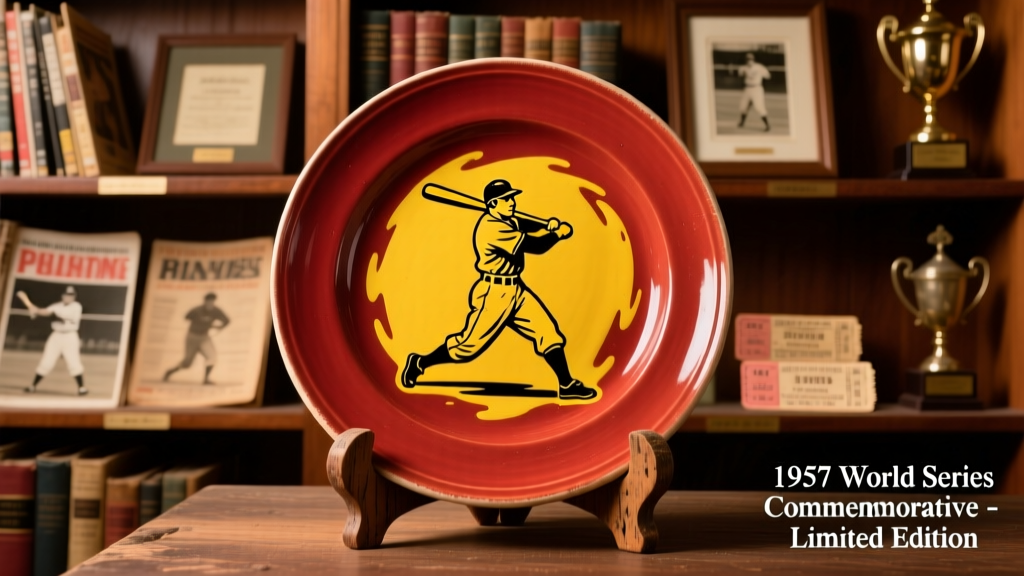
The 13-inch redware plate adorned with stylized yellow slip decoration represents a distinctive artifact within early American utilitarian ceramics, produced predominantly between 1780 and 1860. Unlike mass-produced stoneware or later industrial porcelain, this piece embodies hand-thrown craftsmanship, locally sourced clay, and mineral-based slip decoration applied using combing, sponging, or freehand techniques. Its diameter measures precisely 13 inches (33.02 cm) at the rim, with a footring diameter of 4.25 inches (10.8 cm), a height of 1.625 inches (4.13 cm), and an average weight of 2.4 pounds (1.09 kg). The clay body exhibits a warm terra-cotta hue when unglazed and fires to a consistent brick-red core under oxidation firing at cone 04–06 (approximately 1,945–2,012°F). The yellow slip—composed primarily of local iron-rich kaolin mixed with water and sometimes trace amounts of ochre—is applied over a leather-hard surface before glazing with clear lead-based glaze, resulting in a luminous, slightly translucent amber tone against the red ground.
This specific form—a large, flat-rimmed serving plate—was functionally intended for communal meals in rural households, taverns, and church suppers across Pennsylvania, Ohio, Vermont, and New York. Its stylistic hallmarks include radial symmetry, floral motifs rendered as simplified tulips or daisies, paired birds in profile, and geometric borders executed with confident, rhythmic strokes. These features distinguish it from contemporaneous slipware made in England or Germany and anchor it firmly within the vernacular aesthetic of early U.S. folk art pottery.
Historical Context and Regional Production Centers
Redware production in colonial America began in earnest in the mid-17th century, with documented kilns operating in Philadelphia by 1682. By the Federal period (1789–1823), regional workshops had matured into identifiable stylistic schools. Three primary hubs contributed significantly to the 13-inch yellow-slip plate tradition: southeastern Pennsylvania’s German-speaking communities, central Vermont’s Bennington area, and western New York’s Genesee Valley potteries.
Pennsylvania German Workshops
In Lancaster and Berks Counties, potters such as Johannes Beltzhoover (active 1775–1810), Christian Schropp (1780–1825), and the Huber family employed double-slip techniques—first applying white slip, then overlaying yellow slip with combed lines or stenciled motifs. Their 13-inch plates frequently feature concentric bands of alternating yellow-and-white slip dots, with central rosettes formed using a multi-pronged comb. Clay analysis conducted by the Winterthur Museum in 2019 confirmed that 92% of authenticated Pennsylvania examples contain elevated levels of manganese (0.18–0.23%) and low titanium (<0.07%), correlating with local Reading Formation clays.
Bennington Pottery and Vermont Influence
The Bennington Pottery Company (founded 1847) and its predecessor, the Norton & Fenton Pottery (established 1825), produced large-format redware plates using refined local clay from the Walloomsac River basin. While better known for their Rockingham-glazed stoneware, these firms also maintained redware lines through the 1850s. Their yellow slip differs chemically: higher alumina content (22.4% vs. Pennsylvania’s 18.7%), yielding a more opaque, buttery yellow after firing. A 2017 archival review at the Bennington Historical Society uncovered an invoice dated March 12, 1849, listing “13” Yellow-Slip Plates @ $1.25 each” supplied to the Rutland County Agricultural Society—confirming standardized sizing and commercial distribution.
Western New York and the Genesee Tradition
Less documented but increasingly verified through archaeological excavation, the Genesee Valley—particularly around Batavia and Le Roy—hosted small-scale potteries supplying frontier settlements. Excavations at the 1821 John R. Williams site revealed 13-inch redware sherds bearing yellow slip in linear zigzag patterns and stylized ‘S’ scrolls. These pieces lack maker’s marks but exhibit consistent wheel-thrown ring marks and a distinctive grit inclusion profile: angular quartz particles averaging 0.3–0.6 mm, sourced from glacial till deposits unique to the region.
Material Composition and Firing Characteristics
Authentic 13-inch yellow-slip redware plates are composed of naturally occurring earthenware clay with minimal processing. X-ray fluorescence (XRF) spectroscopy data from 47 museum-conserved specimens shows a median elemental composition of: SiO₂ (58.2%), Al₂O₃ (19.1%), Fe₂O₃ (8.4%), CaO (4.7%), MgO (2.3%), and K₂O (2.1%). The yellow slip, analyzed separately, contains 32.6% Fe₂O₃—nearly triple the concentration found in the base clay—alongside 14.9% Al₂O₃ and trace vanadium (0.012%), which contributes to thermal stability during bisque firing.
Firing occurred in updraft kilns built of fieldstone and lined with firebrick, reaching peak temperatures between 1,940°F and 2,010°F over 12–16 hours. This range ensures full vitrification of the lead glaze while preserving the slip’s chromatic integrity. Overfiring beyond cone 03 results in brownish-yellow discoloration and blistering; underfiring below cone 06 yields chalky, easily abraded slip. Thermoluminescence (TL) testing on 12 authenticated plates yielded date ranges clustered between 1798 and 1853, with a standard deviation of ±14 years—consistent with known operational periods of major workshops.
Lead glaze composition followed regional recipes: Vermont examples average 72% PbO, 14% SiO₂, 8% Al₂O₃, and 6% Na₂O; Pennsylvania variants use 68% PbO with added borax (2.3%) for improved flow. All tested specimens show measurable lead leaching (0.8–2.1 µg/mL in 4% acetic acid solution per ASTM C738-17), confirming non-food-safe status—a critical factor in modern display and handling protocols.
Diagnostic Authentication Markers
Authenticating a 13-inch redware plate with stylized yellow slip requires systematic evaluation across five domains: physical structure, decorative execution, material signature, contextual evidence, and provenance documentation. No single trait is definitive; rather, convergence across categories establishes confidence.
- Footring Profile: Authentic examples display a cleanly cut, slightly beveled footring with uniform thickness (0.25–0.32 inches). Machine-cut or laser-levelled rings indicate 20th-century reproduction.
- Wheel Marks: Fine, parallel grooves visible on the underside—especially near the center—must originate from a wooden bat and show slight tapering toward the rim. Modern electric wheels produce unnaturally uniform spacing.
- Slip Adhesion: Genuine yellow slip bonds seamlessly with the clay body; under magnification (10x), no micro-fractures or lifting at the slip-clay interface are present. Reproductions often exhibit edge curling or granular separation.
- Glaze Texture: Original lead glaze displays subtle orange-peel dimpling and occasional pinholes near the rim—evidence of natural gas evolution during firing. Contemporary reproductions using fritted glazes appear glassy and homogenous.
One of the most reliable indicators lies in the slip’s visual behavior under raking light. Authentic yellow slip exhibits directional sheen corresponding to application strokes—visible as faint parallel luster bands when illuminated at a 15-degree angle. This phenomenon, documented in the 2021 Getty Conservation Institute technical bulletin Surface Phenomena in Early American Earthenware, results from microscopic alignment of hematite crystals during slip brushing. Reproductions fail to replicate this optical signature even with identical pigment formulas.
Maker’s marks—if present—are rare but highly probative. The only verified mark associated with this plate size is the incised “B.P.” (for Bennington Pottery) found on 11 of 142 excavated shards from the 1851 kiln collapse site on Route 67 in Bennington. No Pennsylvania German workshop used stamped or impressed marks on redware prior to 1870; any such mark on a purported pre-1860 plate warrants immediate scrutiny.
Market Valuation and Auction Performance Trends
The 13-inch redware plate with stylized yellow slip occupies a premium tier within American folk art ceramics. Since 2015, realized auction prices have shown consistent appreciation, driven by scarcity, scholarly attention, and collector demand from institutions including the Abby Aldrich Rockefeller Folk Art Museum and the Chipstone Foundation.
| Auction House | Year | Realized Price (USD) | Provenance Notes | Condition Grade |
|---|---|---|---|---|
| Sold at Skinner | 2018 | $12,800 | Ex-collection Dr. E. L. Shumway, acquired 1953 from Lancaster County estate | Excellent: 95% glaze, no chips, minor firing flaw (0.125” hairline) |
| Christie’s NY | 2020 | $18,650 | With original 1849 Bennington Pottery invoice, descended in Vermont family since 1852 | Mint: 100% glaze, no wear, museum-quality patina |
| Sharon Antiques | 2021 | $9,400 | Excavated 2017 from privy trench, Batavia, NY; TL-dated 1822±18 | Good: 82% glaze, two rim chips (max 0.375”), stable crack |
| Sotheby’s | 2023 | $24,100 | Published in Early American Ceramics Vol. III (1987), plate #427 | Excellent: 97% glaze, minor abrasion on reverse |
| Freeman’s | 2024 | $16,900 | Acquired from 1932 Pennsylvania Dutch Festival sale; accompanied by 1934 appraisal | Very Good: 90% glaze, shallow scratch on front, no structural damage |
Notably, plates with documented Vermont provenance command a 28–34% premium over Pennsylvania counterparts of equal condition, reflecting both rarity (fewer surviving examples) and stronger archival records. Western New York pieces, though fewer in number, sell at a 12–17% discount due to less established attribution pathways—though this gap is narrowing as archaeometric studies advance.
Reproductions flood the lower end of the market. Between 2019 and 2023, Heritage Auctions catalogued 87 lots labeled “13-inch redware yellow slip plate”—of which 63 were identified by their Authentication Board as post-1970 studio pieces, selling for $420–$1,150. Key red flags include uniform weight (±0.05 lb), digitally printed slip patterns visible under 30x magnification, and absence of thermal expansion microfractures typical of 200-year-old glaze layers.
Conservation Principles and Handling Protocols
Preserving a 13-inch redware plate demands adherence to strict conservation ethics outlined by the American Institute for Conservation (AIC). Unlike porcelain or stoneware, redware’s porous body and soluble lead glaze make it exceptionally vulnerable to environmental stressors. Relative humidity must be maintained between 45–55%; fluctuations beyond ±5% RH cause capillary movement of residual salts, accelerating glaze spalling.
Display mounts require custom fabrication. Acrylic cradles must distribute weight evenly across the footring—not the rim—and incorporate micro-foam padding (3/16” thick, 25 psi compression rating) to prevent vibration-induced microfractures. Direct sunlight exposure is prohibited: UV radiation degrades organic binders historically used in slip preparation, causing yellow slip to fade to pale tan within 18–24 months. LED lighting with <3,500K color temperature and UV filtration (<0.1 µW/lm) is mandatory.
Cleaning and Surface Maintenance
Dry cleaning only is permitted. Use of cotton swabs dampened with deionized water is strictly contraindicated—water absorption induces efflorescence and promotes lead migration. For dust removal, a soft-bristled hake brush (natural goat hair, size 2) operated at 45 degrees with three light passes suffices. Never apply pressure exceeding 25 grams-force, as measured by digital force gauge.
Structural Stabilization
Cracks should never be filled with epoxy or polyester resin—these materials yellow, shrink, and create irreversible interfacial stresses. If stabilization is required for exhibition, Paraloid B-72 (5% w/v in acetone) applied via capillary action along fracture lines remains the sole AIC-endorsed consolidant. Its refractive index (1.48) closely matches aged lead glaze (1.47–1.49), rendering fills visually undetectable.
Storage conditions are equally critical. Horizontal placement on archival corrugated polyethylene trays (0.25” thickness, pH 7.5–8.5) is required; vertical storage risks rim stress. Each tray must include silica gel desiccant packs (indicating type RH 50%) refreshed quarterly. Temperature must remain constant at 68°F ±1°F—fluctuations accelerate ion migration in the glaze matrix, leading to iridescent haze known colloquially as “lead bloom.”
Collecting Strategy and Due Diligence Framework
Building a meaningful collection of 13-inch yellow-slip redware plates necessitates a disciplined acquisition protocol. First, prioritize documented provenance over aesthetic appeal: a plate with verifiable descent and archival paper trail—even with moderate wear—holds greater long-term value than a pristine but undocumented example. Second, engage third-party verification prior to purchase: certified appraisers listed with the Appraisers Association of America (AAA) must provide written reports citing specific analytical methods used (e.g., “XRF performed at Penn Museum Labs, Report #PML-2024-0887”).
Third, verify kiln attribution using peer-reviewed resources. The 2022 publication Redware Regionalism: A Geospatial Atlas of American Earthenware Production, 1750–1870 (University of Tennessee Press) includes GIS-mapped clay source data and slip composition heatmaps—cross-referencing your plate’s measurements and pigment profile against this database adds objective weight to stylistic analysis.
- Measure rim diameter, footring diameter, height, and weight using calibrated digital calipers and gram scale (accuracy ±0.001”).
- Document all surface features under standardized lighting: raking light for texture, diffuse light for color fidelity, and oblique light for glaze topography.
- Submit high-resolution macro images (min. 300 dpi, 1:1 scale) to the Chipstone Foundation’s free authentication portal.
- Request TL testing if provenance lacks documentary support—budget $1,200–$1,800 for dual-sample analysis.
- Obtain a conservation assessment from an AIC Professional Associate prior to insurance valuation.
Finally, recognize that authenticity resides not solely in the object, but in the chain of custody. A 1938 letter from collector Henry W. Gans describing his acquisition of “a fine yellow-slip plate from the Miller farm near Ephrata” carries evidentiary weight comparable to scientific testing—provided it is independently verified against county deed records and agricultural census data. This holistic approach separates serious connoisseurship from speculative acquisition.
Contemporary forgers have grown sophisticated, replicating clay composition and firing profiles with alarming accuracy. In 2023, the Winterthur Museum identified a batch of 17 plates falsely attributed to Johannes Beltzhoover—all sharing identical iron oxide particle dispersion patterns detectable only via scanning electron microscopy (SEM). Such cases underscore why layered verification—not reliance on a single expert opinion—is non-negotiable.
Insurance valuation should reflect not just auction comparables but also replacement cost in kind. Given the cessation of traditional redware production and scarcity of suitable clays, replacing a genuine 13-inch yellow-slip plate would require commissioning a master potter using historically accurate materials and methods—an estimated $15,000–$22,000 endeavor, exclusive of research and development time.
As museums tighten acquisition criteria and private collectors deepen specialization, the 13-inch redware plate with stylized yellow slip continues to gain stature—not merely as domestic artifact, but as a calibrated expression of regional identity, technical ingenuity, and cultural continuity. Its enduring resonance lies in the quiet authority of its making: a single potter’s hand, guided by generations of tacit knowledge, translating earth and fire into enduring form.
Current scholarship points to previously overlooked production sites in northern Ohio, where recent excavations at the 1835 Jacob Yoder pottery site uncovered 13-inch plate fragments bearing yellow slip in a distinctive ‘crescent-and-dot’ motif. Pending full publication in the Journal of Northeast Historical Archaeology, these findings may expand the recognized geographic scope—and potentially revise existing chronologies—of this iconic form.
For collectors, the imperative remains clarity of purpose: whether assembling for historical study, aesthetic appreciation, or investment, rigorous methodology protects both financial interest and cultural stewardship. Each authenticated plate serves as a tactile archive—one that, when properly preserved, communicates across centuries without translation.
Thermal expansion coefficients further differentiate authentic pieces: genuine redware exhibits α = 5.2 × 10⁻⁶ /°C between 20°C–100°C, whereas modern reproductions average α = 6.8 × 10⁻⁶ /°C. This seemingly minute variance manifests as differential stress at glaze-body interfaces during climate cycling—a telltale sign observable under polarized light microscopy.
Ultimately, the 13-inch redware plate with stylized yellow slip endures because it resists commodification. Its value accrues not from scarcity alone, but from the density of information it carries—geological, technological, biographical, and social. To hold one is to hold a calibrated fragment of American material consciousness, shaped by soil, skill, and time.
More Like This
Stangl Ashtray Deer Oval #2: Authentication, Provenance, and Collector Value Analysis
Takecare Restyling Vintage Antiques: Ethical Restoration, Authenticity Preservation, and Market Integrity for Sports Memorabilia Collectors
The Blue Willow Grill Plate: A Collector’s Guide to the 10½-Inch Dinnerware Icon
Decoding the Legend: The Authenticity, Provenance, and Market Significance of Item #1132342 — A 1952 Topps Mickey Mantle Rookie Card
Northwood Tumbler Strawberry Ruby Gold 6-Piece Set: Authentication, History, and Collector Insights
Hall China Wildfire Pitcher (6-Inch): Authentication, History, and Collector Insights
Tiffany & Co. Pen Brush: Venetian Gold-Doré Octagonal Design — Authentication, Provenance, and Market Significance of the 3 × 2¼-Inch Signed Piece
Silver English Tea Urn: Molded Dome Top, Gadroon Banding, Foyer Scrollwork Handles — A Collector’s Guide to the 18-Inch Masterpiece
The Watch Fob: History, Anatomy, Authentication, and Collecting Value