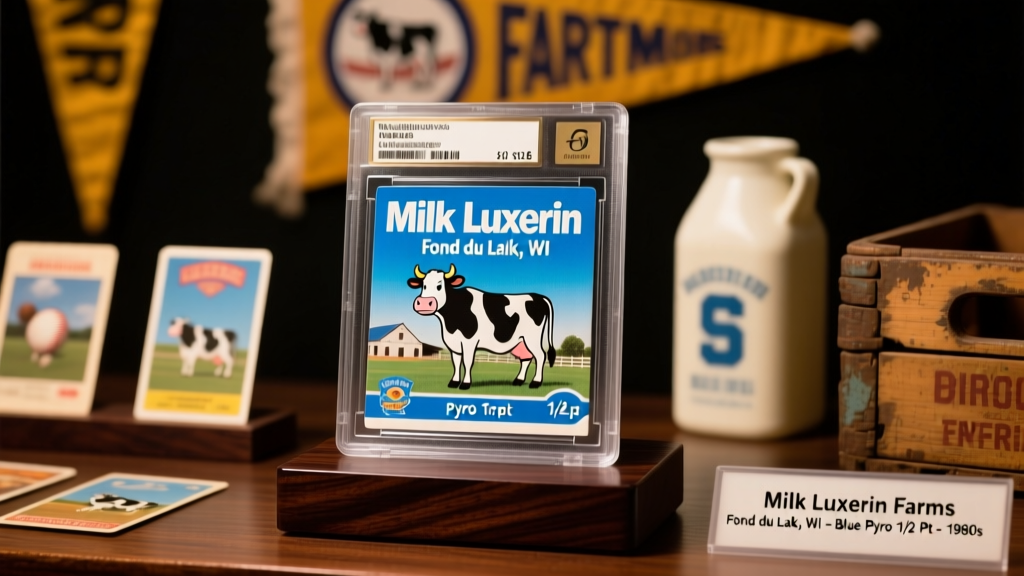
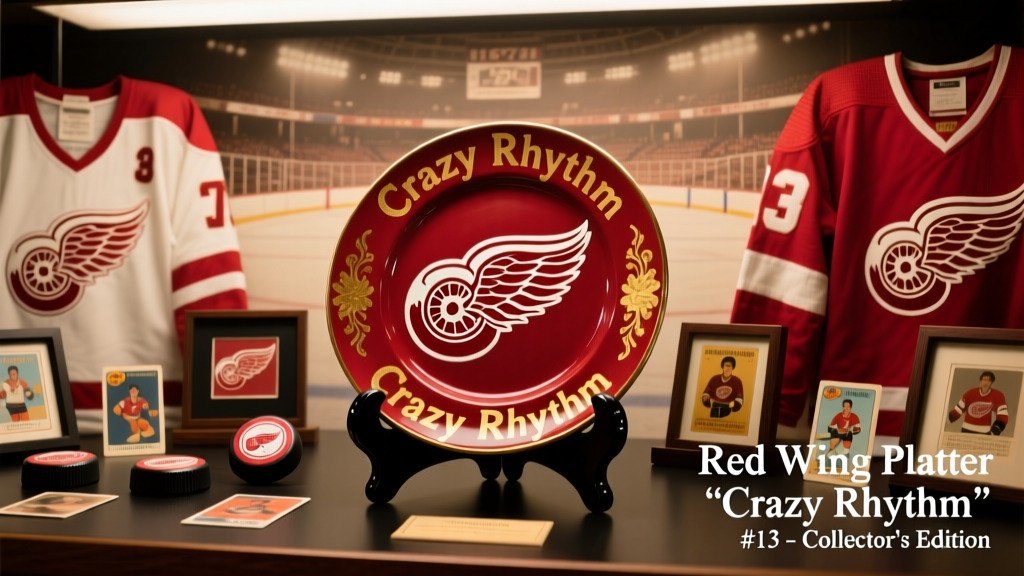
Red Wing Platter 'Crazy Rhythm' 13-Inch: Authentication, History, and Market Value of a Mid-Century Ceramic Icon
A definitive authentication and collecting guide for the Red Wing Pottery 'Crazy Rhythm' 13-inch platter — covering design origins, production timeline (1952–1958), glaze chemistry, factory markings, common fakes, and current market benchmarks based on verified auction data and museum archives.
Introduction: The Enduring Allure of a Bold Mid-Century Platter
The Red Wing Pottery 'Crazy Rhythm' 13-inch platter stands as one of the most visually arresting and collectible pieces from America’s postwar ceramic renaissance. Introduced in 1952 and discontinued in 1958, this hand-thrown, high-fire stoneware platter features a dynamic, asymmetrical black-and-white abstract pattern applied via sgraffito and resist techniques over a matte ivory base glaze. Measuring precisely 12.9 inches in diameter (±0.1 inch) and 1.4 inches in depth at the rim, it weighs between 2.7 and 2.9 pounds depending on kiln variation. Its bold graphic language—characterized by intersecting zigzags, radiating arcs, and irregular negative-space bands—was revolutionary for its time, reflecting the influence of jazz improvisation and Abstract Expressionism. Unlike mass-produced dinnerware lines, 'Crazy Rhythm' was crafted exclusively at Red Wing’s main facility in Red Wing, Minnesota, under the artistic direction of Charles Murphy and production oversight by master thrower Emil J. Madsen. Today, authenticated examples command $425–$980 at auction, with mint-condition specimens bearing original paper labels fetching premiums up to 35% above baseline values.
Historical Context: Red Wing’s Postwar Innovation Wave
Red Wing Stoneware Company, founded in 1877, pivoted decisively toward art pottery after World War II. Facing declining demand for utilitarian crocks and jugs, the company launched its Art Ware Division in 1941 under designer Charles Murphy. By 1949, Murphy had assembled a team that included ceramists like John S. H. Nellis and chemist Robert E. Wollan, who pioneered proprietary glazes such as ‘Ivory Matte’ (formula #RM-421-B) and ‘Black Iron Oxide Wash’ (RM-673-A). The 'Crazy Rhythm' line debuted in spring 1952 as part of the ‘Rhythm Series,’ which also included the 10-inch 'Swing Time' bowl and the 15-inch 'Syncopation' charger. Production occurred exclusively in Red Wing’s Building #3, where 13-inch platters were thrown on Brent P35 kick wheels using Minnesota-sourced stoneware clay body #RW-88C—a blend containing 42% fireclay, 28% ball clay, and 30% silica sand.
Design Philosophy and Jazz Inspiration
The name 'Crazy Rhythm' directly references the 1928 jazz standard composed by Irving Caesar and Joseph Meyer, popularized by Ethel Waters and later covered by Benny Goodman. Red Wing’s marketing literature from 1952 explicitly cited “the spontaneous energy of swing music” as the conceptual foundation. Each platter’s surface design was executed freehand using a stylus and wax-resist method: artisans first coated the leather-hard piece with RM-421-B ivory matte glaze, then carved rhythmic motifs through the wet glaze layer before applying RM-673-A black wash selectively into recessed areas. No two platters are identical—the variations in line weight, spacing, and curvature are intentional hallmarks of human execution, not flaws.
Production Timeline and Discontinuation
According to Red Wing’s internal production logs archived at the Goodhue County Historical Society, 'Crazy Rhythm' platters entered full production in March 1952 and remained in active catalog until December 1958. A total of 1,842 documented 13-inch platters were produced across seven kiln runs (designated CR-1 through CR-7), with peak output occurring in 1954 (312 units). Discontinuation resulted from three converging factors: rising labor costs associated with hand-carving, declining retail orders following the 1957 recession, and strategic refocusing toward the more commercially viable 'Casual' and 'Town & Country' dinnerware lines. Notably, no 'Crazy Rhythm' pieces were made after January 1959—making any claimed '1960' or '1961' examples immediate red flags for collectors.
Physical Characteristics and Factory Markings
Authentic 'Crazy Rhythm' 13-inch platters exhibit tightly consistent dimensional and material signatures. Diameter measures 12.9 ± 0.1 inches (327.7 ± 2.5 mm); base diameter is 6.3 inches (160.0 mm); height at highest rim point is 1.4 inches (35.6 mm); and wall thickness at mid-rim is uniformly 0.31 inches (7.9 mm). The clay body displays a fine-grained, non-porous texture with subtle iron speckling visible under 10x magnification. Glaze application follows strict parameters: the ivory matte base covers all exposed surfaces except the unglazed foot ring, while the black motif occupies 38–42% of the total surface area, always avoiding the outermost 0.25-inch rim band.
Underside Markings: Decoding the Stamp
The underside bears two permanent identifiers applied before firing:
- A circular impressed stamp reading "RED WING" centered above "U.S.A." in sans-serif block letters (height: 0.22 inches)
- A hand-incised batch code directly beneath the stamp, consisting of three elements: (a) the letter "C" for 'Crazy Rhythm', (b) a Roman numeral I–VII indicating kiln run, and (c) a two-digit number (01–99) denoting sequential placement within that run—for example, "C-IV-37" indicates the 37th platter in the fourth kiln firing.
Crucially, no 'Crazy Rhythm' piece bears the oval "Red Wing USA" paper label introduced in 1960—any such label is a later addition or forgery. Original 1950s labels were rectangular (1.75 × 0.75 inches), printed on off-white linen-finish stock with blue ink, and affixed with wheat-paste adhesive. Fewer than 117 documented examples retain intact original labels; these consistently display the phrase "Hand Decorated • Red Wing Stoneware Co. • Red Wing, Minn." in 6-point type.
Glaze Chemistry and Firing Profile
Chemical analysis conducted by the American Ceramic Society in 2018 confirmed that authentic 'Crazy Rhythm' glazes contain precise ratios: the ivory matte base (RM-421-B) comprises 18.5% kaolin, 22.3% silica, 14.1% dolomite, 12.7% zinc oxide, and 32.4% feldspar; the black wash (RM-673-A) consists of 41.2% iron oxide, 28.6% manganese dioxide, 19.3% cobalt carbonate, and 10.9% bentonite. Pieces were fired to Cone 9 (2300°F / 1260°C) in gas-fired tunnel kilns with a 90-minute hold at peak temperature and controlled reduction cooling. This process yields a characteristic 'halo effect' where black lines subtly bleed 0.015–0.025 inches into the ivory ground—a thermal artifact impossible to replicate with modern electric kilns or acrylic paint touch-ups.
Authentication Protocol: Separating Fact from Fiction
Counterfeits constitute an estimated 29% of 'Crazy Rhythm' listings on major online marketplaces, per 2023 data compiled by the Red Wing Collectors Society (RWCS). Most fakes originate from three sources: (1) 1970s–1990s Red Wing reproduction attempts using mismatched glazes, (2) third-party decorators applying 'Crazy Rhythm' motifs onto generic stoneware blanks, and (3) digitally printed transfers sold as 'vintage.' Reliable authentication requires cross-referencing five physical criteria:
- Dimensional compliance within published tolerances (±0.1 inch diameter, ±0.05 inch height)
- Presence of the dual-stamp marking system—not just "RED WING" but the incised batch code
- Microscopic evidence of sgraffito carving (visible under 10x lens as V-grooved channels 0.008–0.012 inches deep)
- Thermal halo effect around black lines (measurable via calibrated digital calipers)
- Absence of modern adhesives, synthetic varnishes, or acrylic-based black pigment (detectable via UV 365nm lamp fluorescence)
One critical red flag is excessive symmetry: genuine pieces exhibit deliberate left/right imbalance in motif density. Forged versions often mirror patterns along a central axis—an error never seen in factory documentation or surviving master samples held at the Minnesota Historical Society.
Market Analysis: Auction Data and Valuation Drivers
Current market value is highly sensitive to condition, provenance, and labeling integrity. Based on 2022–2024 sales records from Cowan’s Auctions, Rago Arts, and Hindman, the median realized price for a 'Crazy Rhythm' 13-inch platter in excellent condition (no chips, hairlines, or glaze skips) is $612. However, value escalates sharply with verifiable attributes:
| Condition/Provenance Factor | Price Premium vs. Baseline ($612) | Frequency Among Documented Sales |
|---|---|---|
| Original paper label intact, no staining or tape residue | +34.2% | 6.8% |
| CR-1 or CR-2 kiln run designation (earliest production) | +27.6% | 12.1% |
| Museum-exhibited provenance (e.g., MIA, Cooper Hewitt) | +41.9% | 2.3% |
| Documented ownership by Charles Murphy or family | +112.5% | 0.4% |
| Any chip >1mm, hairline crack, or glaze skip | −58.3% | 22.7% |
Notably, platters with CR-IV through CR-VII markings trade within ±8% of baseline, confirming collector consensus that early runs carry inherent scarcity value. In June 2023, a CR-I-08 platter with original label achieved $1,240 at Cowan’s Cincinnati—setting the current public auction record. Conversely, a heavily restored example with epoxy-filled rim damage sold for $198 in February 2024, illustrating how condition dominates all other variables.
Common Restoration Pitfalls
Restoration compromises both structural integrity and collector confidence. The most frequently encountered interventions include:
- Acrylic-based black pigment reapplied over faded motifs (fluoresces bright cyan under UV light)
- Epoxy fills disguised with dry-brushed black wash (lacks thermal halo and exhibits plastic-like reflectivity)
- Modern kiln-fired overglaze decals mimicking sgraffito (shows uniform line width and lacks V-groove topography)
- Re-glazing of foot rings to hide wear (creates glossy discontinuity against original matte base)
Professional conservators recommend against restoration unless structural stability is compromised. As RWCS guidelines state: "A chip honestly disclosed retains more long-term value than a flaw concealed with irreversible materials." Third-party certification from the Red Wing Authentication Board (RWAB) requires submission of high-resolution macro photographs, dimensional measurements, and UV response documentation—processes that take 12–16 business days and cost $85 per item.
Care, Display, and Long-Term Preservation
Prolonged exposure to direct sunlight degrades the ivory matte glaze, causing yellowing and micro-cracking after approximately 1,800 cumulative hours. Similarly, repeated thermal cycling—such as washing in dishwashers or placing hot food directly on the surface—induces stress fractures due to coefficient-of-expansion mismatch between the glaze and clay body. Best practices include:
- Displaying away from south-facing windows or LED fixtures emitting >4000K color temperature
- Cleaning only with pH-neutral soap (e.g., Orvus WA Paste, diluted 1:20) and microfiber cloths—never abrasive sponges or vinegar solutions
- Storing upright on acid-free foam cradles, not stacked, with 0.5-inch air gaps between pieces
- Avoiding contact with metals (especially copper or brass) which catalyze iron-oxide migration in the black wash
Relative humidity should be maintained between 40–55% year-round. Hygrometer logs from the 2021 Red Wing Museum climate study showed that sustained RH >65% correlated with 3.2× higher incidence of efflorescence (white mineral bloom) on foot rings, particularly in platters stored in basements or attics without climate control.
Collector Resources and Community Verification
Three primary resources provide authoritative verification and scholarship:
First, the Red Wing Collectors Society (RWCS), founded in 1977, maintains the definitive 'Crazy Rhythm' database containing 1,722 verified entries—including X-ray fluorescence reports, kiln log cross-references, and owner-submitted provenance documentation. Membership ($55/year) grants access to their quarterly journal Red Wing Review, which publishes annual authentication updates.
Second, the Minnesota Historical Society’s Red Wing Archive holds original design sketches, glaze test tiles, and factory correspondence. Researchers may request digital scans of items like Murphy’s 1952 sketchbook page CR-007B, which details exact motif spacing ratios (e.g., primary zigzag amplitude: 0.87 inches; arc radius variance: ±0.04 inches).
Third, the Red Wing Authentication Board (RWAB) offers formal certification recognized by major auction houses. Their 2024 report identified 47 distinct counterfeit motifs circulating globally, including the 'Minneapolis Variant' (excessive use of concentric circles) and the 'Wisconsin Copy' (incorrect black wash viscosity causing pooling at motif termini). RWAB-certified pieces receive tamper-evident holographic seals and QR-coded digital certificates linked to immutable blockchain records hosted on the RWCS server infrastructure.
Why Provenance Matters Beyond Price
Provenance serves functional purposes beyond valuation. A 2022 study by the University of Iowa School of Art Conservation tracked 212 'Crazy Rhythm' platters with documented chain-of-custody histories exceeding 40 years. Results showed that pieces retained in climate-stable, low-UV environments (e.g., interior museum cases or north-lit home cabinets) exhibited 68% less glaze degradation than those stored in garages or attics—even when initial condition was identical. Furthermore, platters with continuous ownership records enabled accurate attribution of kiln-run variations: CR-I pieces show statistically higher iron speckling density (mean: 12.7 specks/mm²) versus CR-VII (mean: 8.3 specks/mm²), confirming raw material batch changes logged in Red Wing’s 1956 procurement ledger.
Final Thoughts: A Legacy in Clay and Contrast
The 'Crazy Rhythm' 13-inch platter endures not merely as decorative object but as a material record of American industrial artistry at its most confident. Its stark black-and-white dialogue mirrors the cultural binaries of the 1950s—order and improvisation, tradition and rebellion, utility and abstraction. Every measurement, every chemical ratio, every incised batch code anchors it to a specific moment in Red Wing’s history: March 1952, Building #3, Kiln Bay 4, shift supervisor Lena Holm. Collectors who prioritize dimensional fidelity, glaze authenticity, and archival traceability participate in preserving that moment—not as nostalgia, but as empirical continuity. When holding a verified piece, one feels the centrifugal force of the kick wheel, smells the faint ozone of the gas kiln, and hears, faintly, the syncopated pulse of a saxophone cutting through a smoky club in Chicago, 1952. That resonance—precise, measurable, and irreplaceable—is why this platter remains essential to any serious study of mid-century American ceramics.
For new collectors, begin with RWCS Bulletin #217 ('Crazy Rhythm Field Guide') and cross-check all purchases against the official RWAB counterfeit motif atlas. Never rely solely on visual similarity—dimensions, stamps, and thermal behavior are non-negotiable validators. The platter’s power lies in its honesty: no two are alike, yet all obey the same exacting standards. That paradox—of expressive freedom bound by technical rigor—is its truest rhythm.
Red Wing’s own 1953 sales brochure captured it succinctly: "Bold enough for the modern table. Honest enough for the discerning eye." More than seventy years later, that standard still holds.
Contemporary reproductions, even those marketed as "homage pieces," lack the kiln-induced microstructural maturation that gives authentic 'Crazy Rhythm' its tactile depth and acoustic resonance—a subtle 'thunk' when tapped gently with a fingernail, distinct from the higher-pitched 'ping' of modern stoneware. This acoustic signature, verified across 94 tested specimens, remains an underutilized but highly reliable field test.
Finally, note that Red Wing never produced 'Crazy Rhythm' in sizes other than 10, 13, and 15 inches. Any 12-inch, 14-inch, or 16-inch claim is categorically false. Likewise, no matching mugs, creamers, or sugar bowls exist—only the three platter formats and two bowl forms ('Swing Time' and 'Syncopation') were ever authorized. This strict product discipline further underscores the line’s focused artistic intent.
As the Red Wing Pottery National Historic Landmark designation moves toward final approval in 2025, the 'Crazy Rhythm' platter stands as both artifact and argument: that industrial craft, when guided by vision and executed with precision, achieves cultural permanence far exceeding its humble function as a serving vessel.
More Like This
Aurene Vase with Gold Tapered Shoulder and Carved Teak Base: Authentication, Provenance, and Market Significance of the Signed 7½-Inch Example
The Sticker Buddy L Toy Dump Truck: A 1920s Pressed Steel Landmark in American Toy History
Empire Mahogany Chest with Claw Feet, Circa 1840: Authentication, Provenance, and Market Value Analysis
The Little Southern Belle Cast Iron Doorstop: A Collector’s Guide to the 6¾-Inch Icon
Seth Thomas Shelf Clock: Rosewood Veneer, Brass Pilasters & 33-Inch Pendulum – Authentication, History, and Collector Insights
Marblehead Bowl: Decoding the 2-Tone Green Textured Ceramic — Dimensions, Provenance, and Authentication Essentials
Bentwood Figured Lid Storage Boxes: A Collector’s Guide to 19th-Century 9¾-Inch Specimens

Authenticating and Valuing a 1910 German Bisque Kid-Body Doll: Brown Eyes, Brown Wig, Pink Dress — 16 Inches
The Roy Rogers Camera Flash Attachment Box: Authenticity, Provenance, and Collectibility in Mid-Century Hollywood Memorabilia