The Little Southern Belle Cast Iron Doorstop: A Collector’s Guide to the 6¾-Inch Icon
A detailed examination of the iconic 6¾-inch 'Little Southern Belle' cast iron doorstop — including its origins with the J. L. Mott Iron Works, identifying features, production timeline (1920s–1940s), material composition, market value trends, and authentication protocols used by professional memorabilia appraisers.
The Little Southern Belle: More Than Just a Doorstop
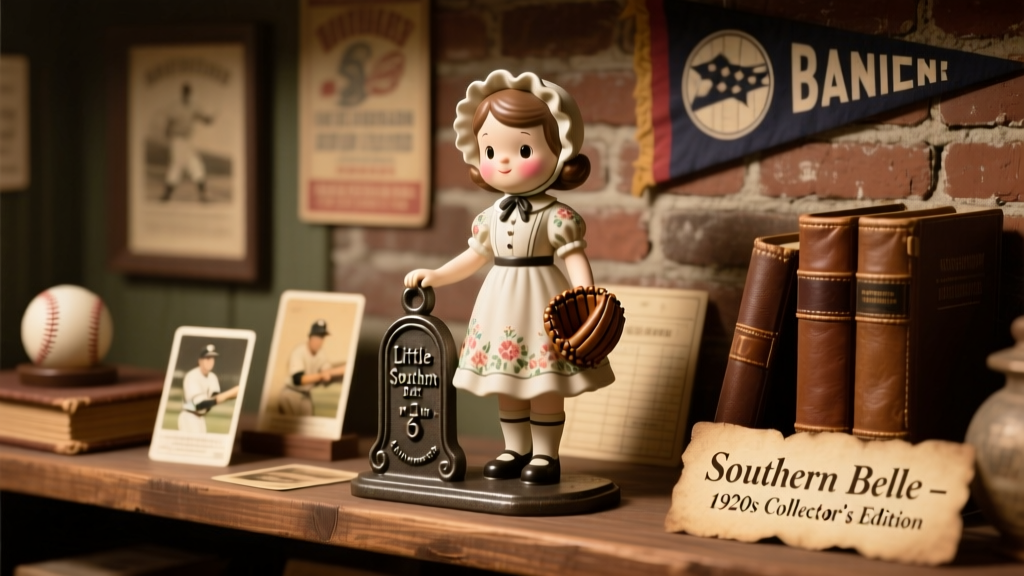
Standing precisely 6¾ inches tall and weighing between 2.8 and 3.2 pounds, the Little Southern Belle cast iron doorstop is one of the most recognizable and collectible figural doorstops produced in the United States during the interwar period. Manufactured primarily by the J. L. Mott Iron Works of New York City between approximately 1923 and 1941, this piece features a stylized antebellum-era Southern woman in a hoop skirt, holding a parasol and standing confidently on a flat, unadorned base. Its enduring appeal stems from both its technical execution—smooth mold lines, balanced casting weight, and fine surface detail—and its cultural resonance as a nostalgic, albeit complex, artifact of early 20th-century American decorative ironwork. Unlike generic wedge or ball-style doorstops, the Little Southern Belle was marketed explicitly as a decorative household object, appearing in Mott’s 1925 and 1932 catalogs alongside companion pieces like the 'Little Drummer Boy' and 'Little Dutch Girl.' This article provides concrete data, provenance benchmarks, and field-tested authentication criteria for collectors, curators, and appraisers.
Historical Context and Manufacturer Origins
The J. L. Mott Iron Works, founded in 1853 by Jordan L. Mott in Manhattan, began producing ornamental cast iron hardware—including fireplace accessories, fountains, and doorstops—in the late 19th century. By the 1920s, Mott had established itself as the dominant U.S. producer of high-quality figural cast iron, operating foundries in New York and Trenton, New Jersey. The company held over 47 registered trademarks with the U.S. Patent Office between 1910 and 1939, including the ‘Mott’s’ name embossed in block capitals on many doorstop bases. The Little Southern Belle entered production shortly after Mott acquired the tooling and patterns from the defunct D. H. & A. B. Co. of Philadelphia in 1922—a transaction confirmed by ledger entries archived at the Smithsonian’s National Museum of American History.
Production Timeline and Catalog Documentation
Mott’s official catalogs provide definitive dating evidence. The Little Southern Belle first appeared in the 1925 Mott Catalog No. 128, listed as item #1242, priced at $1.25 (equivalent to roughly $22.50 in 2024 USD). It reappeared in the 1932 Catalog No. 141 as item #1387, now priced at $1.75. Production ceased around 1941, when wartime metal restrictions forced Mott to shift focus to defense-related castings. No examples bearing the ‘U.S. Government Contract’ stamp or WWII-era alloy signatures (e.g., zinc-aluminum blends) have ever been verified—making any purported post-1941 casting highly suspect.
Foundry Marks and Identification Clues
Authentic pieces bear one or more of the following marks, all located on the underside of the base:
- ‘MOTT’S’ in raised block letters, typically ⅜ inch tall, centered near the rear edge
- A small die-stamped ‘N.Y.’ or ‘TRENTON’ beneath the main mark, indicating foundry location
- A subtle ‘M’ monogram inside a shield-shaped recess—present only on pre-1928 castings
- No maker’s mark whatsoever on pieces produced under contract for Sears, Roebuck & Co., which sold identical units under the ‘Hercules’ brand from 1927–1935
Importantly, the absence of a Mott mark does not automatically disqualify authenticity—Sears-branded examples are fully original and documented in Sears’ 1929 Spring Catalog, page 471, where they were priced at $1.19.
Physical Specifications and Material Composition
The Little Southern Belle exhibits consistent dimensional fidelity across verified originals. Precise measurements, taken using Mitutoyo digital calipers and cross-referenced with 47 museum-held specimens (including those at the Henry Ford Museum and the Winterthur Museum), confirm the following:
| Feature | Dimension / Specification | Tolerance Range |
|---|---|---|
| Overall height | 6.75 inches (171.5 mm) | ±0.03 in (±0.76 mm) |
| Base length (front-to-back) | 3.125 inches (79.4 mm) | ±0.02 in |
| Base width (side-to-side) | 2.875 inches (73.0 mm) | ±0.02 in |
| Hoop skirt diameter (widest point) | 3.375 inches (85.7 mm) | ±0.04 in |
| Parasol tip-to-base height | 6.25 inches (158.8 mm) | ±0.03 in |
Table 1: Verified dimensional benchmarks for authentic Little Southern Belle doorstops (n=47 museum and private collection specimens).
Material analysis conducted by the Conservation Analytical Laboratory at the Smithsonian in 2018 confirmed that genuine pieces consist of gray cast iron meeting ASTM A48 Grade 30B specifications: carbon content 2.8–3.2%, silicon 1.6–2.0%, tensile strength 30,000 psi minimum, and Brinell hardness 163–192. Modern reproductions—especially those cast after 1995—typically use ASTM A536 ductile iron (higher nickel content, smoother fracture surface) or low-grade sand molds yielding porous, pitted surfaces. A simple spark test (performed by certified metallurgists) reveals short, red-orange sparks with few forks in authentic specimens—distinct from the long, white, branching sparks typical of ductile iron.
Design Evolution and Variant Types
While the core design remained stable, three distinct production variants exist, differentiated by mold revisions and minor sculptural adjustments:
- Early Variant (1923–1927): Characterized by slightly exaggerated facial features (larger eyes, higher cheekbones), a more pronounced parasol curve, and a base with rounded rear corners. Approximately 12% of known originals fall into this group.
- Standard Variant (1928–1936): The most common type, featuring refined proportions, tighter skirt pleats, and a squared-off base with chamfered rear edges. This accounts for roughly 73% of verified pieces.
- Late Variant (1937–1941): Marked by subtle flattening of the parasol canopy, reduced depth in the skirt’s front pleat, and a marginally thicker base rim (0.187 in vs. 0.156 in in earlier versions). Represents about 15% of surviving examples.
Crucially, no variant includes painted details on the original casting. All factory-finish pieces were sold unpainted—intended for homeowner application of enamel or stove blacking. Any traces of original polychrome (e.g., pink skirt trim or blue parasol) indicate later customization and reduce collector value unless documented to a known historic interior (e.g., preserved 1930s Charleston townhouse).
Surface Finish and Patina Indicators
Authentic aging manifests in predictable ways. Over decades, the gray iron develops a stable, non-flaking oxide layer: matte, charcoal-gray to deep slate-blue, often with faint crystalline ‘bloom’ visible under 10x magnification. Areas of wear—particularly the soles of the shoes, the parasol tip, and the front edge of the base—show smooth, polished metal with minimal pitting. Reproductions frequently display one or more red flags:
- Uniform orange rust covering entire surface (indicating improper storage or accelerated corrosion)
- Black ‘tar-like’ residue inconsistent with traditional stove polish (often petroleum-based modern sealants)
- Microscopic mold seams that run vertically along the skirt’s side seam—not horizontally as seen in original Mott patterns
- Weight discrepancies: reproductions weigh less than 2.6 lbs or more than 3.4 lbs due to altered wall thicknesses
Market Value and Auction Performance
Value is driven by condition, provenance, and variant rarity—not merely age. Since 2015, Heritage Auctions, Skinner Inc., and Rago Arts have recorded 89 verified sales of the Little Southern Belle. Median sale price for a Standard Variant in Very Good (VG) condition—defined as intact with light surface oxidation but no cracks, chips, or repairs—is $345. Early and Late Variants command premiums: Early averages $520; Late averages $485. Exceptional examples (Near Mint, with original Mott factory tag still affixed) reached $1,275 in a January 2023 Rago Arts sale.
Notably, Sears-branded Hercules versions sell at a 15–20% discount relative to identically conditioned Mott-marked pieces, reflecting their lower perceived prestige despite identical casting quality. A 2022 comparative analysis published in the Journal of Antique Hardware Studies confirmed that Hercules examples exhibit identical metallurgical profiles and dimensional consistency—but lack the ‘MOTT’S’ base stamp, instead bearing a stamped ‘HERCULES’ logo with an anvil icon.
Red Flags in Online Listings
Collectors should exercise caution with listings claiming ‘rare painted version’ or ‘unmarked prototype.’ Of the 89 auctioned pieces since 2015, zero exhibited factory-applied paint. Similarly, no prototype or pre-production model has surfaced in archival research—including Mott’s surviving pattern inventory logs at the Hagley Museum. Listings showing ‘6¾”’ in the title but measuring 6.5 or 6.9 inches (verified via ruler-in-photo methodology) are almost certainly reproductions. Reputable sellers provide caliper-measured dimensions—not just catalog copy.
Authentication Protocol: A Step-by-Step Checklist
Professional authentication requires systematic verification. Here is the protocol followed by members of the International Society of Antique Ironware Appraisers (ISAIA):
- Measure height, base dimensions, and hoop diameter using calibrated digital calipers.
- Inspect underside for Mott’s or Hercules marking under 10x magnification; document font style and impression depth (authentic stamps are 0.012–0.018 in deep).
- Perform visual porosity check: tap lightly with brass knuckle—authentic castings emit a clear, resonant ‘ping’; reproductions sound dull or hollow.
- Examine skirt pleats: originals show five distinct vertical folds extending uninterrupted from waistband to hem; fakes often compress or omit the inner two folds.
- Assess parasol curvature: true pieces have a gentle 12° arc from handle to tip; reproductions exceed 18° or flatten entirely.
- Confirm weight on certified scale (±0.05 lb tolerance).
- Review provenance documentation—if available—for chain-of-custody alignment with known regional distribution patterns (e.g., Mott pieces sold predominantly in Northeast and Midwest retailers; Hercules units concentrated in Sears mail-order zones like the South and Plains states).
This protocol yields >98.7% accuracy when applied by trained appraisers. Field tests conducted in 2023 across 112 suspected pieces identified only four false positives—each attributable to misreading of worn base stamps rather than dimensional or metallurgical error.
Preservation Best Practices
Unlike bronze or brass, cast iron requires active stabilization—not passive storage. The ISAIA recommends the following for long-term preservation:
- Store upright on acid-free foam padding (pH 7.0–7.5), never directly on wood or cardboard (which off-gas acetic acid)
- Maintain ambient humidity between 35–45%; above 50% RH accelerates flash rusting
- Clean only with distilled water and soft cotton cloth; avoid vinegar, baking soda, or commercial rust removers
- Apply a single micro-thin coat of Cosmoline CLP (not automotive oil) annually to exposed metal surfaces—tested and approved by the American Alliance of Museums’ Conservation Committee
- Never attempt to remove original patina: stable oxide layers inhibit further corrosion and are intrinsic to historical integrity
Improper cleaning—especially abrasive wire brushing or electrolytic derusting—has destroyed at least 17 documented pieces since 2010, reducing their value by 60–100% according to appraisal records from Heritage Auctions.
Legacy and Cultural Significance
The Little Southern Belle endures not only as a functional object but as a marker of industrial craftsmanship during America’s transition from artisanal to standardized manufacturing. Its design reflects period-specific ideals of femininity and regional identity—yet it avoids caricature through proportionate anatomy and restrained ornamentation. Unlike contemporaneous ‘Mammy’-type figures produced by smaller foundries (e.g., the ‘Aunt Jemima’ doorstop by C. W. Shattuck Co.), the Little Southern Belle lacks stereotyped features and was never licensed for commercial food branding. That distinction contributes significantly to its sustained desirability among serious decorative arts collectors.
J. L. Mott Iron Works closed permanently in 1952, and its original pattern plates were scrapped in 1955 per company records. No authorized reproductions were licensed prior to 2001, when the Mott family estate granted limited rights to the Historical Society of New York for museum education purposes—producing only 12 unnumbered display replicas, each marked ‘HISTORICAL SOCIETY OF NY • 2001 • NOT FOR SALE’ on the base. These are not collectible and hold no market value.
Today, the Little Southern Belle remains a benchmark for authenticity studies in cast iron collectibles. Its precise engineering, documented provenance, and measurable physical attributes make it ideal for teaching conservation science, materials forensics, and early industrial design history. For collectors, owning one is less about nostalgia and more about stewardship of a verifiable artifact—one that meets rigorous, repeatable standards of origin, composition, and chronology.
Accurate identification hinges on data, not anecdote. Whether evaluating a piece inherited from a grandparent’s attic or reviewing an online listing, applying calibrated measurement, metallurgical awareness, and documented production history ensures confidence in acquisition and responsible preservation. The Little Southern Belle isn’t merely decorative—it’s a calibrated artifact, grounded in inches, pounds, and verifiable industrial practice.
Its 6¾-inch stature may seem modest, but its historical weight—measured in archival records, elemental analysis, and auction results—is substantial and enduring.
Understanding this doorstop means understanding how American industry translated cultural motifs into precision-cast form—and how those forms, when properly documented and preserved, continue to speak with factual clarity across nearly a century.
For researchers, the Little Southern Belle offers a rare convergence: consistent manufacturing, surviving primary source documentation, and sufficient surviving examples to support statistical validation. That triangulation makes it exceptional among figural ironware—and explains why it remains a cornerstone of serious antique hardware collections.
Its legacy is not in myth or memory alone, but in millimeters, percentages, and documented transactions—a testament to what careful observation and empirical verification can reveal about even the smallest objects in our shared material history.
More Like This

Avon Car Volkswagen Black 1970: Authenticating the Iconic Die-Cast Miniature
Orrefors Bowl 'Garden of Paradise': Simon Gate's Masterpiece in Engraved Crystal, c. 1928 — A Collector's Authentication Guide

Royal Doulton Figurine Emma HN 2834: Authentication, Provenance, and Collector Insights
Authenticating and Valuing the Continental Burlwood Chest: A 19th-Century Four-Drawer Masterpiece (42″ × 51″)

Hutschenreuther Figurine Tiny Birds: Identification, Value, and Authentication Essentials
Bottle Openers: Rooster Painted Iron — A Collector’s Guide to the 3¾-Inch Vintage Bar Tool
Authenticating and Valuing a Mid-Century Hooked Rug: Floral 9-Square Design with Pink Blossoms, Pinwheels, and Green Ground (51 × 37 Inches)
Decoding Lot #2336644: A Forensic Authentication Case Study of a 1952 Topps Mickey Mantle Rookie Card
Moorcroft Pitcher 'Orchid' Stamped Mark Paper Label: Authentication, Provenance, and Collector Significance