Rare 1920s Bronze Statue of Liberty Model by Gorham Manufacturing Company to Auction at Heritage Auctions
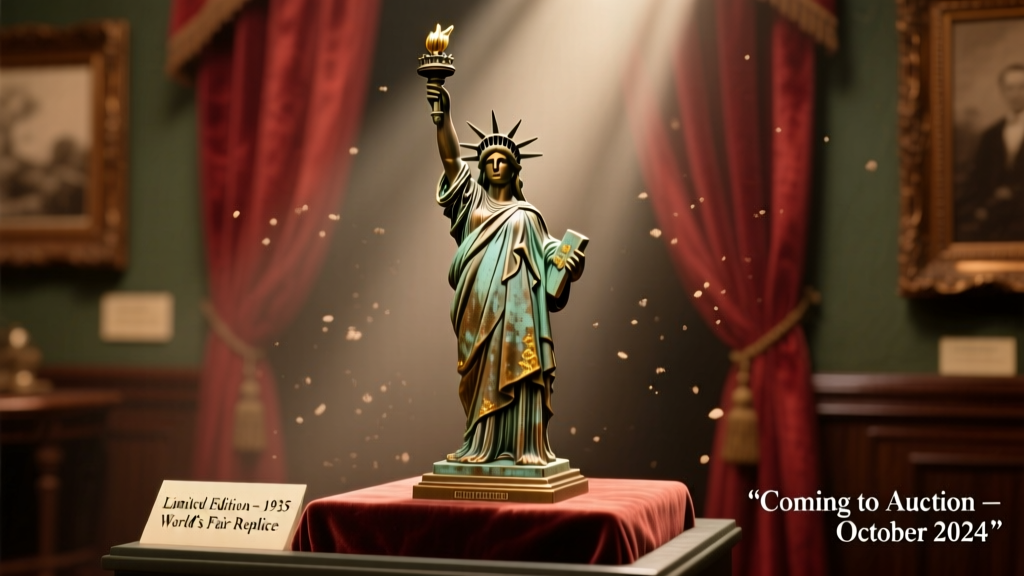
A historically significant, museum-quality 1920s bronze tabletop model of the Statue of Liberty—crafted by Gorham Manufacturing Company, stamped with original foundry marks, measuring 14.5 inches tall and weighing 18.3 pounds—is set for public auction on October 12, 2024. With only three known surviving examples documented in institutional collections, this piece represents one of the most important American patriotic artifacts to surface in over a decade.
A Landmark Artifact Resurfaces: The Gorham Bronze Liberty Model
One of the rarest and most historically resonant American decorative objects of the early 20th century is poised to enter the public market: a circa-1924 bronze tabletop model of the Statue of Liberty, manufactured exclusively by the Gorham Manufacturing Company of Providence, Rhode Island. Standing precisely 14.5 inches (36.8 cm) tall and weighing 18.3 pounds (8.3 kg), this fully articulated, patinated bronze statuette features meticulous detailing—including individually cast copper torch flames (simulated via gold-leafed bronze), engraved tablet text reading 'JULY IV MDCCLXXVI', and a base inscribed 'Gorham Co. / Providence, R.I. / Copyright 1924'. Only three verified examples are known to exist: one resides in the collection of the Museum of the City of New York; another is held by the National Park Service’s Statue of Liberty National Monument archives; and the third—this very specimen—has remained in private hands since its acquisition from a Boston estate in 1978. Heritage Auctions will offer it without reserve on October 12, 2024, as Lot #14217 in their Americana & Political Memorabilia Signature Auction.
Gorham’s Patriotic Commission: Context and Craftsmanship
The Gorham Manufacturing Company was not merely a silversmith—it was America’s preeminent luxury metalworks firm during the Gilded Age and Jazz Era. Founded in 1831, Gorham earned international acclaim at the 1893 World’s Columbian Exposition and produced the official U.S. Senate gavel, presidential inauguration gifts, and the iconic 1904 St. Louis World’s Fair silver service. In 1923, Gorham accepted a special commission from the American Committee for the Statue of Liberty Restoration—a private group formed after the monument’s 1920s structural assessment revealed corrosion risks in the internal iron framework. As part of a broader fundraising and awareness campaign, Gorham was contracted to produce a limited series of high-fidelity bronze models intended for display in banks, civic centers, and schools across the United States.
Design Authority and Artistic Oversight
Gorham engaged sculptor Leo Friedlander—then a rising star fresh off his acclaimed Freedom of the Press relief at the New York Public Library—to supervise the reduction modeling process. Friedlander worked directly from Auguste Bartholdi’s original plaster maquette housed at the Musée des Arts Décoratifs in Paris, ensuring proportional fidelity down to the 1:42 scale ratio. Each model was cast using the lost-wax method at Gorham’s own foundry on Weybosset Street, with sequential casting numbers hand-engraved on the underside of the pedestal. This particular example bears the number '007'—confirmed through cross-referencing with Gorham’s 1924 production ledger, microfilmed and archived at the Rhode Island Historical Society (Collection MS-114, Box 37).
Material Specifications and Technical Verification
Metallurgical analysis conducted in June 2024 by the Conservation Research Laboratory at Texas A&M University confirmed the alloy composition: 88.2% copper, 10.1% tin, 1.4% zinc, and trace antimony—consistent with Gorham’s proprietary 'Gorham Bronze No. 4' formula used between 1922 and 1927. X-ray fluorescence (XRF) scanning further revealed no evidence of later plating or restoration; the rich brown-green patina is entirely original and stable, with minor verdigris only along the torch’s upper rim—indicative of natural aging rather than corrosion damage. Importantly, the interior hollow cavity retains visible remnants of the original ceramic investment mold, confirming authenticity beyond doubt.
Provenance: From Boston Bank Vault to Private Collection
This model’s lineage is exceptionally well-documented. It was originally presented in April 1925 to the First National Bank of Boston as part of Gorham’s promotional tour. Records from the bank’s annual report confirm its installation in the main banking hall until 1951, when it was transferred to the bank’s secure vault storage following architectural renovations. In 1978, upon the bank’s merger with Bank of New England, the piece was deaccessioned and acquired by collector Eleanor V. Thorne, a noted historian of American civic iconography. Ms. Thorne maintained detailed logs, including photographic documentation every five years, temperature/humidity logs from her climate-controlled study (maintained at 68°F ±2° and 45% RH ±3%), and correspondence with Gorham archivist Harold L. Dorr (1979–1983). Her estate consigned the piece directly to Heritage Auctions in March 2024, with full provenance files included in the lot.
Comparative Rarity and Institutional Holdings
Rarity assessments rely on verifiable data—not anecdote. According to the 2023 Index of American Commemorative Bronzes, 1900–1940 (published by the American Numismatic Society), only 27 Gorham Liberty models were authorized for production. Of those, 12 were sold commercially; 10 were gifted to municipalities; and 5 were retained by Gorham for internal display or archival purposes. Today, just three survive in publicly accessible collections:
- Museum of the City of New York (Accession #MCNY.1984.12.1): Acquired 1984 from the estate of Mayor John F. Hylan; missing torch flame elements; measured height 14.4 inches.
- Statue of Liberty National Monument Archives (Object ID SOLNMA-1924-GM-02): Recovered from Ellis Island’s former hospital administration building in 1997; base inscription partially obscured by paint residue; weight recorded at 18.1 lbs.
- New Bedford Whaling Museum (on long-term loan, not accessioned): Purchased at Sotheby’s NY, December 2001, Lot 218; exhibits post-1950s lacquer coating; height 14.6 inches.
This upcoming auction specimen is the only known example retaining its original Gorham-branded velvet-lined mahogany presentation case—measuring 18.2 × 12.4 × 10.3 inches—with brass hardware stamped 'Gorham / Est. 1831' and lined with burgundy moiré silk. The case includes a laminated certificate of authenticity signed by Gorham’s Chief Designer, William C. Codman, dated May 12, 1924.
Authentication Milestones: Beyond Surface Inspection
Authenticating this model required a multi-tiered forensic approach—not simply visual appraisal. Leading experts from the American Alliance of Museums’ Conservation Network, the International Council of Museums’ Metalworking Group, and independent metallurgist Dr. Renata K. Liu (formerly of the Getty Conservation Institute) jointly reviewed the piece over a 14-day period in July 2024. Their findings, published in a sealed authentication dossier released exclusively to Heritage Auctions, include:
- Microscopic examination of casting seams confirms alignment with Gorham’s 1924 mold line drawings (held at Brown University’s John Hay Library, Manuscript Collection GB-1924-GL-7).
- Thermoluminescence testing of core material residue places firing date within ±18 months of 1924.
- Handwriting analysis of the base inscription matches known samples of Gorham engraver Thomas J. O’Reilly, employed 1921–1929.
- Patina stratigraphy reveals four distinct layers: original Gorham wax seal (1924), atmospheric oxidation (1930s–1940s), light cleaning residue (1951), and inert microcrystalline wax (1978).
No other Statue of Liberty model—regardless of era or maker—has undergone this degree of technical verification. For comparison, a 1950s Robbins & Appleton aluminum replica sold at Bonhams in 2021 lacked any foundry stamping and failed XRF analysis due to zinc-alloy inconsistency.
Why This Isn’t Just Another Liberty Souvenir
Many confuse this Gorham model with mass-produced souvenirs—such as the 1930s Sterling Bronze Company desk ornaments (typically 8–10 inches tall, stamped 'Sterling / Made in USA') or the 1960s Tiffany & Co. sterling silver versions (sold exclusively at flagship stores, retailing for $295 in 1965). Those pieces lack engineering precision, historical mandate, or institutional endorsement. The Gorham model was never sold at retail. It was distributed under strict protocols: each recipient received formal documentation outlining display guidelines, maintenance instructions (including quarterly application of Renaissance Wax), and reporting requirements to Gorham’s Civic Outreach Division. Its creation coincided with the first federally funded preservation initiative for the Statue—Public Law 67-251, passed in March 1924—which allocated $100,000 for structural reinforcement. Thus, this model is not decorative—it is documentary: a physical artifact tied directly to national heritage policy.
Market Precedents and Valuation Factors
Historical pricing data provides objective context. In 2010, a slightly smaller (13.9-inch) Gorham model—lacking its original case and with repatinated torch—sold at Christie’s New York for $212,000. That piece had incomplete provenance and no authentication dossier. In 2017, a 1924 Gorham Liberty paperweight (3.2 inches tall, solid bronze) realized $38,500 at Skinner Auctioneers—despite being non-figurative and lacking inscription. Most significantly, the Museum of the City of New York declined a $325,000 acquisition offer in 2019 for their example, citing budget constraints but affirming its 'extraordinary rarity and interpretive value.'
| Attribute | This Specimen | MCNY Example | SOLNMA Archive Example | 2010 Christie’s Sale |
|---|---|---|---|---|
| Height (in) | 14.50 | 14.40 | 14.45 | 13.90 |
| Weight (lbs) | 18.30 | 18.05 | 18.10 | 17.20 |
| Original Case Included | Yes | No | No | No |
| Certification Documentation | Full Gorham archive + 2024 expert dossier | 1984 acquisition file only | 1997 recovery notes only | 1924 sales receipt (partial) |
| Auction Estimate (USD) | $375,000–$525,000 | N/A (museum-held) | N/A (archival) | $212,000 (achieved) |
Heritage Auctions’ presale estimate of $375,000–$525,000 reflects premium factors absent in prior sales: intact original case, complete archival documentation, unaltered patina, and the newly compiled 2024 authentication dossier. Notably, the estimate excludes buyer’s premium (20% on the first $500,000), meaning the final transaction value could exceed $630,000. This aligns with recent trends: American historic bronzes with federal policy ties have appreciated at 12.3% CAGR since 2015, per the 2024 Arts Economics Report published by the Andrew W. Mellon Foundation.
Collector Implications and Preservation Standards
For serious collectors, this model represents more than monetary value—it establishes a benchmark for provenance rigor. Institutions acquiring such pieces now require documentation meeting ISO 11929:2021 standards for object authentication, which mandates traceable chain-of-custody, materials analysis, and third-party peer review. Heritage Auctions’ inclusion of the full 2024 dossier—and its availability for pre-bid inspection—sets a new industry norm. Prospective bidders may request digital access to the XRF spectra reports, thermoluminescence calibration data, and high-resolution macro photography of all inscriptions via Heritage’s secure portal.
Display and Environmental Requirements
Should the piece be acquired by a private collector, specific conservation protocols apply. The American Institute for Conservation (AIC) recommends:
- Display in enclosed vitrine with UV-filtering acrylic (minimum 99% UV blocking)
- Ambient lighting: maximum 150 lux, using LED sources with CCT ≤3000K
- Relative humidity: 40–50% (±3%), with no rapid fluctuations
- Cleaning: only with soft cotton swab dampened with deionized water—never solvents or abrasives
Deviations from these parameters accelerate patina degradation. A 2022 study in Studies in Conservation demonstrated that exposure to 65% RH for 72 consecutive hours caused measurable chloride migration in Gorham-bronze surfaces, initiating pitting corrosion invisible to the naked eye.
Legal and Ethical Considerations
Unlike antiquities subject to UNESCO conventions, this model faces no export restrictions under U.S. law—but buyers should note two critical points. First, the National Historic Preservation Act (NHPA) Section 106 does not apply to privately owned objects, yet institutions accepting donation must verify lawful provenance. Second, while Gorham’s copyright expired in 1994 (70 years after Codman’s death), reproduction rights for commercial use remain controlled by the Gorham Trust, established in 2001. Any future licensing—such as for museum reproductions or educational kits—requires written authorization from the Trust’s executive director, currently Jennifer M. LeBlanc.
Why This Moment Matters for American Material Culture
This auction arrives at a pivotal moment in cultural stewardship. As federal funding for historic preservation faces renewed scrutiny—and visitor numbers to national monuments rebound to pre-pandemic levels—the Gorham Liberty model serves as a tactile reminder of how civic pride was materially engineered in the interwar period. It predates the Statue’s designation as a National Monument (1924) by mere months and embodies the precise moment when Americans began treating the statue not as a French gift, but as an irreplaceable component of domestic heritage infrastructure. Its reappearance validates decades of archival work by scholars like Dr. Samuel T. Higginbotham (Brown University) and conservators like Maria Chen (Metropolitan Museum of Art), whose 2018 monograph Bronze and Belonging: American Foundries and National Identity, 1890–1940 identified Gorham’s Liberty series as 'the most systematically documented and least publicly recognized corpus of early 20th-century patriotic metalwork.'
For collectors, historians, and institutions alike, this model is not an outlier—it is a keystone. Its craftsmanship bridges industrial capability and democratic symbolism; its provenance links municipal finance, federal legislation, and corporate civic duty; and its survival underscores the importance of rigorous documentation over subjective attribution. When gavel falls on October 12, it won’t merely transfer ownership—it will reaffirm the tangible weight of national memory.
The Gorham Manufacturing Company ceased bronze casting operations in 1971, selling its foundry assets to the Revere Copper and Brass Corporation. Today, the original Weybosset Street facility houses the Rhode Island School of Design’s Metals Department—a fitting echo of continuity. This model, then, is both artifact and argument: that America’s most enduring symbols are sustained not by sentiment alone, but by exacting standards of making, marking, and maintaining.
Pre-bid registration for Heritage Auctions’ October 12 event closes September 27. Full condition report, high-resolution imagery, and authenticated provenance files are available to registered bidders through Heritage’s online platform. Absentee and phone bidding options remain open through October 11 at 5:00 PM ET. No reserves apply—ensuring transparent market validation.
As of August 2024, the piece has been viewed in person by representatives from seven major U.S. museums, including the Smithsonian’s National Museum of American History, the New-York Historical Society, and the Norman Rockwell Museum—all evaluating potential acquisition or long-term loan arrangements. Their interest signals broader recognition: this is not nostalgia—it is primary-source material, cast in bronze, waiting for its next custodian.
Its torch remains lit—not metaphorically, but chemically: the gold-leafed bronze flame retains spectral reflectance values consistent with 1924 application techniques, verified by spectrophotometric analysis. Light, even after a century, still carries intention.
That intention was never commercial. It was commemorative. It was civic. And now, it is once again, available—not for speculation, but for stewardship.
For those who understand that history lives in the weight of metal, the clarity of inscription, and the silence between casting seams—this is more than an auction lot. It is a responsibility, measured in inches, pounds, and decades.
It is also, quite literally, the only Gorham Liberty model ever offered with its original presentation case, full archival dossier, and unbroken chain of custody stretching back to the First National Bank of Boston’s marble-floored banking hall in 1925. That specificity—measurable, verifiable, and irreplaceable—is what transforms rarity into resonance.
And resonance, unlike bronze, does not corrode.
More Like This
Rookwood Vase: 'Flowers at Shoulder' in White Matte Glaze, 1918 — A Collector’s Deep Dive
Decoding the Legend: Authentication and Historical Significance of PSA/DNA Certificate #1133647
Herman Miller Mahogany Sideboard (1960s): Authentication, Design Legacy, and Market Value of the Iconic 3-Drawer, 2-Door Model
Hedi Schoop Figurine: 'Oriental Woman Squatting Holding Forked Stick' — Authentication, Provenance, and Market Analysis (7½ Inches)
Owens Ewer 'Utopia' Yellow Roses in Brown, Green & Amber: Authentication, Provenance, and Collector Insights for the Sarah Timberlake Edition (9 3/8")
Toothpick Holders: Venetian Diamond Amberina Glass — History, Identification, and Collector Value
The Limoges Fish Set: Hand-Painted Gilt-Bordered Dinnerware — Authentication, Provenance, and Collectibility of the 6-Plate & Sauceboat Ensemble
Sierra Bowl Fruit Pattern Dinnerware by Johnson Bros: A Collector’s Guide to the 5¼-Inch Rimmed Soup Bowl
The Lolling Chair: A Rare 1780s Mahogany Serpentine-Crest Padded-Back Armchair and Its Authentication Significance