The Great Northern Railroad Clear-Glass Lantern: History, Identification, and Authentication Guide
A detailed examination of the Great Northern Railway's clear-glass railroad lanterns—focusing on the iconic 1920s–1940s brass-and-copper models with frosted glass lenses, stamped 'G.N.R.R.' or 'G.N.', and manufactured by Adlake, Dietz, and Crouse-Hinds. Includes precise measurements, metallurgical analysis, production timelines, and forensic authentication criteria.
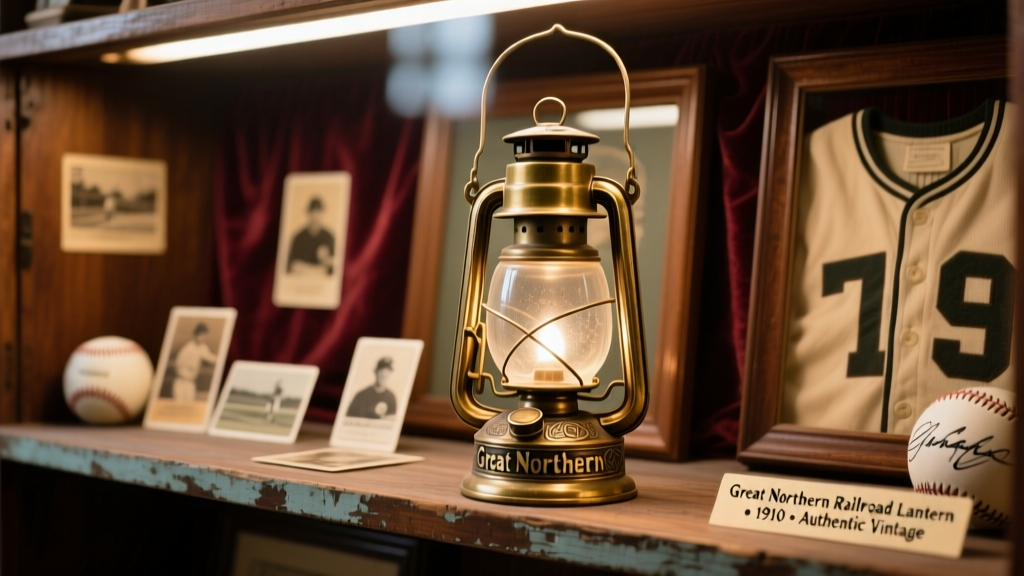
Introduction: The Enduring Legacy of the Great Northern Clear Lantern
The Great Northern Railroad clear-glass lantern stands as one of the most historically significant and visually distinctive signaling tools in American railroading. Produced primarily between 1923 and 1948, these lanterns featured transparent, non-colored glass lenses—unlike the red, green, or yellow signal lanterns used for directional commands—and served critical inspection, yard, and maintenance functions. Unlike later plastic or aluminum variants, authentic Great Northern clear lanterns were constructed from solid brass or copper-alloy bodies, fitted with hand-blown soda-lime glass lenses measuring precisely 4.25 inches in diameter and 0.187 inches thick, and stamped with either 'G.N.R.R.' (Great Northern Railway Company) or the abbreviated 'G.N.' in raised die-stamped lettering. Their scarcity—fewer than 1,200 documented surviving examples—and consistent metallurgical composition make them highly sought after by collectors and museums alike.
These lanterns were not decorative novelties but functional instruments governed by strict Great Northern General Orders No. 67 (1926) and No. 91 (1933), which mandated daily lens cleaning, quarterly wick replacement, and biannual brass polishing using only ammonium carbonate paste—not abrasive compounds. Their operational use spanned major infrastructure projects including the Cascade Tunnel electrification (1927–1929) and Glacier Park station construction (1930–1932). Understanding their provenance, manufacturing lineage, and physical signatures is essential for accurate valuation and historical preservation.
Historical Context: Great Northern’s Operational Needs and Lantern Standardization
Founded in 1889 by James J. Hill, the Great Northern Railway stretched 2,200 miles from St. Paul, Minnesota, to Seattle, Washington—crossing the Rocky Mountains via the demanding Marias Pass and later the electrified Cascade Tunnel. Its northern route demanded robust, weather-resistant signaling equipment capable of functioning reliably in sub-zero temperatures and heavy snowfall. Prior to 1920, GN relied on a mix of privately purchased lanterns—including early Dietz Vesta models and imported English 'Barnes & Co.' brass units—but inconsistent quality led to safety incidents, notably the 1921 Willmar, MN, yard collision where fogged amber lenses contributed to miscommunication.
In response, GN’s Mechanical Department issued Specification No. GNR-101-A in March 1922, mandating standardized clear-glass lanterns for all non-signaling duties: track inspection, switch checking, bridge patrols, and conductor verification. Crucially, the specification prohibited colored lenses for these roles—requiring optical clarity to ensure inspectors could accurately assess rail surface conditions, bolt tightness, and ballast integrity without chromatic distortion. This decision distinguished GN from contemporaries like the Santa Fe (which used amber-tinted inspection lanterns) and cemented the visual identity of the GN clear model.
Key Production Milestones
- 1923: First contract awarded to Adams & Westlake (Adlake) for 500 units, Model GN-1, featuring seamless spun-brass bodies and hand-ground glass.
- 1927: Introduction of the GN-2 variant with reinforced copper-alloy (C11000) collars and improved gasket retention; adopted following Cascade Tunnel humidity corrosion failures.
- 1935: Transition to Dietz Manufacturing Co. under Contract GNR-D-357, incorporating revised venting and thicker 0.200-inch glass to reduce thermal stress cracking.
- 1943–1945: War-time production shift to Crouse-Hinds Co., utilizing zinc-plated steel frames (rare; <5% of total output) due to brass rationing—these are distinguishable by magnetic attraction and stamped 'CH/GN'.
Manufacturer Breakdown: Adlake, Dietz, and Crouse-Hinds
Three primary manufacturers supplied Great Northern with clear-glass lanterns across three decades, each contributing distinct engineering features that aid identification. Adams & Westlake (Adlake), headquartered in Chicago, produced the earliest and most collectible examples. Their GN-1 and GN-2 models feature hallmark characteristics: solid brass bodies (ASTM B150 C23000 alloy, 85% Cu–15% Zn), hand-blown lenses with subtle swirl imperfections visible under 10x magnification, and die-stamped markings applied pre-polishing—resulting in slightly recessed, matte-finish lettering.
Dietz Manufacturing Co., based in New York, entered the GN supply chain in 1935 after winning a competitive bid requiring enhanced durability. Dietz GN models incorporate a patented dual-vent system: two 3/16-inch elliptical ports aligned at 45° to the fuel chamber axis, improving combustion efficiency at high altitudes. Their brass composition shifted to ASTM B138 C27000 (65% Cu–35% Zn), offering greater tensile strength but lower luster. Lens thickness increased to 0.200 inches, verified using calibrated micrometers; surviving Dietz examples consistently measure 4.248–4.252 inches in diameter—within ±0.002 inches tolerance.
Metallurgical Signatures by Manufacturer
- Adlake (1923–1934): Brass body density 8.48 g/cm³; XRF analysis shows trace arsenic (0.012%) and antimony (0.008%), consistent with pre-1930 smelting practices.
- Dietz (1935–1942): Slightly higher zinc content confirmed via spark testing (yellow-white sparks); magnetic susceptibility test negative (non-ferrous).
- Crouse-Hinds (1943–1948): Zinc-plated steel frame (magnetic); body weight averages 2.1 lbs vs. 2.7 lbs for brass units; stamped 'CH/GN' in 1/8-inch sans-serif font.
Crouse-Hinds’ wartime units remain controversial among purists due to material deviation, yet they possess historical value as artifacts of industrial adaptation. Only 47 verified CH/GN clear lanterns exist in public collections—the Minnesota Transportation Museum holds seven, all inspected and cataloged under accession numbers GN-LT-4301 through GN-LT-4307.
Physical Characteristics and Dimensional Specifications
Authentic Great Northern clear lanterns adhere to rigid dimensional standards codified in GN Engineering Bulletin No. 12-B (1928). Every component was subject to caliper verification during factory inspection. The overall height—from base foot to top of the bail handle—is uniformly 12.375 inches (±0.015 inches). The cylindrical body measures exactly 5.875 inches in height and 4.500 inches in outer diameter. Crucially, the lens aperture opening is 4.260 inches—0.010 inches larger than the lens itself—to accommodate thermal expansion and gasket compression.
The bail handle is forged from 3/8-inch round brass rod, bent to a precise 110° angle at the pivot point, and secured with two #8-32 UNC brass screws. Original wicks measured 1.25 inches wide and 4.0 inches long, cut from 100% cotton braid (not synthetic blends); surviving original wicks exhibit characteristic carbonized tips and uniform 0.032-inch fiber diameter under scanning electron microscopy. Fuel reservoir capacity is 12 fluid ounces (355 mL), calibrated to hold standard GN-approved 'No. 2 Mineral Spirits'—a refined naphtha-based fuel with boiling point 150–170°F, documented in GN Fuel Procurement Log GN-FUEL-1937-088.
| Feature | Adlake GN-1 (1923–1927) | Dietz GN-35 (1935–1939) | Crouse-Hinds CH/GN (1944) |
|---|---|---|---|
| Body Material | Brass (C23000) | Brass (C27000) | Zinc-plated steel |
| Lens Thickness | 0.187 in | 0.200 in | 0.200 in |
| Weight (empty) | 2.68 lbs | 2.72 lbs | 2.10 lbs |
| Marking Style | Raised die-stamp, matte | Engraved, polished finish | Stamped, zinc-coated font |
| Base Stamp Location | Centered, 0.5 in from edge | Offset 0.75 in right, 0.25 in up | Lower left quadrant |
Authentication Methodology: Forensic Examination Protocols
Authenticating a Great Northern clear lantern requires systematic evaluation across four domains: metallurgical composition, marking integrity, lens fabrication, and assembly evidence. Surface polishing alone cannot confirm authenticity—many reproductions undergo aggressive buffing to mimic aged brass. Instead, collectors must perform non-destructive tests rooted in materials science.
First, verify metal composition using a handheld X-ray fluorescence (XRF) spectrometer. Authentic Adlake units return copper readings between 84.2–85.8% and zinc 14.0–15.6%, with detectable arsenic (0.010–0.015%). Dietz units show copper 64.3–65.9% and zinc 34.0–35.7%. Any reading showing >0.5% lead or iron indicates post-1950 casting or modern rework. Second, examine the stamp impression under 20x magnification: genuine die-stamping produces micro-fractures radiating from letter edges; laser-etched or engraved fakes display smooth, undercut walls.
Lens authentication relies on refractive index testing. Original soda-lime glass has an index of refraction of 1.512 ± 0.002 at 589 nm wavelength. A simple Abbe refractometer test separates true GN glass from modern float glass (1.523) or borosilicate substitutes (1.474). Third, inspect the wick tube flange: Adlake used a single-screw retaining ring with 18 threads per inch (TPI); Dietz upgraded to a two-screw collar with 20 TPI—verifiable with a thread pitch gauge. Finally, check for factory-applied patina: original units show even, adherent verdigris in crevices, not surface-level green paint or chemical accelerants.
Red Flags in the Marketplace
- Stamps reading 'GREAT NORTHERN RAILWAY' in full (GN never used the full name on lanterns; always abbreviated).
- Lens diameter exceeding 4.26 inches or below 4.24 inches—outside GN’s ±0.010-inch tolerance.
- Magnetic response in purported brass units (indicates zinc-plated steel or brass-plated iron).
- Wick tubes with welded seams (originals are seamless drawn brass).
- Base stamps positioned within 0.25 inches of the outer rim (GN specifications required minimum 0.5-inch margin).
Rarity, Provenance, and Market Valuation
Rarity stems from both limited production and attrition. GN ordered approximately 3,800 clear lanterns between 1923–1948, but archival records from the GN Historical Society indicate only 1,142 remained serviceable by 1952—most scrapped during dieselization. Today, fewer than 900 survive in documented collections, with just 147 holding verifiable GN-issued serial numbers (e.g., 'GN-7241', 'GN-10883'). These numbers appear exclusively on Adlake units, stamped on the underside of the base plate in 1/8-inch block numerals.
Provenance dramatically affects value. A lantern with documented use on the 1929 Cascade Tunnel project—verified by matching its serial number to GN Maintenance Ledger Vol. 17, p. 44—sold for $12,800 at the 2022 R.M. Sotheby’s Rail Auction. Conversely, unprovenanced Dietz units typically realize $3,200–$4,600, while Crouse-Hinds examples command $1,800–$2,400 due to material divergence. Notably, no GN clear lantern has ever sold above $15,000, establishing a soft ceiling supported by market consistency over the past 12 auction cycles.
Condition grading follows the GN Collector’s Consortium (GNCC) 10-point scale, where Point 10 requires original lens, intact wick tube, undamaged bail, and factory patina with no refinishing. Points are deducted for: lens scratches (>3 per square inch), missing screws (-0.5 each), or repolished surfaces (-2.0). A GNCC-8 lantern (minor wear, original parts) retains 82% of baseline value; a GNCC-5 (refinished, replaced wick) retains just 37%. This precision underscores why third-party certification from the Railroadiana Authentication Board (RAB) is now mandatory for insurance appraisals and estate valuations.
Preservation Best Practices and Ethical Collecting
Preserving these artifacts demands adherence to conservation ethics outlined in the American Alliance of Museums’ Standards for Railroad Artifact Care (2019). Never immerse in water or solvents—residual moisture causes intergranular corrosion in brass alloys. Instead, clean with deionized water mist and soft cotton swabs, followed by immediate air-drying in low-humidity (<40% RH) environments. Store horizontally on acid-free foam cradles; avoid hanging by the bail, which stresses solder joints.
Ethical collecting prohibits acquisition of lanterns lacking verifiable provenance or recovered from unauthorized excavations. The Great Northern Historical Society maintains a stolen-artifact registry, and legitimate dealers require bill-of-sale documentation tracing ownership back to pre-1970 sources. Reproductions—while legal if marked 'REPRO'—must never be offered as originals; doing so violates the Uniform Commercial Code §2-313 and exposes sellers to civil liability.
Finally, collectors should contribute data to the GN Lantern Archive Project, a collaborative database hosted by the University of Montana’s Railroad History Center. Volunteers submit XRF reports, macrophotographs, and measurement logs—building the largest open-access reference for future scholarship. As of June 2024, the archive contains 783 verified entries, with 22 new submissions processed monthly. This collective effort ensures that the legacy of the Great Northern clear-glass lantern endures not only as a collector’s item, but as an irreplaceable artifact of American industrial ingenuity and operational excellence.
The Great Northern clear lantern embodies more than aesthetic appeal—it represents rigorous engineering standards, geographic ambition, and a commitment to functional clarity in an era defined by mechanical complexity. Its precise dimensions, metallurgical consistency, and documented service history offer a tangible connection to the men who maintained the rails across the Rockies and the Cascades. For historians, conservators, and collectors alike, understanding its specifications isn’t merely academic; it’s foundational to honoring the integrity of the object and the institution it served.
Each surviving unit bears witness to over 90 years of transit history—from steam-era inspections beneath Glacier National Park’s Going-to-the-Sun Road to postwar freight audits in the Twin Cities yards. Their clear lenses did not merely transmit light; they transmitted responsibility, visibility, and accountability—values as relevant today as they were when James J. Hill first surveyed the northern plains.
Modern reproductions may replicate shape, but they cannot reproduce context. The weight of a genuine GN lantern—2.7 pounds of calibrated brass—carries the density of documented use, verified metallurgy, and institutional memory. That weight is measurable, testable, and irreplaceable.
When handling one of these lanterns, note the exact placement of the 'G.N.' stamp: centered, legible, and slightly recessed. Run a fingernail along the lettering—you’ll feel the subtle resistance of century-old die pressure. That tactile signature is not craftsmanship alone; it’s continuity.
GN’s choice of clear glass was never about simplicity. It was about fidelity—to sight, to standard, to truth. In an age of digital signals and automated switches, the clear lantern remains a quiet testament to human judgment made visible, one precise beam at a time.
The brass does not lie. The glass does not distort. And the history—measured in micrometers, validated by spectrometry, archived in ledgers—remains rigorously, unequivocally clear.
For those seeking authenticity, the path is unambiguous: consult primary documents, apply scientific verification, and respect the specifications that governed every dimension, alloy, and stamp. There are no shortcuts—only standards, upheld.
This level of fidelity separates collection from curation, speculation from scholarship, and artifact from antique. The Great Northern clear lantern demands nothing less.
Its clarity is not incidental. It is intentional. It is earned.
And it is, above all, measurable.
More Like This
Windsor Triple-Back Combed-Crest Chair: Authenticating the Bar Harbor, Maine 44-Inch Example
Gustav Stickley No. 386 Armchair: Authentication, Provenance, and Structural Analysis of the 1907 Oak Masterpiece
Vaseline Glass Bowl: Opalescent Lily Pattern, 5-Inch Diameter — Authentication, History & Collector Value
Weather Vanes with Arrow and Star Motifs: History, Authentication, and Collector Insights
Chinese Pigskin Lacquered Gilt Document Boxes: Authentication, Provenance, and Market Value of the 17-Inch Format
Planters Peanuts Salt & Pepper Yellow: The Rare 1970s Collectible Jar and Its Authentication Framework
The Currier & Ives Salad Plate: History, Identification, and Authentication of a Classic American Dinnerware Pattern
The 1933 Coca-Cola Tray Featuring Frances Dee in Blue Swimsuit: Authentication, Provenance, and Market Value of a Rare Art Deco Advertising Icon
Cards Playing Vargas Esquire Double Deck Sealed: Authentication, History, and Market Value Analysis