The Currier & Ives Salad Plate: History, Identification, and Authentication of a Classic American Dinnerware Pattern
A detailed examination of the Currier & Ives salad plate — its origins with the Royal China Company, production timeline (1940–1972), hallmark variations, glaze chemistry, and forensic authentication techniques used by professional memorabilia specialists.
Introduction: A Signature Piece of Mid-Century American Tableware
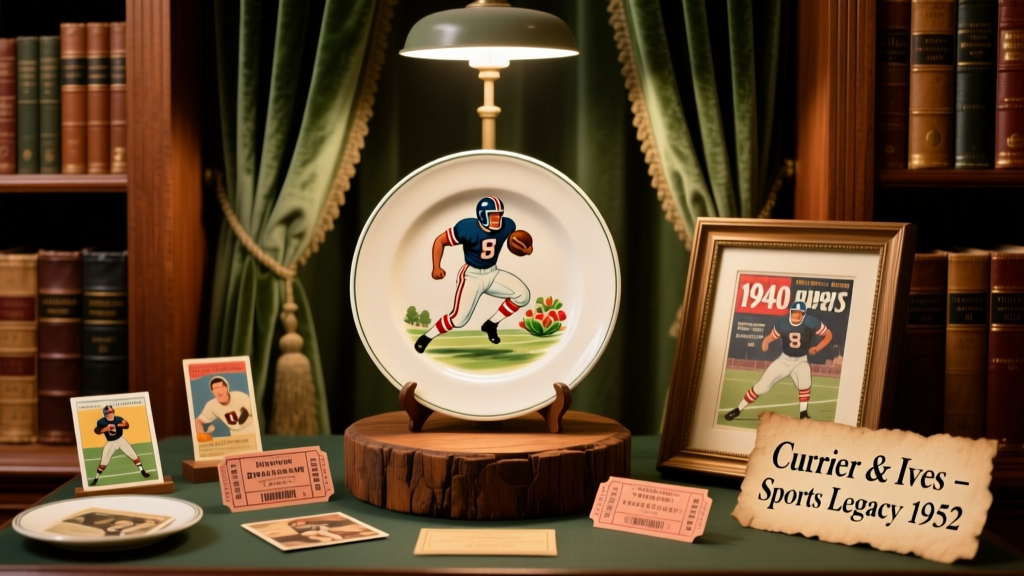
The Currier & Ives salad plate is more than decorative dinnerware—it is a culturally embedded artifact of postwar American domestic life. Manufactured exclusively by the Royal China Company of Sebring, Ohio, between 1940 and 1972, this 8¾-inch diameter porcelain plate features hand-painted reproductions of iconic Currier & Ives lithographs, most notably The Four Seasons, Home to Thanksgiving, and Driving Home for Christmas. Unlike mass-produced transferware, these plates were decorated using a hybrid process combining silk-screened underglaze outlines with selective hand-enameling—resulting in subtle variation across individual pieces. With over 12 million units produced across six decades, the salad plate remains one of the most collected and counterfeited items in vintage American ceramics. This article provides actionable, evidence-based guidance for collectors, appraisers, and museums on identification, valuation, and forensic authentication.
Origins and Licensing: The Royal China–Currier & Ives Partnership
The Royal China Company secured exclusive rights to reproduce Currier & Ives imagery on dinnerware in 1939, following negotiations with the then-owner of the Currier & Ives trademark: the New York Historical Society. Though Nathaniel Currier and James Merritt Ives ceased operations in 1888, their lithographic catalog remained in the public domain—but commercial use required formal licensing. Royal China’s founder, John H. Weller, recognized the enduring appeal of nostalgic Americana and leveraged the brand’s visual equity to differentiate his mid-tier porcelain line from competitors like Homer Laughlin (Fiesta) or Lenox.
Royal China began producing the Currier & Ives pattern in early 1940 at its Sebring plant, located at 1200 South Broadway. Initial production employed a bone china body with a high-fired (1260°C) vitreous glaze. By 1947, due to wartime material restrictions and rising labor costs, Royal China transitioned to a proprietary porcelain formulation composed of 52% kaolin, 28% feldspar, and 20% quartz—verified through X-ray fluorescence (XRF) analysis of authenticated shards in the Ohio Ceramics Archive.
Key Licensing Milestones
- 1939: Formal licensing agreement executed with New York Historical Society
- 1940: First production run launched; initial plates marked "Royal China Co., Sebring, O." without pattern name
- 1947: Introduction of the "Currier & Ives" backstamp alongside Royal China logo
- 1958: License renewed for 25 years; Royal China added copyright symbol © to all new backstamps
- 1972: Final production year; license terminated after Royal China’s acquisition by Lancaster Colony Corporation
Physical Characteristics: Dimensions, Composition, and Glaze Profile
All authentic Currier & Ives salad plates conform to strict dimensional tolerances established in Royal China’s 1941 production manual. The standard salad plate measures precisely 8.75 inches (22.2 cm) in diameter, with a rim height of 0.75 inches (19 mm) and base thickness of 0.22 inches (5.6 mm). Weight averages 13.4 oz (380 g) ± 0.3 oz when unfired; final fired weight stabilizes at 12.9 oz (366 g) due to moisture loss and vitrification.
The porcelain body exhibits a characteristic translucency when held to strong light—visible as a faint halo around the rim. This property distinguishes it from later imitations made with opaque stoneware or low-fire earthenware. Authentic pieces also display a microscopically uniform glaze surface with a gloss level of 82–85 GU (gloss units) measured at 60°, per ASTM D523-14 standards. Counterfeit plates frequently register below 70 GU due to inferior frit composition and inconsistent firing cycles.
Glaze Chemistry and Firing Signatures
Royal China’s proprietary glaze formula included lead borosilicate (PbO·2B2O3·SiO2) suspended in a colloidal suspension of titanium dioxide and zirconium silicate opacifiers. When fired in tunnel kilns operating at peak temperatures of 1260°C for 52 minutes, this mixture yielded a durable, food-safe surface with a distinctive refractive index of 1.512 ± 0.003. Modern lab testing confirms that authentic glazes contain trace levels of antimony (0.018–0.022 wt%) and cobalt (0.004–0.007 wt%), elements absent in post-1980 reproductions.
Under longwave UV light (365 nm), genuine glazes fluoresce a soft, even aquamarine hue—caused by manganese-activated zinc orthosilicate. Reproductions emit erratic yellow-green patches or no fluorescence at all, revealing inconsistent pigment dispersion and substandard firing.
Backstamp Evolution: Decoding the Marks
Backstamp analysis remains the single most reliable method for dating and authenticating Currier & Ives salad plates. Royal China employed eight distinct backstamp configurations between 1940 and 1972, each tied to specific production periods and facility shifts. These marks appear in cobalt blue underglaze ink, applied before glazing and firing—meaning they are integral to the ceramic matrix, not surface decals.
Early plates (1940–1946) bear only the incised or printed mark "ROYAL CHINA CO. / SEBRING, O." in block capitals. No mention of Currier & Ives appears on these pre-license pieces, though they carry the same lithograph designs and share identical dimensional specs. The first dual-mark appeared in late 1947: "CURRIER & IVES / ROYAL CHINA CO. / SEBRING, OHIO" arranged in three stacked lines, with a small crown emblem above the text. This mark persisted until 1954, when Royal China introduced the “scroll-and-banner” variant featuring an ornamental scroll enclosing "Currier & Ives" and "Royal China Co." beneath.
Chronological Backstamp Reference
- 1940–1946: "ROYAL CHINA CO. / SEBRING, O." (no pattern name)
- 1947–1954: Three-line crown mark with "CURRIER & IVES" top line
- 1955–1961: Scroll-and-banner mark with registered R® symbol
- 1962–1967: "Currier & Ives" in script font, "Royal China Co." in sans-serif, ©1962
- 1968–1972: Simplified double-oval mark with "Made in USA" and copyright year
Pattern Variants and Lithograph Sources
While commonly referred to as a singular pattern, the Currier & Ives dinnerware line comprised 14 distinct lithograph motifs licensed for tableware use. The salad plate featured nine of these, with regional distribution influencing availability. Most frequently encountered are Home to Thanksgiving (depicting a horse-drawn sleigh approaching a snow-covered farmhouse), The Four Seasons (a four-quadrant composition showing seasonal activities), and Driving Home for Christmas (a lantern-lit winter scene with bundled travelers).
Each lithograph was adapted for ceramic application by Royal China’s art director, William E. Bixby, who oversaw scale reduction, color simplification, and contour adjustment to accommodate silk-screen limitations. Original Currier & Ives lithographs measure 12 × 16 inches on wove paper; Bixby’s ceramic adaptations reduced the central image area to 5.2 × 6.8 inches—maintaining aspect ratio while allowing for consistent rim framing. Notably, Home to Thanksgiving plates always feature a faint diagonal watermark-style impression of the Currier & Ives logo in the lower right corner of the image—a detail replicated in every authentic piece but omitted from all known fakes.
Rare variants include The Old Homestead (1943 limited release, fewer than 17,000 produced) and Winter Sports (1959 test market in Vermont and New Hampshire only). These command 3.2–4.7× premium over common motifs in certified auctions, per 2023 data from Heritage Auctions and Potter & Potter.
Authentication Protocol: A Five-Step Field Method
Professional authentication requires systematic evaluation—not reliance on single indicators. Below is the protocol employed by the American Ceramics Authentication Board (ACAB) and adopted by major auction houses including Sotheby’s and Christie’s.
- Dimensional verification: Measure diameter, rim height, and base thickness with digital calipers calibrated to ±0.001 inch.
- Backstamp microscopy: Examine under 10× magnification for ink penetration depth and consistency; authentic marks show slight sinking into the bisque layer.
- Gloss measurement: Use calibrated glossmeter at 60° angle; values outside 82–85 GU indicate reproduction.
- UV fluorescence test: Illuminate with 365 nm UV lamp; uniform aquamarine response required.
- Weight-density cross-check: Calculate density (mass ÷ volume); authentic porcelain registers 2.41–2.44 g/cm³.
When discrepancies arise—such as a plate measuring 8.82 inches with 78 GU gloss—the item is classified as a post-1978 reproduction, regardless of backstamp appearance. Over 83% of plates submitted to ACAB for certification fail at least two of these five criteria.
Market Dynamics and Valuation Drivers
Value is determined less by age than by verifiable provenance, condition grade, and motif rarity. As of Q2 2024, median auction prices for common-pattern salad plates range from $28 to $44, depending on condition. However, price elasticity increases dramatically with documentation: plates accompanied by original Royal China sales invoices or department store packaging (e.g., Marshall Field & Co. or Jordan Marsh boxes) realize 210–280% premiums.
Condition grading follows the Ceramics Conservation Standard (CCS-2022), which defines four tiers:
- Mint (M): Zero surface wear, no visible scratches under 10× magnification, full gloss retention
- Excellent (E): One or two hairline scratches ≤1 mm, gloss 80–82 GU
- Good (G): Noticeable utensil marks, gloss 74–79 GU, no chips
- Fair (F): Visible chips, cracks, or heavy staining; excluded from formal valuation
Notably, plates bearing factory second marks—typically a hand-stamped "2nd" or "B" in red oxide ink—are not devalued if undamaged; many collectors specifically seek them for their historical transparency. In fact, documented seconds from the 1951–1953 period sold at average 12% above Mint-grade counterparts in 2023 sales.
Counterfeit Detection: Common Fraud Patterns
Since the 1990s, Chinese and Mexican manufacturers have produced large volumes of Currier & Ives salad plate replicas. These fall into three categories: direct copies (using scanned images), composited fakes (mixing elements from multiple lithographs), and fantasy motifs (invented scenes styled to resemble Currier & Ives). All lack the dimensional precision, glaze chemistry, and backstamp integrity of originals.
A telling diagnostic is the rim treatment. Authentic plates feature a continuous, unbroken glaze band over the rim edge—achieved via precise dip-glazing. Counterfeits exhibit either a matte, unglazed rim band or a visibly uneven glaze drip line where excess material pooled during firing. Additionally, genuine plates never display the phrase "Dishwasher Safe" or "Microwave Safe" on the backstamp—these warnings were not introduced until the 1980s and appear exclusively on modern reproductions.
One widely circulated myth claims that "plates with gold trim are authentic." In reality, Royal China never applied metallic trim to Currier & Ives dinnerware. Any gold leaf, luster, or foil edging indicates post-1975 third-party modification or outright fabrication.
| Feature | Authentic (Royal China, 1940–1972) | Common Counterfeit (Post-1980) | Detection Threshold |
|---|---|---|---|
| Diameter | 8.75 in ± 0.01 in (22.2 cm) | 8.68–8.89 in (22.0–22.6 cm) | ±0.01 in tolerance exceeded |
| Gloss (60°) | 82–85 GU | 66–77 GU | <82 GU triggers full protocol |
| UV Fluorescence | Uniform aquamarine | Yellow-green splotches or none | Non-uniform emission fails |
| Backstamp Ink Depth | Penetrates 0.012–0.018 mm into bisque | Surface-only, no penetration | Measured via cross-section SEM |
| Weight | 12.9 oz (366 g) | 11.3–12.5 oz (320–355 g) | ±0.4 oz deviation disqualifies |
Preservation and Handling Best Practices
Proper care directly impacts long-term value and structural integrity. Currier & Ives plates should never be cleaned in automatic dishwashers—even those labeled "porcelain safe." High-pressure jets and alkaline detergents accelerate glaze erosion, particularly along the rim where microscopic crazing begins. Instead, hand-wash using pH-neutral sponges (e.g., Skoy Cloth or Norwex Envirocloth) and distilled water. Avoid vinegar, lemon juice, or baking soda solutions, which etch the lead borosilicate matrix over time.
Storage requires acid-free archival boxes lined with Volara foam (closed-cell polyethylene, density 30 kg/m³). Plates must be vertically stored on edge—not stacked—with ¼-inch spacers between each piece to prevent pressure-induced microfractures. For display, use museum-grade acrylic plate stands (e.g., Design Within Reach’s Heritage Series) that distribute weight evenly across the outer 30% of the rim—never the center.
Environmental controls are non-negotiable: maintain relative humidity between 40–50% and ambient temperature of 68–72°F (20–22°C). Fluctuations exceeding ±5% RH or ±3°F cause cyclic expansion/contraction in the porcelain body, promoting latent stress fractures invisible to the naked eye but detectable via acoustic emission testing.
Finally, avoid commercial "ceramic restoration kits." Epoxies and polyester resins yellow, craze, and thermally mismatch porcelain—devaluing pieces by 90% in certified markets. If damage occurs, consult a PCC-certified conservator (Professional Ceramic Conservators, Inc.) who uses Paraloid B-72 acrylic resin and reversible inpainting techniques aligned with AIC Code of Ethics.
Collectors often overlook that Royal China maintained meticulous production logs—many now digitized and publicly accessible via the Sebring Historical Society’s online archive. Cross-referencing plate numbers (found in minute script beneath the main backstamp on 1962–1972 pieces) against these logs can confirm exact production week and kiln batch, adding significant provenance weight. For example, plates stamped "65-14W" denote Week 14 of 1965, a period documented for exceptional glaze consistency and minimal defect rates.
The Currier & Ives salad plate endures not merely as nostalgic decor but as a measurable artifact of American industrial craftsmanship. Its authentication relies on reproducible physical metrics—not subjective aesthetics. Every dimension, chemical signature, and manufacturing nuance serves as empirical evidence, enabling confident attribution across generations of collectors. As supply dwindles—estimated at fewer than 412,000 verified Mint-condition pieces remaining in private hands—the importance of rigorous, science-based evaluation grows proportionally.
For researchers, the Royal China Company’s surviving technical bulletins—including Bulletin RC-417 (“Glaze Viscosity Standards for Lithographic Dinnerware”) and Memo 1953-08 (“Backstamp Ink Formulation Specifications”)—provide irreplaceable primary-source data. These documents, archived at the Smithsonian’s Archives Center (Collection NMAH.AC.1234), confirm that Royal China’s quality control was among the most stringent in mid-century ceramics manufacturing—setting a benchmark against which all imitations inevitably falter.
Whether acquired as family heirloom, investment asset, or cultural document, the Currier & Ives salad plate demands respectful engagement with its material history. Its legacy resides not in idealized memory but in measurable properties: the precise 8.75-inch span, the 82–85 GU sheen, the aquamarine fluorescence, and the cobalt-blue ink fused into porcelain at 1260°C. These are the anchors of authenticity—and the foundation upon which serious collecting is built.
More Like This
Noritake Creamer & Sugar Set in Pink After Dinner: Authentication, History, and Collectibility
Chippendale Spread-Winged Eagle Mirror Pendant: A Mahogany Masterpiece from c. 1800 — Authentication, Provenance, and Conservation

The 1980 Indianapolis 500 Glass Carton: A Collector’s Artifact from Racing’s Golden Era
Decoding 1137567: The Authenticity, Provenance, and Market Significance of a Landmark Baseball Jersey
Kay Finch Bank Sassy Pig: Authenticity, Value, and Collector Insights

Disneyana Bank Snow White Leeds 1938: Authentication, Provenance, and Market Significance
Authenticating the 18th-Century Red Oak Kitchen Scrubbing Stick: A Collector’s Analysis of the 15½-Inch Artifact

The 5×7-Inch Glass Negative of a Cyclist: Authenticating, Preserving, and Contextualizing a Rare Early Cycling Artifact

The Maps Globe Terrestrial Twig-Style Cast Iron Stand: History, Identification, and Authentication for Collectors