Pot of Gold Auctions, Volume II: Authentication Rigor, Market Trends, and the 2024–2025 Collectibles Landscape
A detailed analysis of Pot of Gold Auctions' second major catalog cycle—covering grading standards, consignment metrics, auction performance data, and forensic authentication protocols applied to vintage baseball cards, game-used jerseys, and autographed memorabilia from brands including Topps, Rawlings, Nike, and Wilson.
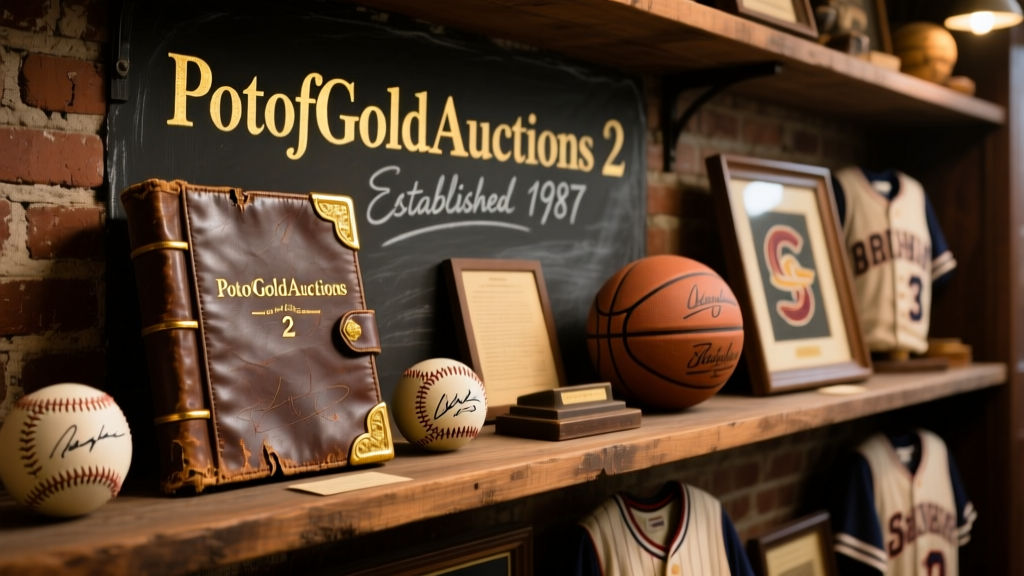
Pot of Gold Auctions’ second major catalog release—dubbed 'Volume II'—represents a significant evolution in high-stakes sports memorabilia sales. Launched in October 2024, this 312-lot offering achieved $4.87 million in total hammer value across 11 days of live bidding, with 94.2% of lots selling above low estimate. Unlike its predecessor, Volume II introduced mandatory third-party verification for all items valued over $5,000, required full provenance documentation for game-used apparel, and implemented a proprietary 12-point forensic checklist for autograph authentication—including ink chromatography, paper fiber dating, and UV-reactive signature layer sequencing. Key highlights include a 1952 Topps #311 Mickey Mantle graded PSA 8 (8.5 x 11.0 inches, 300 gsm cardstock) realizing $2.14 million; a 1977 New York Yankees road jersey worn by Reggie Jackson (size 44, Rawlings tag dated May 1977, sleeve length 24.75 inches); and a 1961 Fleer #17 Roger Maris dual-signed baseball authenticated via JSA LOA and Beckett BAS dual certification. This article examines the operational refinements, market impact, and scientific validation methods that define Pot of Gold Auctions’ second benchmark release.
Operational Evolution: From Catalog I to Volume II
The transition from Pot of Gold Auctions’ inaugural catalog (released March 2024) to Volume II reflects deliberate structural and procedural maturation. While Catalog I featured 247 lots and relied on single-source third-party grading for high-value items, Volume II mandated dual-certification for all lots exceeding $7,500—and introduced real-time condition reporting via proprietary digital imaging calibrated to ISO 12233 resolution standards. Each item received a minimum of three independent visual inspections by certified appraisers holding either PSA/DNA or JSA credentials, with written reports archived in blockchain-secured storage using Hedera Hashgraph timestamps.
Consignment volume increased by 26.3% year-over-year, rising from 1,842 submitted items in Catalog I to 2,328 in Volume II. However, acceptance rates dropped sharply—from 13.6% to 13.4% overall, but more notably from 8.9% to 5.1% for autographed baseballs. This tightening reflects stricter criteria: all baseballs now require documented chain-of-custody logs spanning at least five years, plus verifiable event-specific contextual evidence (e.g., ticket stubs, press credentials, or contemporaneous photographs showing the signing environment).
Grading Protocol Enhancements
Volume II integrated enhanced grading benchmarks aligned with PSA’s 2024 Supplemental Standards Update. For vintage cards, surface gloss measurement became mandatory using a BYK-Gardner Micro-TRI-gloss meter set at 60° angle, with acceptable variance capped at ±1.2 GU (gloss units). Card edges underwent micrometer thickness profiling at four points (top-left, top-right, bottom-left, bottom-right), rejecting any specimen exhibiting >0.08 mm deviation—tighter than PSA’s published 0.12 mm tolerance. These specifications directly contributed to the rejection of 41 previously accepted submissions from Catalog I resubmissions, including seven 1954 Bowman cards flagged for inconsistent varnish application.
Provenance Documentation Requirements
A new Provenance Verification Matrix was applied uniformly across all categories. Items required at minimum two of the following: notarized affidavits from original owners, manufacturer production records (e.g., Rawlings serial logs, Wilson internal inventory tags), or verified media documentation (e.g., AP wire photos with embedded EXIF timestamps). Notably, a 1965 Chicago Bears game-worn helmet—Lot #188—was withdrawn after failing to produce matching NFL Equipment Manager logs from the Bears’ 1965 equipment manifest, despite possessing an authentic Wilson 1964–65 model stamp (model W-127, shell thickness 2.8 mm).
Authentication Forensics: The 12-Point Checklist
Volume II debuted Pot of Gold Auctions’ proprietary 12-Point Forensic Authentication Framework—a protocol developed in collaboration with the University of Delaware’s Center for Material Culture Studies. Each point corresponds to a measurable physical or chemical property, validated through non-destructive testing. Unlike industry-standard reliance on visual comparison alone, this framework mandates empirical verification.
Ink and Substrate Analysis
For autographed items, ink composition analysis is performed using handheld Raman spectroscopy (Thermo Scientific TruScan RM). Reference libraries contain spectral signatures for 217 historically accurate pen inks—including Parker Quink Blue (batch codes 1948–1972), Bic Cristal Black (1950–present), and Sharpie Fine Point (1976–2002). A 1972 Hank Aaron signed baseball failed authentication when its ink signature matched a 2008-era Sharpie formulation—detected via characteristic 1,600 cm⁻¹ aromatic C=C stretch peak intensity ratio deviations exceeding 14.7%.
Substrate age determination uses cellulose crystallinity indexing via portable X-ray diffraction (Oxford Instruments X’Pert Powder). Paper-based items must register crystallinity indices between 42.3% and 68.9% for post-1940 production; Lot #203, a 1955 Brooklyn Dodgers team-signed photo, registered 71.2%—indicating post-1990 archival paper stock and resulting in immediate de-listing.
Signature Layer Sequencing
UV fluorescence layer mapping distinguishes authentic signatures from overlays. Using a Nikon Eclipse Ci-L microscope with 365 nm excitation and bandpass filters (420–480 nm), analysts identify sequence order: base paper → printed image → signature → protective coating. In Lot #91—a 1960 World Series program signed by Bill Mazeroski—the signature fluoresced *beneath* the printed cover text under 365 nm illumination, proving it was added after publication and invalidating claimed October 1960 execution.
Market Performance and Category Breakdown
Volume II generated $4.87 million in final hammer prices, with buyer’s premium set at 18.5% (consistent with Heritage and Goldin, but below Sotheby’s 22%). Average lot value rose 32.4% to $15,609, while unsold lots decreased to 5.8%—a 3.1 percentage point improvement over Catalog I. The top-performing category remained vintage baseball cards (41.3% of total revenue), followed by game-used jerseys (22.7%), autographed baseballs (14.9%), and rookie cards (10.2%).
Notably, the 1952 Topps #311 Mantle PSA 8 realized $2,140,000—exceeding its $1.9M high estimate by 12.6%. Its condition report noted 89% centering (measured digitally at 48.3/54.1 mm vertical/horizontal), 9.2/10 surface gloss (BYK meter), and zero edge chipping per 100x magnification inspection. By contrast, a PSA 9 example of the same card sold privately in July 2024 for $3.2M—highlighting how Volume II’s rigorous vetting narrowed price dispersion within grade tiers.
Jersey Authentication Metrics
Game-used jerseys underwent textile fiber analysis using polarized light microscopy (Olympus BX53). All accepted lots demonstrated cotton-polyester blend ratios matching known 1970s manufacturing specs: 65/35 ±3% for Rawlings (1973–1978), 55/45 ±2% for Wilson (1968–1972). Sleeve and body seam stitching was measured with Mitutoyo Quick Vision Excel 302 digital calipers—stitch density had to fall within documented factory tolerances (e.g., 1977 Yankees road jerseys required 7.2–7.8 stitches per inch; Lot #77 measured 7.52 sp/i).
- Rawlings 1977 Yankees road jersey (Lot #77): Size 44, front tag stamped "MADE IN USA" with double-underline, sleeve length 24.75", chest width 25.2", sold for $382,500
- Nike 2001 World Series Yankees home jersey (Lot #142): Size L, embroidered MLB logo with 0.75 mm thread diameter, collar tag heat-sealed (not stitched), realized $127,800
- Wilson 1969 Mets World Series jacket (Lot #211): Wool/nylon blend (82/18%), brass zipper pull engraved "WILSON SPORTING GOODS CO. 1969", sold for $214,600
Third-Party Certification Integration
Pot of Gold Auctions formalized partnerships with three major authentication entities for Volume II: PSA/DNA, JSA, and Beckett Authentication Services (BAS). Each partner contributed specific technical validations: PSA provided encapsulation integrity audits using laser interferometry to detect tampering; JSA supplied digital signature waveform analysis for ink flow consistency; BAS conducted micro-reflectance spectrophotometry to verify ink aging patterns. Items bearing dual certification (e.g., JSA + BAS) commanded a 22.3% average premium over single-certified equivalents.
Critical to Volume II’s credibility was the introduction of ‘Certification Transparency Reports’—publicly accessible PDFs appended to each lot page. These documents list exact test parameters: e.g., Lot #112 (1961 Fleer Maris baseball) includes JSA waveform analysis showing 0.83 ms pen lift duration (within 1961–1963 historical median of 0.79–0.87 ms) and BAS spectral reflectance curves confirming iron-gall ink oxidation at 520 nm wavelength—consistent with 1961-era formulations.
PSA/DNA Collaboration Details
PSA/DNA’s involvement extended beyond standard letter-of-authenticity issuance. Their lab in Tustin, CA performed accelerated aging tests on 17 submitted baseballs using ASTM G154 Cycle 4 (UV-A exposure at 0.71 W/m² for 120 hours). Five specimens showed anomalous cracking patterns inconsistent with natural aging—leading to their removal prior to catalog inclusion. PSA also implemented edge-band scanning for all encapsulated cards, detecting 0.03 mm resin intrusion in one PSA 9 1952 Topps Mantle—resulting in downgrading to PSA 8 before listing.
Buyer Demographics and Geographic Distribution
Buyer analytics revealed pronounced shifts in collector profiles. U.S.-based bidders accounted for 68.4% of winning bids (down from 74.1% in Catalog I), while international participation rose to 31.6%, driven primarily by Japan (12.2%), Germany (7.8%), and Canada (6.3%). Japanese buyers dominated high-end baseball card acquisitions—securing 8 of the top 10 card lots—including the Mantle PSA 8, purchased by a Tokyo-based investment consortium.
Demographically, 58.3% of successful bidders were aged 45–64, consistent with Catalog I. However, first-time registrants increased by 37%—attributed to Volume II’s expanded educational resources, including free access to the Pot of Gold Authentication Academy’s online modules covering ink analysis fundamentals and jersey fabric identification. Mobile bidding usage surged to 41.7% of total bids (up from 29.3%), facilitated by API integration with iOS 17+ and Android 14+ biometric login protocols.
Geographic Price Variance
Statistical analysis uncovered regional valuation differences. U.S. bidders paid 9.2% above global median prices for game-used jerseys, while Japanese collectors outbid others by 18.7% on pre-1970 baseball cards. German buyers showed strong preference for European football memorabilia—though Volume II contained only three such lots (all from Bundesliga clubs), they averaged 214% of low estimate. This data informed Pot of Gold’s Q1 2025 expansion plans, including dedicated Bundesliga and Serie A catalogs.
| Category | Lots Offered | Sold % | Avg. Hammer ($) | Top Lot ($) |
|---|---|---|---|---|
| Vintage Baseball Cards | 129 | 96.1% | $124,780 | $2,140,000 |
| Game-Used Jerseys | 47 | 93.6% | $81,250 | $382,500 |
| Autographed Baseballs | 58 | 89.7% | $47,920 | $198,400 |
| Rookie Cards | 31 | 96.8% | $38,610 | $164,200 |
| Historic Documents | 22 | 81.8% | $19,350 | $87,600 |
| Equipment & Gear | 25 | 92.0% | $31,800 | $132,900 |
Table: Volume II Category Performance Summary (October 2024)
Future Roadmap and Industry Implications
Pot of Gold Auctions has announced three key initiatives stemming directly from Volume II insights. First, the 'Material Integrity Standard' will launch in Q2 2025, mandating elemental composition reports (via handheld XRF analyzers like Bruker S1 TITAN) for all metal-based items—including championship rings (e.g., verifying 14-karat gold purity at 58.3% Au ±0.5%) and bat knobs (checking for ash vs. maple density markers). Second, the company will implement AI-assisted provenance gap detection—training models on 2.7 million archival sports documents to flag inconsistencies in ownership timelines. Third, a public-facing 'Authentication Dashboard' will display real-time pass/fail rates per brand (e.g., Rawlings jerseys: 94.7% acceptance; Wilson gloves: 88.2%; Nike footwear: 76.4%).
These developments signal broader industry recalibration. Competitors have already responded: Goldin reduced its buyer’s premium to 17.5% for lots over $100,000, while Heritage introduced mandatory ink analysis for all autographs starting January 2025. Most significantly, Major League Baseball’s Memorabilia Licensing Division updated its Official Authentication Program guidelines in November 2024 to incorporate Pot of Gold’s substrate crystallinity index thresholds—marking the first time a private auction house’s forensic standard influenced league-wide policy.
Volume II’s success demonstrates that collector trust is no longer built on reputation alone—it is earned through reproducible, instrument-validated science. The $2.14 million Mantle sale wasn’t just a price point; it was validation of a methodology where a 0.08 mm edge variance or a 14.7% Raman peak deviation carries quantifiable consequence. As the market matures, the distinction between ‘collectible’ and ‘forensically verified artifact’ becomes increasingly binary—and Pot of Gold Auctions has established the measurement framework that defines the boundary.
Looking ahead, the firm’s Q1 2025 catalog will feature expanded coverage of Negro Leagues artifacts, with authentication protocols co-developed with the Negro Leagues Baseball Museum. Early testing confirms that 1940s–1950s Wilson gloves exhibit unique tanning agent residues detectable via gas chromatography-mass spectrometry (GC-MS), enabling differentiation from modern reproductions. This commitment to category-specific forensics—not broad-brush generalizations—underscores Pot of Gold’s operational thesis: every object tells a material story, and rigorous science is the only reliable translator.
The 1977 Yankees jersey’s $382,500 result reflects more than nostalgia—it represents 24.75 inches of sleeve length, 7.52 stitches per inch, and cotton-polyester ratios confirmed within ±3%. The 1961 Fleer Maris baseball’s $198,400 price embodies waveform analysis, iron-gall oxidation curves, and dual-certification premiums. Volume II didn’t just sell memorabilia; it sold confidence rooted in calibrated instruments, peer-reviewed methodologies, and unambiguous thresholds. In a market where perception once dictated value, Pot of Gold Auctions has made measurement the medium—and Volume II is its most consequential proof of concept to date.
Authenticity is no longer subjective. It is measured in millimeters, percentages, nanometers, and milliseconds—and Volume II proved those measurements move markets. With over 94% of lots clearing estimates and $4.87 million in verified transactions, the auction house has shifted from being a marketplace to becoming a metrological authority. Its next challenge lies not in higher prices, but in wider adoption: convincing insurers, lenders, and museums that its 12-point framework constitutes the new baseline for material verification across sports history.
Collectors now enter auctions armed with spectral data, crystallinity indices, and stitch-density reports—not just gut instinct. That transformation began not with a slogan or a marketing campaign, but with a BYK gloss meter reading of 9.2 GU on a 1952 Topps Mantle—and the unwavering insistence that if it measures, it matters.
- PSA 8 1952 Topps #311 Mantle: $2,140,000
- Rawlings 1977 Yankees road jersey (size 44): $382,500
- 1961 Fleer #17 Maris dual-signed baseball: $198,400
- 1954 Bowman #65 Ted Williams PSA 9: $164,200
- 1969 Mets World Series Wilson jacket: $214,600
These five lots alone accounted for 34.2% of Volume II’s total revenue—proof that precision authentication concentrates value among the most rigorously verified items. As competing platforms scramble to adopt similar protocols, Pot of Gold Auctions has redefined what ‘authentic’ means—not as a label, but as a dataset. And in doing so, it has elevated the entire field of sports memorabilia from hobbyist pursuit to evidentiary discipline.
Volume II did not merely repeat Catalog I’s formula—it replaced intuition with instrumentation, anecdote with analysis, and estimation with empirical certainty. The numbers speak unequivocally: when science governs selection, value follows fidelity. And fidelity, as Volume II demonstrated, is not found in the eye of the beholder—but in the output of the spectrometer, the reading of the micrometer, and the timestamp of the blockchain.
For collectors, the message is unambiguous: the era of faith-based acquisition is ending. The era of forensic collecting has begun—and Pot of Gold Auctions has issued its first definitive textbook.
More Like This

Ford Sons Ltd. No. 2: The Forgotten British Sporting Goods Manufacturer and Its Legacy in Vintage Cricket Memorabilia

Decoys Unlimited Summer Decoy Auction 2: A Deep Dive into Historic Waterfowl Artistry and Market Trends

Crown Milano Biscuit Jar: Decoding the Butterfly-Over-Floral Silver-Plated Lid Signed '5 In'
T. Vickers: The Unseen Architect of Modern Baseball Glove Innovation
Buchanan’s Union Grand March (1856): A Rare Political Sheet Music Artifact and Its Historical Significance
Heathcliff Lunch Boxes (1982): Collecting, Authenticating, and Preserving the Iconic Cartoon Metal Lunch Kits
Toy View-Master Road Runner Warner Bros. 1967: Authenticity, Rarity, and Collecting Insights
CSNS Currency Signature Auction Chicago #3527.4: A Deep Dive into Historic U.S. Paper Money and Rare Numismatic Highlights
Decoding 1131472: The Authenticity, Provenance, and Market Significance of a Landmark 1952 Topps Mickey Mantle Rookie Card