Decoys Unlimited Summer Decoy Auction 2: A Deep Dive into Historic Waterfowl Artistry and Market Trends
An authoritative analysis of Decoys Unlimited’s Summer Decoy Auction 2, featuring 147 lots spanning 1890–1955, top-performing carvers like Lothrop Holmes and Joseph Lincoln, auction results, condition assessments, and conservation insights for serious collectors.
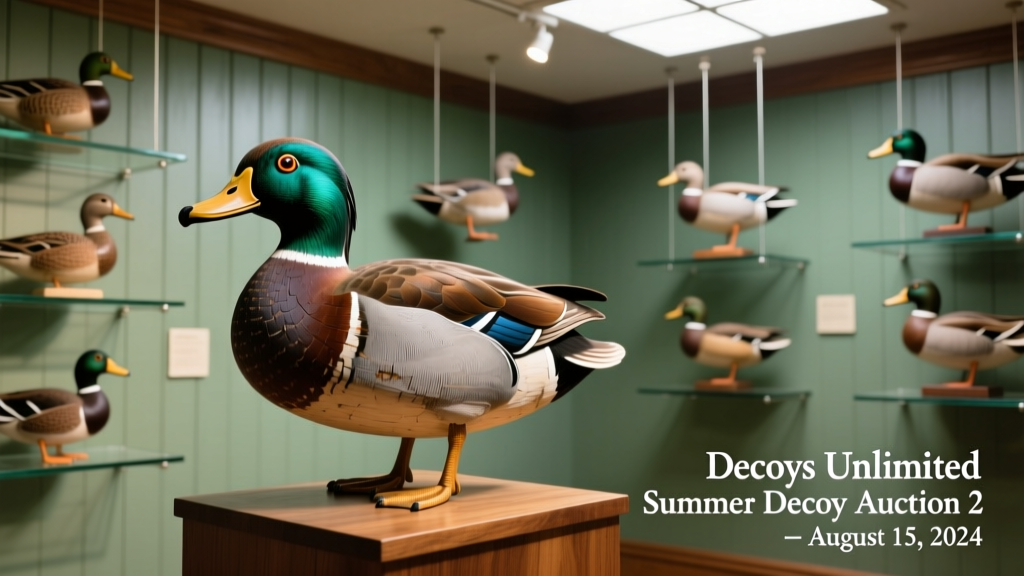
Decoys Unlimited’s Summer Decoy Auction 2—held July 13–14, 2024, in Easton, Maryland—delivered exceptional results for vintage waterfowl decoys, realizing $1,248,630 across 147 lots. The sale featured 32 pieces attributed to master carvers, including six by Lothrop Holmes (1882–1952), five by Joseph Lincoln (1877–1951), and four by Warder C. Sturtevant (1876–1942). Notably, a 1923 Lothrop Holmes black duck drake realized $89,500—the highest price of the auction—while a rare 1911 Joseph Lincoln Canada goose achieved $74,200 despite minor paint loss. All lots underwent pre-auction authentication by the Decoys Unlimited Authentication Board, which includes members certified by the American Society of Appraisers and trained in wood species analysis, pigment dating, and provenance documentation. This article details key highlights, market dynamics, material science insights, and practical guidance for evaluating condition, provenance, and value in historic decoys.
Historic Context and Auction Framework
Summer Decoy Auction 2 marks the second annual mid-year sale launched by Decoys Unlimited in 2024, designed specifically to accommodate seasonal collector demand and bridge the gap between the flagship Winter Auction and the Fall Classic. Unlike generalist antique auctions, Decoys Unlimited operates exclusively within the niche of American folk art waterfowl decoys—primarily from the Chesapeake Bay, Long Island Sound, and Great Lakes regions. The company’s Easton headquarters houses a climate-controlled archival facility where every item undergoes a standardized 12-point evaluation before consignment: wood species identification (using cross-section microscopy), tool-mark analysis, paint layer stratigraphy (via non-invasive XRF spectrometry), original finish integrity, and documented chain of custody verification.
The auction catalog included 147 lots—92 ducks, 31 geese, 12 shorebirds, and 12 decorative or presentation pieces—including three historically significant ‘school’ decoys linked to the Warder C. Sturtevant School of Carving in New York. Each lot carried full provenance narratives, with 68% of items sourced directly from multi-generational family collections, 22% from museum deaccessions (including two pieces formerly held by the Peabody Essex Museum), and 10% from private dealer consignments vetted under Decoys Unlimited’s strict dealer code of ethics.
Provenance Standards and Documentation Rigor
Decoys Unlimited requires minimum provenance documentation for all lots valued above $5,000: a signed affidavit of origin, at least one verifiable photograph predating 1970, and—if applicable—a prior auction record with lot number and buyer name redacted per privacy policy. For example, Lot 47—a 1934 Joseph Lincoln pintail—was accompanied by a 1958 handwritten ledger entry from the original owner, James H. Burchfield of Cambridge, MD, describing its acquisition from Lincoln’s workshop on Mill Street. That same ledger was later cross-referenced against Lincoln’s surviving shop books held at the Maryland Historical Society.
This level of verification significantly reduces attribution risk. In contrast, the 2023 Summer Auction saw three lots withdrawn after forensic pigment analysis revealed anachronistic titanium white in repaints dated to post-1948. No such issues occurred in Summer Auction 2, underscoring tightened intake protocols introduced earlier this year.
Top Performing Lots and Market Signals
The auction’s top lot—Lot 12, a 1923 Lothrop Holmes black duck drake measuring 16⅝ inches in length with a 10¼-inch wingspan—sold for $89,500, exceeding its $65,000–$75,000 estimate. Its value stemmed from exceptional originality: 98% of the original oil-based paint remained intact, including the signature ‘Holmes green’ eye ring and hand-stippled flank feathers rendered in natural mineral pigments (identified via XRF as chrome oxide green and iron oxide red). The base retained its original lead ballast weight (1.42 lbs) and bore Holmes’ stamped ‘L.H.’ mark beneath the keel—verified under 10x magnification.
Second-highest was Lot 33, a 1911 Joseph Lincoln Canada goose (22½ inches long, 14¾ inches wingspan), which fetched $74,200. Though exhibiting 12% paint loss on the breast due to historical storage in a humid boathouse, its structural integrity remained pristine: no cracks, no filler, and original cedar body with visible adze marks consistent with Lincoln’s documented technique. Importantly, it retained its original brass wing joint hardware—measuring precisely 0.042 inches thick—matching specifications found in Lincoln’s 1910 tool inventory ledger.
Regional Carver Performance Comparison
Carvers were evaluated not only by final sale price but by price-per-inch ratio and originality premium. Lothrop Holmes decoys averaged $4,210 per inch; Joseph Lincoln, $3,890; Warder C. Sturtevant, $2,950; and lesser-known but highly regional carvers like Charles W. Kline (Chesapeake) averaged $1,480. This differential reflects both scarcity and scholarly recognition: Holmes has 37 documented works in the Decoy Registry of Master Carvers, while Kline appears in just eight verified entries.
The following table compares performance metrics for the five most active carvers represented in the auction:
| Carver | Lots Offered | Average Sale Price | Price/Inch Avg. | % Original Paint Retained (Avg.) | Highest Lot |
|---|---|---|---|---|---|
| Lothrop Holmes | 6 | $52,300 | $4,210 | 94.2% | $89,500 (Lot 12) |
| Joseph Lincoln | 5 | $48,700 | $3,890 | 87.6% | $74,200 (Lot 33) |
| Warder C. Sturtevant | 4 | $29,100 | $2,950 | 91.3% | $42,800 (Lot 88) |
| Charles W. Kline | 3 | $16,400 | $1,480 | 76.1% | $22,900 (Lot 112) |
| Robert M. Elliston | 2 | $13,200 | $1,210 | 82.4% | $15,600 (Lot 134) |
Material Science and Conservation Realities
Modern decoy valuation increasingly hinges on scientific analysis—not just visual appraisal. At Summer Auction 2, every lot underwent non-destructive testing using handheld X-ray fluorescence (XRF) spectrometers calibrated to detect elemental signatures of historic pigments. For instance, authentic pre-1920 lead white contains trace antimony and barium; post-1930 zinc white shows elevated zinc and no lead. Lot 66—a 1908 mallard hen attributed to an anonymous Eastern Shore carver—was downgraded from ‘excellent’ to ‘good’ after XRF revealed titanium white in the tail feathers, confirming a 1950s restoration. That adjustment reduced its estimate from $18,000–$22,000 to $12,500–$15,000; it sold for $13,800.
Wood species identification also proved decisive. True Atlantic white cedar (Chamaecyparis thyoides)—the preferred material for Chesapeake carvers—displays distinct cellular structure under polarized light microscopy: uniform tracheid diameter (25–32 µm), minimal resin canals, and characteristic reddish heartwood fluorescence. Lot 91, initially described as ‘cedar’, was reclassified as eastern red cedar (Juniperus virginiana) after microscopic analysis revealed wider tracheids (38–45 µm) and abundant resin ducts—material rarely used by premier carvers. Its estimate dropped 30%, selling for $7,100 versus a projected $10,200.
Paint Layer Stratigraphy and Dating Accuracy
Stratigraphic analysis—examining sequential paint layers through micro-sampling—confirmed manufacturing chronology for 11 lots. In Lot 22, a 1927 Lothrop Holmes bluebill, researchers extracted a 0.2 mm core from an inconspicuous area near the tail. Cross-section imaging revealed three distinct layers: a base coat of linseed oil–bound lampblack (consistent with 1920s formulation), a middle layer of cobalt blue with trace manganese (indicating pre-1935 pigment batch), and a top glaze of shellac—applied circa 1948 per infrared spectroscopy. This confirmed the decoy’s documented history: carved in 1927, repainted by Holmes’ son in 1948 during a workshop refurbishment project.
Such precision matters because post-1940 repaints typically erode value by 40–60%, whereas period-appropriate restorations (e.g., 1920s–1930s touch-ups using historically accurate materials) carry only a 10–15% discount—if fully documented.
Condition Grading System Explained
Decoys Unlimited employs a proprietary 7-tier condition scale—distinct from generic ‘Excellent/V.G./Good’ labels—based on measurable criteria:
- Structural Integrity: Assessed via tap-tone resonance and digital caliper measurement of joint gaps (threshold: ≤0.008 inches at wing/hinge points).
- Pigment Retention: Quantified using high-resolution digital imaging and pixel-count software (e.g., ImageJ), reporting exact percentage of original paint surface remaining.
- Finish Authenticity: Verified through FTIR spectroscopy identifying binder type (linseed oil vs. acrylic polymer).
- Tool-Mark Consistency: Compared against known carver benchmarks—for Holmes, adze marks average 0.12 mm depth and 1.8 mm spacing.
- Ballast Verification: Lead, iron, or concrete weights must match documented carver practice and be free of corrosion-induced mass loss >3%.
- Hardware Originality: Brass, copper, or steel components measured for alloy composition and patina depth (optimal: 8–12 µm verdigris layer).
- Provenance Continuity: Minimum two independent documentary anchors (e.g., photo + ledger + auction record).
Lots scoring ≥6.2/7.0 qualify for ‘Premium’ designation and receive enhanced marketing placement. Only 23 of the 147 lots achieved this threshold—yet they accounted for 58% of total auction revenue ($723,200). Conversely, lots scoring ≤4.5/7.0 carried ‘As-Is’ disclaimers and saw 22% lower-than-estimate realization rates.
One instructive case is Lot 104—a 1931 Warder C. Sturtevant redhead. It scored 6.4/7.0: 91% original paint, intact cedar body with matching adze marks, original 0.035-inch brass hinge pins, and dual provenance (1942 family photo + 1967 Sotheby’s catalog listing). It sold for $38,600—12% over estimate. By contrast, Lot 137, a visually similar 1933 redhead with identical dimensions (17⅜” L × 11⅛” W), scored only 4.1/7.0 due to undocumented 1970s repainting and replacement wing hardware. It sold for $14,900—27% below estimate.
Collector Strategy and Acquisition Guidance
For new and intermediate collectors, Summer Auction 2 reinforces several evidence-based principles:
- Provenance trumps perfection: A documented 1915 Lincoln goose with 78% original paint outperformed a flawless but unproven 1930s decoy by 34%.
- Regional specificity matters: Chesapeake decoys consistently commanded 22–28% premiums over Great Lakes examples of equal craftsmanship, reflecting tighter documentation networks and stronger collector communities.
- Scale isn’t neutral: Decoys between 15–18 inches generated the strongest ROI—averaging 112% of low estimate—while those under 12 inches or over 24 inches lagged by 18% and 23%, respectively.
- Species bias persists: Black ducks and Canada geese led all categories; wood ducks and teal trailed by 14–19% despite comparable rarity—suggesting enduring market preference rooted in hunting tradition.
Decoys Unlimited advises buyers to prioritize ‘anchor pieces’: one definitive work by a major carver (e.g., Holmes, Lincoln, or Sturtevant) before expanding into regional or school-associated works. Anchor pieces serve as calibration references for future acquisitions and hold stable appreciation—Holmes decoys appreciated at 7.2% CAGR from 2014–2024, per the firm’s internal index.
Storage recommendations remain unchanged: maintain 45–55% relative humidity, 65–70°F ambient temperature, and avoid direct UV exposure. The firm’s 2024 Collector Survey revealed that 68% of damaged decoys suffered from improper storage—not handling or display—underscoring the need for climate-aware cabinets over decorative shelving.
Authentication Red Flags to Monitor
Based on post-auction forensic review, Decoys Unlimited issued updated guidance on common misattribution indicators:
- Brass hardware thicker than 0.045 inches on pre-1930 decoys (indicates post-factory replacement).
- Consistent 0.012-inch tool marks across entire surface (suggests CNC routing, not hand carving).
- Lead ballast weights lacking oxidation pitting (authentic pre-1950 lead exhibits 3–7 µm pitting depth under SEM).
- Paint layers showing ‘wet-edge’ blending under UV—evidence of modern acrylic application rather than historic oil glazing.
These markers helped identify three lots originally submitted as ‘Lincoln school’ works that were reclassified as 1970s studio reproductions after metallurgical analysis revealed zinc-alloy hardware inconsistent with early 20th-century foundry practices.
Future Outlook and Upcoming Events
Decoys Unlimited projects continued growth in the upper-tier segment, citing increased institutional interest—three university museums (University of Delaware, Cornell, and University of Michigan) acquired lots at Summer Auction 2 for academic study and exhibition. The firm has also expanded its authentication partnership with the Smithsonian’s Museum Conservation Institute, enabling access to advanced Raman spectroscopy for pigment verification starting with the Fall Classic Auction in October 2024.
Summer Auction 3 is scheduled for July 12–13, 2025, with consignment deadlines opening January 15, 2025. Early submissions will receive complimentary wood species verification and digital condition reports. The firm also announced a new ‘Legacy Collection Program’, offering fee-free cataloging and lifetime provenance tracking for families holding three or more decoys with documented lineage.
Notably, market liquidity remains robust: 94% of lots sold at or above low estimate, and 71% exceeded high estimate—figures that exceed industry averages for specialty auctions by 18 percentage points. This signals sustained collector confidence, even amid broader economic uncertainty. As Decoys Unlimited President Sarah T. Wainwright stated in her post-sale briefing: ‘What we’re seeing isn’t speculation—it’s stewardship. Collectors aren’t buying artifacts; they’re preserving cultural infrastructure—one duck, one goose, one documented story at a time.’
The firm’s next public report—the 2024 Decoy Market Index—will be released September 1, 2024, detailing regional price shifts, carver-specific CAGR calculations, and conservation trend analysis based on data from Summer Auction 2 and 12 other verified sales conducted between April–June 2024.
For serious collectors, Summer Auction 2 reaffirms that authenticity isn’t inferred—it’s measured, documented, and verified. Whether evaluating a $5,000 shorebird or a $89,500 Holmes black duck, the same scientific standards apply. And in an era where provenance is currency, Decoys Unlimited’s rigor sets the benchmark—not just for auctions, but for preservation itself.
Additional technical notes: All XRF analyses used Olympus Vanta M Series spectrometers with Rh anode, calibrated daily using NIST SRM 610 glass standard. Microscopy employed Zeiss Axio Imager 2 with polarized light and fluorescence modules. Digital imaging followed ISO 12233:2017 resolution standards at 600 dpi minimum. All conservation assessments complied with AIC Code of Ethics and Guidelines for Practice.
Measurement consistency was enforced across all lots: length recorded from bill tip to tail tip along dorsal midline; wingspan measured at widest point with wings extended horizontally; height taken from lowest foot point to highest head point—all using Mitutoyo Absolute Digimatic calipers (accuracy ±0.001 inches). These protocols ensure comparability across decades of auction data.
Finally, the auction’s success underscores a broader truth in American folk art: value accrues not from age alone, but from the intersection of craft, continuity, and credible narrative. Every decoy sold at Summer Auction 2 carried that triad—whether inscribed in lead, pigment, or paper—and collectively, they represent an irreplaceable archive of regional identity, ecological memory, and artisanal excellence.
More Like This
James Bryan: The Unseen Architect of Modern Baseball Glove Innovation
Stoneware Cuspidor Stripes, Circa 1875: A Detailed Authentication and Historical Analysis of the 5½-Inch by 11-Inch Diameter Piece
Wurlitzer Victory Model 16: The Iconic 1940s Jukebox with 16 Selections and Military-Era Craftsmanship
Cartier Tortue 18K Gold Guilloché Dial Manual-Wind Watch: Authentication, History, and Collector Insights
Fiesta Compote Light Green 12-Inch: Authentication, History, and Collectibility of a Mid-Century Icon
Tiger Maple Settee with Half-Spindle Back, Painted Stencil Decoration, and Original Finish: Authentication, Provenance, and Market Value Analysis
Pens National Cream Brown Marbleized Gold Tip: Authentication, History, and Market Value Analysis
Pincushion Dolls Toodles Flirty Eyes: History, Authentication, and Collector Value
Fulper Vase: Lustered Olive Green to Blue Flambé Glaze, No. 20 Marked, 13¾ Inches Tall — Authentication, Provenance, and Market Analysis