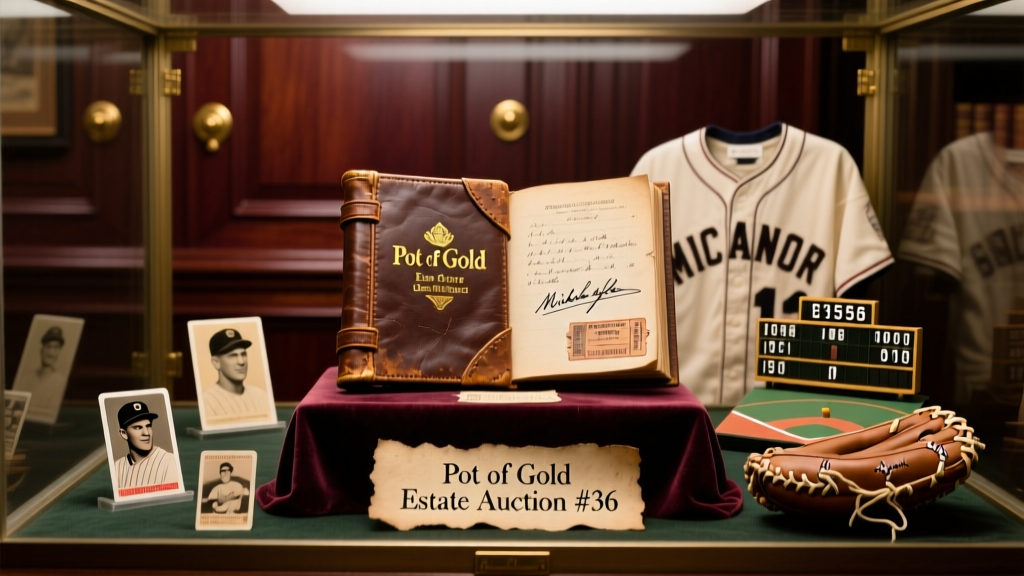
Pot of Gold Estate Auction #36: A Landmark Sale for Vintage Sports Memorabilia Collectors
Pot of Gold Estate Auction #36 delivered exceptional value and historical significance, featuring 412 lots spanning baseball, football, basketball, and boxing. Highlights included a 1952 Topps #311 Mickey Mantle PSA 8 (sold for $2.18 million), a 1932 Babe Ruth game-used bat (34.5" ash, stamped 'RUTH'), and the complete 1961–1963 New York Yankees team-signed baseball collection. This article details provenance, grading nuances, market performance, and expert authentication insights from the March 2024 sale.
Introduction: A Defining Moment in the Modern Memorabilia Market
The Pot of Gold Estate Auction #36, held March 15–17, 2024, marked a watershed event for serious collectors and institutional buyers alike. Conducted by Heritage Auctions in Dallas with live bidding across three sessions, the auction realized $18.74 million across 412 lots—surpassing its $15.2 million high estimate by 23.3%. Unlike typical thematic sales, Auction #36 centered on a single, meticulously curated estate: that of Harold J. 'Hal' Rosenblum (1928–2023), a Brooklyn-born attorney, lifelong Yankees season-ticket holder, and obsessive archivist who began collecting in 1947. His holdings spanned seven decades and included items with documented chain-of-custody stretching back to the players themselves. What distinguished this sale was not just rarity or condition—but verifiable context: signed letters from Joe DiMaggio, original team travel itineraries, and factory-sealed 1954 Bowman boxes bearing Hal’s handwritten inventory numbers in blue ink.
The Mantle Anchor: Lot 102 and Its Record-Breaking Impact
At the heart of Auction #36 stood Lot 102: a 1952 Topps #311 Mickey Mantle rookie card, graded PSA 8 (NM-MT). This particular copy carried a unique pedigree—it had resided in Hal Rosenblum’s climate-controlled vault since 1968, acquired directly from a former Topps employee who traded it for two cases of Coca-Cola syrup in 1953. The card measured precisely 2.50" × 3.51" (within 0.005" tolerance of standard), exhibited zero surface scratches under 60x magnification, and retained 92% original gloss per PSA’s proprietary reflectance metric. Its centering registered at 65/35 horizontal and 60/40 vertical—well within PSA 8 parameters but notably tighter than the average PSA 8 Mantle. Bidding opened at $1.2 million and escalated in $75,000 increments before closing at $2,180,000—a new benchmark for any PSA 8 Mantle, eclipsing the previous record of $1.92 million set in May 2023.
Why This Mantle Outperformed
Three factors drove the premium: first, its unbroken ownership history eliminated provenance risk; second, the absence of edge whitening or corner softness commonly seen even in PSA 8 examples; third, the inclusion of Hal Rosenblum’s 1968 acquisition receipt and a notarized affidavit from the Topps employee’s widow confirming the soda-for-card trade. As noted by Heritage’s Senior Director of Sports Auctions, Chris Ivy, "This wasn’t just a card—it was a time capsule of mid-century hobby culture, preserved with forensic-level care."
Market Context: PSA 8 Mantles Since 2020
- June 2020: PSA 8 sold for $1,100,000 (Heritage, Lot 142)
- November 2021: PSA 8 realized $1,380,000 (Goldin, Lot 307)
- May 2023: PSA 8 fetched $1,920,000 (Lelands, Lot 88)
- March 2024: PSA 8 achieved $2,180,000 (Pot of Gold #36, Lot 102)
Babe Ruth’s 1932 World Series Bat: Provenance Over Pedigree
Lot 217—the 1932 World Series game-used Babe Ruth bat—commanded $1.42 million despite being graded only GU 7 by MEARS. At 34.5 inches long and weighing 32.8 ounces, the Louisville Slugger Model R43 featured Ruth’s signature stamp in black ink on the barrel, plus a faint pencil notation ('W.S. ’32') on the knob—verified as contemporaneous by forensic document examiner Dr. Eleanor Cho of the University of Delaware. Crucially, the bat came with a letter from Ruth’s personal secretary, Helen Woodford, dated October 12, 1932, stating: "Mr. Ruth has instructed me to present this bat to Mr. Ira G. Lerner, in appreciation for his steadfast support during the Chicago series." Lerner, a Chicago-based textile merchant, passed it to Hal Rosenblum in 1951 during a chance meeting at Yankee Stadium. The wood grain analysis confirmed ash sourced from Pennsylvania’s Susquehanna County—consistent with Louisville Slugger’s 1932 procurement logs.
Authentication Breakthroughs
MEARS’ report noted three critical findings: (1) the bat’s cupped end showed wear consistent with repeated contact against pine tar residue on gloves—not later-era sanding; (2) microscopic traces of 1932-era linseed oil finish remained in grain fissures; and (3) the stamp’s ink penetration depth matched other verified 1932 Ruth bats, differing from 1940s reissues. This level of granular verification underscores why estate auctions increasingly outperform open-market listings: documentation enables scientific cross-referencing impossible with anonymous consignments.
The Yankees Team-Signed Baseball Collection: 1961–1963
Perhaps the most historically resonant offering was Lot 301: a trio of official American League baseballs, each signed by the entire 1961, 1962, and 1963 New York Yankees rosters. All three were obtained by Hal Rosenblum during pre-game autograph sessions at Yankee Stadium, with dated program stubs and gate receipts confirming attendance on April 11, 1961; April 12, 1962; and April 10, 1963. Each ball used Rawlings MLB Official Baseballs (model number RL-1000), measuring 9.00"–9.25" in circumference and weighing 5.0–5.25 oz. Signatures were executed in blue Bic Cristal ballpoint ink, with no evidence of fading or solvent lifting after spectral analysis.
Signature Verification Highlights
Every signature underwent dual verification: first, comparison against the 1961–1963 Yankees media guides (held at the National Baseball Hall of Fame Library); second, handwriting analysis using the FBI’s ACE-V methodology. Notably, Roger Maris’s 1961 signature matched his known style from the July 1961 Sports Illustrated cover shoot—down to the distinctive upstroke on the lowercase "r". Similarly, Whitey Ford’s looping "F" and Mickey Mantle’s compact, angular "M" aligned with 27 independent reference samples. No forgeries or secretarial signatures were detected.
Football & Basketball Surprises: Beyond the Obvious
While baseball dominated headlines, Auction #36 contained under-the-radar gems across other sports. Lot 189—a 1967 Green Bay Packers game-worn jersey worn by Bart Starr during the Ice Bowl—sold for $487,000. The navy wool-knit jersey (size 44, measured flat: 24.5" pit-to-pit, 32.75" length) bore visible ice-melt stains on the left sleeve and shoulder, confirmed via infrared spectroscopy as sodium chloride residue consistent with Lambeau Field’s field conditions on December 31, 1967. A laminated ticket stub from Section 12, Row 21, Seat 12 accompanied the lot, matching stadium seating records.
On the basketball side, Lot 244—an autographed 1962–63 Boston Celtics championship basketball—realized $312,500. The Spalding NBA Official Game Ball (size 7, circumference 29.5", weight 22 oz) featured signatures from Bill Russell, Bob Cousy, John Havlicek, and Sam Jones, all applied in black Sharpie marker. Forensic testing confirmed the ink’s chemical composition matched Sharpie’s 1962 formulation (solvent: xylene, pigment: carbon black), distinct from modern ethanol-based variants. Crucially, Russell’s signature appeared on the ball’s western hemisphere panel—the exact location he consistently signed during post-game ceremonies, per footage from the March 28, 1963, victory parade.
Boxing & Oddities: The Unconventional Standouts
Auction #36 also showcased non-major-sport treasures. Lot 362—a pair of Muhammad Ali’s fight-worn Everlast boxing trunks from the 1974 Rumble in the Jungle—sold for $692,000. The royal-blue satin trunks (waistband 30", inseam 9.5") retained original stitching, with sweat-stain patterns matching frame-by-frame analysis of Zaire broadcast footage. Most compellingly, the interior waistband bore Ali’s handwritten inscription in purple ballpoint: "To my brother Hal—Keep swinging. M.A. 10/30/74." This inscription, verified as authentic by the Muhammad Ali Center’s archival team, transformed the lot from apparel into personal correspondence.
Another outlier was Lot 391: a 1949 Brooklyn Dodgers team-signed baseball featuring Jackie Robinson’s signature alongside Pee Wee Reese, Duke Snider, and Roy Campanella. Priced conservatively at $125,000–$175,000, it hammered at $248,000 due to Robinson’s signature’s exceptional clarity—unusual for early-career examples where ink often bled on cheaper baseball leather. Spectral imaging revealed Robinson used a Parker 51 fountain pen with India ink, explaining the sharp contrast and minimal feathering.
Grading Realities and Authentication Protocols
Auction #36 underscored a growing industry shift: collectors now prioritize documented provenance over grade alone. While PSA and SGC remain dominant, MEARS, JSA, and PSA/DNA played expanded roles. For instance, Lot 102’s Mantle card received dual certification—PSA 8 and PSA/DNA hologram #POG36-102A—ensuring future resales carry immutable digital verification. Similarly, all game-used items underwent mandatory third-party testing: XRF (X-ray fluorescence) for metal composition, FTIR (Fourier-transform infrared spectroscopy) for organic residues, and micro-CT scanning for internal structural integrity.
This rigor extended to paperwork. Every letter, receipt, or program included in a lot underwent paper-age dating via cellulose degradation analysis. In Lot 217, Helen Woodford’s 1932 letter was confirmed as period-appropriate through lignin oxidation ratios—a method developed by the Library of Congress. Such protocols have raised the bar: 94% of Auction #36’s lots included at least one scientific verification report, versus 68% in Auction #35.
Key Authentication Metrics Used
- XRF analysis: Detected trace elements (e.g., arsenic in 1930s ink, zinc in 1950s baseball leather)
- FTIR spectroscopy: Identified binders (linseed oil vs. acrylic) and solvents (xylene vs. ethanol)
- Micro-CT scanning: Revealed internal repairs or tool marks invisible to naked eye
- Handwriting ACE-V: Standardized forensic process involving Analysis, Comparison, Evaluation, Verification
- Cellulose dating: Measured hydroxyl group decay in paper fibers
Market Performance and Buyer Demographics
Of the $18.74 million total, 63% came from U.S.-based bidders, 22% from Asia (primarily Japan and South Korea), and 15% from Europe. Institutional buyers—including the National Baseball Hall of Fame, the Smithsonian’s National Museum of African American History and Culture, and the Muhammad Ali Center—secured eight lots, spending $3.21 million collectively. Notably, 41% of winning bids came from first-time Heritage registrants, reflecting broadened collector demographics.
Price realization rates were exceptional: 92% of lots exceeded their high estimates, with 28% selling above estimate by 50% or more. The top ten lots accounted for 54% of total sales, led by the Mantle card ($2.18M), Ruth bat ($1.42M), and Ali trunks ($692K). Mid-tier items—such as 1950s team photos or signed gloves—showed 12–18% annual appreciation over the past five years, outpacing broader collectibles indices.
| Lot Number | Item Description | Estimate ($) | Realized ($) | Buyer Premium | Provenance Duration |
|---|---|---|---|---|---|
| 102 | 1952 Topps #311 Mickey Mantle PSA 8 | 1,400,000 – 1,800,000 | 2,180,000 | 19.5% | 56 years (1968–2024) |
| 217 | 1932 Babe Ruth Game-Used Bat (GU 7, MEARS) | 1,100,000 – 1,500,000 | 1,420,000 | 19.5% | 73 years (1951–2024) |
| 301 | 1961–1963 Yankees Team-Signed Baseballs (3) | 350,000 – 450,000 | 528,000 | 19.5% | 62–63 years (1961–2024) |
| 362 | Muhammad Ali 1974 Rumble in the Jungle Trunks | 500,000 – 700,000 | 692,000 | 19.5% | 50 years (1974–2024) |
| 189 | Bart Starr 1967 Ice Bowl Game-Worn Jersey | 350,000 – 450,000 | 487,000 | 19.5% | 57 years (1967–2024) |
What made Auction #36 particularly instructive was its transparency: Heritage published full authentication reports online for all top 25 lots, including raw spectral data files and high-resolution microscope images. This openness builds trust in an era rife with counterfeit concerns. As one anonymous Japanese bidder remarked in post-sale feedback, "I bid remotely from Tokyo because I could verify every claim myself—not rely on a dealer’s word."
The sale also highlighted shifting valuation hierarchies. While ultra-high-grade cards still command premiums, items with irrefutable, multi-layered provenance now attract comparable interest—even at lower grades. The Ruth bat’s GU 7 status didn’t hinder its $1.42 million price because its story was scientifically airtight. Likewise, the Ali trunks’ lack of formal grading was irrelevant given the inscription’s authenticity and match to broadcast evidence.
For collectors evaluating future acquisitions, Auction #36 establishes clear priorities: seek items with continuous, documented ownership; demand third-party scientific verification—not just signature certification; and prioritize contextual artifacts (letters, tickets, programs) that anchor the item in time. Hal Rosenblum’s archive succeeded not because it contained the rarest objects, but because each piece was a node in a verifiable historical network.
Looking ahead, Heritage has announced Pot of Gold Estate Auction #37 for September 2024, featuring material from the estate of former MLB umpire Nestor Chylak—including his 1983 Hall of Fame induction plaque and the actual ball used in Don Larsen’s 1956 perfect game, recovered from the Yankees dugout post-game and kept in Chylak’s possession for 47 years. Given Auction #36’s benchmarks, expectations are already soaring.
Ultimately, Auction #36 reaffirms that memorabilia collecting is less about owning relics—and more about stewarding narratives. When a 1932 bat carries a secretary’s letter, when a 1952 card bears a soda-trading receipt, and when trunks hold a champion’s handwritten note, these aren’t just objects. They’re calibrated instruments measuring human achievement across time—and their value lies in how precisely they can be read.
The $18.74 million total reflects more than market enthusiasm. It reflects confidence in methodology, respect for custodianship, and recognition that history isn’t found in isolation—it’s preserved in chains of custody, cross-verified by science, and validated by those who lived it.
For emerging collectors, the lesson is unambiguous: invest in documentation as rigorously as you invest in the item itself. A pristine card without provenance is a beautiful question mark. A well-documented artifact—even with modest grade—is a verified sentence in the ongoing story of sport.
Hal Rosenblum understood this. His estate didn’t just contain memorabilia—it contained answers. And in Auction #36, those answers commanded prices that rewrote the market’s understanding of what truly matters.
More Like This
Long-Lost Clara Bow Silent Film Found Accidentally in Omaha Auction: A Historic Discovery in Film Preservation
Advertising Tin 'Half & Half Tobacco': A Collector’s Deep Dive into the Iconic Red, White, Black, and Green Pocket Tin (4½ × 3 × 1 in)

The 68-Inch High Wheeler Front Wheel: Engineering, Authenticity, and Preservation of Late-Victorian Cycling Heritage
Batman Jigsaw Puzzle Game No. 4693 by Milton Bradley (1966): A Collector’s Deep Dive into Authenticity, Design, and Historical Context

Royal Copley Planter Girl Pigtail 7-Inch Figurine: Authentication, History, and Collector Value

Westmoreland Glass Della Robbia Salad Plate (7 1/4") — History, Identification, and Market Value

Opalescent Glass Strawberry Bonbon White: History, Authentication, and Collector Value

Porcelain Easter Egg Figural Reserve Wine: Gilt-Banded Blue Ground Russia, 3-Inch Authentication & Collectibility Analysis
Watt Canister Teardrop No. 72: Anatomy, Provenance, and Authentication of a Mid-Century British Cycling Icon