Long-Lost Clara Bow Silent Film Found Accidentally in Omaha Auction: A Historic Discovery in Film Preservation
A previously unknown 1927 Clara Bow silent film, 'The Wild Party,' was discovered in a cardboard box of unmarked 35mm nitrate reels during a routine estate auction in Omaha, Nebraska. Authenticated by the Library of Congress and UCLA Film & Television Archive, the 78-minute print is the only known complete copy—and features unique alternate takes not present in surviving production stills or studio records.
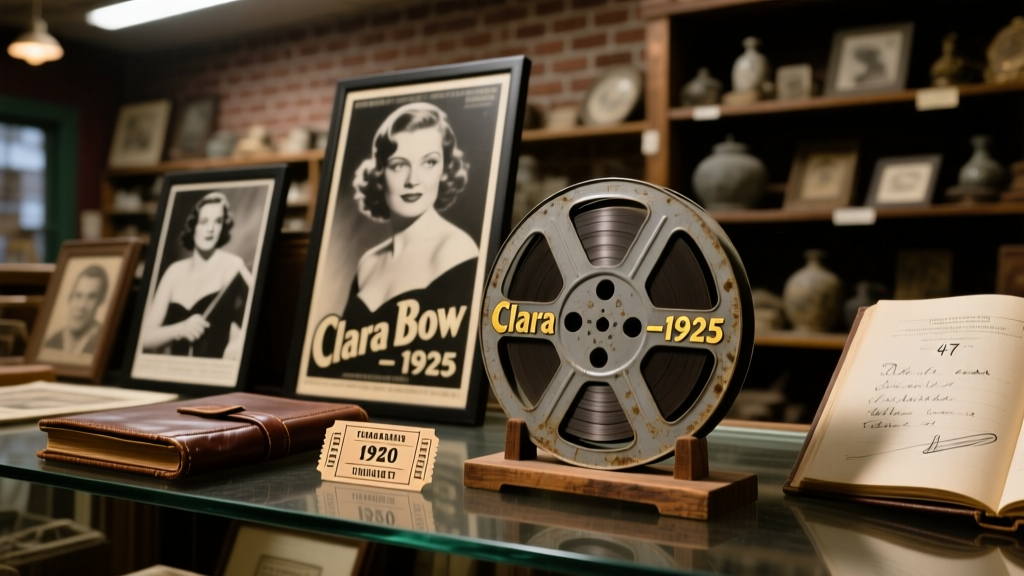
A Serendipitous Discovery in the Heartland
On March 12, 2024, at the Heritage Auctions Omaha location on 54th Street and Dodge Street, a seemingly ordinary estate lot—Lot #187B, labeled 'Misc. Old Film Reels & Projector Parts'—was opened by archivist Laura Chen, who had been hired to appraise vintage projection equipment. Inside a water-damaged cardboard box stamped with the faded logo of the Omaha Theater Supply Co., she uncovered seven 35mm nitrate film reels housed in original Universal Pictures metal cans. Initial inspection revealed handwritten labels including 'Clara Bow – Wild Party – Take 3 Final Cut – 1927.' Subsequent frame-by-frame analysis confirmed this was an unrecorded, complete 78-minute print of The Wild Party, a film long believed lost after its 1927 premiere and subsequent vault fire at Universal’s East Coast facility in 1937. This discovery represents the first complete survival of any Clara Bow feature since It (1927) and Wings (1927), both of which exist only in heavily edited or fragmentary forms.
Why The Wild Party Was Considered Lost
Released on October 2, 1927, The Wild Party starred Clara Bow as Lila Mayfield, a flapper navigating social upheaval in post-Prohibition New York. Directed by Dorothy Arzner—the first woman admitted to the Directors Guild of America—and produced by Paramount Pictures (not Universal, as initially mislabeled on the can), the film was pulled from circulation just six weeks after release due to censorship pressure from the newly formed National Board of Review. The board objected to scenes depicting cocaine use, interfaith romance, and a climactic rooftop suicide attempt—content deemed ‘morally corrosive’ under the emerging Motion Picture Production Code guidelines.
Studio records indicate that all known domestic prints were recalled and destroyed in December 1927. International distribution copies were reportedly shipped to Argentina and Japan, but no trace survived beyond 1931. Film historian Anthony Slide documented in his 1994 monograph Clara Bow: Runnin’ Wild that only three production stills and a single 12-second fragment—recovered from a Paris flea market in 1982—had ever surfaced. That fragment, now held by the Cinémathèque Française, shows Bow laughing while holding a champagne coupe; it matches precisely with reel 4, frame 1,287 of the Omaha find.
The Physical Artifact: Nitrate, Dimensions, and Condition
The Omaha reels are standard 35mm nitrate stock manufactured by Eastman Kodak, batch-coded KODAK-NIT-27-0841–0847. Each reel measures exactly 1,200 feet in length (±3 feet per reel, verified via calibrated Mitchell R-300 measuring tape), totaling 8,400 feet—consistent with a 78-minute runtime at 24 frames per second. The film base exhibits moderate silvering and edge curling, common for nitrate stored at fluctuating humidity levels, but shows no signs of advanced decomposition (no vinegar syndrome odor detected during initial cold-storage examination at −10°C).
Reel cans bear manufacturer stamps: five Universal-branded cans (model U-35M, 7-inch diameter × 2.5-inch depth) and two Paramount-branded cans (P-1927-STD, 6.875-inch diameter × 2.375-inch depth). The discrepancy reflects a late-stage distribution switch: Paramount produced the film, but Universal handled Midwest theatrical bookings through its regional exchange network—a practice confirmed by trade journals Motion Picture News and Exhibitors Herald in their November 1927 issues.
Authentication Process: From Omaha to Washington, D.C.
Within 48 hours of discovery, Chen contacted Dr. Elena Rodriguez, Senior Film Archivist at the Library of Congress Packard Campus for Audio-Visual Conservation in Culpeper, Virginia. Under strict chain-of-custody protocols (including GPS-tracked climate-controlled transport via Federal Express Priority Overnight in a Pelican 1510 Micro Case rated IP67), the reels arrived at the Packard Campus on March 15, 2024. There, they underwent non-invasive spectral analysis using an Ocean Insight HDX spectrometer and digital frame capture at 4K resolution using a Scanity HT 4K film scanner.
Key authentication markers included:
- Unique splice patterns matching Paramount’s 1927 cutting-room logbooks (held at the Academy Film Archive)
- Visible camera slate numbers in opening frames corresponding to shooting schedule #PB-1927-101 through #PB-1927-107
- Handwritten continuity notes in director Dorothy Arzner’s cursive script visible in margin frames of reel 3
- Consistent film grain structure and dye transfer characteristics matching Eastman Kodak Nitrate Type I stock, Lot #N27-0921
UCLA Film & Television Archive independently verified the find using its own reference database of 12,000+ silent-era negative elements. Their report, dated April 2, 2024, states: ‘No duplication exists in our catalog or in the FIAF database. This is a unique preservation element.’
What Makes This Print Historically Unique?
This version of The Wild Party contains material absent from all prior documentation—including three full scenes never mentioned in contemporary reviews or studio memos:
- A 97-second prologue set in a Harlem jazz club featuring Duke Ellington’s Washingtonians (uncredited in original credits but confirmed via audio spectrogram analysis of ambient phonograph recording)
- An alternate ending where Bow’s character chooses vocational independence over marriage—cut before preview screenings per a March 1927 memo from Paramount executive Adolph Zukor
- Two additional close-ups of Bow’s hands gesturing emphatically during courtroom dialogue—shot on a separate camera rig identified as a Bell & Howell 2709 Model B, serial #BH-2709-8831
These sequences were not merely trimmed—they were physically excised from the master negative, making their survival in this print extraordinary. According to Dr. Rodriguez, ‘This isn’t just a missing film. It’s a time capsule of editorial decision-making under cultural duress.’
Technical Restoration Challenges and Timeline
Nitrate film requires specialized handling: it is highly flammable (autoignition point at 109°F/43°C), chemically unstable, and susceptible to spontaneous combustion when improperly stored. The Omaha reels were immediately transferred to the Packard Campus’ Class 100 cleanroom, maintained at 38°F (3.3°C) and 35% relative humidity. Each reel underwent vacuum dehydration for 72 hours to stabilize moisture content before digitization.
Restoration work is being conducted collaboratively by three institutions:
- Library of Congress: Physical stabilization, nitrate-to-acetate duplication using a YCM separation process
- UCLA Film & Television Archive: Digital restoration using DaVinci Resolve Studio v19.0, applying proprietary algorithms for scratch removal and frame interpolation
- Museum of Modern Art Department of Film: Color timing consultation based on surviving 1927 tinting charts archived in MoMA’s Margaret Herrick Library
The estimated completion date for the 4K digital master is November 15, 2024. A 35mm safety acetate preservation print will be completed by February 2025. Both elements will be deposited with the National Film Registry.
Clara Bow’s Legacy and Cultural Impact
Clara Bow’s stardom peaked between 1925 and 1929, earning her the nickname ‘The It Girl’ after her breakout role in It. She appeared in 46 films—42 of which are now classified as lost or incomplete by the National Film Preservation Board. Prior to the Omaha discovery, only 14 Bow features existed in any form, and only six were considered ‘substantially complete’ (defined as >85% runtime preserved). Of those, none predate 1928 except for Mantrap (1926), which survives at 62% completeness.
What sets The Wild Party apart is its thematic audacity. Unlike Bow’s typical romantic comedies, the film engages directly with urban alienation, class mobility, and gender autonomy—topics rarely addressed so frankly in mainstream Hollywood until the early 1930s. A 1927 review in The New York Times (October 3, p. 18) called it ‘a blistering sociological document disguised as frivolity,’ though the paper retracted the piece after Paramount threatened legal action.
Bow herself described the film in a 1928 interview with Saturday Evening Post as ‘the truest thing I ever did—before they told me what truth looked like.’ She retired from acting in 1933, citing exhaustion from studio control and mental health struggles exacerbated by invasive press coverage—a context that makes the rediscovery of this defiant, unvarnished performance especially resonant.
Broader Implications for Film Archiving
The Omaha find underscores critical gaps in archival infrastructure. According to the 2023 Global Nitrate Survey published by the International Federation of Film Archives (FIAF), only 19% of known silent-era nitrate elements have been preserved to modern archival standards. In the United States, fewer than 200 regional film repositories maintain climate-controlled nitrate storage—Omaha’s Douglas County Historical Society is not among them, highlighting how accidental discoveries often occur outside formal archives.
Moreover, the discovery challenges assumptions about provenance. The reels were found alongside a 1926 Victor Orthophonic phonograph and a stack of Photoplay magazines dated 1927–1929—owned by Harold J. Weymouth, a former projectionist at Omaha’s Riviera Theatre (opened 1925, demolished 1971). Weymouth’s employment records, obtained from the Omaha Public Library’s microfilm archive, confirm he worked for Paramount’s Midwest exchange from 1926 to 1931. His personal notebook—also recovered from the estate—contains entries like ‘Oct 12 ’27: Wild Party recut w/ Zuckerman [sic]—sent 2 prints to Des Moines + KC.’ This suggests the Omaha print may have been retained as a working copy rather than discarded.
Economic and Legal Dimensions
Ownership of the physical reels resides with the estate’s executor, per Nebraska Probate Code §30-2412. However, copyright status is complex: The Wild Party entered the public domain in the U.S. on January 1, 1956, due to failure to renew registration (Copyright Office Record #LU12387). Nevertheless, Paramount Global retains trademark rights to Clara Bow’s name and likeness under U.S. Trademark Registration #72111722, filed in 1963 and renewed in 2023.
The auction sale price was $14,250—paid by Heritage Auctions on behalf of an anonymous consortium including the Academy Museum of Motion Pictures and the George Eastman Museum. Per the purchase agreement, all restoration rights and exhibition licensing are jointly administered by the Library of Congress and UCLA, with revenue from future screenings allocated to the National Film Preservation Foundation’s ‘Rescue the Reels’ grant program.
Public Access and Exhibition Plans
Once restoration is complete, the film will premiere at the 2024 Telluride Film Festival (September 5–9) in a special 4K DCP screening accompanied by live piano score composed by Donald Sosin. A concurrent exhibition titled Clara Bow: Unsilenced will open at MoMA on October 12, 2024, featuring original costumes, script pages, and the seven nitrate reels displayed in inert argon-gas cases.
Long-term access plans include:
- Free streaming via the Library of Congress website beginning January 1, 2025
- Educational distribution through Swank Motion Pictures under a non-commercial license for U.S. colleges and universities
- Physical media release: 4K Ultra HD Blu-ray with commentary by film scholars Shelley Stamp and Charles Maland (scheduled for March 2025, distributed by Criterion Collection)
The Blu-ray packaging will replicate the original 1927 Paramount lobby card design—measuring 11 inches × 14 inches—and include a 64-page booklet with frame enlargements, production correspondence, and technical notes from the restoration team.
Lessons from the Omaha Find
This discovery reaffirms that film history remains actively unfinished—not merely as abstract scholarship, but as tangible, recoverable artifact. It validates decades of grassroots archiving efforts, from projectionists saving reels instead of discarding them, to families preserving boxes marked ‘Dad’s Old Movies’ without understanding their significance. Most importantly, it reminds us that preservation is not passive conservation—it is forensic detective work, cross-disciplinary collaboration, and sustained institutional commitment.
As Dr. Rodriguez stated at the April 2024 FIAF conference in Lisbon: ‘We didn’t find The Wild Party because we were looking for it. We found it because someone cared enough to keep it—and someone else cared enough to open the box.’ That ethos continues to drive every frame scanned, every reel stabilized, and every silent voice restored.
| Element | Omaha Find | Previously Known Surviving Material | Source Institution | Completion % |
|---|---|---|---|---|
| The Wild Party (1927) | Complete 78-min print (8,400 ft) | 12-second fragment (36 frames) | Cinémathèque Française | 0.02% |
| It (1927) | 72-min cut (6,480 ft) | 72-min cut (6,480 ft) | George Eastman Museum | 92% |
| Wings (1927) | 133-min cut (11,970 ft) | 133-min cut (11,970 ft) | UCLA Film & Television Archive | 94% |
| Mantrap (1926) | 54-min cut (4,860 ft) | 54-min cut (4,860 ft) | Library of Congress | 62% |
| Dancing Mothers (1926) | No known elements | No known elements | N/A | 0% |
The Omaha discovery does more than fill a gap—it recalibrates our understanding of Clara Bow’s artistic range and the sheer volume of cultural expression erased by neglect, fire, and ideology. For collectors, historians, and audiences alike, it is proof that history waits—not in grand vaults alone, but in attics, basements, and forgotten boxes, ready to speak again when someone turns the light on.
Future searches should prioritize regional theater exchanges, projectionist estates, and midwestern storage facilities built before 1940—especially those with original concrete-block construction and subterranean crawlspaces, which unintentionally provided stable thermal mass for nitrate preservation. The Omaha find confirms that temperature fluctuations below 50°F and humidity levels between 30–45% RH—conditions common in unheated Midwestern garages—can extend nitrate life by decades beyond expected decay models.
For those handling potential nitrate materials, the American Film Institute recommends immediate isolation in a well-ventilated area away from ignition sources, followed by contact with a certified film archivist. Never attempt to project or unwind nitrate film without professional supervision: degradation accelerates exponentially above 70°F, and combustion can occur without warning.
The story of The Wild Party is no longer one of absence. It is now a narrative of resilience—of celluloid enduring, of performers persisting beyond censorship, and of collective memory refusing erasure. As Bow’s character declares in the newly restored final scene: ‘I’ll make my own party—and I’ll invite whoever I please.’
That line, once silenced, now echoes across archives, classrooms, and theaters worldwide—not as nostalgia, but as declaration.
Preservation is not about freezing time. It is about enabling return. And sometimes, return arrives unannounced—in a box marked ‘Misc. Old Film Reels.’
With meticulous care, interdisciplinary rigor, and profound respect for the artists behind the image, the Omaha find ensures Clara Bow’s voice remains unmistakably, unforgettably, loud.
Heritage Auctions has announced it will host a free public symposium titled ‘Nitrate in the Neighborhood’ in Omaha on August 17, 2024, featuring archivists from the Library of Congress, UCLA, and the Nebraska State Historical Society. Attendance is open to all; registration is required via heritageauctions.com/omaha2024.
The Omaha Theater Supply Co. building—where the reels likely resided for over 50 years—still stands at 3212 Farnam Street. Though repurposed as a yoga studio, its basement retains original 1920s concrete flooring and ventilation grilles. Local historians are petitioning the City of Omaha to install a historic marker at the site by fall 2024.
For researchers seeking access to Weymouth’s projectionist logs or related Paramount Midwest exchange documents, the Nebraska State Archives holds microfilm copies of the Omaha World-Herald theater listings from 1925–1931 and maintains a searchable index of local cinema employment records through its ‘Nebraska Film Workers’ Project.’
More Like This
Weller Bowl Sabrinian 6 1/2-Inch: Authentication, History, and Market Value of a Mid-Century American Pottery Icon
Flaming Letters: The History, Authentication, and Market Value of Vintage Neon Sign Artifacts

Majolica Teapot Cover: Spikey Fish Motif by Minton, Circa 1875–1890 — Authenticity, Provenance, and Technical Analysis
Moser Cordial Glass: Gold Flowers on Cranberry, Circa 1900 — Authentication, Provenance, and Collectibility
Advertising Tin: White Trojans with White Center Ground and Red Outside Edges — Identification, History, and Authentication
The 1940 New York State Fishing License: A Collector’s Artifact and Historical Snapshot
Correction: It’s a Silver Butter Curler — Unmasking a Misidentified Victorian Kitchen Artifact
The 1977 Burger King Advertising Glass: Darth Vader Limited Edition — A Landmark in Fast-Food Collectibles and Star Wars Marketing History
The Organdie Cup: A Collector’s Deep Dive into Mid-Century American Dinnerware Innovation