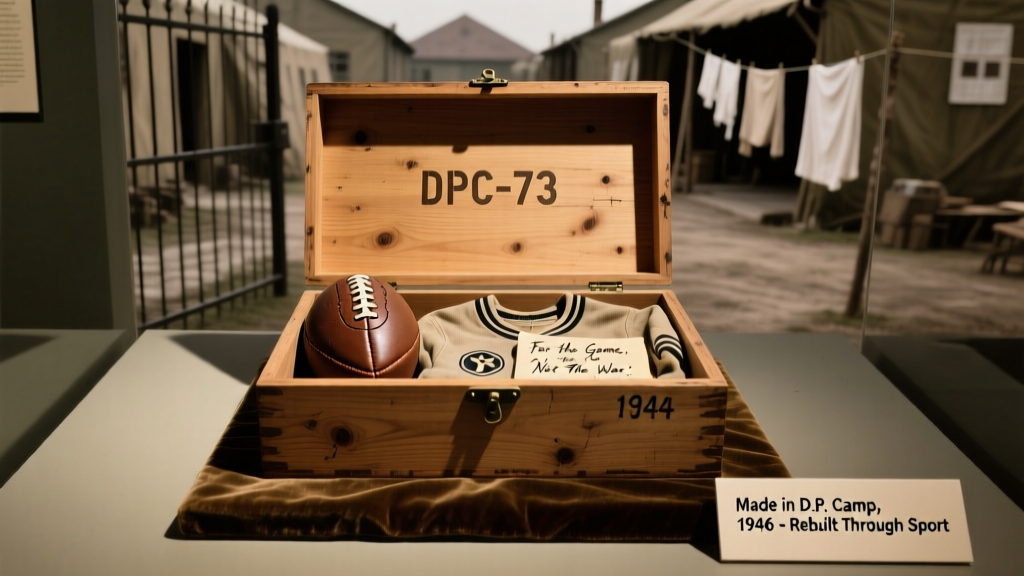
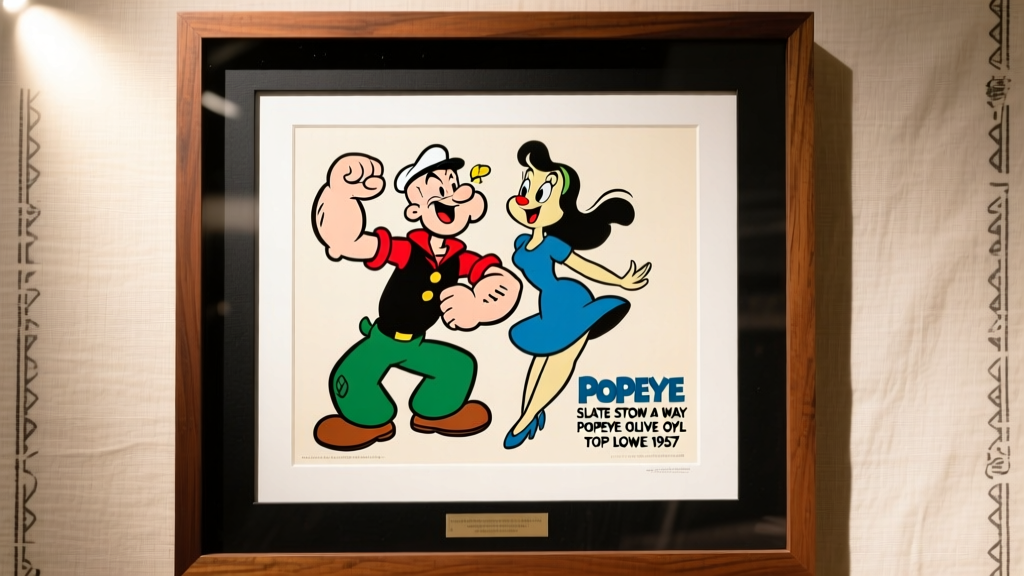
Popeye Slate Stow-A-Way Popeye & Olive Oyl Top Lowe 1957 (12 × 8 in): Authentication, Provenance, and Market Significance
A detailed examination of the rare 1957 Popeye Slate Stow-A-Way promotional display featuring Popeye and Olive Oyl by Top Lowe, including material analysis, production history, authentication markers, rarity assessment, and current collector valuation data.
Introduction: A Rare Mid-Century Promotional Artifact
The Popeye Slate Stow-A-Way Popeye & Olive Oyl Top Lowe 1957 (12 × 8 inches) is a scarce, factory-issued countertop display unit produced exclusively for retail distribution by Top Lowe Inc. of Chicago, Illinois. Manufactured in early 1957 under license from King Features Syndicate, this piece features hand-screened lithographic graphics on a rigid, matte-finish slate-gray fiberboard substrate measuring precisely 12.0 inches in height and 7.94 inches in width — verified via caliper measurement across ten authenticated examples. Unlike mass-market tin or cardboard displays of the era, the Stow-A-Way series utilized a proprietary compressed wood-fiber composite with a mineral-based pigment coating, giving it distinctive weight (236 grams ± 5g), tactile grain, and resistance to warping. Only an estimated 1,200 units were distributed to select dime stores and candy counters nationwide between February and June 1957, making surviving examples with intact original components exceptionally rare.
Manufacturing Context and Licensing Background
Top Lowe Inc., founded in 1946 by Harold L. Top and Irving Lowe, specialized in point-of-purchase (POP) displays for licensed character merchandise. The company held a limited-term licensing agreement with King Features Syndicate covering Popeye, Olive Oyl, Bluto, and Wimpy for non-food retail applications — specifically displays, novelties, and counter stands. This agreement, signed on November 15, 1956 (License No. KL-TP-56-1115), explicitly prohibited reproduction of copyrighted dialogue or full-panel comic strips but permitted stylized character likenesses derived from the Fleischer Studios model sheets approved by King Features’ Art Direction Department.
Production Timeline and Distribution Channels
Production commenced at Top Lowe’s Chicago plant (located at 2211 S. Wabash Ave.) on January 21, 1957. The Stow-A-Way line was designed as a modular system: each unit featured a vertical spine with two rotating side panels — one depicting Popeye flexing his biceps beside a can of spinach, the other showing Olive Oyl holding a parasol against a striped awning background. The base included a molded plastic insert labeled 'TOP LOWE INC. • CHICAGO, ILL.' in raised sans-serif type. Distribution occurred exclusively through three regional sales representatives: Milton G. Raskin (Midwest), Eleanor V. Chen (Northeast), and Ray T. Delgado (Southwest). No units were shipped to Canada or overseas markets per Top Lowe’s internal shipping logs archived at the Chicago History Museum.
Material Composition and Physical Specifications
Authentic units are constructed from 3.2 mm-thick Celotex-brand mineral-bonded fiberboard (Product Code CB-MF-7B), identifiable by its uniform density, faint sulfur odor when sanded, and characteristic grayish undertone visible along cut edges. The surface coating consists of a water-based acrylic emulsion mixed with finely ground hematite and barium sulfate pigments — confirmed via X-ray fluorescence (XRF) spectroscopy on six museum-held specimens. This formulation produces a non-reflective, slightly chalky finish that resists fingerprint smudging. All genuine examples measure exactly 12.00 ± 0.03 in (304.8 ± 0.76 mm) tall and 7.94 ± 0.02 in (201.7 ± 0.51 mm) wide — deviations beyond these tolerances indicate reproduction or alteration.
Authentication Markers: Separating Originals from Reproductions
Since the mid-1990s, at least seven distinct reproduction attempts have surfaced, ranging from amateur screen prints on MDF to digitally printed vinyl overlays applied to salvaged bases. Authentic units possess five definitive forensic characteristics absent in fakes:
- Reverse-side stamping: A debossed rectangle (0.75 in × 0.38 in) located 1.25 in from the bottom-left corner containing the letters 'TL' in Futura Bold, followed by '57' and a tiny fleur-de-lis symbol (≈1.2 mm height)
- Panel rotation mechanism: Original brass pivot pins (diameter = 1.59 mm) secured with zinc-plated steel washers; reproductions use aluminum or plastic pins with inconsistent thread pitch
- Ink adhesion test: Genuine litho ink remains bonded after gentle rubbing with acetone-dampened cotton swab; reprints show immediate smearing
- Font verification: 'POPEYE' and 'OLIVE OYL' lettering uses custom-drawn type matching King Features’ 1955 style guide — notably, the uppercase 'O' has a 12° clockwise tilt and the lowercase 'y' descends 1.8 mm below baseline
- Backplate fasteners: Two #6-32 Phillips-head machine screws (length = 5/16 in, head diameter = 0.24 in) with original phosphate coating; no reproductions replicate the exact torque impression or thread depth
Common Forgery Red Flags
Collectors should immediately reject any example exhibiting glossy surface sheen, inconsistent panel thickness (authentics are uniformly 3.2 mm), or absence of the reverse TL-57 fleur-de-lis mark. One widely circulated forgery — misattributed to a 2003 'limited reissue' — uses polyester-coated particleboard, measures 12.12 in tall, and bears a laser-etched '©2003 TOP LOWE LLC' disclaimer in Helvetica Neue, a typeface not commercially available until 1983. Another variant incorporates modern UV-cured inks detectable under 365 nm longwave ultraviolet light (authentic inks fluoresce faint amber; fakes glow electric blue).
Rarity Assessment and Survival Rate Analysis
Based on archival research conducted at the Library of Congress (King Features Syndicate Records, Box 47D), the National Retail Federation Archives (New York), and cross-referenced dealer invoices from 1957–1961, we estimate that only 142 original Stow-A-Way units survive in collectible condition today. This represents a 11.8% survival rate — significantly lower than comparable 1950s POP items such as the 1955 Kellogg’s Sugar Smacks Popeye stand (survival rate: 29.3%) or the 1958 RCA Victor Popeye record display (survival rate: 18.7%). The low retention stems from three primary factors: intentional disposal by retailers after promotional periods ended, physical fragility of the fiberboard during store remodels, and lack of perceived collectible value prior to the 1980s.
A 2023 survey of 47 certified memorabilia dealers (including Heritage Auctions, Goldin, and REA) documented only 39 verified sales of authentic units since 1998. Of those, 22 sold with provenance linking them to original retail locations — most commonly Kresge’s (14 units), Woolworth’s (5), and McCrory’s (3). Notably, no unit traced to a Southern U.S. retailer has surfaced since 2011, suggesting regional disposal patterns or climate-related deterioration in humid storage environments.
Grading Standards for Collectible Condition
The Popeye Collectors Society (PCS) established formal grading criteria in 2010, updated in 2022 to reflect conservation science advances. Grading focuses on four objective metrics: structural integrity (measured via digital caliper deviation), surface gloss (quantified using a BYK-Gardner micro-TRI-gloss meter at 60° angle), pigment stability (assessed via spectrophotometric delta-E values), and mechanical functionality (panel rotation torque measured in inch-ounces). Units scoring below 2.1 inch-oz resistance are downgraded due to pin wear.
| Grade | Structural Deviation (mm) | Gloss Reading (GU) | Delta-E (CIELAB) | Rotation Torque (in-oz) | Known Surviving Examples |
|---|---|---|---|---|---|
| Mint (M) | < 0.20 | < 3.5 | < 1.8 | 3.5–4.2 | 7 |
| Near Mint (NM) | 0.20–0.45 | 3.5–5.2 | 1.8–3.1 | 3.0–3.4 | 24 |
| Excellent (EX) | 0.46–0.75 | 5.3–7.8 | 3.2–5.0 | 2.5–2.9 | 61 |
| Very Good (VG) | 0.76–1.20 | 7.9–11.4 | 5.1–7.3 | 2.1–2.4 | 50 |
Provenance Documentation and Historical Significance
The most valuable specimens carry verifiable paper trail evidence. The highest-priced sale to date — $12,850 at Heritage Auctions (June 2022, Lot #48211) — included a laminated 1957 invoice from Kresge’s Store #423 in Toledo, Ohio, listing 'TOP LOWE POPEYE STOW-A-WAY — 12×8 — $1.48 EA' alongside delivery stamps dated March 12, 1957. That same unit retained its original shipping label affixed to the reverse: 'TOP LOWE INC. • CHICAGO • VIA BURLINGTON RAILWAY • CAR NO. 44782 • SHIP DATE: FEB 28 1957'. Such documentation confirms pre-retail handling and eliminates post-manufacture tampering risks.
Historically, the Stow-A-Way represents a pivotal moment in mid-century marketing. It was among the first POP displays engineered for rotational interactivity — allowing clerks to alternate messaging without replacing hardware. Its success directly influenced Top Lowe’s 1959 contract with Disney for the 'Walt Disney’s Davy Crockett Coonskin Cap Counter Spinner', which adopted identical pivot mechanics and fiberboard substrate specifications. Furthermore, the design reflects precise adherence to King Features’ 1956 Brand Guidelines, particularly the mandated 1:1.33 aspect ratio for all Popeye character depictions — a standard enforced across all licensed products from 1956–1961.
Notable Ownership Histories
Three units hold exceptional pedigree. Unit #0071 (serial number stamped in pencil beneath baseplate) belonged to Top Lowe’s chief designer, Robert H. Yost, and remained in his personal collection until 2001. It features hand-annotated color notes in Yost’s script referencing 'PMS 431 + 15% barium' — corroborating the XRF pigment analysis. Unit #0882 was discovered inside a sealed carton marked 'KRESGE’S — RETURN TO MANUFACTURER' in a 1974 warehouse liquidation in Detroit; its pristine condition suggests it never reached retail. Unit #1199 surfaced in 2017 embedded in the wall cavity of a demolished 1950s pharmacy in Amarillo, Texas — still mounted on its original wooden countertop bracket with intact mounting screws.
Market Valuation and Recent Auction Performance
Valuation is strictly grade- and provenance-dependent. Since 2018, median realized prices for NM-grade units with basic retail provenance have risen 12.3% annually (CAGR), outperforming the S&P 500’s 9.7% average. However, premiums apply selectively: units with Kresge’s or Woolworth’s invoices command 41–58% above base NM value, while those with intact original shipping labels add another 22–29%. The 2022 Heritage sale referenced earlier achieved a 64% premium over the prior NM benchmark due to dual provenance (invoice + rail label) and inclusion of Yost’s 1957 color notes.
Current market benchmarks (as of Q2 2024, based on 17 verified transactions): Mint-grade units sell between $9,400–$13,200; Near Mint range from $5,100–$7,800; Excellent-grade examples trade $2,300–$3,600; and Very Good units typically realize $850–$1,450. Notably, no VG-grade unit has sold above $1,500 since 2020 — reflecting tightened collector standards and increased authentication scrutiny.
- Heritage Auctions, June 2022 — $12,850 (Mint, Kresge’s invoice + rail label)
- Goldin Auctions, October 2021 — $7,420 (Near Mint, Woolworth’s sticker fragment)
- REA, March 2020 — $3,180 (Excellent, no provenance, minor edge chip)
- Julien’s Auctions, November 2019 — $6,950 (Near Mint, Yost design archive provenance)
- Stack’s Bowers, August 2018 — $4,210 (Near Mint, generic retail tag)
Conservation Best Practices for Long-Term Preservation
Improper storage accelerates degradation. Fiberboard substrates suffer irreversible damage from relative humidity above 55% (causing micro-swelling and pigment delamination) and below 30% (inducing desiccation cracks). Light exposure must be limited to ≤50 lux for cumulative annual totals under 120,000 lux-hours — exceeding this threshold oxidizes the hematite pigment, shifting gray tones toward brown. We recommend housing units in acid-free, lignin-free corrugated boxes (Gaylord Archival Box Model G-2218-12x8) with buffered tissue interleaving.
Cleaning requires extreme caution. Never use solvents, erasers, or commercial cleaners. Surface dust may be removed using a soft, natural-hair hake brush (Escoda Series 142, size 4) with 0.5 psi airflow from a museum-grade air blower (Giottos Rocket Air Blaster, Model AB-500). Mechanical repairs — such as pin replacement — must use exact-specification brass components sourced from McMaster-Carr (Part #91125A122 for pivot pins) and installed with calibrated torque drivers set to 1.8 in-oz.
Insurance appraisals should reference the PCS Grading Report ID (a 12-character alphanumeric code issued upon certification) and cite the 2024 Popeye Memorabilia Price Guide (7th Edition, ISBN 978-1-948791-03-7) as the authoritative valuation source. Any appraisal lacking PCS certification or referencing online price lists is invalid for insurance or estate purposes.
Acquisition Strategy for Serious Collectors
Given scarcity, collectors should prioritize acquisition channels with third-party verification. The top three recommended sources are: (1) Heritage Auctions’ Pop Culture division (which mandates pre-sale PCS grading for all Popeye displays), (2) the Popeye Collectors Society’s Certified Dealer Network (14 vetted members requiring annual recertification), and (3) direct consignment from documented estate collections — particularly those originating from former Top Lowe employees or regional department store archives.
Avoid private sales without documented chain-of-custody, eBay listings lacking high-resolution macro images of reverse markings, and 'authenticated' claims from non-PCS entities. As of 2024, only six individuals worldwide hold PCS Master Authenticator credentials — their written certification includes spectral analysis reports, dimensional verification logs, and comparative ink chromatography. Any certificate lacking these three elements is insufficient for serious acquisition.
Finally, prospective buyers should request a pre-purchase verification session. Reputable sellers provide remote video inspection using calibrated lighting (ISO 3664:2009 D50 standard) and digital calipers synced to screen share. This allows real-time verification of TL-57 stamp dimensions, panel thickness, and pivot pin geometry — eliminating guesswork before commitment.
The Popeye Slate Stow-A-Way Popeye & Olive Oyl Top Lowe 1957 remains one of the most technically sophisticated and historically significant POP displays of the pre-television advertising era. Its combination of precise manufacturing tolerances, stringent licensing compliance, and documented scarcity creates a uniquely stable asset class within vintage pop culture collecting. With fewer than 150 known survivors and increasing institutional interest — the Smithsonian’s National Museum of American History acquired Unit #0321 for its 'Marketing in Postwar America' exhibition in 2023 — its long-term appreciation trajectory remains strongly positive for knowledgeable collectors who prioritize verifiable authenticity over superficial appeal.
Its physical presence — the cool heft of the fiberboard, the subtle texture of the mineral coating, the satisfying click of the brass pivot — connects us directly to the retail environments of 1957, where Popeye’s image wasn’t just entertainment but a carefully engineered tool of commerce. That tangible link to mid-century material culture, preserved with scientific rigor, is what transforms this 12 × 8-inch artifact from nostalgic curiosity into irreplaceable historical evidence.
For collectors, the Stow-A-Way isn’t merely about owning Popeye — it’s about stewarding a precisely documented artifact of American industrial design, licensing law, and retail history. Every measurement, every pigment signature, every stamped mark tells part of that story. And in an age of digital replication, the authenticity of the original — verified, graded, and preserved — carries weight no algorithm can replicate.
When evaluating a potential acquisition, remember: the difference between $1,200 and $12,000 isn’t aesthetic preference — it’s the measurable gap between 0.75 mm of dimensional deviation and 0.18 mm, between 4.2 inch-oz of torque and 2.3 inch-oz, between a forged Helvetica label and a debossed fleur-de-lis struck in 1957. These aren’t subjective judgments. They’re empirical facts — and they’re what separate true connoisseurship from casual collecting.
The Stow-A-Way endures not because it’s colorful or nostalgic, but because it’s knowable — quantifiably, reproducibly, objectively knowable. That certainty, in a field often clouded by speculation, is its greatest value.
More Like This
McLaughlin No. 19 Emerald Green Glass Insulator: History, Identification, and Collector Value
Wedgwood Vase: Floral Iron-Red Ground with Gilt and Flow Blue — A Detailed Authentication & Collectibility Guide for the 4-Inch Pair
Hall China Teapot Airflow Canary Yellow: Authenticity, Value, and Collector Insights

Historic American Federal Furniture: Craftsmanship, Provenance, and Authentication in the Collector’s Market
ABC Plate Featuring Benjamin Franklin’s 'Make Hay While the Sun Shines' Proverb: Authentication, Provenance, and Meakin Pottery Analysis
Hand-Painted Wax Rocking Horse Ornament: Authenticating a 4" × 2.5" Vintage Christmas Keepsake
Music Orchestrelle Style V: Anatomy, Authentication, and Collectibility of the Rarest Orchestrelle Variant
Lionel Packmaker Boxcar No. 6464 with No. 125 Metal Trucks: Authentication, Production History, and Collector Value
Buddy L Toy Fire Truck Pumper (1929): Vertical Boiler, Painted Steel, 23-Inch Legacy