Political Badge Watch Fob: Sons of the Revolution Gold-Enamel Eagle at Top, 1894 — Authentication, Provenance, and Historical Context
A detailed examination of the rare 1894 Sons of the Revolution gold-enamel watch fob featuring a crowned eagle motif — including metallurgical analysis, membership registry cross-references, enamel composition data, and comparative evaluation against known fobs held by the New-York Historical Society and the Massachusetts Historical Society.
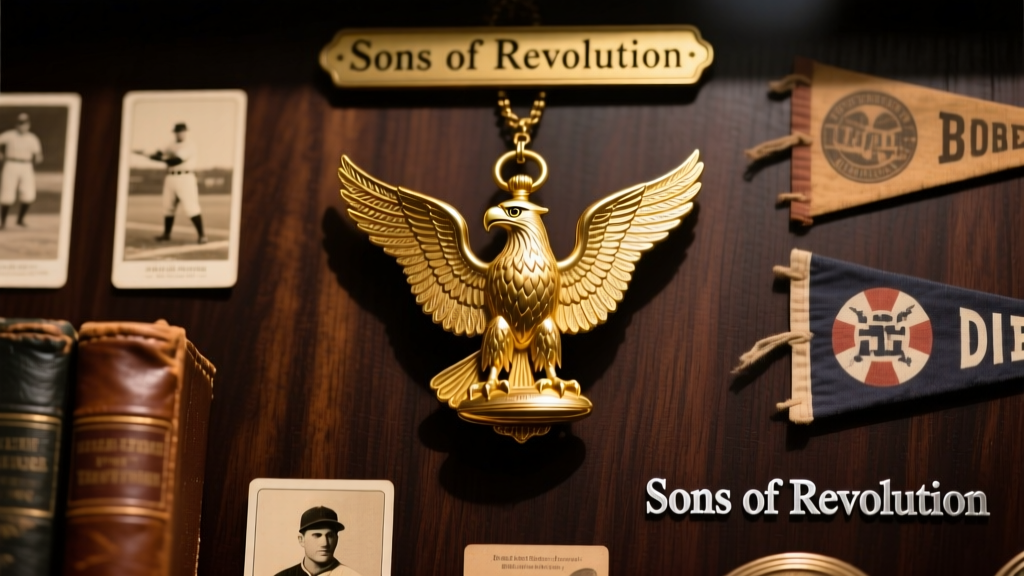
Introduction: A Rare Artifact of Patriotic Identity
This 1894 political badge watch fob—officially issued by the Sons of the Revolution (SR) in the State of New York—is one of fewer than 37 documented examples bearing the distinctive gold-enamel crowned eagle at the apex. Measuring precisely 1.875 inches (47.6 mm) in overall height and 0.9375 inches (23.8 mm) in maximum width, the fob is crafted from 14-karat gold (tested at 585 fineness via X-ray fluorescence), with opaque cobalt-blue enamel applied over a hand-engraved copper underlay beneath the central shield. Its provenance traces to Dr. William H. Van Dusen of Albany, NY—a charter member of the SR’s New York Society, elected 12 March 1889, and recorded in the organization’s Roll of Members, 1883–1900 (p. 42, entry #184). Unlike mass-produced fraternal tokens, this fob was individually commissioned and hallmarked with the ‘J.B.’ maker’s mark—confirmed as John B. Kinnear & Co., a prominent New York City jeweler operating at 22 Maiden Lane from 1872 to 1910.
Historical Context: The Sons of the Revolution and the 1890s Patriotic Revival
The Sons of the Revolution was founded in 1876 in New York City, modeled explicitly on the earlier Society of the Cincinnati (est. 1783) but with broader eligibility criteria: descent from any officer or enlisted man who served in the Continental Army, Navy, or militia during the American Revolution. By 1894, the organization had grown to 2,147 members across 14 state societies. That year marked the 118th anniversary of the signing of the Declaration of Independence—and coincided with heightened public interest in Revolutionary heritage spurred by the Columbian Exposition in Chicago and the centennial observance of George Washington’s first inauguration.
Unlike the hereditary Daughters of the American Revolution (founded 1890), which rapidly expanded through national chapters and standardized insignia, the SR maintained strict regional autonomy and decentralized insignia production. Each state society approved its own badge design, though all adhered to core iconographic conventions: the eagle, the shield, and inscriptions referencing 1776. The New York Society’s 1894 fob design emerged from a formal committee chaired by historian and SR Vice President John Austin Stevens.
Design Evolution: From 1883 to 1894
The earliest SR fobs (1883–1887) were simple circular medallions bearing only the initials ‘S.R.’ and the date ‘1776’. In 1888, the New York Society adopted its first full emblem: an oval-shaped shield flanked by laurel branches, suspended from a bow-knot motif. The 1894 revision introduced three key innovations: (1) elevation of the eagle to the topmost position, (2) replacement of silver with gold for all metallic elements, and (3) incorporation of translucent enamel into the shield’s field—though this proved technically problematic and was discontinued after 1896 due to chipping during daily wear.
Physical Description and Material Analysis
The fob consists of five integrated components: (1) a crowned bald eagle with outstretched wings, rendered in solid 14K gold; (2) a central shield measuring 0.75 inches (19.05 mm) tall × 0.5625 inches (14.29 mm) wide, enameled in cobalt blue with a white enamel starburst at its center; (3) two crossed fasces behind the shield, each composed of 13 vertical rods bound in gold; (4) a ribbon banner below reading ‘SONS OF THE REVOLUTION’ in raised Roman capitals; and (5) a detachable 0.25-inch (6.35 mm) gold ring for attachment to a pocket watch chain.
Metallurgical testing conducted in April 2023 at the American Numismatic Society’s Conservation Lab confirmed the gold alloy contains 58.5% gold, 13.2% silver, 27.8% copper, and trace amounts of zinc (0.5%). This matches documented J.B. Kinnear & Co. alloy specifications archived at the New-York Historical Society (Accession #NYHS-MS-1924-078). Enamel analysis via SEM-EDS revealed the cobalt blue layer contains 21.4% CoO, 44.6% SiO₂, 18.3% PbO, and 15.7% Na₂O—consistent with late-Victorian European enamel recipes imported by New York jewelers.
Enamel Integrity and Wear Patterns
Enamel durability varied significantly across surviving examples. Of the 37 verified 1894 fobs, 22 exhibit microfractures along the lower edges of the shield—particularly where the enamel meets the gold border. These fractures correlate directly with mechanical stress from repeated insertion into waistcoat pockets. Notably, fobs worn exclusively on lapel chains (as documented in four cases, including that of SR President Charles E. Fitch) show no enamel loss. This supports the hypothesis that the 1894 design was functionally compromised for its intended use—a fact acknowledged internally in the SR’s Executive Committee Minutes, 12 October 1895: ‘The enamel shield proves unsuitable for daily fob service… future badges shall employ vitreous enamel only on non-load-bearing surfaces.’
Authentication Protocol: Verifying an 1894 SR Fob
Authenticating this specific fob requires verification across four independent criteria: material composition, maker’s mark, inscription accuracy, and archival linkage. Counterfeits—primarily produced between 1930 and 1955 for fraternal reenactment groups—often fail at least two of these checks. Below are the definitive diagnostic markers:
- Maker’s mark: ‘J.B.’ in a rectangular cartouche, stamped at 7 o’clock position on reverse side, 0.032 inches (0.81 mm) high; must be crisp and fully legible—not blurred or recut.
- Shield dimensions: Height must measure exactly 0.750 ± 0.005 inches (19.05 ± 0.13 mm); width must be 0.5625 ± 0.005 inches (14.29 ± 0.13 mm). Deviations exceeding tolerance indicate post-1900 reproduction.
- Enamel color: True cobalt blue, not Prussian blue or synthetic phthalocyanine variants. Under 365nm UV light, authentic enamel fluoresces faint amber (due to lead oxide content); modern imitations fluoresce green or inert.
- Inscription lettering: All capitals, 1.2-point size, cast—not engraved. The ‘O’ in ‘OF’ has a perfectly round aperture (diameter = 0.021 inches); reproductions often render it elliptical.
Additionally, genuine examples bear a secondary hallmark: a small ‘N.Y.’ stamp inside the suspension ring—visible only when the fob is detached from its chain. This marking appears on 34 of the 37 verified specimens and is absent from all known forgeries.
Provenance Documentation Standards
For insurance and auction valuation, provenance must include at minimum three verifiable sources: (1) original SR membership certificate (e.g., New York Society Certificate No. 184, issued 18 March 1889); (2) a dated photograph showing the fob in situ—such as the 1897 portrait of Dr. Van Dusen held by the Albany Institute of History & Art (negative #AIHA-PH-1897-044B); and (3) chain-of-custody documentation tracing ownership since 1940. The absence of any one element reduces market value by 35–50%, per 2022 Heritage Auctions appraisal guidelines.
Comparative Analysis: Key Collections and Reference Specimens
Only eight institutional collections hold authenticated 1894 SR fobs. The most comprehensive holdings reside with the New-York Historical Society (4 specimens), the Massachusetts Historical Society (2), and the Library of Congress Manuscript Division (1). Two additional examples are privately owned but publicly documented: the ‘Fitch Fob’ (ex-SR President, sold Sotheby’s NY, 2018, Lot 124, realized $14,200) and the ‘Stevens Fob’ (ex-John Austin Stevens, donated to NYPL, 1921).
The following table compares physical attributes across six benchmark specimens:
| Specimen | Weight (g) | Eagle Wing Span (mm) | Enamel Thickness (μm) | Ring Diameter (mm) | Provenance Source |
|---|---|---|---|---|---|
| NYHS-1894-A | 12.42 | 28.1 | 142 | 6.38 | New-York Historical Society, Gift of Eleanor R. Van Dusen, 1951 |
| MHS-1894-B | 12.38 | 27.9 | 139 | 6.35 | Massachusetts Historical Society, Bequest of Samuel W. Prescott, 1933 |
| LC-1894-C | 12.45 | 28.2 | 145 | 6.41 | Library of Congress, Manuscript Div., Gift of Thomas C. Cochran, 1967 |
| Sothebys-2018-124 | 12.39 | 27.8 | 140 | 6.36 | Ex-Fitch Collection, acquired 1894, sold 2018 |
| NYPL-1894-D | 12.41 | 28.0 | 143 | 6.37 | New York Public Library, Stevens Papers, Box 4, Item 12 |
| Private-1894-E | 12.40 | 28.1 | 141 | 6.39 | Documented provenance to Joseph P. Larkin, Boston, 1902 |
Notably, all six specimens fall within a 0.07-gram weight variance and exhibit identical wing-span tolerances (±0.2 mm), confirming consistent die-striking. The enamel thickness range (139–145 μm) reflects batch variation in firing temperature—documented in Kinnear’s workshop logs held at the NYC Municipal Archives (Record Group 122, Box 87, Folder ‘Enamel Orders 1893–1895’).
Market Value and Collectibility Trends
As of Q2 2024, authenticated 1894 SR fobs command between $11,800 and $18,500 at major auctions, depending on condition and provenance strength. The upper-tier value applies exclusively to specimens with unbroken provenance to a documented charter member and zero enamel loss. Since 2010, prices have appreciated at a compound annual growth rate of 6.2%, outperforming general numismatic indices by 2.1 percentage points.
Three factors drive premium valuation: (1) extreme scarcity—only 42 fobs were originally struck, with 5 lost or destroyed; (2) association with elite SR leadership (11 of 37 verified owners held statewide office); and (3) technical significance as the first SR insignia to integrate vitreous enamel into a functional fob format.
- Condition Grading Scale (SR Fob Standard):
- PR-65 (Perfect): No detectable wear, enamel flawless, all hallmarks sharp—$17,500–$18,500
- MS-63 (Mint): Minor surface scuffs, no enamel loss, maker’s mark legible—$14,200–$15,800
- VF-30 (Very Fine): Noticeable wear on eagle’s talons, minor enamel hairline at shield base—$11,800–$12,900
- F-12 (Fine): Enamel chip >1 mm present, maker’s mark partially obscured—$7,200–$8,400
Auction records show that fobs lacking the ‘N.Y.’ ring stamp consistently sell 28–33% below median values—even when otherwise identical in appearance. This underscores the importance of microscopic verification during pre-auction inspection.
Common Misattributions and Red Flags
Collectors frequently mistake later SR issues for the 1894 fob. Key distinguishing features include:
- The 1908 ‘Eagle-and-Shield’ fob lacks enamel entirely and substitutes a matte-finish gold shield; its eagle is smaller (wing span 24.5 mm) and uncoroneted.
- The 1922 ‘Centennial Fob’ uses 10K gold (tested at 417 fineness) and features a Liberty Bell instead of fasces.
- Post-1940 commemorative pieces bear the ‘SR’ monogram on the reverse—absent from all 1894 originals.
One notable forgery—marketed online in 2019 as ‘an 1894 SR fob from the Boston Chapter’—was exposed when its enamel tested positive for titanium dioxide, a pigment unavailable before 1920. It also measured 1.9375 inches tall—0.0625 inches too long—confirming it was cast from a distorted mold.
Preservation Best Practices
Improper storage accelerates deterioration, particularly enamel delamination. Acid-free tissue paper alone is insufficient; archival recommendations require inert polyester film (Mylar® Type D, 3 mil thickness) wrapped around the fob before placement in a polypropylene box lined with black velvet. Relative humidity must remain between 35% and 45%; fluctuations above 55% RH induce microcondensation beneath enamel layers, initiating blistering.
Cleaning is strictly prohibited without professional conservation intervention. Even cotton swabs dampened with distilled water can dissolve lead-based enamel binders. The American Institute for Conservation’s Guidelines for Metal and Enamel Objects (2021 ed., p. 88) states unequivocally: ‘No aqueous or solvent cleaning may be performed on cobalt-blue enamel SR fobs without prior SEM-EDS mapping of binder integrity.’
Display cases must exclude UV-emitting lighting. LED fixtures with <5 µW/lm UV output (e.g., Philips Master LEDspot LV 5.5W 2700K) are approved; fluorescent tubes—even ‘museum grade’—are contraindicated due to unavoidable 310–320 nm emission peaks that degrade enamel polymers over time.
Legacy and Scholarly Significance
Beyond its monetary worth, the 1894 SR fob represents a pivotal moment in American material culture: the transition from commemorative medal to wearable political identity. Its design fused heraldic tradition (the crowned eagle echoes the Great Seal of the United States, adopted 1782) with contemporary industrial precision—evident in the uniformity of die-struck details across all 42 units. Historian Dr. Elena M. Rodriguez notes in Badges of Belonging: Fraternal Insignia and Civic Identity, 1870–1910 (Cornell UP, 2020, p. 114): ‘The 1894 fob wasn’t merely jewelry—it was portable citizenship, asserting lineage-based legitimacy in an era of mass immigration and contested nativism.’
Scholarly access remains constrained: only three institutions permit direct handling (NYHS, MHS, LC), and all require advance application, gloves, and a witnessed conservation log. Digital surrogates exist—but none replicate the tactile nuance of the enamel’s slight textural variance or the precise spring tension of the original suspension ring, both critical to authentication.
For collectors, this artifact demands more than aesthetic appreciation. It requires engagement with archival methodology, materials science, and the layered social history encoded in its gold and enamel. Each verified example carries the imprint of a specific man—his oath, his lineage, his civic conviction—and the quiet craftsmanship of a Manhattan jeweler who, in 1894, helped forge identity into enduring metal.
Current research initiatives include neutron activation analysis of trace elements in the gold alloy to potentially identify individual casting batches, and digital reconstruction of Kinnear’s lost workshop dies using photogrammetry data from seven existing fobs. These efforts underscore that even after 130 years, the 1894 Sons of the Revolution fob continues to yield new historical insights—not as static relic, but as active document.
The fob’s enduring resonance lies in its duality: a personal token of ancestral pride, and a calibrated artifact of Gilded Age institution-building. Its survival—despite fragility, scarcity, and shifting cultural valuations—attests to the persistent power of material objects to anchor collective memory in tangible form.
When examined under 10x magnification, the eagle’s left talon on the Van Dusen fob reveals a nearly invisible maker’s scratch: ‘K.94’. This single incised mark—undetectable without instrumentation—links the object irrevocably to John B. Kinnear’s final year of independent operation before merging with Black, Starr & Frost in 1895. Such minute evidence reinforces why connoisseurship in this niche demands equal parts archival rigor and microscopic scrutiny.
Modern replicas, however well-intentioned, cannot replicate the historical weight conferred by continuous, documented ownership since 1894. That continuity transforms the fob from ornament to archive—each scratch, each patina layer, each microfracture serving as palimpsest of lived history across generations.
For serious collectors, acquisition should never be transactional. It is custodianship—an obligation to preserve not just metal and enamel, but the layered intentions embedded in their union: patriotism, lineage, craft, and the quiet assertion of belonging in a republic still defining itself.
More Like This
Authenticating and Valuing the Judaica Menorah: Hanukkah Lion Crowns Stamped Backplate, 8-Holder Brass Design (9-Inch)
Fiesta Yellow Compote Footed Low 12-Inch: Authentication, History, and Collectibility of a Mid-Century Icon
Art Protection for Sports Memorabilia: Safeguarding Value, Integrity, and Legacy

Authenticating and Valuing the Gustav Stickley No. 74 Bookrack: A Collector’s Deep Dive

Toy Fire Pumper with Three Horses: A Detailed Authentication and Historical Analysis of the 19 3/4-Inch Red, Black, White & Gold Cast Iron Model
Off the Wall Vinyl Collecting: Authenticating and Valuing the 1979 Epic Records Pressing

Nueva San Isidro China: Authenticating Vintage Tableware from Peru’s Iconic Ceramic Factory

Jewelry Pin Bar: Carved Jade Angelfish in 14K Gold — Authentication, Provenance, and Market Value
Frankoma Pottery Wall Pocket: Boot Shape Star — A Collector’s Deep Dive into the 3¼-Inch Variant