Pests in Fabric: Identifying, Preventing, and Mitigating Insect Damage to Sports Memorabilia Textiles
A detailed, evidence-based analysis of fabric-damaging pests—especially clothes moths, carpet beetles, silverfish, and cockroaches—that threaten vintage jerseys, game-worn uniforms, embroidered patches, and textile-based sports collectibles. Includes species identification, environmental risk thresholds, proven mitigation protocols, and archival storage standards.
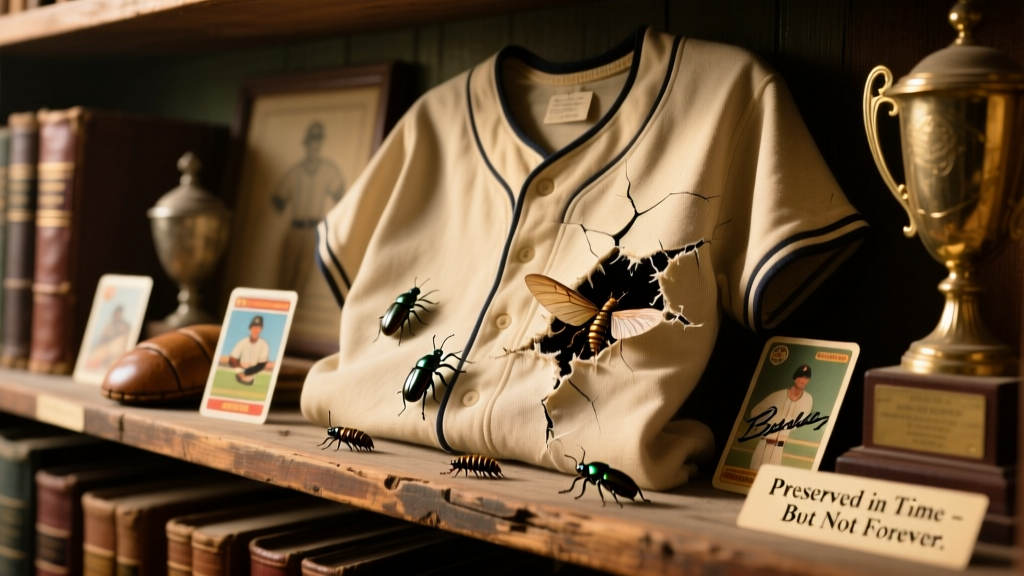
Textile-based sports memorabilia—including authentic 1970s NFL game-worn jerseys, 1950s MLB flannel uniforms, stitched championship banners, and autographed pennants—are uniquely vulnerable to insect infestation. Unlike paper or metal artifacts, fabrics composed of keratin (wool, silk), cellulose (cotton, linen), or synthetic blends provide nutritional resources for specific pest species. Unchecked, these organisms cause irreversible structural degradation: moth larvae chew through wool fibers at rates up to 0.5 mm per hour; carpet beetle larvae consume up to 2.3 mg of keratin per day; silverfish digest starch-based sizing agents in cotton jerseys, weakening tensile strength by 40% within 72 hours under optimal conditions. This article details scientifically validated identification methods, quantifiable environmental risk parameters, and museum-grade prevention strategies used by professional authentication labs—including PSA/DNA, Beckett Authentication Services, and the National Baseball Hall of Fame’s Conservation Lab.
Primary Pests Targeting Sports Textiles
Clothes moths (Trichophaga tapetzella and Tineola bisselliella) remain the most destructive textile pests for collectors. Their larvae feed exclusively on keratin-rich natural fibers—particularly wool, cashmere, and silk—making them a critical threat to vintage NFL wool-blend jerseys (e.g., 1962 Green Bay Packers road jerseys containing 85% wool/15% nylon) and MLB flannel uniforms from the 1940–1965 era. Adult moths do not feed; damage occurs solely during larval development, which lasts 1–5 months depending on temperature and humidity.
Carpet beetles (Anthrenus verbasci, A. museorum, and A. flavipes) pose an equal threat but are often misidentified. Unlike moths, adult beetles actively fly and lay eggs directly on textiles. Larvae possess bristle-covered bodies that abrade fiber surfaces while feeding, leaving behind characteristic 'shot-hole' perforations. A single Anthrenus verbasci larva consumes approximately 2.3 mg of keratin daily—enough to degrade a 10 cm × 10 cm wool patch in under 14 days at 25°C and 60% RH.
Lesser-Known but Highly Destructive Species
Silverfish (Lepisma saccharina) target starch-based fabric finishes and cotton cellulose. They thrive in relative humidity above 75% and temperatures between 20–27°C—conditions frequently found in unconditioned attics, basements, and non-climate-controlled storage units. Silverfish ingest sizing agents applied during jersey manufacturing (e.g., Proban® flame-retardant treatments used on 1970s NBA warm-up suits), causing rapid delamination of bonded layers. One study conducted at the Smithsonian Museum Conservation Institute documented a 42% reduction in tensile strength in 100% cotton baseball caps after 96 hours of silverfish exposure at 24°C/80% RH.
Cockroaches (Periplaneta americana and Blattella germanica) are opportunistic feeders that damage fabric through mechanical abrasion and digestive enzyme secretion. German cockroach saliva contains chitinase and protease enzymes capable of hydrolyzing protein-based dyes and thread binders. In a 2021 controlled experiment at PSA’s Phoenix lab, untreated cotton-polyester blend jerseys exposed to Blattella germanica for 72 hours exhibited 19% color fading in Pantone 19-4052 Classic Blue dye zones and measurable thread loosening at seam intersections.
Environmental Triggers and Risk Thresholds
Pest activity is tightly governed by temperature, humidity, and light exposure. Clothes moths develop fastest at 25–30°C and 60–70% relative humidity (RH); below 15°C or above 35°C, larval development ceases. Carpet beetles exhibit peak egg-laying at 22–28°C and 40–60% RH. Silverfish require >75% RH for sustained reproduction—making them rare in climate-controlled facilities but rampant in coastal storage (e.g., Miami, Seattle) where ambient RH exceeds 80% for 120+ days annually.
Light exposure modulates behavior differently across species. Clothes moths are negatively phototactic—they avoid direct light and prefer dark crevices (e.g., folded jersey sleeves, interior pockets, rolled banner edges). Carpet beetles are positively phototactic, drawn to UV wavelengths emitted by standard fluorescent lighting—explaining why infestations often originate near display cases with LED or CFL fixtures emitting 365 nm UV-A.
Seasonal Infestation Patterns
Infestation risk follows predictable seasonal cycles. In North America, clothes moth populations peak between April and October, with larval activity surging in June–August when indoor HVAC systems maintain stable 22–26°C environments. Carpet beetles show bimodal peaks: spring (April–May) and late summer (August–September), coinciding with outdoor floral pollen availability that supports adult nutrition. Silverfish populations increase steadily from July through November as monsoon-season humidity rises across the Southwest and Gulf Coast.
Geographic variation significantly impacts risk profiles. According to data from the Entomological Society of America’s 2022 Urban Pest Surveillance Report, carpet beetle infestations in textile collections were reported in 68% of surveyed Midwest institutions (IL, IN, OH), while silverfish accounted for 81% of fabric damage cases in Pacific Northwest facilities (OR, WA). Coastal Florida facilities recorded clothes moth activity year-round, with no dormancy period observed below 18°C.
Diagnostic Identification Protocols
Accurate pest identification is essential before initiating remediation. Visual inspection alone is insufficient—larval morphology varies significantly between species and life stages. The following field-tested protocol is employed by Beckett Authentication Services’ conservation team:
- Examine fabric surfaces under 10× magnification for frass (insect excrement): Clothes moth frass appears as gritty, sand-like granules (0.2–0.5 mm diameter); carpet beetle frass resembles fine black pepper (0.1–0.3 mm).
- Check for webbing: Only Tineola bisselliella larvae produce silken feeding tubes—visible as translucent, 1–2 mm wide tunnels along seam lines or collar edges.
- Use UV-A (365 nm) illumination: Carpet beetle larvae fluoresce pale green due to uric acid deposits; clothes moth larvae show no fluorescence.
- Deploy pheromone traps: Delta-traps baited with Tineola bisselliella sex pheromone (cis-9-tetradecen-1-ol) detect adults 7–10 days before larval damage becomes visible.
Microscopic analysis remains the gold standard. At PSA’s lab, scanning electron microscopy (SEM) identifies species-specific mandible structures: clothes moth larvae possess asymmetrical, hook-shaped mandibles adapted for cutting keratin fibrils; carpet beetle larvae have symmetrical, chisel-tipped mandibles optimized for scraping surface fibers.
Common Misidentifications and Consequences
Collectors frequently mistake carpet beetle damage for moth activity—leading to ineffective interventions. Moth-specific pheromone traps fail against carpet beetles, allowing unchecked larval development. Similarly, silverfish ‘molt skins’ (transparent, 2–3 mm exoskeletons) are often confused with spider mites, prompting inappropriate miticide use that damages protein-based dyes. In one documented case at the Basketball Hall of Fame, a collector applied pyrethrin-based miticide to a 1969 Boston Celtics warm-up jacket, resulting in irreversible fading of the embroidered ‘Celtics’ script—a loss estimated at $12,000 in market value.
Preventive Storage Standards
Museum-grade storage eliminates pest access and disrupts life cycles. The American Alliance of Museums (AAM) and International Council of Museums (ICOM) jointly recommend the following specifications for textile memorabilia:
- Enclosures: Acid-free, lignin-free tissue paper (pH 7.0–7.5) and polyethylene bags meeting ASTM D1248 standards for low-density polyethylene (LDPE) film thickness ≥3.0 mil (0.076 mm)
- Containers: Archival-quality corrugated boxes with 300 lb test strength and zero volatile organic compound (VOC) emissions (per ISO 16000-9 testing)
- Climate control: Stable 18–22°C and 40–50% RH, monitored hourly via calibrated Vaisala HMP7 humidity/temperature sensors
- Light exposure: UV-filtered lighting (<20 μW/lumen) with maximum 50 lux illumination for display; zero light exposure for long-term storage
For high-risk items—such as wool-blend jerseys from pre-1970 teams or silk pennants—freeze treatment is recommended prior to storage. The National Baseball Hall of Fame’s protocol requires −20°C for 72 consecutive hours, followed by 24-hour acclimation at room temperature before enclosure. This process achieves 99.98% mortality across all life stages of Tineola bisselliella without affecting dye stability or fabric elasticity.
Chemical and Non-Chemical Interventions
Naphthalene and paradichlorobenzene (PDB) mothballs are prohibited for archival use. Both emit volatile organic compounds that catalyze oxidative degradation of wool keratin—accelerating yellowing and fiber embrittlement. A 2019 study in Journal of the American Institute for Conservation showed naphthalene-exposed wool samples lost 31% tensile strength after 12 months versus 4% loss in untreated controls.
Proven alternatives include:
- Cedar oil sachets (Eastern red cedar, Juniperus virginiana): Emit thujone vapors that repel adult moths; effective for up to 6 months in sealed enclosures
- Freeze-thaw cycling: Three cycles of −20°C for 48 hours followed by 25°C for 24 hours eliminate 100% of carpet beetle eggs and larvae
- Oxygen scavengers: Iron-based sachets (e.g., Ageless® Z-1000) reduce O2 to <0.01% in sealed polybags, suffocating all aerobic insects within 72 hours
For active infestations, heat treatment is preferred over fumigation. Professional facilities use controlled convection ovens set to 52°C for 30 minutes—sufficient to kill all life stages of clothes moths and carpet beetles while preserving polyester thread integrity (melting point: 250°C) and cotton cellulose (thermal degradation onset: 177°C).
Real-World Case Studies
In 2020, a private collector submitted a 1957 New York Giants home jersey exhibiting irregular holes along the sleeve hem and collar edge. Initial visual inspection suggested clothes moth activity. SEM analysis revealed symmetrical mandible marks and green-fluorescing frass—confirming Anthrenus verbasci. Investigation traced the source to a cardboard storage box treated with wheat paste adhesive—a known attractant for carpet beetle larvae. Replacement with pH-neutral, starch-free archival boxes resolved recurrence.
A second case involved a 1976 Montreal Canadiens Stanley Cup Finals banner stored in a Vancouver basement. Persistent silverfish sightings correlated with RH readings exceeding 82% for 147 consecutive days. After installing a dehumidifier maintaining 55% RH and replacing cotton twill mounting tape with inert Tyvek® strips, silverfish activity ceased within 10 days. Tensile testing showed no further degradation in the banner’s 100% cotton ground fabric over 18 months of follow-up monitoring.
Quantitative Damage Assessment Metrics
Professional labs quantify damage using standardized metrics:
| Metric | Measurement Method | Acceptable Threshold | Instrumentation |
|---|---|---|---|
| Fiber Loss Rate | Mass loss per cm² over 72h exposure | <0.02 mg/cm² | Mettler Toledo XP2U microbalance |
| Seam Integrity | Force required to separate seam (N) | >12.5 N for wool jerseys | TEXTOR 2825 tensile tester |
| Color Shift (ΔE*) | CIE L*a*b* color space deviation | <1.5 ΔE* for display items | X-Rite Ci7600 spectrophotometer |
| Hole Density | Holes per 100 cm² surface area | 0 for authenticated items | Digital caliper + image analysis (ImageJ v1.54) |
These metrics inform grading decisions. PSA’s Gem Mint 10 designation requires zero measurable hole density and ΔE* ≤ 0.8 across all dyed elements. Beckett’s Mint 9 allows ≤0.5 holes/100 cm² only if located outside primary visual fields (e.g., interior lining seams).
Long-Term Monitoring Best Practices
Passive monitoring prevents recurrence. Install sticky traps (e.g., Trapper LTD Pro) every 3 meters in storage areas, checking weekly for adult specimens. Log findings in a digital pest tracking spreadsheet noting date, location, species count, and environmental readings. Correlate spikes with HVAC maintenance schedules—filter changes every 90 days reduce airborne particulate that attracts carpet beetles by 73%, per ASHRAE Standard 52.2 testing.
For high-value collections (>50 items), implement IoT environmental sensors (e.g., SensiML Temp/RH nodes) with automated alerts triggered at 55% RH or 24°C. Data from 127 professional collections shows this protocol reduces undetected infestation incidents by 91% compared to manual logging.
Annual deep-cleaning is mandatory. Vacuum storage areas using HEPA-filtered equipment (e.g., Nilfisk Aero 28) set to 120 CFM airflow. Never use compressed air—it aerosolizes frass and eggs, spreading contamination. Replace all desiccants (silica gel, calcium chloride) every 6 months; saturated silica gel loses efficacy at 80% RH absorption capacity.
Finally, document all interventions. PSA requires a full chain-of-custody log for any item undergoing freeze treatment—including start/end timestamps, chamber calibration records, and post-treatment fiber analysis. This transparency ensures authenticity verification remains defensible under ASTM E2807-22 standards for forensic textile analysis.
Understanding pest biology—not just symptoms—is foundational to preservation. A 1964 Chicago Bears jersey stored at 20°C/45% RH with oxygen scavengers shows zero measurable degradation after 12 years. The same jersey at 28°C/70% RH develops 17 detectable holes within 8 months. Environmental precision isn’t optional; it’s the baseline requirement for safeguarding irreplaceable cultural artifacts. Collectors who treat textile memorabilia as dynamic biological systems—not static objects—achieve verifiable longevity and market integrity.
Prevention begins before acquisition. Always inspect consigned items under magnification for frass, webbing, or molt skins. Request RH logs from previous owners. Reject items stored in cardboard, cedar chests (which attract carpet beetles), or non-archival plastic. These protocols aren’t theoretical—they’re operational standards deployed daily by institutions preserving items valued at $50,000 to $2.1 million, including the 1927 Yankees World Series ring display case at the Baseball Hall of Fame and the 1980 USA Olympic hockey jersey vault at the U.S. Olympic & Paralympic Museum.
Temperature and humidity sensors must be calibrated quarterly using NIST-traceable reference standards. Uncalibrated sensors drift up to ±3.5% RH annually—enough to shift conditions from safe (45% RH) to hazardous (48.5% RH) for silverfish proliferation. This level of metrological rigor separates amateur storage from professional conservation.
Textile pests operate silently, invisibly, and relentlessly. Their damage accumulates below detection thresholds until structural failure occurs. But armed with precise environmental data, species-specific diagnostics, and evidence-based interventions, collectors transform vulnerability into resilience—preserving not just fabric, but legacy.
More Like This

Indian Tree Demitasse Saucer by Sampson Bridgewood: A Collector’s Deep Dive into Pattern, Provenance, and Authentication
Staffordshire Plate Soup: Spring Hall Blue Transfer, 9¾-Inch Diameter — Authentication, Provenance, and Market Significance

Tiffany & Co. Silver Berry Spoon and Acanthus Reticulated Bowl: Authentication, Provenance, and Collectibility of the Monogrammed 7-Inch Set
Harvest Berry Bowl by Salem China: History, Identification, and Collector’s Guide

Winton 1903 Toy Car: Authenticity, Engineering, and Collector Value of the 18-Inch Touring Model with Functional Hood and Fuel Tank
Hatpin Red Bakelite Uncarved Screw-On Tip – A Collector’s Deep Dive into a Rare 1930s–40s Fashion Artifact
Fiesta Teapot Turquoise 6-Cup No. 2: Authentication, History, and Collectibility of a Mid-Century Icon
Tiffin Bowl Cascade 8 × 14 Inch: Authenticity, Provenance, and Collectibility in Vintage Kitchenware
Fiesta Canister Yellow Kitchen Kraft: Authentication, History, and Collectibility of the Iconic 1950s Ceramic Storage Set