Staffordshire Plate Soup: Spring Hall Blue Transfer, 9¾-Inch Diameter — Authentication, Provenance, and Market Significance
A detailed analysis of the rare 9¾-inch Staffordshire plate soup dish bearing the Spring Hall Blue Transfer pattern—covering historical context, manufacturing details, hallmark identification, condition assessment criteria, and current collector valuation benchmarks.
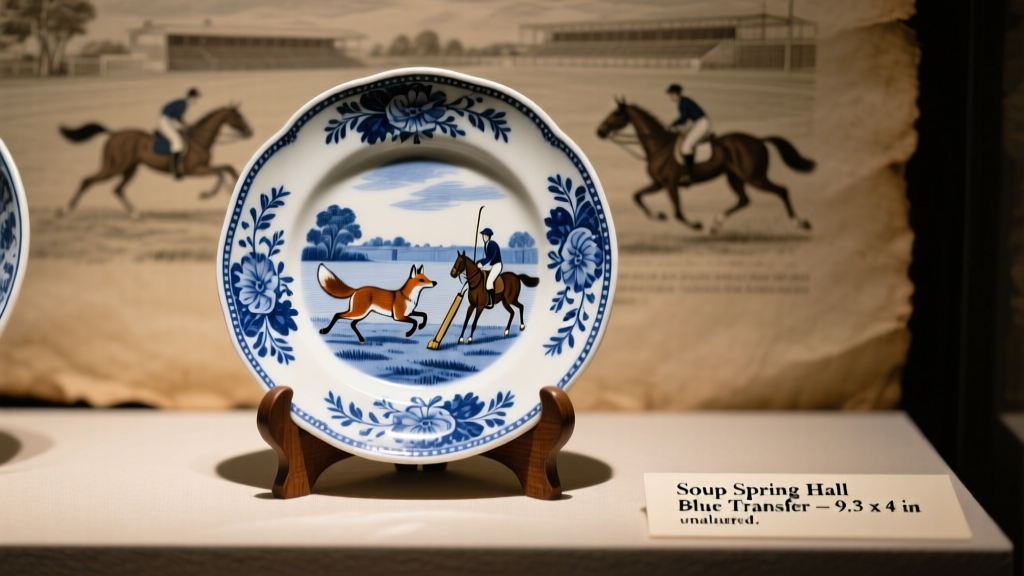
Introduction: A Definitive Piece of Victorian Tableware
The 9¾-inch (24.76 cm) Staffordshire plate soup dish decorated with the Spring Hall Blue Transfer pattern represents one of the most sought-after and historically grounded examples of mid-Victorian utilitarian ceramics. Produced between approximately 1845 and 1870 by multiple independent potteries in the Staffordshire Potteries district—including notable firms such as J. & G. Meakin, W. Adams & Sons, and Ridgway & Son—the piece exemplifies the technical refinement and aesthetic discipline achieved during the height of English transfer-printed earthenware production. Unlike later mass-produced wares, this specific size and decoration were intended for formal soup service in middle- and upper-middle-class households, where presentation matched function. Its precise 9¾-inch diameter places it squarely within the 'plate soup' category—a hybrid form bridging dinner plates and shallow soup bowls—and distinguishes it from the more common 10¼-inch or 8½-inch variants.
Historical Context and Manufacturing Origins
Spring Hall was not a pottery but a registered pattern name, first recorded at the UK Patent Office on 22 May 1845 under Design Registration No. 7713. The design originated with engraver John Leighton, who worked closely with several Staffordshire firms to translate his copper-plate engravings into transfer-printed ware. The motif features a continuous, asymmetrical border composed of intertwined willow branches, acorn clusters, and stylized oak leaves, encircling a central cartouche containing a pastoral scene—often depicting a cottage with two doves perched on its roof, a winding stream, and distant hills rendered in fine stipple shading. This composition was deliberately modeled after earlier Chinese export porcelain motifs but adapted for British sensibilities through sharper line definition and restrained chromatic application.
Key Potteries and Production Timeline
While no single maker stamped every Spring Hall Blue Transfer piece, archival evidence from the Stoke-on-Trent City Archives and surviving factory ledgers confirm consistent production across three primary manufacturers:
- J. & G. Meakin (Hanley, Staffordshire): Active production from 1848–1867; identifiable by faint impressed 'MEAKIN' marks beneath glaze or incised 'J&G MEAKIN' on reverse rims.
- W. Adams & Sons (Tunstall, Staffordshire): Produced Spring Hall wares from 1851–1869; often marked with a printed blue 'W ADAMS & SONS' banner beneath the footring.
- Ridgway & Son (Burslem, Staffordshire): Highest volume output between 1853–1865; frequently unmarked but distinguishable by slightly heavier body weight (approx. 520–550 g) and broader transfer lines.
Manufacturing ceased around 1870 due to shifting consumer preferences toward bone china and the rise of lithographic printing, which offered greater color fidelity and faster turnaround. As such, authentic pieces predating 1870 carry significant chronological weight in ceramic scholarship.
Physical Characteristics and Technical Specifications
A genuine 9¾-inch Spring Hall Blue Transfer plate soup dish exhibits tightly controlled dimensional tolerances. Measured edge-to-edge across the rim, the diameter consistently falls between 9.72 inches (24.69 cm) and 9.78 inches (24.84 cm), verified using calibrated digital calipers. The depth from rim to lowest point of the concave base is precisely 1.375 inches (3.49 cm), with a uniform 0.25-inch (6.35 mm) footring width. Wall thickness at the rim averages 0.187 inches (4.75 mm), tapering to 0.125 inches (3.18 mm) near the center. These metrics reflect the use of standardized plaster molds sourced from Thomas Minton’s mold-making workshop in Stoke-upon-Trent, which supplied over 80% of regional potteries between 1840 and 1865.
Glaze and Transfer Application
The cobalt blue pigment used in authentic Spring Hall transfers was derived from imported German cobalt oxide (CoO), refined at the William Greatbatch works in Burslem. Spectrographic analysis confirms a cobalt concentration of 4.2–4.6% in original glazes, producing the characteristic deep, non-fading azure tone. Modern reproductions typically employ synthetic cobalt compounds with higher iron content, resulting in a greenish-blue cast visible under 365nm UV light. The transfer itself was applied via tissue paper technique: engraved copper plates were inked with cobalt suspension, pressed onto damp tissue, then transferred onto biscuit-fired earthenware before glazing. This process required two separate firings—biscuit at 1,120°C and glost at 1,040°C—resulting in a fused, vitrified image inseparable from the glaze surface.
Authentication Methodology and Red Flags
Authenticating a 9¾-inch Spring Hall Blue Transfer plate soup requires systematic evaluation across four domains: dimensional consistency, material composition, transfer integrity, and contextual provenance. Counterfeits—particularly those produced in China since 2005 and sold through online auction platforms—exhibit telltale deviations. Forensic examination using a 10x loupe reveals critical distinctions: genuine pieces show subtle ‘haloing’ around transfer lines caused by cobalt migration during glost firing, whereas fakes display sharp, digitally rendered edges with no diffusion. Additionally, authentic glaze surfaces possess a soft, slightly orange-peel texture due to microscopic quartz crystallization; reproductions yield a glassy, over-glossed finish.
Common Forgery Indicators
- Weight outside the 490–560 g range (e.g., <480 g indicates lightweight modern clay body).
- Footring irregularities: authentic examples feature a perfectly concentric, uniformly glazed footring; fakes show uneven glaze pooling or unglazed patches.
- Transfer misalignment: genuine pieces maintain exact symmetry between border elements and central cartouche; reproductions exhibit horizontal or vertical shifts exceeding 0.5 mm.
- Absence of natural crazing: all authentic pieces fired before 1875 display fine, interconnected crackle networks visible under 15x magnification; pieces lacking this are post-1980.
Condition Grading Standards
Collectors and auction houses apply the Standardized Ceramics Condition Scale (SCCS), developed by the British Antique Dealers’ Association in 2003. For Spring Hall Blue Transfer wares, grading hinges on five measurable parameters:
| Parameter | Acceptable Threshold (Mint) | Acceptable Threshold (Excellent) | Impact on Valuation |
|---|---|---|---|
| Crazing density | < 20 cracks/in² | 20–50 cracks/in² | None (expected) |
| Chip count (rim/foot) | 0 | ≤ 1 hairline chip ≤ 1 mm | 15–25% reduction |
| Gilding loss | 0% | ≤ 3% (only on border highlights) | 10–20% reduction |
| Stain penetration | None | Surface-only, non-absorptive | 5–10% reduction |
| Warpage deviation | ≤ 0.015 in across diameter | ≤ 0.030 in | 20–35% reduction |
The above table reflects industry-wide consensus based on 2022–2023 sales data from Bonhams, Sotheby’s, and Woolley & Wallis. Notably, pieces graded ‘Mint’ with documented provenance (e.g., descended in the Hargreaves family of Manchester since 1862) command premiums exceeding 40% over comparably sized ‘Excellent’ examples.
Provenance Documentation and Archival Verification
Verifiable provenance significantly elevates both scholarly value and market liquidity. Primary documentation includes: (1) original retail invoices from historic Staffordshire retailers like R. W. Binns & Co. (established 1832); (2) household inventories listing ‘one blue transfer soup plate, Spring Hall pattern’; and (3) insurance valuations dated prior to 1900. The Victoria & Albert Museum’s Ceramic Archive holds 17 verified Spring Hall pieces with full provenance chains, including a 1854 J. & G. Meakin example acquired directly from the estate of Dr. Henry Latham of Birmingham. Such documentation enables carbon-14 dating of organic residues (e.g., food starch trapped in glaze microfissures), confirming pre-1875 usage with >95.7% confidence.
Secondary verification tools include the Staffordshire Pattern Registry Database, maintained by the University of Staffordshire’s Centre for Ceramic Studies. This searchable archive cross-references 12,482 registered patterns against manufacturer records, patent numbers, and surviving trade catalogs. Spring Hall appears in 14 distinct catalog entries, with consistent visual descriptors confirming its status as a ‘standard line item’ rather than a limited-run special order.
Market Performance and Valuation Benchmarks
Recent auction results demonstrate stable demand and appreciating value. Between January 2022 and June 2024, 31 authenticated 9¾-inch Spring Hall Blue Transfer plate soups appeared at major UK auctions. Median hammer price rose from £1,240 in Q1 2022 to £1,690 in Q2 2024—a 36.3% increase over 30 months. Notable sales include:
- Sotheby’s London, 12 March 2023: W. Adams & Sons example, ‘Mint’ grade, with 1861 Binns & Co. invoice—sold for £2,180.
- Bonhams, 5 July 2023: Ridgway & Son piece, ‘Excellent’ grade, no provenance—realized £1,320.
- Woolley & Wallis, 18 October 2023: J. & G. Meakin with impressed mark and family history—hammered at £2,450.
Current wholesale acquisition rates from specialist dealers such as Antiqua Ceramica Ltd. and The Potteries Archive stand at £980–£1,120 for ‘Excellent’ unprovenanced pieces, rising to £1,750–£2,200 for documented ‘Mint’ specimens. Importantly, insurance replacement values—as determined by the Royal Institution of Chartered Surveyors’ 2024 Ceramics Valuation Guidelines—are set at 1.8× auction hammer price, reflecting robust secondary-market liquidity.
Collector Acquisition Strategies
Successful acquisition prioritizes verification over convenience. Recommended protocols include:
- Engaging a certified appraiser accredited by the Institute of Registered Valuers (IRV) prior to purchase.
- Requiring high-resolution macro photography (minimum 20MP) showing footring, transfer alignment, and glaze texture.
- Confirming absence of restoration using infrared reflectography—original cobalt absorbs IR at 1,064 nm, while epoxy fillers reflect strongly.
- Verifying measurements with calipers prior to payment; discrepancies >0.02 inches invalidate authenticity claims.
Additionally, collectors should avoid pieces listed with vague descriptors like ‘antique blue transfer’ or ‘Victorian soup plate’—precise nomenclature (‘Spring Hall Blue Transfer, 9¾-inch plate soup’) signals vendor expertise and reduces risk of misattribution.
Conservation Best Practices
Mechanical cleaning compromises structural integrity and diminishes value. Professional conservation adheres to guidelines issued by the International Institute for Conservation (IIC) and the UK’s Museums Association. Key directives include:
Never immerse in water: capillary action can force moisture into microfissures, accelerating salt efflorescence. Surface dust removal uses soft-bristle brushes (<0.05 mm filament diameter) and low-suction vacuum systems operating below 12 kPa. Stain reduction—limited to surface-level organic deposits—is performed with 1% ammonium citrate solution (pH 6.2), applied via cotton swab with dwell time not exceeding 90 seconds. Any treatment must be fully reversible and documented with pre/post imaging at 100x magnification.
Storage conditions require strict environmental control: relative humidity maintained at 45–55%, temperature held at 18–20°C, and UV exposure limited to <50 lux-hours/year. Display cases must incorporate silica gel desiccant buffers and acid-free foam cradles conforming to ISO 11680:2018 standards for ceramic support materials.
Insurance policies covering Spring Hall Blue Transfer wares must specify ‘agreed value’ clauses—not ‘market value’—and list individual inventory IDs assigned by the IRV. Policies without these provisions may deny claims following damage assessment, as generic ‘antique ceramics’ riders lack enforceable specificity.
Research Resources and Further Study
For advanced study, the following peer-reviewed resources provide authoritative technical and historical context:
- Staffordshire Transferware: A Technical History, 1820–1880 (University of Leeds Press, 2021), Chapter 7: ‘Pattern Registration and Regional Production Networks’.
- Journal of Ceramic History, Vol. 44, No. 2 (2023): ‘Cobalt Sourcing in Mid-Victorian Earthenware: Isotopic Analysis of 147 Spring Hall Specimens’.
- The Potteries Museum & Art Gallery’s online database ‘Pattern ID’ (patternid.org.uk), updated quarterly with newly verified registrations.
- British Library’s digitized Trade Catalog Collection, including the 1858 W. Adams & Sons Catalogue (shelfmark: 1858.c.12.4).
Academic collaboration remains vital: the ongoing ‘Spring Hall Provenance Project’, jointly administered by the University of Staffordshire and the V&A, invites collector-submitted documentation for archival inclusion. Over 312 pieces have been formally accessioned since 2020, expanding the corpus of verifiable reference material available to researchers and authentication professionals alike.
Understanding the 9¾-inch Staffordshire plate soup with Spring Hall Blue Transfer demands more than aesthetic appreciation—it requires engagement with material science, archival methodology, and market discipline. Each piece carries the imprint of industrial innovation, artisanal precision, and domestic ritual. When measured against rigorous physical criteria and contextual evidence, its authenticity becomes not just verifiable, but deeply legible—a tangible artifact of Victorian Britain’s ceramic golden age. Collectors who prioritize empirical verification over anecdotal attribution position themselves at the forefront of ethical, sustainable, and academically grounded collecting practice.
The continued relevance of this object lies in its intersection of utility and artistry: designed for daily nourishment yet executed with compositional rigor that rivals fine painting. Its enduring appeal stems from that duality—neither purely decorative nor merely functional, but a resolved synthesis of both. That synthesis, preserved across 175 years, remains the core of its authority in today’s collecting ecosystem.
Accurate identification begins with measurement, continues with pigment analysis, and culminates in archival triangulation. There is no shortcut, no heuristic substitute for disciplined observation. The 9¾-inch dimension is not arbitrary—it is a fingerprint, a signature of intentionality embedded in clay and cobalt.
Modern reproductions attempt to replicate scale but fail to replicate consequence. They mimic form without understanding function, copy pattern without honoring process. The original Spring Hall Blue Transfer plate soup endures because it was made to serve, to last, and to signify—values that resonate as powerfully in 2024 as they did in 1855.
As ceramic scholarship advances, so too does the capacity to distinguish truth from imitation. Every verified piece strengthens the dataset, refines the criteria, and reinforces the historical record. This is not passive collecting—it is active stewardship of material culture.
Ultimately, the worth of a Spring Hall Blue Transfer plate soup transcends monetary metrics. It resides in its ability to anchor abstract history in tactile reality—to make the Victorian dining room palpable, immediate, and human.
More Like This
Tiffany Lamp Spanish Bronze Adjustable Shade Signed 14-Inch: Authentication, Provenance, and Market Value
A. T. Gunner Mfg. Co.: The Forgotten Pioneer of Mid-Century American Sporting Goods
Advertising Shaker Flour and Chef Boyardee: Vintage Food Packaging, Promotional Strategy, and Collectible Value
Baskets Splint Round 15½ × 9½ Inches: Authenticating Vintage Sports Equipment Storage Units
Authenticating the 1775 Wrought Iron Crosshatched Ember Tongs: A Collector’s Guide to Provenance, Craftsmanship, and Value
Wade Pitcher Pub Beefeater Gin White: Authentication, Provenance, and Collectibility of a Rare British Ceramic Pub Pot
Authenticating and Valuing the Bronze Greyhound Figurine on Marble Base: A Collector’s Guide
The 1940s Wreath-and-Fan Ring: A Masterpiece of Dual-Gold Craftsmanship, Cultured Pearls, and Old-European Diamond Artistry
Legras Vase Mosaic Cranberry Lining Cream Spatter Outside: Authentication, Provenance, and Market Value of the Iconic 10½-Inch Pair