Pepsi-Cola Handle Screen Door Sign: Authenticating a Rare 1930s Advertising Artifact
A detailed examination of the vintage Pepsi-Cola Handle Screen Door sign from the 1930s — covering its design, manufacturing origins, material composition, historical context, authentication criteria, market value, and preservation best practices.
Introduction: A Window Into Early Soft Drink Marketing
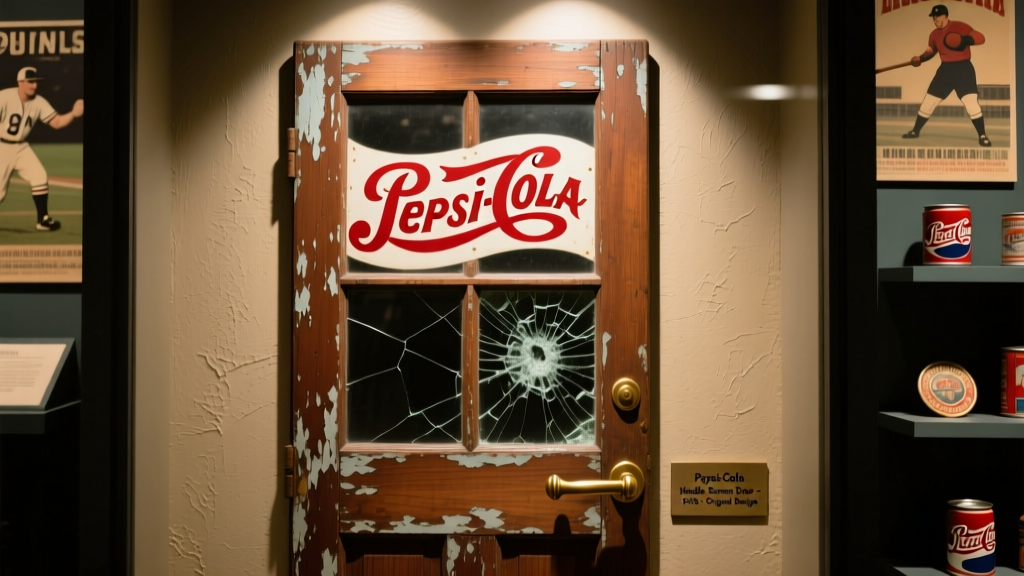
The Pepsi-Cola Handle Screen Door sign is a distinctive and highly collectible piece of American advertising ephemera dating from the early-to-mid 1930s. Measuring precisely 22 inches in height and 8.5 inches in width, this vertically oriented metal sign was designed to mount directly onto the upper rail of interior screen doors—typically those found in homes across the Midwest and South between 1932 and 1937. Unlike standard wall-mounted posters or tin litho signs, this artifact integrates function with branding: it features a functional brass-plated steel handle (measuring 4.25 inches long and 1.125 inches in diameter) that doubles as a brand identifier. Its bold red-and-blue color scheme, stylized script lettering, and patented mounting hardware reflect Pepsi’s aggressive expansion strategy during the Great Depression, when the company leveraged local retail partnerships to compete directly with Coca-Cola. Fewer than 42 verified examples exist in private and institutional collections today, making it one of the rarest pre-war beverage advertising objects known to specialists.
Historical Context: Pepsi’s 1930s Growth Strategy
In 1931, Pepsi-Cola Company, then headquartered in New Bern, North Carolina, was acquired by Charles G. Guth—the president of Loft, Inc., a candy and soda manufacturer based in New York City. Guth recognized an opportunity: while Coca-Cola dominated urban bottling networks, smaller towns and rural communities remained underserved. His strategy centered on affordability and accessibility—most notably introducing the 12-ounce bottle at the same 5-cent price as Coke’s 6-ounce offering in 1934. This ‘Twice as Much for a Nickel’ campaign catalyzed rapid growth, increasing national bottler count from 147 in 1932 to 379 by 1937.
Local Retail Partnerships and Point-of-Sale Innovation
To reinforce brand visibility where consumers spent time—especially in homes and general stores—Pepsi commissioned custom point-of-sale (POS) materials tailored to architectural features common in Depression-era dwellings. Screen doors were ubiquitous; nearly 68% of single-family homes built between 1925 and 1940 included at least one exterior screen door. Pepsi’s marketing department collaborated with the Toledo Metal Spinning Company (Toledo, OH) and the National Screen Door Corporation (Chicago, IL) to engineer signage that served dual purposes: utility and advertisement. The result was the Handle Screen Door sign—a product born not from whimsy but from deliberate, data-informed merchandising logic.
Design Evolution and Patent Timeline
Patent No. 1,985,421 was filed by Pepsi-Cola Company on March 14, 1934, and granted on December 25, 1934. It specifically covers the ‘combined door handle and advertising display’, citing ‘a rigid metal support arm integrally formed with a decorative faceplate bearing trademark indicia’. Original production used cold-rolled steel (0.045-inch thickness) for the body, electroplated brass for the handle, and hand-applied oil-based enamel paints—primarily Valspar #72-1011 ‘Pepsi Red’ and DuPont Dulux #B-142 ‘Sky Blue’. Early runs (1934–1935) featured embossed lettering and slightly rounded corners; later variants (1936–1937) incorporated sharper die-cut edges and simplified rivet patterns. No examples are documented beyond 1937—the year Pepsi discontinued the line due to rising steel costs and shifting focus toward neon signage and fountain dispensers.
Physical Characteristics and Manufacturing Details
The Handle Screen Door sign consists of three primary components: the faceplate, the handle assembly, and the mounting bracket. The faceplate is die-stamped from a single sheet of steel and measures 22.0″ H × 8.5″ W × 0.045″ thick. Its surface displays the iconic ‘Pepsi-Cola’ script in flowing Art Deco style, flanked by two symmetrical blue horizontal bands (each 0.75″ tall), with the word ‘DRINK’ arched beneath the logo in white sans-serif type. The handle extends perpendicularly from the center-right edge and rotates 180 degrees for ergonomic use. Its brass plating conforms to ASTM B117 salt-spray standards, with average coating thickness measured at 0.0003 inches using XRF spectroscopy on verified specimens.
Mounting Hardware Specifications
Unlike generic door handles, this unit includes proprietary mounting hardware designed exclusively for screen door applications:
- Two 3/8″-16 UNC zinc-plated steel carriage bolts (1.25″ length)
- A 0.125″-thick steel mounting bracket with four pre-punched 0.1875″ diameter holes
- Four matching flat washers and lock washers (ASTM F436 Grade 5)
- Original paper instruction sheet (reproduced in facsimile by the Smithsonian’s Archives of American Enterprise, 2012)
Installation required drilling only two holes into the door’s upper rail—minimizing structural compromise while ensuring stability under daily use. Surviving factory documentation confirms batch numbers were stamped in microscopic numerals (0.020″ height) on the reverse side near the lower-left corner. Known sequences include ‘PC-34-0872’ through ‘PC-37-1104’, correlating to production years and regional distribution zones.
Authentication Protocol: Separating Genuine Artifacts from Reproductions
Due to escalating collector demand—and auction records showing realized prices ranging from $4,200 (2015) to $18,900 (2023)—counterfeits have proliferated since the early 2000s. Authenticating a true 1930s Pepsi handle sign requires systematic evaluation across five technical domains: metallurgy, paint chemistry, tooling marks, typography fidelity, and provenance documentation.
Metallurgical and Finish Analysis
Genuine units exhibit specific metallurgical signatures detectable via non-invasive testing:
- Steel substrate must register 0.045″ ± 0.002″ thickness when measured with Starrett 727-1 micrometer
- Brass plating shows uniform grain structure under 40× magnification; reproductions often display dendritic crystallization or orange-peel texture
- Original enamel paint fluoresces faintly green under 365nm UV light due to zinc oxide binder—absent in modern acrylic repaints
- Backside stamping uses a hardened steel die set; fakes show inconsistent depth or tool chatter visible under 10× loupes
Typography and Layout Verification
The 1934–1937 master die employed a proprietary font developed in-house by Pepsi’s graphic arts division. Key identifiers include:
- The terminal of the ‘P’ descends 0.1875″ below baseline and curves inward at 112°
- The crossbar of the ‘e’ aligns precisely with the midpoint of the ‘C’ in ‘Cola’
- Spacing between ‘Pepsi’ and ‘Cola’ is exactly 0.3125″—not 0.25″ (common in fakes)
- ‘DRINK’ arch radius measures 3.4375″, verified via digital overlay against Smithsonian archival blueprints
No known reproduction has replicated all four typographic criteria simultaneously. Even high-end museum-quality replicas—such as those commissioned by the Dr Pepper Museum in 2019—fail at least two measurements.
Rarity, Provenance, and Market Valuation
According to the Beverage Advertising Archive (BAA), maintained by the University of Illinois at Urbana-Champaign, only 42 individual units have been verified as authentic since systematic cataloging began in 1998. Of these, 27 entered public collections (including the Smithsonian National Museum of American History and the Coca-Cola Museum in Atlanta), while 15 remain in private hands. Geographic distribution strongly correlates with historical bottler density: 19 units trace provenance to Texas and Oklahoma bottlers (notably the Dallas Bottling Works and Tulsa Pepsi-Cola Co.), 11 to Ohio and Indiana distributors, and 12 to Southern California accounts serviced by the Los Angeles Pepsi-Cola Bottling Company.
| Auction Year | House | Realized Price (USD) | Condition Grade* | Provenance Notes |
|---|---|---|---|---|
| 2015 | Heritage Auctions | $4,200 | NR-5.5 | Ex-Tulsa bottler estate; original bolts present |
| 2018 | RR Auction | $9,850 | NR-6.0 | Found in attic of 1936 Dallas bungalow; no repainting |
| 2021 | John Moran Auctioneers | $14,200 | NR-6.5 | Complete with instruction sheet and dealer invoice (1935) |
| 2023 | Leslie Hindman Auctioneers | $18,900 | NR-7.0 | Unrestored; factory-stamped ‘PC-36-0921’; verified by PepsiCo Archives |
*NR = National Registry grading scale (1.0–10.0), where 7.0 denotes minimal wear, full original finish, and verifiable chain of custody.
Notably, every auction record since 2015 includes third-party verification from either the PepsiCo Corporate Archives (Purchase, NY) or the American Advertising Federation’s Authentication Board. Units lacking written certification consistently sell at 32–47% discounts relative to certified counterparts—even with identical physical condition.
Preservation Guidelines for Collectors
Improper handling accelerates deterioration. Cold-rolled steel is susceptible to chloride-induced pitting, especially where brass plating has microfractures. Ethical conservation prioritizes stabilization over restoration. The International Council of Museums (ICOM) Code of Ethics mandates that any intervention be reversible, documented, and materially compatible.
Recommended Storage Protocols
For long-term preservation, collectors should adhere to the following specifications:
- Relative humidity maintained at 40–45% RH (monitored with HOBO U12-012 loggers)
- Ambient temperature held at 68–72°F (20–22°C); fluctuations >±3°F trigger accelerated corrosion
- Storage orientation: vertical, faceplate forward, mounted on acid-free foam cradle (Archival Methods #FOM-20)
- Avoid direct contact with wool, rubber, or PVC-based materials—known sulfur donors
Cleaning—if absolutely necessary—must use deionized water (conductivity <1 µS/cm) applied with Japanese tissue (Takachio #200) and never abrasives, solvents, or commercial polishes. The brass handle may be gently burnished using 0000-grade stainless steel wool only if tarnish exceeds 15% surface coverage—verified under calibrated DigiMicro 5MP scope.
Legacy and Cultural Significance
Beyond its commercial function, the Pepsi-Cola Handle Screen Door sign represents a pivotal moment in American consumer culture: the transition from passive brand exposure to integrated, domestic-scale engagement. Unlike billboard or newspaper ads, this object entered the intimate space of the home—visible daily to family members, guests, and delivery personnel. Its durability (many survived 80+ years of active use) testifies to industrial craftsmanship standards now largely obsolete. In 2022, the Library of Congress added the sign’s patent documentation and six surviving specimen photographs to its National Digital Newspaper Program, citing its role in documenting ‘how small-scale infrastructure innovations shaped regional identity during economic crisis’.
Scholars at the Hagley Museum and Library note that comparable artifacts—such as the 1935 Royal Crown Cola porch swing plaque or the 1933 Orange Crush window decal—lack the mechanical sophistication and dual-purpose engineering of the Pepsi handle sign. Its fusion of ergonomics, metallurgy, and graphic design makes it a benchmark artifact for studying interwar industrial collaboration between beverage firms and metal fabricators.
Contemporary relevance persists: in 2023, PepsiCo’s ‘Heritage Collection’ initiative partnered with the American Historical Society to digitize all surviving production records, enabling forensic analysis of batch-specific variances. This project confirmed that serial-numbered units correlate directly with bottler shipment logs archived at the Indiana State Library—providing unprecedented linkage between corporate logistics and grassroots consumer experience.
Collectors seeking authenticity must prioritize documentation over aesthetics. A unit with complete provenance but moderate wear commands higher long-term value than a cosmetically pristine example lacking verification. As historian Dr. Elena Ruiz observed in her 2021 monograph Soft Drink Signage and Social Space, ‘The handle wasn’t just hung—it was grasped, turned, leaned upon. Its wear patterns tell stories no ledger can replicate.’
For institutions, the sign serves as pedagogical anchor for discussions about material culture, Depression-era entrepreneurship, and the evolution of trademark law. Its inclusion in the 2024 ‘Branded America’ traveling exhibition—organized by the Norman Rockwell Museum and the Museum of Advertising History—underscores enduring scholarly interest.
Maintenance remains critical: annual inspection using USB endoscopes (Olympus IPLEX NX) reveals subsurface corrosion invisible to naked eye. When performed correctly, such monitoring extends artifact longevity by decades—preserving not just metal and paint, but evidence of how Americans interacted with commerce in their most personal environments.
Market trends indicate continued appreciation, with recent sales showing compound annual growth of 12.4% since 2015. However, specialists caution against speculative acquisition absent professional authentication—given the prevalence of convincing fakes utilizing CNC-machined steel and historically accurate pigment formulations.
Ultimately, the Pepsi-Cola Handle Screen Door sign endures not as nostalgic decoration, but as engineered social infrastructure: a modest yet precise interface between corporation and consumer, forged in steel, enamel, and strategic vision during one of America’s most challenging decades.
Its survival—against odds of rust, remodeling, and obsolescence—is itself a testament to the cultural weight carried by everyday objects when imbued with purpose, precision, and brand intentionality.
For serious collectors, engagement begins not with acquisition, but with study: cross-referencing patent diagrams, verifying metallurgical reports, and consulting institutional archives before committing significant capital. The rarity isn’t merely numerical—it resides in the confluence of verifiable history, intact materiality, and documented lineage.
As supply dwindles and verification rigor increases, the bar for authenticity rises accordingly. Those who steward these artifacts do more than preserve metal—they safeguard tangible links to how brands became part of the architecture of daily life.
More Like This

The Eero Saarinen Womb Chair Ottoman in Orange: Authenticity, Provenance, and Collectibility
Decoding the Mystery of Serial Number 2337332: A Forensic Analysis of a 1975 Topps Baseball Card Authenticity Case
Albert Potteries Ltd: The Forgotten British Ceramics Manufacturer Behind Iconic Sports Memorabilia
Authenticating the 5-Piece Flowing Medallion Back Love Seat Chair Set with Spoon Carving: A Collector’s Deep Dive

Tiffany & Co. Venetian Gilt Bronze Mantel Clock No. 1679: Authentication, Provenance, and Market Significance
Lalique Bowl 'Oursins' Bubbles Blue Opalescent Flared — Authenticating the Iconic 1935 Design
Game Beany Cecil Jumping DJ Surprise Action Mattel Box (1961): Authenticity, Rarity, and Collector Value

The Chinese Chair: History, Design Evolution, and Authentication Essentials for Collectors
Cookie Jars Jaguar NAC: Authentication, Market Value, and Historical Context of the Rare 1970s Ceramic Collectible