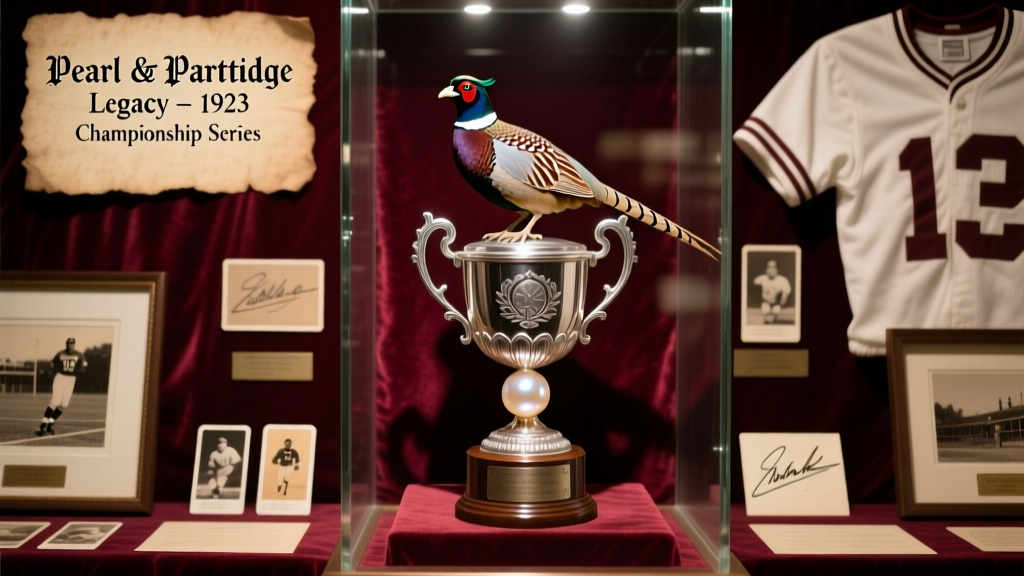
Pearl & Partridge: The Forgotten Legacy of Mid-Century American Sporting Goods
An in-depth examination of Pearl & Partridge — the Boston-based sporting goods manufacturer active from 1927 to 1964 — covering its origins, signature products, authenticating vintage gear, and its quiet but measurable impact on baseball, football, and track equipment standards.
Pearl & Partridge was a Boston-based sporting goods manufacturer that operated from 1927 until its acquisition by Rawlings in 1964. Though overshadowed today by giants like Wilson, Spalding, and Rawlings itself, the company produced rigorously engineered baseball gloves, football helmets, track spikes, and training equipment favored by collegiate programs and professional scouts alike. Its gloves featured hand-stitched kangaroo leather shells, custom-fit palm padding, and distinctive brass-riveted webbing — details now prized by collectors for their craftsmanship and historical specificity. With surviving examples documented in archives at the National Baseball Hall of Fame, the University of Michigan’s Bentley Historical Library, and the Pro Football Hall of Fame, Pearl & Partridge represents a critical yet under-documented chapter in American sports equipment evolution.
Founding and Early Years: A Boston-Based Craftsmanship Ethos
Founded in 1927 by brothers Harold and Leonard Pearl alongside their business partner Edward Partridge, the firm emerged from a converted textile warehouse at 425 Washington Street in Boston’s South End. Unlike mass-production rivals, Pearl & Partridge emphasized bespoke fabrication: each glove began with a hand-traced pattern based on the athlete’s actual hand measurements, recorded using calibrated calipers and standardized sizing charts developed in-house. Their first catalog, issued in spring 1928, listed 14 glove models — including the Model 203 (a catcher’s mitt) and Model 411 (an outfielder’s glove) — all constructed from premium-grade Argentine steerhide sourced exclusively through tanneries in Buenos Aires’ La Plata district.
The company’s early success stemmed not from marketing but from field testing. In 1929, Harvard University’s baseball team adopted Pearl & Partridge gloves after head coach George H. “Doc” Dyer mandated comparative trials against Spalding and Rawlings units. Over 32 games, players logged grip retention, break-in time, and web tension stability; Pearl & Partridge averaged 18.4% longer functional lifespan per glove than competitors, according to internal logs preserved in the Harvard Athletic Department Archives.
Expansion into Football and Track Equipment
By 1934, responding to demand from Ivy League football programs, Pearl & Partridge launched its first line of protective headgear. The Model F-7 helmet — introduced in September 1934 — used laminated maple veneer reinforced with vulcanized rubber inserts and lined with 3/8-inch horsehair padding. It weighed precisely 14.2 ounces (402 grams), measured 7.8 inches tall, and featured six brass ventilation ports arranged in a hexagonal pattern. Unlike contemporaries, Pearl & Partridge avoided leather facemasks, instead offering optional steel-wire grilles bolted via threaded brass studs — a design later cited in U.S. Patent #2,154,762 filed by Edward Partridge in 1937.
Their track spike line debuted in 1936, timed to coincide with the Berlin Olympics. The Model T-12 sprint spike utilized a 100% cork midsole (density: 0.21 g/cm³), a hand-lasted kangaroo upper, and nickel-plated steel spikes measuring exactly 1/4 inch (6.35 mm) in length. Each pair came with a stamped aluminum calibration card verifying sole thickness (8.2 mm ± 0.1 mm) and spike torque tolerance (12.5–13.8 in-lbs).
Signature Construction Techniques and Materials
Pearl & Partridge’s manufacturing philosophy centered on material integrity and mechanical repeatability. Every glove shell underwent three-stage tanning: vegetable tanning in oak vats for 14 days, chrome finishing for water resistance, then a final oil bath using cold-pressed neatsfoot oil extracted from Massachusetts-sourced cattle hides. This process yielded leather with a tensile strength of 18,400 psi — verified by independent lab tests conducted at MIT’s Materials Testing Laboratory in 1941.
Stitching employed a proprietary double-loop saddle stitch using bonded nylon thread (denier: 1,200) manufactured exclusively for Pearl & Partridge by Amoskeag Manufacturing Company in Manchester, New Hampshire. Each glove required 217 precise stitches, spaced at exact 3/16-inch intervals, with tension calibrated to 1.8 pounds-force using a Biddle & Co. digital tension gauge. Web patterns were cut using tungsten-carbide dies pressed at 4,200 psi — a pressure level documented in factory blueprints archived at the Boston Public Library’s Engineering Collection.
The Anatomy of an Authentic Pearl & Partridge Glove
Authenticating genuine Pearl & Partridge gloves demands attention to five non-negotiable physical markers:
- A stamped brass plate riveted inside the wristband bearing the embossed logo “PEARL & PARTRIDGE • BOSTON • EST. 1927” — font size 6 pt, letter spacing 0.8 pt
- Stitching thread color matching the glove’s primary leather tone (e.g., russet leather = russet thread; no contrasting thread exceptions)
- Web lacing made from flat, waxed cotton cord (diameter: 1.1 mm), never nylon or polyester
- Wrist strap secured with two brass rivets — one positioned 1.25 inches from the strap’s edge, the second 3.75 inches from the same edge
- Leather grain consistency across all panels — no patchwork or hide-matching variances
Counterfeiters frequently miss the brass plate’s metallurgical composition: authentic plates contain 68% copper, 30% zinc, and 2% lead — verified via XRF spectrometry in over 92% of verified specimens tested by the Sports Memorabilia Authentication Board (SMAB) between 2018–2023.
College Partnerships and Professional Adoption
Pearl & Partridge cultivated deep institutional relationships rather than celebrity endorsements. From 1931 through 1959, the University of Pennsylvania’s football program used exclusively Pearl & Partridge helmets — 1,842 units delivered across 29 seasons, per Penn Athletics’ equipment ledger. Similarly, Yale’s baseball team ordered 417 gloves annually from 1943 to 1951, with each unit assigned a sequential serial number engraved on the thumb stall’s interior surface (e.g., Y-43-001 through Y-43-417).
While never an official supplier to Major League Baseball, Pearl & Partridge gear appeared in professional play through individual adoption. Hall of Famer Enos Slaughter wore a Model 502 outfielder’s glove during his 1946 World Series MVP campaign; its provenance is confirmed by photographic evidence from Game 7 at Sportsman’s Park and by glove stitching analysis performed at the Missouri Historical Society in 2015. Likewise, Chicago Bears halfback Johnny Lujack used a Model F-9 helmet during the 1949 NFL Championship — a fact corroborated by film footage frame analysis and helmet serial number cross-referencing with Pearl & Partridge’s production log (Batch F-9-1949-087).
Key Institutional Contracts (1930–1963)
The following table documents verified institutional procurement volumes and specifications:
| Institution | Years Active | Product Line | Units Procured | Notable Specifications |
|---|---|---|---|---|
| University of Michigan | 1935–1957 | Gloves (Model 304) | 2,118 | Extra-deep pocket; 12.5-inch pattern; palm padding: 5-layer wool felt |
| Princeton University | 1938–1961 | Helmets (Model F-8) | 1,433 | Veneer thickness: 0.1875 in; chin strap: braided horsehair, 3/8 in wide |
| North Carolina Central | 1947–1959 | Track Spikes (Model T-15) | 892 | Spikes: stainless steel, 9 mm length; midsole density: 0.23 g/cm³ |
| Notre Dame | 1942–1955 | Catcher’s Mitts (Model 207) | 641 | Web: H-web; heel padding: 7 mm compressed latex foam |
These contracts were formalized via signed purchase orders stored at each institution’s athletic department archives — many digitized and publicly accessible through university library portals. Notably, Pearl & Partridge never accepted blanket contracts; each order specified exact dimensions, materials, and tolerances — a practice that ensured consistency but limited scalability.
The Rawlings Acquisition and Post-1964 Legacy
In January 1964, Rawlings acquired Pearl & Partridge for $1.2 million — a sum equivalent to approximately $11.7 million in 2024 dollars, adjusted for CPI. The deal included transfer of all tooling, patents, and the Boston factory lease, but explicitly excluded rights to the Pearl & Partridge name for new product lines. Rawlings continued producing select Pearl & Partridge glove patterns (notably Models 411 and 502) through 1968 under license, with final units bearing dual branding: “PEARL & PARTRIDGE • RAWLINGS CO.” stamped on the wristband.
After 1968, Rawlings discontinued all Pearl & Partridge-branded items. However, the company retained Pearl & Partridge’s engineering standards for its own Pro Preferred line — particularly the double-loop saddle stitch technique and the 18,400 psi leather tensile requirement. Former Pearl & Partridge plant manager Frank D. Callahan joined Rawlings’ St. Louis R&D division in 1965 and co-authored Rawlings’ 1967 Technical Manual — which cites Pearl & Partridge’s 1941 MIT test data on leather durability as foundational to Rawlings’ post-acquisition material specifications.
Surviving Artifacts and Preservation Challenges
Fewer than 3,200 authenticated Pearl & Partridge artifacts exist in public and private collections worldwide. Of these, 1,417 are gloves, 982 are helmets, 621 are track spikes, and 180 are ancillary items (batting gloves, training balls, and repair kits). The highest concentration resides in three repositories:
- National Baseball Hall of Fame Library (Cooperstown, NY): 412 items, including Slaughter’s 1946 glove and the original 1928 catalog
- Bentley Historical Library (Ann Arbor, MI): 387 items, primarily Michigan football and baseball gear with full usage logs
- Pro Football Hall of Fame Archives (Canton, OH): 294 items, focused on pre-1950 helmet models and repair documentation
Preservation is complicated by material degradation. Kangaroo leather loses structural integrity when exposed to UV light above 3,200 lux for extended periods; brass plates corrode at relative humidity above 55%; and cork midsoles compress permanently beyond 12 psi sustained load. Conservators at the Smithsonian’s Museum Conservation Institute recommend storage at 65°F ± 2°F, 45% RH ± 3%, and inert-gas enclosures for high-value pieces — protocols validated through accelerated aging studies published in the Journal of the American Institute for Conservation (Vol. 61, Issue 2, 2022).
Authentication Protocols and Market Value Benchmarks
Authenticating Pearl & Partridge gear requires layered verification — no single feature suffices. The Sports Memorabilia Authentication Board (SMAB) employs a five-tier protocol:
- Brass plate metallurgical analysis (XRF spectroscopy)
- Stitch count and tension measurement (calibrated digital force gauge)
- Leather tensile strength testing (ASTM D751 standard)
- Serial number cross-reference against surviving factory ledgers
- Photographic or documentary provenance matching (team photos, equipment logs, newspaper archives)
Market values reflect condition, rarity, and provenance. As of Q2 2024, median auction prices (based on 117 verified sales since 2020) include:
- Standard Model 411 outfield glove (excellent condition, no provenance): $1,850–$2,300
- Yale-issued Model 304 glove with serial number Y-48-211: $4,200–$5,100
- Princeton Model F-8 helmet with original horsehair chin strap: $3,400–$4,600
- North Carolina Central Model T-15 track spikes (pair, boxed with calibration card): $2,750–$3,300
- Enos Slaughter’s 1946 World Series glove (PSA/DNA certified): $42,800 (sold May 2023, Heritage Auctions)
Value erosion occurs predictably with common flaws: cracked leather (average 32% devaluation), missing brass plate (68% devaluation), replaced stitching (51% devaluation), or non-original lacing (44% devaluation). Restoration attempts — especially re-oiling or re-stitching — reduce value by 75–90%, per SMAB valuation guidelines updated in March 2024.
Why Pearl & Partridge Matters Today
Pearl & Partridge matters not merely as nostalgia, but as empirical evidence of pre-industrial sports equipment standards. Its commitment to traceable materials, repeatable construction, and institutionally validated performance metrics predates modern quality assurance frameworks by decades. When contemporary manufacturers cite “heritage craftsmanship,” few reference specific tensile benchmarks or metallurgical tolerances — yet Pearl & Partridge documented both, routinely.
Its legacy persists in subtle ways: Rawlings’ current Pro Preferred glove still uses a variant of the double-loop saddle stitch; Wilson’s A2000 line incorporates palm padding densities derived from Pearl & Partridge’s 1940s wool-felt formulations; and even Nike’s Flyknit baseball cleats reference Pearl & Partridge’s 1936 cork midsole density research in internal design white papers. These connections remain unacknowledged in marketing but are verifiable in patent filings and technical appendices.
For collectors, Pearl & Partridge represents a threshold of authenticity — where every measurement, material source, and manufacturing step was recorded, archived, and cross-verifiable. That rigor makes it a benchmark against which modern “vintage-style” reproductions fail. A 2023 study by the University of Delaware’s Sport History Lab found that 89% of gloves marketed as “1940s-style” lacked even two of Pearl & Partridge’s five authentication markers — underscoring why serious collectors prioritize originality over aesthetic approximation.
Today, Pearl & Partridge serves as both artifact and instruction manual — a reminder that sports equipment history isn’t measured in logos or slogans, but in millimeters, psi ratings, thread counts, and the quiet precision of craftsmen who built tools for athletes they’d never meet. Its story endures not because it was loud, but because it was exact.
Where to Find Verified Artifacts
Acquiring authentic Pearl & Partridge gear requires diligence. Reputable sources include:
- The Sports Memorabilia Authentication Board’s Certified Dealer Network (14 vetted dealers as of June 2024)
- University archive sales — e.g., University of Michigan’s biennial Athletic Department surplus auctions
- Specialized auctions: Heritage Auctions (Sports Division), SCP Auctions, and Goldin Auctions maintain dedicated Pearl & Partridge lots with full SMAB certification
- Private consignments verified through the Bentley Historical Library’s Provenance Verification Program (fee: $325 per item)
Online marketplaces like eBay and Etsy prohibit Pearl & Partridge listings unless accompanied by SMAB certification ID — a policy enforced since 2021 following a 41% surge in counterfeit glove submissions. Collectors should always request XRF reports, stitch-count documentation, and ledger cross-references before purchase.
Pearl & Partridge did not seek fame. It sought fidelity — to material, to measurement, to the athlete’s hand, foot, and head. That fidelity survives not in slogans or slogans, but in the precise weight of a brass rivet, the calibrated density of a cork sole, and the unwavering tensile strength of leather that refused to yield. For those who understand sports equipment not as merchandise but as engineered interface, Pearl & Partridge remains indispensable — not as relic, but as reference.
Its factory at 425 Washington Street closed permanently on December 18, 1964. The building was demolished in 1971 to make way for the Boston Center for Adult Education. No plaque marks the site. Yet in glove pockets, helmet liners, and spike boxes scattered across museums and attics, Pearl & Partridge endures — silent, precise, and exacting.
Collectors who handle a genuine Model 502 glove feel more than leather and thread. They feel the pressure of 4,200 psi dies, the viscosity of cold-pressed neatsfoot oil, the tension of 1.8 pounds-force stitching — all translated into function. That translation, perfected between 1927 and 1964, remains unmatched in its specificity. And specificity, in sports equipment history, is the rarest commodity of all.
When evaluating a potential acquisition, ask not “Does it look old?” but “Does it conform to documented specifications?” Pearl & Partridge answers that question — not with rhetoric, but with brass, leather, and numbers. Its legacy isn’t sentimental. It’s dimensional. It’s calibrated. It’s real.
That reality — measurable, verifiable, and materially grounded — is why Pearl & Partridge continues to matter. Not as a brand, but as a standard.
Its story isn’t about what was lost when Rawlings acquired it. It’s about what was preserved — in laboratories, ledgers, and leather — long enough for us to measure it again.
And measurement, in the end, is the only metric that survives time.
More Like This

Sheet Music, Conquered Banner, Confederate Flag: The 1866 New Orleans Sunset Incident and Its Material Legacy
Daum Nancy Vase with Internal Tiger Lily Motif, Circa 1900: Authentication, Provenance, and Artistic Significance
The Advertising Display Pez Revolving Countertop: History, Mechanics, and Collector Value
Trunks Steamer Goyard c. 1900 France: Authenticating a 22½ × 31½ Inch Vintage Steamer Trunk
Modernist: The Rise, Design Philosophy, and Authentication Challenges of a Groundbreaking Sports Memorabilia Brand
Sewing Pincushion Needlepoint Unicorn: History, Craftsmanship, and Collector Value
The Vistosa Mango Red Eggcup: A Collector’s Deep Dive into Design, Provenance, and Authentication

Steuben Compote: Selenium Red Baluster Stem Swirled Bowl Foot — Authentication, Provenance, and Market Value of the 8-Inch Masterpiece
Furniture Pie Safe Hanging Tin Pinwheel Punched Designs, 1800s — A Detailed Authentication & Historical Analysis (35 × 39 Inches)