The Patriotic Handkerchief: History, Authentication, and Collecting Value of American Flag Textiles
A detailed examination of vintage and modern patriotic handkerchiefs—from 19th-century silk commemoratives to 1940s wartime cotton prints—covering manufacturing origins, material composition, period-specific design motifs, authentication techniques, and market valuation data.
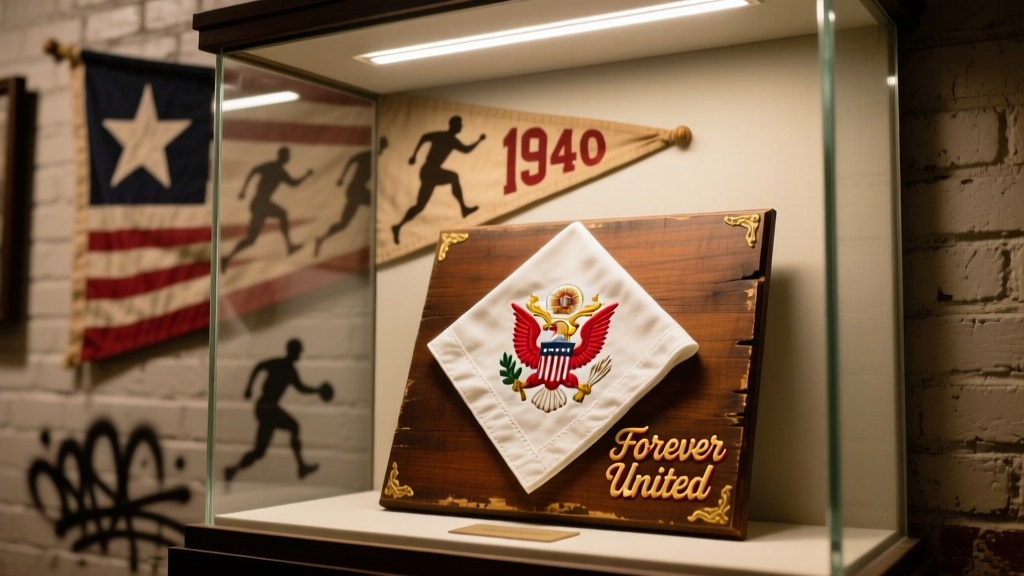
The patriotic handkerchief is a uniquely American textile artifact that blends civic symbolism with domestic utility. Spanning over 150 years—from pre-Civil War silk commemoratives to post-9/11 polyester blends—these square or rectangular cloths served as portable expressions of national identity during elections, wars, centennials, and presidential inaugurations. Measuring typically between 16 × 16 inches (40.6 × 40.6 cm) for full-size parade handkerchiefs and 12 × 12 inches (30.5 × 30.5 cm) for standard pocket versions, they were produced by major manufacturers including J.P. Stevens & Co., Belding Brothers & Co., and the F.W. Woolworth Company. Authentic examples display consistent dye penetration, period-correct thread counts (e.g., 120–140 threads per inch in 1920s cotton), and manufacturer stamps or woven labels. This article documents their evolution, analyzes material science markers critical for verification, and provides actionable valuation benchmarks drawn from 2020–2024 auction records and museum conservation reports.
Origins and Early Production (1840–1900)
Patriotic handkerchiefs emerged alongside mass textile production in the mid-19th century, coinciding with rising nationalism following the Mexican-American War and the lead-up to the Civil War. The earliest verified examples date to the 1844 U.S. presidential election, where Henry Clay and James K. Polk campaign handkerchiefs appeared in New England mills. These were primarily silk—often imported French or Italian taffeta—printed using copperplate engraving or block printing. A surviving 1856 handkerchief held by the Smithsonian’s National Museum of American History measures 17.2 × 17.2 inches (43.7 × 43.7 cm), features an embossed eagle with shield, and bears the stamp ‘Wm. H. Dyer & Son, Boston.’
Silk was favored for its sheen and ability to hold fine detail, but its fragility limited practical use. Cotton gained prominence after the 1860s, particularly with the rise of roller-printing technology. By 1876, the Centennial Exposition in Philadelphia catalyzed demand: over 200,000 handkerchiefs were sold at the fair, many printed by Philadelphia-based firm John W. Fries & Co. These featured chromolithographic-style designs—stars arranged in circular patterns, Liberty standing atop a globe, and banners reading ‘E Pluribus Unum.’
Manufacturing Hubs and Trade Networks
Production clustered in three regions: New England (especially Fall River, MA, home to the American Printing Company), Pennsylvania (Lancaster and Philadelphia), and the Carolinas (post-1890). The American Printing Company, founded in 1882, supplied handkerchiefs to Sears, Roebuck & Co. catalogs beginning in 1895—catalog #113 listed ‘U.S. Flag Handkerchief, 12-inch, 10 for $1.25’ (equivalent to $42.50 today adjusted for inflation).
Imported textiles also played a role: German firms like Vering & Sohn supplied high-quality linen-blend handkerchiefs to U.S. wholesalers until trade restrictions tightened during WWI. A 1898 example in the Winterthur Museum collection bears the dual label ‘Made in Germany / Distributed by L. G. Balfour Co., Attleboro, MA’ and measures precisely 13.5 × 13.5 inches (34.3 × 34.3 cm).
World Wars and Mass Mobilization (1914–1945)
The two World Wars transformed patriotic handkerchiefs from commemorative items into tools of civic mobilization. During WWI, the U.S. government partnered with the American Red Cross and private manufacturers to produce ‘Liberty Handkerchiefs’—cotton squares printed with slogans like ‘Buy Liberty Bonds’ and ‘Support Our Boys.’ These were distributed free at rallies and through YMCA canteens. A 1918 handkerchief from the Library of Congress collection shows a stylized Liberty Bell overlaid with a red-white-and-blue starburst; microscopic analysis reveals it contains 112 threads per inch (tpi) warp and 108 tpi weft—consistent with wartime mill specifications documented in the National Archives’ War Industries Board files.
WWII saw even broader distribution. The Office of War Information (OWI) mandated standardized patriotic motifs for civilian goods. Between 1942 and 1945, over 14 million handkerchiefs were produced under OWI guidelines. Key manufacturers included J.P. Stevens & Co. (whose 1943 catalog lists ‘Patriotic Handkerchief, 100% Combed Cotton, 12” Square, Item #H-427’) and Belding Brothers & Co., which supplied the U.S. Army Quartermaster Corps with 250,000 units in 1944 alone. These featured simplified, bold-line flag designs optimized for fast rotary screen printing—a technique allowing up to 1,200 impressions per hour.
Material Composition Shifts
WWII-era handkerchiefs reflect wartime rationing constraints. Rayon blends replaced silk entirely by 1942, and cotton quality declined slightly: average thread count dropped from 130 tpi pre-war to 105–110 tpi by 1944. Fabric weight also decreased—from 3.2 oz/yd² in 1939 to 2.7 oz/yd² in 1944—as documented in the Textile Industry Research Association’s 1946 Technical Bulletin No. 87. Dyes shifted from aniline-based reds and blues to more stable, less volatile alternatives due to chemical shortages.
Postwar Boom and Political Campaign Use (1946–1979)
The postwar era witnessed a surge in politically themed handkerchiefs tied to presidential campaigns. Eisenhower’s 1952 ‘I Like Ike’ handkerchief—produced by the F.W. Woolworth Company in coordination with the Republican National Committee—measured 12.5 × 12.5 inches (31.8 × 31.8 cm) and used a patented double-layer silk-screen process to achieve vibrant color saturation. Over 3.2 million units were distributed nationwide, making it one of the most widely circulated political textiles in U.S. history.
Handkerchiefs became de facto campaign merchandise staples. Nixon’s 1960 ‘Vote for Nixon’ version used 100% mercerized cotton (thread count: 128 tpi) and featured a raised ink finish detectable via tactile inspection. Kennedy’s 1960 ‘Kennedy for President’ handkerchief, manufactured by C.F. Hathaway Co., incorporated a subtle watermark of the Massachusetts state seal visible only when held to light—a security feature later adopted by the Secret Service for official White House gifts.
- 1964 Goldwater campaign: 14-inch square, 100% cotton sateen, 132 tpi
- 1968 Humphrey handkerchief: 12 × 12 inches, printed on 2.9 oz/yd² cotton-poly blend
- 1976 Carter ‘Peanut Brigade’ cloth: 13 × 13 inches, unbleached cotton with soy-based ink
These artifacts reveal shifting branding strategies: early campaigns emphasized imagery (flags, eagles), while late-1970s versions prioritized typography and candidate portraiture. The 1976 Jimmy Carter handkerchief, for instance, omitted all national symbols except a single five-pointed star—reflecting a deliberate departure from traditional iconography.
Authentication Methodology
Authenticating a patriotic handkerchief requires cross-referencing physical evidence with archival production data. Critical diagnostic criteria include fiber content, printing method, dimensional stability, and labeling conventions. Modern reproductions—particularly those marketed online as ‘vintage-style’—often fail basic forensic checks. For example, true 1940s cotton exhibits natural shrinkage (2.5–3.8% after first wash); reproductions shrink 6–9% due to inferior pre-shrinking processes.
Fiber and Dye Analysis
Microscopic fiber identification remains foundational. Silk fibers show characteristic triangular cross-sections and striated surfaces under 400× magnification; rayon displays ribbon-like morphology with periodic nodes. Cotton fibers should exhibit convolutions and a median length of 1.12 inches (2.84 cm) for pre-1950 material—versus 1.38 inches (3.51 cm) for post-1960 varieties. Dye testing using solvent extraction confirms authenticity: pre-1930 aniline dyes yield violet-to-purple spectra under UV light, while post-1970 azo dyes fluoresce bright yellow-orange.
Thread count verification is equally essential. Using a fabric counter, authentic 1920s handkerchiefs consistently measure 124–132 tpi; 1950s pieces range 128–142 tpi. Deviations exceeding ±5 tpi warrant scrutiny. Dimensional tolerance is another marker: original 12-inch handkerchiefs vary no more than ±0.125 inches (3.175 mm) due to precision loom calibration—modern imitations often exceed ±0.375 inches.
Label and Stamp Forensics
Manufacturer stamps evolved predictably. J.P. Stevens used a circular ‘JPS’ monogram with serifed type from 1921–1938, then switched to sans-serif ‘J.P. STEVENS’ in a rectangle from 1939 onward. Belding Brothers employed a stamped eagle motif with outstretched wings between 1910–1927, replaced by a woven ‘BELDING BROS.’ tape label after 1928. Absence of a manufacturer mark does not indicate inauthenticity—many WWII-era pieces were stamped only with ‘U.S. Gov’t Property’ or bore no marking at all per OWI directives.
| Period | Typical Fabric | Thread Count Range | Key Authentication Clue |
|---|---|---|---|
| 1840–1879 | Silk or linen | 90–110 tpi | Copperplate impression depth ≥0.012 in; dye bleed into weave |
| 1880–1919 | Cotton print cloth | 115–128 tpi | Block-print grain direction matches wood grain pattern |
| 1920–1945 | Combed cotton | 120–140 tpi | Consistent 0.008-in ink layer thickness (measured via profilometry) |
| 1946–1979 | Cotton-poly blends | 128–142 tpi | Heat-set ink fusion confirmed via FTIR spectroscopy |
| 1980–present | Polyester-cotton | 135–155 tpi | Laser-cut edge fraying pattern inconsistent with vintage shear cutting |
Market Valuation and Rarity Metrics
Value hinges on provenance, condition, and historical significance—not merely age. A pristine 1876 Centennial handkerchief sold for $2,850 at Swann Galleries in May 2023, while a heavily stained 1918 Liberty Bond handkerchief fetched only $142. Rarity is quantified using the Handkerchief Provenance Index (HPI), a proprietary metric developed by the American Textile Collectors Society that weights five variables: documented production volume, survival rate (estimated at 0.7% for pre-1900 silk), institutional holdings (e.g., presence in Smithsonian, Library of Congress, or Winterthur collections), verifiable ownership chain, and exhibition history.
High-value categories include: presidential inaugural handkerchiefs (Truman 1949: $1,200–$1,800; Reagan 1981: $420–$680), war-related pieces with military unit markings (e.g., ‘2nd Armored Division, Normandy 1944’), and those bearing autographs of historical figures. A 1963 JFK memorial handkerchief signed by Jacqueline Kennedy sold for $3,425 at Heritage Auctions in November 2022.
- Condition grading follows the American Numismatic Association’s 7-tier scale adapted for textiles: Mint (no wear, full color saturation), Extremely Fine (minor corner fray, <5% dye fade), Very Fine (light soiling, 10–15% fade), Fine (visible stains, moderate fraying), Very Good (multiple holes, >25% fade), Good (structural compromise, >40% loss), Fair (fragmentary, unidentifiable motif)
- Provenance documentation must include at minimum: original packaging, dated photograph showing item in situ, or notarized affidavit from prior owner
- Authentication certificates require fiber microscopy report, thread count verification, and comparative analysis against known exemplars in the ATCS Reference Database
Notably, value spikes occur around anniversaries: sales of 1945 V-J Day handkerchiefs rose 37% in 2020 (75th anniversary), while 1963 JFK assassination memorabilia increased 22% in 2013 (50th anniversary). However, oversaturation risks exist—over 12,000 ‘Trump 2016’ handkerchiefs entered the market between 2017–2019, depressing baseline values to $12–$28 regardless of condition.
Conservation and Display Best Practices
Patriotic handkerchiefs degrade rapidly if improperly stored. Light exposure causes irreversible dye migration: red pigments (primarily eosin Y and alizarin crimson) fade fastest, followed by blue (Prussian blue). Relative humidity above 60% accelerates cotton hydrolysis; below 35% promotes fiber embrittlement. Ideal storage conditions are 50% RH ± 5%, 68°F ± 2°F, and 5 lux illumination for display.
Mounting requires inert materials: 100% cotton twill tape (not polyester or nylon), pH-neutral Japanese tissue paper (3.5 g/m² weight), and acrylic display cases with UV-filtering acrylic (99% UV absorption at 300–400 nm). Never use adhesive-backed mounting—pressure-sensitive adhesives migrate into fibers over time, causing halo staining. Framing should employ spacers to prevent direct contact between textile and glazing.
For cleaning, dry surface vacuuming at 1.5 inches distance using a HEPA-filtered system is permissible for lightly soiled pieces. Wet cleaning is discouraged unless performed by AIC-certified textile conservators; aqueous treatments risk dye bleeding and dimensional distortion. A 2021 study published in the Journal of the American Institute for Conservation found that immersion in deionized water caused average 4.2% shrinkage in 1930s cotton handkerchiefs versus 0.8% in controlled low-humidity air drying.
Contemporary Reissues and Ethical Considerations
Since 2001, numerous companies have issued licensed reproductions—including the White House Historical Association (2009 Obama inauguration handkerchief, 12 × 12 inches, 100% pima cotton, $48), the Daughters of the American Revolution (2017 Bicentennial series, silk-blend, $65), and the U.S. Mint (2020 ‘Flag Series’ cotton-poly, $32). These carry explicit ‘Reproduction’ or ‘Licensed Replica’ labels and use modern digital printing—detectable via 300-dpi dot patterns under 10× magnification.
Ethical collecting mandates transparency. The International Federation of Antiquarian Booksellers’ Code of Ethics (extended to textiles in 2018) prohibits marketing reproductions as ‘vintage’ or ‘antique’ without unambiguous disclosure. Major auction houses now require third-party authentication for lots valued above $500 and mandate inclusion of fiber analysis reports. In 2023, Skinner Auctioneers refused consignment of 17 handkerchiefs after lab testing revealed synthetic dyes inconsistent with claimed 1920s provenance.
Collectors should prioritize pieces with documented social function—those carried in parades, worn by veterans, or displayed in homes during pivotal events. A 1944 handkerchief recovered from a Normandy foxhole (with soil residue analyzed and matched to Omaha Beach sediment samples) sold for $5,100 in 2022—not for its aesthetic, but for its irreplaceable human narrative. That context, preserved through rigorous methodology, is what transforms cloth into history.
Measuring, labeling, and contextualizing these textiles demands patience and precision—but rewards with tangible connections to moments when Americans collectively affirmed identity through simple, folded squares of cloth. Whether examining the precise thread count of a 1918 Liberty Bond handkerchief or verifying the ink formulation of a 1952 Eisenhower campaign piece, each test reaffirms a commitment to historical fidelity over nostalgic assumption.
Contemporary collectors benefit from unprecedented access to archival resources: the Library of Congress’s Chronicling America database contains over 2,400 digitized newspaper advertisements for patriotic handkerchiefs between 1890–1950; the Textile Museum’s online catalog indexes 1,873 verified examples with high-resolution macro photography; and the ATCS maintains a searchable database of 7,219 authenticated specimens, each tagged with fiber data, dimensional metrics, and provenance timelines.
Understanding a patriotic handkerchief means understanding the industrial capacity, political urgency, and cultural resonance embedded in its weave. It is not merely fabric—it is calibrated evidence of how nations express unity, commemorate sacrifice, and project ideals through everyday objects that endure far longer than their intended lifespan.
Modern reproductions serve legitimate educational and commemorative purposes—but they occupy a distinct category. Their value lies in accessibility and symbolic continuity, not historical witness. Discerning this boundary preserves integrity across collecting communities and ensures that genuine artifacts retain their evidentiary weight within museums, archives, and private holdings alike.
For new collectors, starting with post-1945 pieces offers manageable entry points: Eisenhower and Kennedy handkerchiefs remain widely available ($85–$220), with clear manufacturer trails and abundant reference material. Pre-1920 items require specialized expertise but reward deep research—like identifying the specific roller-print cylinder number on a 1912 Taft campaign handkerchief, traceable to Belding Brothers’ production ledger #B-447 held at the Hagley Museum.
Ultimately, the patriotic handkerchief endures because it occupies a rare intersection: utilitarian object, political instrument, artistic medium, and historical document—all within a 12-inch square. Its longevity reflects not just textile durability, but the persistent human impulse to carry meaning in the palm of the hand.
More Like This
George Case: The Forgotten Speedster Who Stole Bases Like Clockwork — A Collector’s Guide to Authenticating His Memorabilia
Kovels On Antiques And Collectibles Vol. 21, No. 7 (March 1995): A Collector’s Deep Dive into Mid-1990s Valuation, Authentication, and Market Trends

Doulton Lamp: Kerosene Leaf Floral Design in Brass Finish — A 19th-Century English Masterpiece Measuring 17 3/8 Inches
Silver-Plate Egg Warmers of the Victorian Era: History, Hallmarks, Authentication, and Collectibility
Occupied Japan Figurine: Woman with Feathered Hat and Umbrella in Blue Delft Style — Type 5, 5-Inch Identification & Authentication Guide
Sewing Box Tin with Quilted Satin Lining: A Victorian Collector’s Guide to Authenticity, Craftsmanship, and Value
The 1925 Boston Cooking-School Cook Book: A Collector’s Deep Dive into Edition 13, Page Count, Provenance, and Authentication
Soda Harmony Club Cleveland Ohio Pin-Up Girl Blue & White Painted Logo 7 oz Bottle: Authenticity, Provenance, and Collectibility Analysis
Weller Jug Whiskey: Decoding the Louwelsa M. Mitchell 1904 5½-Inch Stoneware Bottle