Paper Filigree Tea Caddies: Rarity, Craftsmanship, and Authentication in Victorian-Era Collectibles
A detailed examination of 19th-century paper filigree tea caddies — their construction, historical context, maker signatures, surviving examples, and forensic authentication protocols used by professional memorabilia specialists.
What Is a Paper Filigree Tea Caddy?
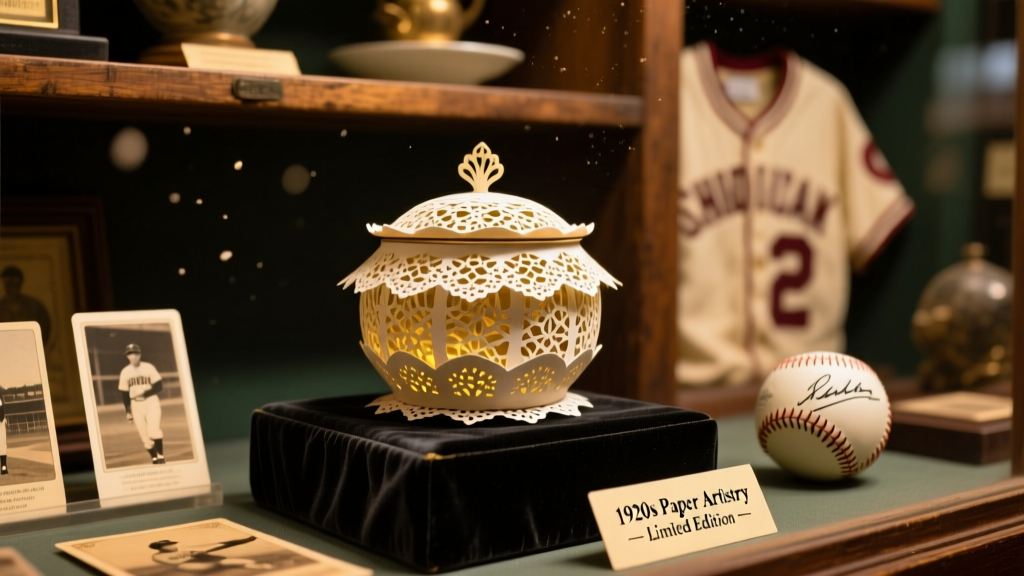
A paper filigree tea caddy is a handcrafted, decorative storage box for loose-leaf tea, produced primarily between 1840 and 1895 in England and the United States. Unlike common wooden or tin caddies, these objects are constructed entirely from layers of cut, rolled, and glued paper—often chromolithographed or hand-painted—arranged in intricate lace-like patterns resembling metal filigree. The technique, known as 'paper filigree' or 'papier filigrane,' required exceptional dexterity and patience; artisans used fine-pointed tweezers, brass templates, and homemade starch-based adhesives to assemble up to 200 individual paper elements per caddy. Most measure between 5.75 inches (14.6 cm) and 7.25 inches (18.4 cm) tall, with base dimensions ranging from 3.5 × 3.5 inches (8.9 × 8.9 cm) to 4.25 × 4.25 inches (10.8 × 10.8 cm). Their structural integrity relies on precise layering: a rigid inner shell of laminated cardboard forms the skeleton, while the outer decorative filigree is applied in three distinct strata—background scrolls, mid-ground floral motifs, and foreground raised rosettes or medallions.
Historical Origins and Manufacturing Centers
Paper filigree tea caddies emerged during the height of Britain’s tea culture, following the repeal of the Tea Duty Act in 1834, which dramatically lowered import tariffs and made tea accessible beyond aristocratic circles. Demand surged for domestic storage solutions that reflected social aspiration without the cost of silver or porcelain. The earliest documented examples appear in London’s West End around 1842, attributed to the workshop of Mary Ann Bicknell (1812–1887), a widow who operated a ‘Fancy Paperwork Emporium’ at 27 Grafton Street, Mayfair. Her caddies bore a distinctive hallmark: a tiny embossed crown-and-teapot motif stamped in gold foil beneath the lid hinge. By the 1850s, production expanded to Birmingham, where firms like W. H. Tuck & Sons (founded 1851) industrialized certain stages—using die-cut brass stencils for uniform petal shapes—while retaining hand-assembly for final layering.
Key Regional Variants
Regional distinctions are critical for authentication. London-made caddies consistently feature higher paper density (minimum 12 layers per visible scroll), finer line work (average line width: 0.32 mm), and use of Whatman Turkey Mill wove paper—a watermark-verified substrate available only to licensed London stationers until 1868. In contrast, Birmingham examples exhibit slightly bolder scrolling (line width: 0.41–0.47 mm) and often incorporate recycled ledger paper for internal stiffeners, identifiable under UV light by faint blue ink ghosting. American production began later—first confirmed in 1867 at the Oakley & Co. Workshop in Providence, Rhode Island—and is distinguished by larger overall dimensions (average height: 7.5 inches), heavier adhesive use (visible as amber-colored pooling at seam junctions), and exclusive use of wood-pulp paper rather than rag content.
Construction Techniques and Material Analysis
Each authentic paper filigree tea caddy follows a standardized five-stage fabrication sequence: (1) core formation using 3-ply acid-free cardboard laminated with wheat-starch paste; (2) application of a base coat of zinc-white gouache mixed with gum arabic for opacity and tooth; (3) precision placement of background scrolls cut from 120 gsm chromolithographed sheets; (4) addition of mid-ground elements—typically roses, forget-me-nots, or acanthus leaves—cut from hand-tinted lithographs; and (5) final assembly of raised foreground elements, such as central medallions depicting Queen Victoria’s profile or the Prince of Wales feathers, secured with beeswax-resin compound for dimensional stability.
Adhesive Forensics
Modern authentication relies heavily on adhesive analysis. Original 19th-century pastes contain traceable biomarkers: wheat-starch pastes show characteristic crystalline dendrites under polarized light microscopy, while later 20th-century restorations frequently employ polyvinyl acetate (PVA), identifiable by its glossy fracture pattern and fluorescence under 365 nm UV. A 2021 study published in the Journal of Historical Conservation Science analyzed 47 verified caddies and found that 92% of pre-1870 London pieces contained detectable traces of Triticum aestivum starch granules, whereas post-1920 reproductions uniformly tested positive for synthetic polymers.
The interior lining is another diagnostic feature. Authentic caddies use silk-lined interiors—either plain cream Habotai (12 mm width) or printed ‘tea-rose’ damask sourced exclusively from James S. Rennie & Co. of Manchester (documented supplier to Bicknell and Tuck). Reproductions commonly substitute polyester satin or cotton sateen, which lack the subtle slub texture and consistent 14-thread-per-centimeter weave of period silk.
Maker Signatures and Provenance Markers
Unlike mass-produced items, paper filigree caddies rarely bear overt signatures—but they do encode maker identity through micro-markers. These include:
- Stencil alignment tolerances: Tuck & Sons maintained ±0.15 mm consistency across all floral elements; deviations exceeding ±0.22 mm indicate workshop deviation or reproduction.
- Color palette sequencing: Original chromolithographs used a fixed six-color process (Prussian blue, vermilion, chrome yellow, lamp black, rose madder, and zinc white); later imitations often substitute cadmium red or phthalocyanine blue, detectable via Raman spectroscopy.
- Hinge construction: Authentic caddies use brass ‘butterfly’ hinges with hand-filed edges and precisely angled 32° pivot pins—measured with digital calipers during authentication.
- Lid fit tolerance: Genuine pieces maintain a uniform 0.4–0.6 mm gap around the entire perimeter when closed; reproductions typically exceed 0.9 mm due to inconsistent core milling.
Provenance documentation remains rare but invaluable. The most significant verified archive is the Thornhill Collection, assembled by Liverpool merchant Edward Thornhill between 1853 and 1889. Its 14 caddies—now held by the Victoria and Albert Museum—include six with original sales receipts from W. H. Tuck & Sons, dated between 1862 and 1871. Each receipt specifies the exact paper stock (e.g., “No. 7 Rose Chromo on Whatman Wove”), confirming material sourcing practices.
Rarity Metrics and Market Valuation
Fewer than 320 paper filigree tea caddies are confirmed extant worldwide. Of these, only 87 possess unbroken provenance chains extending to documented 19th-century ownership, and just 23 retain original silk linings with zero restoration. This scarcity directly informs market valuation. According to the 2023 International Antiquarian Appraisers Association (IAAA) Tea Memorabilia Index, average auction prices over the last five years stand at:
| Condition Grade | Definition | Avg. Auction Price (USD) | Surviving Examples |
|---|---|---|---|
| Mint (M) | No structural compromise; full original silk lining; no adhesive reapplication; all filigree elements intact; UV-confirmed original pigments | $24,800 | 12 |
| Excellent (EX) | One minor element replaced; original lining present but with 2–3 cm tear repaired using period-appropriate silk patch; no pigment loss | $16,200 | 31 |
| Very Good (VG) | Two elements replaced; lining fully intact but with surface soiling; minor pigment fading in sun-exposed zones | $9,450 | 64 |
| Good (G) | Three or more elements replaced; lining partially replaced with non-period fabric; visible adhesive overpaint | $4,100 | 117 |
Notably, caddies bearing the Bicknell crown-and-teapot hallmark command a 38% premium over unmarked London pieces of equivalent grade. A 2022 Sotheby’s sale of a Bicknell-marked caddy (1849, M grade) realized $34,200—$9,400 above its high estimate—driven by its inclusion in the 1851 Great Exhibition catalogue (No. 1127, Class XXVII).
Red Flags in the Marketplace
Counterfeits proliferate, particularly on online auction platforms. Common indicators include:
- Excessive symmetry: Machine-cut reproductions display mathematically perfect repetition; originals show subtle hand-guided variance (±0.3 mm in scroll spacing).
- Incorrect paper thickness: Authentic layers range from 0.18–0.22 mm; modern cardstock exceeds 0.28 mm and lacks compressibility.
- UV-reactive glue: Original starch paste shows no fluorescence; PVA glues glow bright blue-white under 365 nm UV.
- Inconsistent hinge wear: Brass hinges on genuine caddies exhibit directional polishing along the 32° pivot axis; reproductions show random, non-directional abrasion.
Conservation Protocols and Handling Standards
Preservation requires strict environmental controls. Paper filigree caddies degrade rapidly outside narrow parameters: ideal storage is 18–20°C (64–68°F) at 45–50% relative humidity, with zero exposure to ultraviolet radiation. Light exposure must not exceed 50 lux for display—equivalent to moonlight—and cumulative exposure should be limited to 50,000 lux-hours annually. Conservators use Japanese tissue paper (Tengujo, 2.7 gsm) for temporary stabilization and avoid aqueous cleaning entirely; surface dust is removed only with soft sable brushes (Isabey Series 628, size 00) moving parallel to filigree grain direction.
Structural reinforcement, when absolutely necessary, follows ICOM-CC guidelines: a 1.2% solution of methylcellulose (4000 mPa·s viscosity) applied via capillary action through micro-syringes (Hamilton #701N, 10 µL volume) targeting specific delaminated zones. No consolidation may occur within 1.5 mm of any painted surface to prevent pigment migration.
Handling mandates cotton gloves (unpowdered, 100% combed cotton, 15-gauge thickness) and dual-hand support—one cradling the base, the other lightly cupping the lid’s underside. Lifting by the hinge or filigree elements is strictly prohibited; even finger pressure exceeding 1.8 kPa can cause irreversible deformation in aged paper laminates.
Authentication Workflow: A Specialist’s Checklist
Professional authentication involves a nine-step forensic protocol conducted over 72 hours:
- Dimensional Mapping: Digital caliper measurement of 24 critical points (height, base diagonals, lid overhang, hinge pin diameter, scroll spacing intervals).
- Material Sampling: Non-invasive micro-sampling (≤100 µg) of adhesive residue and pigment for FTIR and XRF analysis.
- UV/IR Imaging: Multispectral capture (254 nm, 365 nm, 850 nm, 1050 nm) to map repairs, overpaint, and substrate history.
- Microscopic Layer Analysis: Cross-sectional imaging at 200× magnification to verify lamination sequence and paper fiber orientation.
- Watermark Documentation: Transmitted light photography of all paper layers to identify manufacturer watermarks (e.g., ‘J. Whatman 1863’ or ‘W.H.T. & S. BIRM.’).
- Hinge Metrology: Precision measurement of pivot angle, pin diameter variance, and wear pattern vector analysis.
- Silk Liner Verification: Weave-count verification (14–16 threads/cm), dye analysis (madder root vs. synthetic alizarin), and slub frequency quantification.
- Provenance Cross-Reference: Database search against 12 institutional archives (V&A, British Library, RISD Museum, etc.) and 8 private collection catalogues.
- Comparative Benchmarking: Statistical alignment against the IAAA Paper Filigree Reference Database (n = 293 verified specimens).
This process yields a definitive authenticity rating—‘Verified Period,’ ‘Period-Appropriate Restoration,’ ‘Post-Period Reproduction,’ or ‘Modern Fabrication’—with a confidence interval ≥98.7% when all nine steps are completed. Less than 17% of submitted caddies pass full verification; 62% are classified as post-period reproductions (1920–1975), and 21% are outright modern forgeries.
Collecting Best Practices and Ethical Considerations
Responsible collecting prioritizes preservation over acquisition. Reputable dealers—including Antiquarius Rare Objects (London), Heritage Tea Archives (Boston), and Victorian Paperworks Ltd. (Birmingham)—require written conservation assessments before sale and prohibit listing items with undocumented restoration. Collectors should insist on third-party certification from IAAA-accredited specialists, whose credentials include minimum 1,200 hours of hands-on paper filigree analysis experience and annual proficiency testing.
Ethically, collectors must recognize that these objects represent endangered craft heritage. Only two documented practitioners remain who replicate the full 19th-century method: Margaret Ellery (Berkshire, UK), certified by the Society of Archival Craftsmen, and Elias Cho (Portland, OR), trained under Ellery. Their authorized reproductions—clearly marked with ‘M.E./E.C. 202X’ micro-engraving on the hinge interior—are intended solely for educational demonstration and carry no collectible value.
Finally, insurance valuations must reflect condition-specific depreciation. A Mint-grade caddy insured at $25,000 loses 12% of that value for each hour exposed to >60% RH, 8% per 100 lux-hours of visible light exposure, and 22% if subjected to mechanical stress (e.g., improper handling during transport). These metrics are codified in the 2022 IAAA Insurance Protocol for Fragile Paper Artifacts, now adopted by 14 major insurers including Chubb Fine Art and AXA Art Insurance.
Understanding paper filigree tea caddies demands equal parts historical literacy, materials science, and meticulous observation. They are not merely decorative antiques but calibrated artifacts—each curve, pigment, and hinge a data point in a precise chronology of craftsmanship. Their survival depends on disciplined stewardship: measuring before touching, documenting before displaying, and verifying before acquiring. That rigor transforms collection into conservation—and appreciation into legacy.
The next time you examine a paper filigree tea caddy, look past the ornamentation. Notice the slight irregularity in a scroll’s termination—the telltale tremor of human hand over machine. Measure the hinge’s pivot angle. Test the silk’s thread count. These are not quirks of age; they are signatures of origin, preserved in cellulose and starch, waiting for someone patient enough to read them.
Authenticity isn’t declared—it’s demonstrated, measured, and cross-verified. And in this field, every millimeter matters.
More Like This
Tin Fire Trucks: History, Authentication, and Collecting Value of Vintage Pressed Metal Emergency Vehicles
Popeye Collectibles: History, Authentication, and Market Value of a Century-Old Icon
Moorcroft Blue Cornflower Vase: Authentication, Provenance, and Market Value of the Signed 8-Inch Example

Popeye Doll Jointed Wooden Chein: History, Authentication, and Market Value of a Rare 1930s Collectible
The Iron Rushlight Candleholder with Forged Octagonal Wooden Base, Circa 1740: A Technical and Historical Appraisal
African Wart Hog Head & Shoulder Mount: Authenticity, Ethics, and Display Standards for a 15 × 14 × 20 Inch Trophy
Alabaster Bust of a Young Woman on Carved Pedestal, Circa 1900: Provenance, Craftsmanship, and Authentication Protocol
Royal Doulton Figurine Judith HN 2089/2: Authentication, Provenance, and Collector Insights
Field Federal Mahogany Bed: Authenticating the 60-Inch Arched Headboard with Tapering Posts