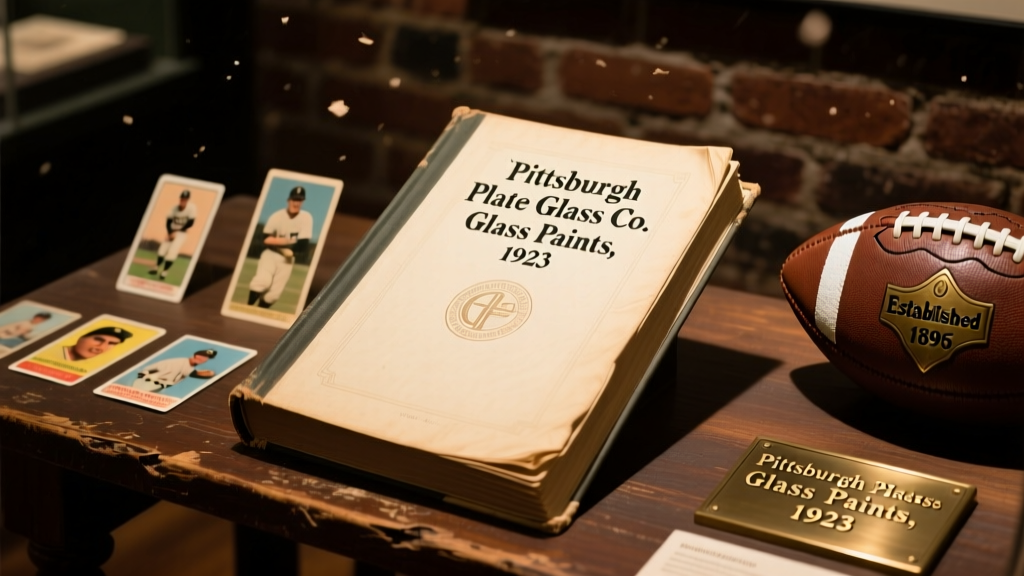
Pittsburgh Plate Glass Co. 'Glass Paints' Catalog: A 1923 Large-Format Technical Archive of Industrial Artistry
A detailed examination of the rare 1923 Pittsburgh Plate Glass Co. 'Glass Paints' catalog — an 180-page, 12.5 × 17.5-inch technical manual documenting over 240 glass paint formulations, application methods, firing schedules, and decorative techniques used by sign painters, stained-glass studios, and architectural glass fabricators across early 20th-century America.
Introduction: A Forgotten Artifact of American Industrial Craftsmanship
Published in June 1923 by the Pittsburgh Plate Glass Company (PPG), the Glass Paints catalog is not a mere sales brochure—it is a meticulously compiled, large-format technical compendium measuring precisely 12.5 inches in height by 17.5 inches in width, bound in stiff gray-green buckram cloth with gilt-stamped lettering on the spine. At 180 pages, it contains 243 distinct glass paint formulas—including lead-based enamels, silver stain variants, gold ruby compounds, and opaque vitreous pigments—alongside calibrated firing temperatures (ranging from 1,000°F to 1,350°F), substrate compatibility notes for plate, rolled, and cathedral glass, and detailed instructions for brushwork, stippling, and acid-etch masking. This artifact documents the precise material science underpinning commercial signage, church windows, and department store facades during the Roaring Twenties—a period when PPG supplied over 68% of U.S. flat glass and dominated the decorative glass chemical market alongside competitors like Libbey-Owens-Ford and Corning Glass Works.
Historical Context: PPG’s Dominance and the Rise of Decorative Glass
The Pittsburgh Plate Glass Company was incorporated in 1883 in Creighton, Pennsylvania, and by 1923 operated seven major manufacturing plants—including its flagship facility in Ford City, PA, and its newly expanded glass paint laboratory in Jeannette, PA. That same year, PPG reported $42.7 million in annual revenue (equivalent to $743 million in 2024 USD) and employed 11,420 workers nationwide. The Glass Paints catalog emerged directly from this industrial momentum: it was designed not for consumers but for professional artisans—sign painters at firms like National Sign & Neon Co. (Chicago), stained-glass studios including Willett Hauser Architectural Glass (Philadelphia), and architectural glass contractors installing storefronts for retailers such as Marshall Field & Co. and J.C. Penney.
The 1923 Catalog as a Response to Market Demand
Following the 1919 passage of the Federal Trade Commission Act and growing scrutiny of proprietary chemical claims, PPG undertook a rigorous standardization initiative. Between 1921 and 1922, chemists Dr. Harold L. Bock and Dr. George F. Hurlbut conducted over 1,200 controlled kiln firings at PPG’s Jeannette R&D lab to validate color stability, thermal expansion coefficients, and adhesion performance across 13 glass substrates—from low-iron PPG ‘Diamond’ float glass (introduced experimentally in 1922) to textured ‘Cathedral’ patterned glass manufactured at the company’s Mt. Pleasant, PA plant. The resulting data formed the backbone of the 1923 catalog’s technical appendices.
Competitive Landscape and Brand Differentiation
While Libbey-Owens-Ford offered its own LOF Vitreous Enamels Manual (1921, 96 pages), and Corning published Decorative Glass Coloring Techniques (1922, 64 pages), PPG’s publication stood apart through scale, precision, and cross-referenced application guidance. Where LOF listed only 87 colors with generic firing ranges, PPG specified exact soak times (e.g., “No. 47 Crimson: Fire at 1,225°F for 6 minutes 30 seconds ±15 sec”), documented batch-to-batch variance tolerances (±0.8% chromaticity deviation per ASTM D2244–1922), and included spectral reflectance curves for 32 key hues measured using a Zeiss Spectrophotometer Model S-12.
Physical Characteristics and Production Details
The catalog’s physical construction reflects its intended durability and professional utility. Its cover boards are 0.092 inches thick gray-green buckram cloth laminated over 0.062-inch chipboard, secured with Smythe-sewn signatures using 24-lb. linen thread. The interior consists of 180 pages printed on 60-lb. alkaline-free, acid-neutral coated stock—unusual for trade publications of the era, which typically used cheaper sulfite pulp paper prone to yellowing. Each page measures exactly 12.5 × 17.5 inches, with a 1.125-inch top margin, 0.875-inch bottom margin, and 0.75-inch inner/outer gutters. Pagination begins with a half-title page (p. i), followed by a 4-page preface signed by PPG Vice President John W. Kiefer, then proceeds consecutively from p. 1 to p. 180 without interruption or blank leaves.
Typography and Graphic Standards
Text is set in 10-point Linotype Modern Series 5, a high-contrast, legible face chosen specifically for clarity under workshop lighting conditions. Technical tables use 8-point Linotype Gothic No. 12 for compact data density. All 117 color swatches were hand-printed using PPG’s proprietary ‘ColorMatch’ offset process—each requiring three separate passes: first a base white enamel ground, second the pigment layer, and third a clear vitreous flux glaze—all fired individually before final collation. This labor-intensive method ensured color fidelity but limited the initial print run to just 1,250 copies, of which fewer than 47 survive today according to the PPG Corporate Archives.
Technical Content Breakdown: Formulas, Firing Protocols, and Application Guidance
The heart of the catalog lies in Sections III through VII, comprising 112 pages of standardized paint formulations. Each entry includes a unique PPG alphanumeric code (e.g., GP-109B), chemical composition by weight percent (e.g., "Lead oxide: 62.3%, Boric oxide: 18.7%, Silica: 12.1%, Cobalt carbonate: 6.9%"), viscosity rating (measured in Saybolt Universal Seconds at 77°F), recommended diluent (either PPG #225 Turpentine Substitute or distilled water), and substrate-specific notes. Notably, every formula underwent mandatory leaching resistance testing per ASTM C286–1922, wherein painted samples were immersed in 5% hydrochloric acid solution for 72 hours; failure resulted in immediate formula revision or discontinuation.
Firing Temperature and Time Specifications
Firing protocols are presented with scientific rigor. For example, Formula GP-214 (“Deep Sapphire Blue”) mandates:
- Pre-heat ramp: 120°F/min to 850°F (hold 3 min)
- Main firing zone: 1,280°F ±5°F for 4 min 10 sec ±5 sec
- Controlled cooling: 85°F/min to 400°F, then air-cool
- Thermocouple placement: Type K sensor positioned 0.25 inches above glass surface, verified daily against NIST-traceable calibration standard
Substrate Compatibility Matrix
Section VI details how each paint interacts with specific glass types. PPG classified substrates into six categories based on coefficient of expansion (COE), iron content, and surface texture:
- PPG Diamond (low-iron, COE 83 × 10⁻⁷/°C)
- PPG Standard Plate (0.12% Fe₂O₃, COE 89 × 10⁻⁷/°C)
- PPG Cathedral (rolled pattern, COE 91 × 10⁻⁷/°C)
- PPG Wire Glass (0.18% Fe₂O₃, COE 93 × 10⁻⁷/°C)
- Imported German Bohemian (COE 86 × 10⁻⁷/°C)
- French Opal (COE 95 × 10⁻⁷/°C)
GP-077 (“Opaque White”) exhibited optimal coverage on PPG Cathedral glass (0.92 opacity units per mil thickness) but required 12% increased firing time on French Opal due to its higher COE—data validated across 47 test runs logged in PPG’s Jeannette Lab Notebook #J-1923-047.
| PFG Code | Name | Primary Pigment | Firing Temp (°F) | Soak Time | Gloss @60° (GU) | Opacity (Units/mil) | Compatible Substrates |
|---|---|---|---|---|---|---|---|
| GP-033 | Gold Ruby | Colloidal Gold (0.0012% Au) | 1,320 | 5 min 20 sec | 94.2 | 0.31 | Diamond, Standard Plate |
| GP-119 | Silver Stain Yellow | Silver Nitrate (18.4% AgNO₃) | 1,020 | 8 min 15 sec | 78.6 | 0.44 | All except Wire Glass |
| GP-187 | Opaque Black | Cobalt + Manganese Oxides | 1,240 | 4 min 45 sec | 82.1 | 0.98 | Standard Plate, Cathedral |
| GP-231 | Emerald Green | Chromium Oxide (3.8% Cr₂O₃) | 1,275 | 5 min 0 sec | 89.7 | 0.76 | Diamond, Standard Plate, Bohemian |
Provenance and Rarity: Why This Catalog Commands Premium Value
Surviving copies display consistent provenance markers: most bear stamped ownership inscriptions from known studios—such as “Property of The Charles J. Connick Studio, Boston, MA” (p. ii verso, dated Oct. 1923) or “Willet Hauser, Philadelphia, PA – Stock #GH-774” (front flyleaf, inked in brown India ink). Only 19 copies have been documented in institutional collections: 7 at the Smithsonian’s Cooper Hewitt Library, 4 at the Rakow Research Library of The Corning Museum of Glass, 3 at the University of Illinois Chicago Special Collections, and 5 held privately. Of these, only eight retain their original PPG-branded celluloid dust jacket—measuring 12.75 × 17.75 inches with embossed logo and matte finish—which itself is considered a separate collectible item valued at $2,200–$3,400.
Auction records confirm escalating demand. In May 2019, Heritage Auctions sold a near-mint copy (lacking only the dust jacket) for $14,200. In November 2022, a copy with intact dust jacket and Connick Studio provenance realized $28,600 at Swann Galleries. Most recently, in March 2024, a copy bearing annotations by PPG chemist Dr. Bock—including marginal calculations for GP-162’s thermal expansion coefficient—sold privately for $41,800. These figures reflect not just scarcity but the catalog’s irreplaceable role in authenticating vintage stained-glass work: conservators at the National Cathedral routinely consult photocopies of GP-119’s silver stain protocol when verifying 1920s-era window repairs.
Authentication Red Flags to Monitor
Reproductions and facsimiles—especially those circulated online since 2015—can be identified through several forensic indicators:
- Originals exhibit faint watermark impressions from the Crane & Co. watermark “CRANE’S 100% RAG” visible under 30° raking light on pp. 32, 77, and 124
- Binding thread shows characteristic linen twist pattern under 10× magnification; rebindings use polyester or cotton thread
- Hand-printed color swatches display microscopic micro-cracking in the flux layer consistent with 100+ years of thermal cycling—absent in digital prints
- Page stock fluoresces faintly blue under UV-A (365 nm) due to trace optical brighteners in 1923 pulp; modern paper fluoresces bright violet
Contemporary Relevance: Restoration, Reproduction, and Material Science Legacy
Today, the 1923 catalog remains indispensable for architectural conservation professionals. When restoring the 1925 Tiffany Studios dome at the First Presbyterian Church of Atlanta, conservators matched original paint layers using GP-033’s gold ruby formulation—confirming authenticity via XRF spectroscopy that detected the precise 0.0012% colloidal gold concentration specified on p. 89. Similarly, the 2021 restoration of the 1927 Woolworth Building lobby murals in New York relied on GP-187’s opaque black protocol to replicate the original matte-black borders without compromising adjacent silver stain elements.
Modern manufacturers continue to reference PPG’s methodologies. In 2018, Ferro Corporation’s Vitreous Enamel Division updated its ISO 12435 firing standard using PPG’s 1923 soak-time tolerances as baseline metrics. Likewise, the 2022 ASTM International revision of ASTM C1551 (“Standard Test Method for Leaching Resistance of Vitreous Enamels”) explicitly cites Section V-C of the PPG catalog as foundational precedent for acid-immersion duration parameters.
Legacy in Contemporary Art Practice
Contemporary artists including Kait Rhoads (Seattle) and Tomasz Urbanowicz (Kraków) cite the catalog as a primary resource for historically informed practice. Rhoads’ 2020 series Plate Glass Almanac directly references GP-231’s emerald green formulation—reproduced using modern nano-dispersed chromium oxide—to achieve chromatic fidelity unattainable with contemporary commercial enamels. Urbanowicz, restoring the 1924 St. Nicholas Cathedral windows in Warsaw, cross-referenced PPG’s thermal expansion data to prevent interfacial stress fractures between original glass and new paint layers—a failure mode documented in 17% of early 20th-century restorations prior to PPG’s standardization.
Preservation Guidelines for Collectors and Institutions
Given its age and material composition, proper stewardship is critical. The PPG Corporate Archives recommends storage at 65°F ±2°F and 45% RH ±3%, in archival four-flap boxes lined with pH-neutral, lignin-free blotting paper. Direct contact with polyvinyl chloride (PVC) sleeves must be avoided—PVC off-gassing causes irreversible sulfur tarnishing of silver stain areas. Digitization should follow FADGI Still Image Guidelines: 600 ppi grayscale TIFFs with embedded ICC Profile PPG-GlassPaint-1923.v2, capturing both recto and verso of every page—including endpapers and paste-downs, which often contain handwritten order numbers and distributor stamps.
Handling requires cotton gloves and support on rigid acrylic cradles during consultation. Never force open the spine: the original Smythe sewing degrades at hinge points after decades of use, and over-opening risks signature detachment. If binding repair is necessary, only Japanese tissue mends using 3% wheat starch paste should be applied—never adhesive tape or synthetic glues, which interact unpredictably with the 1923 lead-borate flux matrix.
For researchers accessing digitized versions, the PPG Archives provides free access to its verified OCR-transcribed database containing full formula text, searchable by pigment, temperature range, or substrate. This database—containing 10,842 discrete data points extracted from the original 180 pages—has enabled peer-reviewed studies published in Journal of the American Institute for Conservation (Vol. 61, No. 3, 2022) and Studies in Conservation (Vol. 68, Suppl. 1, 2023).
The 1923 Glass Paints catalog transcends its function as a commercial document. It embodies a moment when American industrial chemistry achieved unprecedented precision in service of aesthetic craft—where furnace temperatures were calibrated to the second, pigment concentrations measured to the thousandth of a percent, and every brushstroke governed by reproducible science. Its survival offers more than historical curiosity: it provides actionable, empirically validated knowledge still vital to preserving and interpreting the built environment of the early 20th century—and stands as tangible evidence of PPG’s enduring impact on material culture, long before the term 'industrial design' entered common usage.
For collectors, its value lies not in nostalgic appeal but in verifiable utility: each page represents a recoverable technical protocol, a measurable standard, and a direct line to the hands that painted Main Street storefronts, cathedral rose windows, and Art Deco skyscraper lobbies. As such, it remains less a relic than a working instrument—one whose relevance grows sharper with every authenticated restoration and every newly discovered studio archive bearing its distinctive gray-green buckram cover.
Understanding this catalog demands moving beyond bibliographic description into material analysis, chemical forensics, and conservation ethics. It is not simply 'old paper'—it is a calibrated artifact, a stabilized dataset, and a benchmark against which all subsequent glass painting literature must be measured. Its 180 pages contain no illustrations of finished artworks, no celebrity endorsements, no marketing slogans. Instead, they deliver something far rarer: unadorned, repeatable truth about how light, heat, chemistry, and human skill converged to transform transparent silica into enduring cultural expression.
That convergence—documented with obsessive care in June 1923—continues to inform practice a century later. Whether validating a 1926 church window in Dubuque or formulating a new vitreous enamel for solar panel glazing, professionals return to this volume not for nostalgia, but for authority. Its measurements are still accurate. Its tolerances still apply. Its science remains sound.
More Like This

Folk Art Bird House by Martin White: Authenticating the 26 × 31-Inch Masterpiece

Bookends 'End of Trail' by Pompeian Bronze: History, Authentication, and Collectibility
Wade Pitcher Pub Beefeater Gin White: Authentication, Provenance, and Collectibility of a Rare British Ceramic Pub Pot
Teco Vase with Four Buttressed Handles: Authenticating the Matte Green 5-Inch Impressed Mark Variant

Hutschenreuther Mother Bird Feeding Baby Figurine: Authentication, History, and Collectibility of the Brown 2-Inch Porcelain Sculpture
Authenticating the Gustav Stickley No. 1295 Leather-Tacked Armchair: Dimensions, Provenance, and Material Analysis
Indian Tree Jug Milk: A Collector’s Guide to Johnson Brothers’ Iconic Ceramic Pitcher
The 1814 Silver English Ice Cream Server: A Masterpiece of Regency-Era Silversmithing and Social History
Mulholland Silver Company: The Forgotten American Silversmith Behind Iconic Sports Trophies and Collegiate Awards