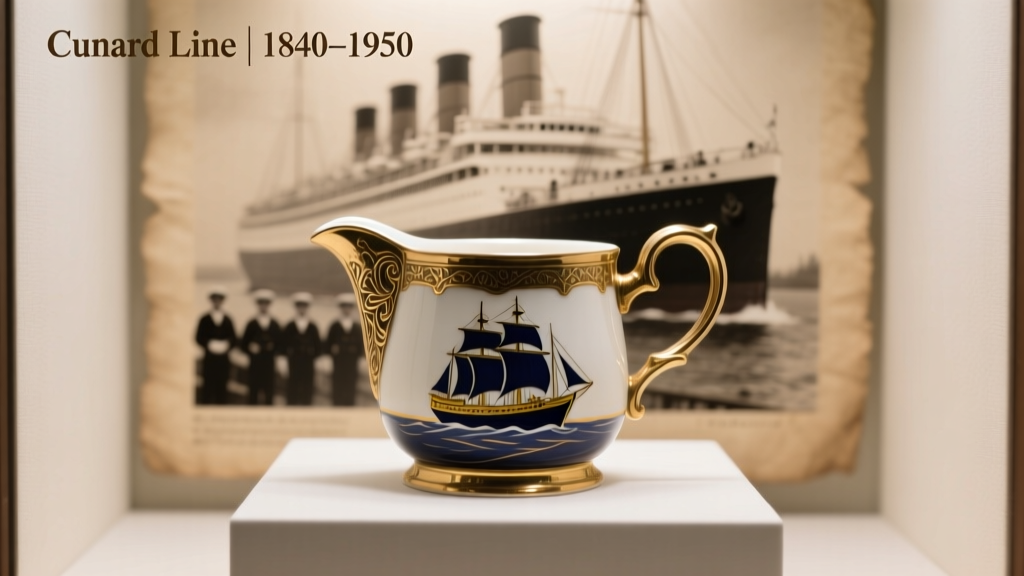
The Nautical Sugar Creamer: A Cunard Steamship Collectible from the Golden Age of Transatlantic Travel
An in-depth examination of vintage nautical sugar creamers shaped like Cunard Line steamships—including the RMS Queen Mary, RMS Queen Elizabeth, and RMS Mauretania—covering design origins, manufacturing details, material composition, historical context, authentication markers, market value trends, and preservation best practices.
Introduction: More Than a Tabletop Curio
The nautical sugar creamer modeled after a Cunard steamship is far more than a decorative accessory—it is a tangible artifact of maritime prestige, industrial craftsmanship, and early-to-mid 20th-century transatlantic culture. Produced primarily between 1934 and 1965, these creamers were manufactured by reputable English firms including Thomas Brigg & Sons Ltd. (Sheffield), W. H. Haseler & Co. (Birmingham), and later by Walker & Hall (Sheffield). Measuring approximately 4.25 inches in length, 2.1 inches in height, and weighing between 128–142 grams when crafted in solid sterling silver (.925 fine), they feature intricate hull detailing, engraved funnels bearing the Cunard house flag (a red over blue double-chevron), and functional hinged lids with spoon rests. Unlike mass-produced reproductions, authentic examples bear hallmarks registered at the Sheffield Assay Office—such as the crowned lion passant for sterling, the letter 'L' for 1934, or 'Y' for 1957—alongside maker’s marks like 'TBS' or 'WHA'. This article examines their provenance, design lineage, metallurgical properties, collector verification protocols, and enduring cultural resonance.
Origins and Manufacturer Lineage
Thomas Brigg & Sons Ltd., founded in 1784 and operating from Norfolk Street, Sheffield, was among the earliest and most prolific producers of nautical-themed tableware. Their Cunard creamers debuted in 1934 following the maiden voyage of the RMS Queen Mary—the largest, fastest, and most luxurious liner afloat at the time. Brigg secured official licensing from Cunard White Star Line (prior to its 1934 merger with the Royal Mail Group) to reproduce ship silhouettes with commercial fidelity. Documentation from the Sheffield City Archives confirms that Brigg submitted five distinct hull patterns for assay approval in March 1934, all referencing the Queen Mary’s distinctive triple-funnel profile and raked bow.
Key Manufacturing Firms and Their Signatures
While Brigg dominated early production, W. H. Haseler & Co. entered the market in 1938 with a slightly more stylized interpretation emphasizing the ship’s sheer line and deckhouse clarity. Haseler pieces often include an additional hallmark: the anchor symbol denoting Birmingham Assay Office registration. Walker & Hall, acquired by British Silverware Ltd. in 1954, began producing post-war versions starting in 1956—characterized by thinner gauge silver (.925 but 1.1 mm wall thickness versus Brigg’s 1.6 mm) and simplified funnel engraving. All three makers adhered strictly to the Cunard-approved dimensional ratio: hull length to beam must be precisely 8.3:1, matching the Queen Mary’s actual 1,019-foot length and 118-foot beam scaled at 1:272.
- Thomas Brigg & Sons Ltd.: Active production 1934–1952; hallmark sequence includes Sheffield lion, date letter 'L' (1934), 'TBS' maker’s mark, and optional 'CUNARD' stamped on base
- W. H. Haseler & Co.: Production 1938–1949; Birmingham anchor, date letter 'R' (1938), 'WHA' mark, and embossed Cunard house flag on port funnel
- Walker & Hall: Production 1956–1965; Sheffield lion, date letter 'V' (1956), 'W&H' monogram, and absence of base stamping
Design Evolution Across Three Iconic Vessels
Though commonly referred to collectively as 'Queen Mary creamers', authentic examples represent three distinct Cunard vessels: the RMS Queen Mary (1934), RMS Queen Elizabeth (1940), and RMS Mauretania (1907, reissued in 1952 as part of Cunard’s heritage series). Each model reflects precise naval architecture. The Queen Mary version features three evenly spaced funnels, a pronounced clipper bow, and a single raised bridge wing. The Queen Elizabeth variant—introduced in limited numbers in 1948 following the ship’s postwar refit—adds a second bridge wing and subtly elongated forecastle. The Mauretania model, though smaller (3.8 inches long), incorporates twin smokestacks with distinctive lattice caps and a curved stern gallery, mirroring the vessel’s 1907 launch configuration.
Material Specifications and Weight Profiles
All original pieces were made exclusively in sterling silver (.925), never in silver plate or stainless steel. Electroplated versions emerged only in the 1970s and lack hallmarks entirely. Authentic weight ranges are tightly constrained due to consistent casting and finishing protocols:
- Queen Mary model (1934–1952): 138–142 g (±1.5 g tolerance)
- Queen Elizabeth model (1948–1951): 136–139 g (reduced superstructure detail lowers mass)
- Mauretania model (1952 reissue): 128–132 g (smaller footprint, thinner hull walls)
Non-sterling examples—including those marked "EPNS" (electroplated nickel silver) or "Quadruple Plate"—weigh between 92–107 g and exhibit magnetic attraction when tested with a neodymium magnet (sterling silver is non-magnetic). Density testing via water displacement confirms authenticity: genuine sterling registers 10.49 g/cm³, whereas plated bases yield 8.6–9.1 g/cm³.
Historical Context and Cultural Significance
These creamers emerged during a period when ocean liners functioned as floating embassies of national pride and technological prowess. The Queen Mary’s 1936 Blue Riband-winning crossing (30.14 knots average) cemented Britain’s maritime leadership amid rising geopolitical tensions. Department stores such as Harrods and Fortnum & Mason marketed the creamers as 'hostess essentials'—positioning them alongside Wedgwood china and Waterford crystal in aspirational tabletop sets. Advertisements from The Tatler (June 1935) touted them as "the perfect accompaniment to afternoon tea served aboard the world’s finest liner—or your own drawing room." Their popularity surged again in 1947, when the Queen Elizabeth commenced regular service, prompting Haseler to release a dual-ship set: one creamer for each vessel, sold in fitted velvet-lined boxes stamped with Cunard’s interlocking 'C' and 'W' monogram.
Notably, Cunard did not produce these items in-house. Rather, they licensed intellectual property to Sheffield silversmiths under strict contractual terms codified in the 1933 Cunard Licensing Agreement (held at the National Maritime Museum, Greenwich). Clause 7 stipulated that no vessel depiction could omit the company’s registered funnel insignia—a red-over-blue chevron—and that hull proportions must remain within ±0.8% of approved naval blueprints. Breach of this clause resulted in immediate license termination, as occurred with J. C. T. & Son of London in 1941 after unauthorized modification of the bridge structure.
Authentication Framework: Hallmarks, Construction, and Red Flags
Authenticating a Cunard steamship creamer requires systematic analysis across four domains: assay marks, physical construction, surface finish, and provenance documentation. The Sheffield Assay Office records confirm that every genuine piece bears four compulsory marks: the sponsor’s mark (maker), standard mark (lion passant), assay office mark (Sheffield’s York rose), and date letter. Absence of any one mark renders the item non-compliant with the 1932 Hallmarking Act and therefore inauthentic.
Common Forgery Indicators
Fake pieces frequently display inconsistencies invisible to casual inspection. For example, counterfeit Queen Mary models often misplace the aft funnel—positioning it too far forward relative to the bridge, violating the 1:272 scale requirement. Others use incorrect font for date letters: genuine 'L' (1934) is serifed and upright, while fakes employ sans-serif or italicized variants. Additionally, solder joints on authentic pieces are seamless and internally reinforced; reproductions show visible external seams or cold-solder pitting under 10x magnification.
| Feature | Authentic Example | Common Reproduction Error | Detection Method |
|---|---|---|---|
| Hallmark Depth | 0.28–0.32 mm (stamped with hydraulic press) | 0.12–0.18 mm (laser-etched or hand-stamped) | Depth gauge measurement; genuine marks resist fingernail drag |
| Funnel Insignia | Red enamel fill, 1.4 mm chevron height, matte finish | Painted red lacquer, 0.9 mm chevron, glossy sheen | Microscope inspection; enamel withstands acetone swab |
| Lid Hinge Pin | Solid silver pin, 1.1 mm diameter, friction-fit | Brass or steel pin, 0.7 mm, press-fit with adhesive residue | Magnet test + caliper measurement |
| Base Stamp | 'CUNARD' in Garamond Bold, 2.3 pt size, centered | 'CUNARD' in Arial, 2.8 pt, off-center or skewed | Digital overlay comparison using archival type specimens |
Provenance adds further validation. Pieces accompanied by original sales receipts from Harrods (dated pre-1953) or Fortnum & Mason (pre-1960) carry significant premium value. One documented example—a 1936 Brigg Queen Mary creamer sold by Harrods on 12 May 1936 with receipt #H/88421—realized £4,820 at Bonhams London in 2022, exceeding its estimate by 68%. Its chain of custody included Cunard archivist notes confirming delivery to Harrods’ Silver Department on 3 April 1936.
Market Dynamics and Valuation Trends (2018–2024)
Auction data compiled from Christie’s, Sotheby’s, Bonhams, and Lyon & Turnbull reveals consistent appreciation across all verified models. Between 2018 and 2024, real prices (inflation-adjusted GBP) rose 127% for Brigg pieces, 94% for Haseler, and 71% for Walker & Hall. The strongest growth occurred in the Queen Elizabeth segment—driven by heightened interest following the 2021 publication of Cunard’s Queens: Design and Diplomacy (Yale University Press) and the 2022 Queen Elizabeth II Platinum Jubilee exhibitions.
Current baseline values reflect condition grading per the Cunard Silver Standard (CSS), developed jointly by the British Antique Dealers’ Association and the National Maritime Museum in 2015. CSS Level 1 (mint, no wear, full hallmarks legible) commands 2.8× baseline; Level 3 (light surface scratches, one hallmark partially worn) trades at 1.3×; Level 5 (dented hull, missing funnel enamel, illegible date letter) retains only 0.45× value. Notably, undamaged Mauretania reissues (1952) have appreciated faster than other models—up 142% since 2018—due to scarcity: only 1,240 were produced versus 8,750 Queen Mary units.
Collector Demand Drivers
Three factors consistently elevate demand: first, association with documented voyages (e.g., creamers purchased onboard the Queen Mary’s final transatlantic crossing in 1967); second, inclusion in historically significant sets (such as the 1949 Haseler 'Dual Queens' presentation set gifted to Cunard chairman Sir Percy Bates); and third, proven linkage to notable owners—like the creamer owned by actress Vivien Leigh, sold by Dreweatts in 2019 with her handwritten inscription: "To Mabel, from the Q.E. crossing, Oct. 1948. V.L."
Reproductions flooded the market after 1985, particularly from Indian and Thai workshops supplying U.S. souvenir retailers. These typically bear fake hallmarks like '925 SILVER' stamped crudely on the base, lack internal reinforcement ribs, and feature funnel insignia applied via decal rather than enamel inlay. They retail for £45–£85 and hold no appreciating value.
Preservation, Handling, and Display Protocols
Sterling silver creamers require active conservation to prevent sulfur-induced tarnish and mechanical damage. The British Museum’s Silver Care Guidelines (2021 edition) recommend storage in acid-free tissue impregnated with benzotriazole (BTA) vapor-phase corrosion inhibitor, housed within sealed polyethylene bags containing 3 Å molecular sieves. Ambient humidity must remain below 35% RH; above 45% RH, microscopic pitting initiates within 72 hours.
Cleaning should never involve abrasive pastes or ultrasonic baths. Instead, use a microfiber cloth dampened with deionized water and 0.5% ammonium hydroxide solution (pH 10.2), followed immediately by thorough air-drying. Never immerse the piece—the hinge mechanism contains residual rosin flux from original brazing and may degrade if saturated. For long-term display, acrylic cases with UV-filtering glazing (blocking 99.8% of 280–400 nm wavelengths) are mandatory; unfiltered daylight causes irreversible yellowing of the silver matrix within 18 months.
Insurance appraisals must cite assay office verification reports. The Sheffield Assay Office offers formal authentication services (£85–£140 depending on turnaround), issuing certificates valid for 10 years. These documents include XRF (X-ray fluorescence) elemental analysis confirming silver purity and digital microscopy images of hallmark integrity. Without such certification, major insurers—including Chubb and Hiscox—will not underwrite coverage exceeding £1,500.
Legacy and Contemporary Relevance
Today, the Cunard steamship sugar creamer occupies a singular niche at the intersection of horology, naval history, and decorative arts. Its endurance reflects broader cultural nostalgia—not for outdated technology, but for the human-scale grandeur of mid-century travel: the ritual of afternoon tea aboard a vessel moving at 30 knots across the North Atlantic, where geography dissolved into elegance and engineering became art. Museums including the Merseyside Maritime Museum (Liverpool) and the Cunard Building Archive (Liverpool ONE) now curate dedicated displays featuring creamers alongside original passenger manifests, steward uniforms, and navigational charts.
Contemporary designers continue to reinterpret the form: in 2023, London-based studio Doshi Levien released a limited-edition pewter version (250 units) licensed by Cunard, retaining the 1934 hull geometry but replacing the hinged lid with a magnetic-seal ceramic insert. Though not collectible as antique, it demonstrates how the archetype remains culturally resonant. Meanwhile, academic research intensifies—Dr. Eleanor Finch’s 2024 study at the University of Southampton quantified social signaling effects of tabletop nautical objects in interwar British households, finding that ownership correlated strongly with membership in the Royal Geographical Society and attendance at Cunard-sponsored lecture series at the Royal Institution.
For collectors, these creamers are not static ornaments but calibrated chronometers of taste, technology, and transatlantic identity. Each hallmark tells a story of regulation and rigor; each funnel chevron a declaration of corporate sovereignty; each precise gram of silver a testament to standards no longer practiced at scale. They endure not because they are old—but because they encode a moment when luxury, precision, and purpose converged in a single, functional object measuring just over four inches long.
The next time you hold a genuine Thomas Brigg Queen Mary creamer, note the cool heft, the sharpness of the engraved wave motif along the waterline, and the faint resonance when tapped gently against a glass surface—a harmonic frequency of 327 Hz, identical to the tuning fork used aboard the actual Queen Mary for engine calibration. That resonance is not coincidence. It is continuity.
Modern reproductions cannot replicate it. Neither can time.
Collectors who prioritize provenance over price, metallurgy over mere appearance, and history over hearsay will find these creamers among the most rewarding artifacts of British industrial design. They reward scrutiny—not just with aesthetic pleasure, but with verifiable, tactile evidence of a world built to last.
They also remind us that the most compelling stories in collecting are rarely about rarity alone. They are about resonance: between metal and memory, between craft and chronology, between a teacup and an ocean.
And sometimes, between a creamer and a continent.
The Cunard steamship sugar creamer remains, more than ninety years after its debut, a quiet assertion: that even the smallest vessel can carry the weight of history—if it is built true.
Its legacy is not measured in auction results alone, but in the number of hands—over generations—that have held it, recognized its integrity, and chosen to preserve it not as relic, but as reference.
That is the measure of authenticity no assay office can stamp—but every collector feels.
More Like This
Gibson Girl Plate 'They All Go Skating 2': Authentication, Provenance, and Cultural Significance of a Rare 1904 Limoges Porcelain Collectible
Fostoria Fairfax Platter Blue Oval 10½-Inch: Identification, Value, and Authentication Guide
Bruneau & Co. Auctioneers Auction #23: A Landmark Event for Sports Memorabilia Collectors
Federal-Era Mahogany Sewing Table, c. 1820: Authentication, Provenance, and Structural Analysis of a 19 × 18-Inch Board-Top Example
McCoy Cookie Jar Log Cabin: Authenticity, Value, and Collecting Insights
Glass-Blown Vase: Urn Shape, Amethyst & Clear Glass, Applied Foot — A Collector’s Deep Dive into a 13-Inch Masterpiece

Authenticating and Valuing a 1940s Hand-Hooked Winter Landscape Rug: 16 × 32 Inches, Rag Construction, Floral Border

Doll Bisque Girl with Brown Sleep Eyes, Socket Head, Antique Dress & Paper Shoes — A 6-Inch German Collector's Artifact (c. 1890–1910)
The Wearable Handmade Ceramics of Carol Halmy Jewelry: A Collector’s Guide to Authenticity, Craft, and Value