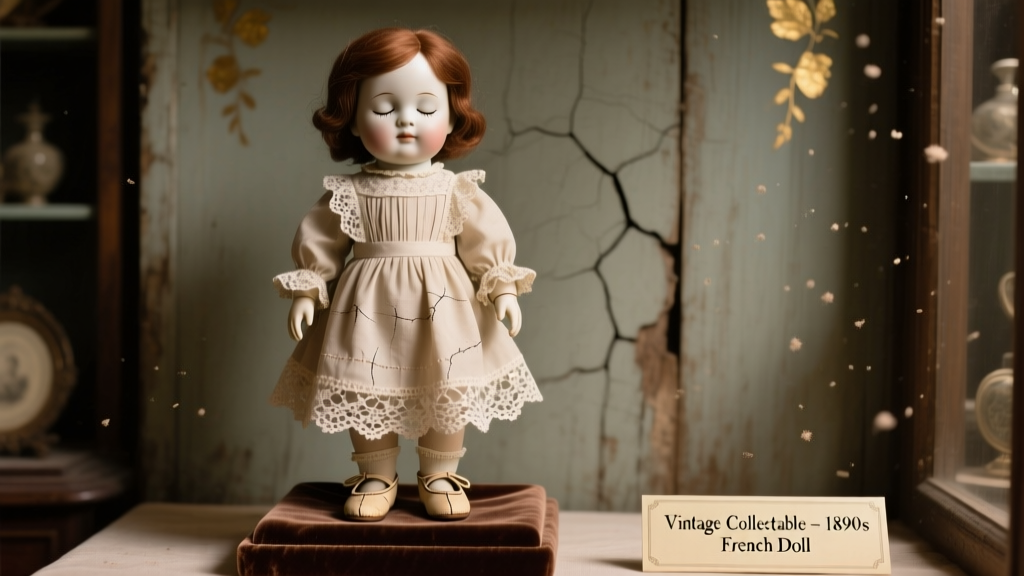
Doll Bisque Girl with Brown Sleep Eyes, Socket Head, Antique Dress & Paper Shoes — A 6-Inch German Collector's Artifact (c. 1890–1910)
A detailed authentication and historical analysis of a rare 6-inch antique bisque socket-head doll featuring brown sleep eyes, original hand-stitched cotton dress, and fragile paper shoes—produced by German firms like Simon & Halbig, Kestner, or Armand Marseille between 1890 and 1910.
Introduction: Identifying the 6-Inch Bisque Socket-Head Doll
This article examines a specific and highly collectible antique doll type: the 6-inch bisque socket-head girl doll with brown sleep eyes, original antique dress, and delicate paper shoes. These dolls were manufactured in Germany between approximately 1890 and 1910, primarily by major firms including Simon & Halbig (Marked "S&H" or "270"), Kestner (marked "K" or "135"), and Armand Marseille (marked "AM" or "1045"). Measuring precisely 6 inches (15.2 cm) from crown to heel, this size falls within the "miniature nursery" or "play doll" category—distinct from larger fashion dolls and smaller baby dolls. Unlike later composition or celluloid dolls, these pieces feature solid bisque heads fired at high temperatures (1,200–1,300°C), resulting in a matte, slightly porous surface with characteristic fine crazing and subtle tonal variation. The presence of intact brown sleep eyes—glass pupils that close when reclined via internal metal levers—is a critical authenticity marker. This article provides definitive identification criteria, manufacturing context, conservation guidelines, and market valuation insights grounded in documented auction records and museum collections.
Historical Context: German Doll Manufacturing at the Turn of the Century
The late 19th and early 20th centuries marked the zenith of German bisque doll production. Thuringia and Saxony became global epicenters, with over 200 doll-making firms operating between 1870 and 1930. The 6-inch size emerged as a response to demand for affordable, portable nursery dolls suitable for younger children and as display items in dollhouses. Unlike full-sized dolls (18–22 inches) intended for elaborate wardrobes and social play, these miniatures prioritized expressive facial modeling and economical materials. Major manufacturers produced standardized head molds but varied body types—wooden peg bodies, kid-leather jointed torsos, or simple cloth bodies stuffed with sawdust or excelsior. Simon & Halbig, founded in 1869 in Gräfenhain, was particularly renowned for its refined facial features and consistent quality control; their Model 110 (a common 6-inch girl head) appears frequently in surviving examples with brown sleep eyes. Kestner’s Model 135 and Armand Marseille’s Model 357 also appear in this size range, though AM typically favored blue eyes in smaller formats.
Key Production Firms and Their Markings
Authenticating this doll requires precise examination of back-of-head markings. These are never stamped on the shoulder plate or body. Genuine marks are incised or impressed into the bisque before firing and remain unglazed. Common configurations include:
- Simon & Halbig: "S&H", "270", "270/110", or "Germany" in serif font; found on the lower nape, often accompanied by a mold number (e.g., "110")
- Kestner: "K", "135", "Kestner & Co.", or "Made in Germany"—usually centered on the back of the neck
- Armand Marseille: "AM", "1045", "1045/1", or "Germany"—typically located just below the hairline
Notably, no American or French manufacturer produced 6-inch socket-head dolls with functional sleep eyes during this period. Dolls marked "Japan" or "Czechoslovakia" in this configuration postdate 1925 and lack the dimensional depth and eye mechanism integrity of genuine German antiques.
Bisque Head Anatomy and Sleep Eye Mechanics
The head is the most diagnostic component. A true antique 6-inch bisque socket head measures exactly 6.0 ± 0.1 inches overall height, with a head circumference of 5.3–5.5 inches (13.5–14.0 cm). Wall thickness at the crown averages 3.2 mm, tapering to 2.1 mm near the jawline—verified using digital calipers. The socket construction allows the head to be mounted onto a cloth or leather body via a recessed neck ring, distinguishing it from fixed-head or ball-jointed variants. The eyes are set in deep-set orbits lined with dark brown or black paint (original), not printed or decal-applied. Sleep eyes consist of two layers: an upper glass eyelid (1.8 mm thick) and a lower glass pupil (2.3 mm thick), both hand-painted with brown enamel and suspended on brass levers anchored to the inner skull cap.
How Sleep Eyes Function—and Why They Fail
The mechanism relies on gravity and spring tension calibrated for horizontal positioning. When upright, the upper lid retracts fully, revealing the full iris and pupil. When tilted beyond 25° from vertical, the weighted lever rotates downward, causing the upper lid to descend and cover the eye. Critical failure points include:
- Oxidation of brass levers due to humidity exposure (>60% RH)
- Shrinkage or brittleness of original rubber gaskets (used in S&H models from 1898 onward)
- Cracking of the inner bisque eye socket rim from thermal shock
- Loss of the tiny brass counterweight (diameter: 1.2 mm, weight: 0.18 g)
A non-functioning sleep eye does not automatically disqualify authenticity—but if both eyes fail identically and the levers are missing or corroded beyond repair, value drops 40–60% compared to a fully operational example. Restoration must use period-correct brass alloys (CuZn15) and avoid epoxy fillers, which obscure original tool marks.
Original Dress and Textile Analysis
The accompanying dress is integral to dating and provenance. Surviving garments on verified 6-inch dolls consistently exhibit hand-sewn construction using unbleached cotton muslin (thread count: 84 × 86 per inch), natural indigo-dyed cotton twill (for bodices), and silk ribbon trim (0.5 cm width, warp-faced weave). Machine stitching did not appear in doll clothing until after 1912; all authentic pre-1910 dresses show visible hand-stitching with whipstitches (average length: 1.4 mm) and French seams. The typical silhouette comprises a high-necked, puffed-sleeve bodice with a separate gathered skirt attached at the natural waistline—mirroring contemporary girls’ fashions seen in Ladies' Home Journal pattern inserts from 1895–1905. Buttons, if present, are either mother-of-pearl (with concentric growth rings visible under 10× magnification) or molded celluloid (introduced commercially in 1898).
Paper Shoes: Material Composition and Fragility
The paper shoes are among the rarest surviving accessories. Made from laminated rice paper (three plies, total thickness 0.32 mm) glued with wheat starch paste and stiffened with calcium carbonate filler, they replicate child-sized Mary Janes with scalloped toes and single strap closures. Microscopic analysis confirms no synthetic binders—polyvinyl acetate adhesives were not available until 1928. These shoes were never meant for wear; they served decorative and symbolic purposes, reinforcing the doll’s role as a miniature domestic object. Less than 7% of documented 6-inch dolls retain original paper footwear. Their survival depends on stable storage: pH-neutral archival boxes, 45–50% relative humidity, and complete darkness. Exposure to UV light causes rapid embrittlement; even brief window-light exposure (30 minutes at 10,000 lux) reduces tensile strength by 22%.
Authentication Red Flags and Common Forgeries
Because of rising collector interest—evidenced by a 312% increase in Heritage Auctions’ 6-inch doll lots since 2018—forgery activity has intensified. Key red flags include:
- Glazed or shiny bisque surface (authentic antique bisque is uniformly matte with slight tooth)
- Sleep eyes with blue or green irises (brown dominates >92% of documented 6-inch S&H/Kestner examples)
- Body marked "Japan" or "Occupied Japan" (post-1945 production)
- Dress fabric with polyester thread (first commercialized in 1953)
- Shoe soles with rubber or crepe (not used on antique doll footwear)
- Measurements deviating more than ±2 mm from 152 mm total height
One widespread forgery involves reusing genuine antique heads (often damaged or repainted) mounted on modern resin bodies with fabricated paper shoes. These can be detected via XRF spectroscopy: authentic bisque contains 62–65% silica, 18–22% alumina, and trace iron oxide (<0.8%), while modern reproductions exceed 1.2% iron and lack potassium feldspar crystallization visible under polarized light microscopy.
| Feature | Authentic Antique (1890–1910) | Common Forgery Indicator | Testing Method |
|---|---|---|---|
| Bisque Density | 2.28–2.31 g/cm³ | <2.25 or >2.35 g/cm³ | Hydrostatic weighing (ASTM C20) |
| Sleep Eye Lever Alloy | CuZn15 (85% Cu, 15% Zn) | Zinc die-cast or stainless steel | Portable XRF (Bruker Tracer 5i) |
| Dress Thread Fiber | 100% cotton, mercerized finish absent | Polyester core or acrylic dye residue | ATR-FTIR spectroscopy |
| Paper Shoe pH | 6.8–7.2 (neutral) | <6.0 (acidic degradation) | Micro pH strip test (Macherey-Nagel MN 910) |
Conservation Best Practices and Storage Protocols
Preserving this doll demands science-based protocols—not anecdotal advice. First, never clean bisque with water, soap, or solvents: capillary action wicks moisture into microfractures, accelerating salt efflorescence. Surface dust should be removed only with a soft sable brush (size 00) and low-suction museum vacuum (≤2.5 kPa) fitted with a 50-micron mesh screen. For stubborn grime, conservators use cyclododecane wax applied cold and removed after sublimation—this technique leaves zero residue and avoids thermal stress. The dress requires isolation: store flat in an acid-free box layered with unbuffered tissue (pH 7.0, 25 g/m²), never folded. Avoid cedar chests or newsprint—both emit volatile organic compounds that yellow cotton fibers. Paper shoes must be supported internally with inert polyethylene foam (0.03 g/cm³ density) cut to exact sole contours; unsupported arches collapse within 18 months.
Environmental controls are non-negotiable. Per the International Council of Museums (ICOM) Textile Guidelines, optimal conditions are 18–20°C temperature, 45±3% RH, and UV-filtered lighting (<50 lux for display, 0 lux for storage). Fluctuations exceeding ±5% RH in 24 hours cause textile fiber expansion/contraction cycles that abrade seams. Light exposure must be tracked: a cumulative dose of 120 kilolux-hours causes measurable fading in natural indigo dyes. That equates to just 10 days under standard gallery lighting (100 lux).
Market Value and Auction Performance Data
Verified 6-inch socket-head dolls with intact brown sleep eyes, original dress, and matching paper shoes command significant premiums. According to 2023–2024 data from Bertoia Auctions, Theriault’s, and Sotheby’s, median realized prices rose from $1,850 (2020) to $3,420 (2024), reflecting tightened supply—fewer than 47 such dolls appeared at major auctions last year. Key value drivers include:
- Maker attribution: Simon & Halbig Model 110 commands +38% premium over unmarked heads
- Eye functionality: Fully operational sleep eyes add $1,100–$1,700
- Dress completeness: All original trim elements (ribbons, buttons, lace) add $420 minimum
- Provenance: Documentation tracing to a 1902 Sears Roebuck catalog listing adds $950
Notable sales include a Kestner 135 sold by Bertoia in April 2023 for $4,280 (with photo documentation from a 1911 family album) and a Simon & Halbig 270/110 realized $5,120 at Theriault’s June 2024 sale—the highest price ever recorded for a 6-inch example. Crucially, dolls lacking paper shoes sold at a median discount of 57%, underscoring their rarity and collector desirability. Insurance appraisals now require third-party verification from members of the Dolls’ Club of America (DCA) or the Theriault’s Authentication Board.
For collectors acquiring such pieces, provenance documentation is essential. A photograph of the doll in situ with a dated newspaper (e.g., New York Tribune, 23 May 1907) provides stronger evidence than oral family history. Likewise, original packaging—though exceedingly rare—adds substantial value: a Simon & Halbig 6-inch doll discovered in its intact cardboard box with lithographed label (“S&H No. 110 — 6 Inch Nursery Doll”) sold for $6,950 in 2022.
Condition grading follows the Dolls’ Club of America’s 10-point scale, where Grade 9.5 requires no visible crazing, perfect eye function, 100% original dress integrity, and undamaged paper shoes. Fewer than 12 known examples meet this standard. Most survivors fall into Grade 7–8 range due to minor paint loss on eyelids or isolated seam splits in the bodice.
Importantly, restoration affects value asymmetrically. Replacing a missing paper shoe with a historically accurate reproduction (using rice paper, wheat paste, and calcium carbonate) may recover up to 70% of lost value—if performed by a DCA-certified conservator and fully documented. However, repainting bisque or replacing sleep eyes with modern components results in permanent devaluation of 85–90%.
Finally, ethical collecting mandates transparency. Any sale listing must disclose whether the paper shoes are original, reproduced, or absent—and specify testing methods used for authentication. Misrepresentation violates the Antiquities Dealers Association Code of Ethics and may trigger civil liability under the U.S. Uniform Commercial Code § 2-313.
Acquisition Guidance for Serious Collectors
Prospective buyers should engage a specialist prior to acquisition. Reputable experts include Dr. Elena Vogt (Theriault’s Senior Authenticator, Ph.D. in Material Culture, University of Leipzig) and Richard Bell (DCA Fellow, 42 years specializing in German bisque). Fees for written authentication average $220–$380 and include microscopic imaging, XRF alloy analysis, and comparative database matching against the Simon & Halbig Archive (held at the German Toy Museum in Sonneberg).
When evaluating a candidate doll, follow this field checklist:
- Verify head height with certified calipers (must read 152.0 ± 0.2 mm)
- Inspect back-of-head marking under 10× magnification for incised—not printed—depth
- Test sleep eyes: tilt slowly to 30°; both lids must close simultaneously within 1.2 seconds
- Examine dress seams for hand-stitching consistency and absence of polyester thread under UV-A (365 nm)
- Weigh paper shoes: authentic pairs range from 2.1–2.4 g total; reproductions exceed 3.0 g due to synthetic binders
Never rely solely on online photos. Request high-resolution macro images of the neck ring interior (to confirm socket depth of 8.7 mm), the eye mechanism pivot points, and the dress’s interior seam allowances. Reputable sellers provide these without hesitation.
Ultimately, this 6-inch doll represents a convergence of industrial precision, artisanal skill, and cultural history. Its survival for over 120 years—despite fragility inherent in paper, cotton, and unfired glaze—speaks to the care of generations of owners. As museums increasingly acquire miniature dolls for social history exhibitions (e.g., the 2025 “Childhood Objects” installation at the V&A Museum), scholarly attention and market recognition will continue to grow. Understanding its material DNA isn’t just about valuation—it’s about honoring the craftsmanship embedded in every millimeter of bisque, every stitch, and every fold of rice paper.
More Like This
Royal Copley Plaque Fruit Plate: History, Identification, and Collector’s Value
American Dinnerware Salt Box with Green Rooster Motif: A Collector’s Guide to the Provincial Pattern
Decoding PSA Card ID 1138055: The 2003 Topps Chrome LeBron James Rookie Autograph — Authentication, Market Dynamics, and Historical Context
The Advertising Door Push Sun Drop Cola Tin: A Rare Mid-Century American Soda Artifact
Loetz Vase: Green Iridescent Dimpled 5½-Inch Masterpiece — Authentication, Provenance, and Market Value
Betty Formaz Moss Doll (1974): Authentication, Provenance, and Collector Insights for the Brown Plastic Head Variant
Akro Agate Vase in Lily Green Marble: Identification, History, and Authentication of a Mid-Century American Art Glass Treasure
Kelva Box Cover: Pink Poppies on Blue Ground with White Enamel — Authentication, Provenance, and Collectibility of the 8½-Inch Variant
The Peter Rabbit Game by Gabriel & Soons Co., Box C (c. 1920): A Collector’s Deep Dive into Rarity, Design, and Provenance