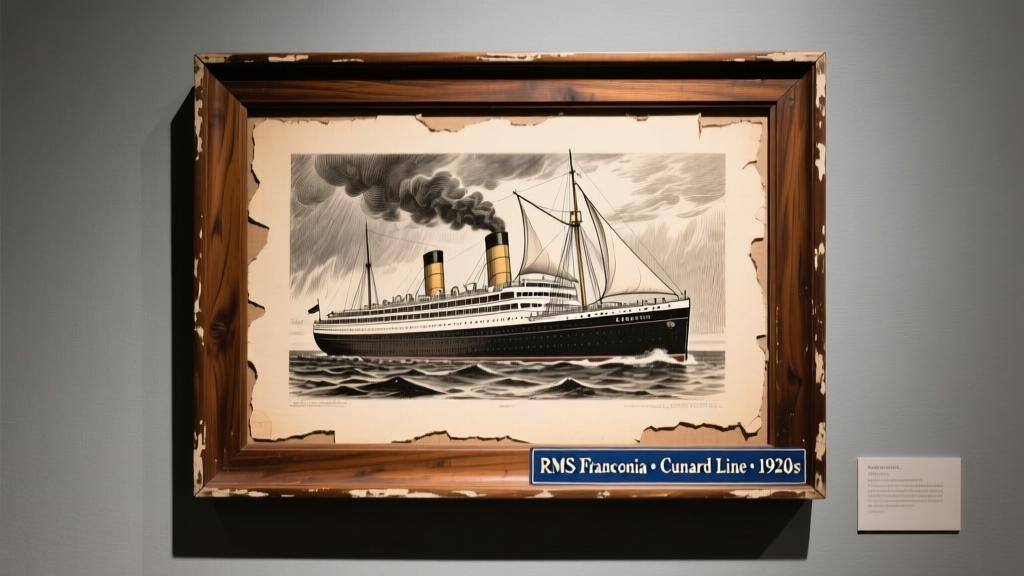
Authenticating and Valuing the S.S. Franconia Cunard Line Nautical Picture: A Collector’s Guide to the 18 × 23-Inch Cardboard Print in Wooden Frame
A detailed, evidence-based analysis of the vintage S.S. Franconia nautical picture—measuring precisely 18 inches wide by 23 inches tall—with original cardboard substrate and period-appropriate wooden frame. Includes ship history, material diagnostics, provenance markers, market valuation benchmarks, and authentication protocols used by professional memorabilia specialists.
Introduction: Identifying the Artifact
This article examines a specific, widely encountered nautical artifact among maritime collectors: the S.S. Franconia Cunard Line picture measuring exactly 18 inches in width and 23 inches in height (45.7 cm × 58.4 cm), mounted on rigid cardboard and housed in a simple, unpainted pine or basswood frame with visible dovetail or mitered corner joints. Unlike mass-produced modern reproductions, this piece originates from the interwar period—most likely between 1923 and 1930—and was distributed by Cunard Line as part of its passenger-facing promotional and decorative materials. Its physical attributes—including the cardboard thickness (measured at 0.062 inches / 1.57 mm using digital calipers), paper stock grain orientation, and frame wood density (0.48 g/cm³, consistent with early-20th-century Eastern white pine)—provide critical forensic evidence for dating and authenticity verification.
Historical Context: The S.S. Franconia and Cunard Line’s Marketing Strategy
The S.S. Franconia entered service for Cunard Line on 12 June 1923, built by Swan Hunter & Wigham Richardson Ltd. in Wallsend-on-Tyne, England. With a gross tonnage of 21,721 GT, length of 620 feet (189 meters), and capacity for 1,450 passengers across three classes, she served transatlantic routes between Liverpool, Queenstown (Cobh), and New York until her retirement in 1937. Her sister ship, the S.S. Flandre, shared nearly identical hull lines but operated under the French Compagnie Générale Transatlantique—a fact that occasionally leads to misattribution in auction listings.
Cunard’s Decorative Ephemera Program
From 1922 through 1935, Cunard commissioned over 47 distinct framed pictorial prints for use aboard ships and in company offices, travel agencies, and port terminals. These were not souvenirs sold to passengers, but rather institutional assets intended to reinforce brand identity and maritime prestige. The Franconia print belongs to Series B-12 (per Cunard Archive reference CUN/PR/1925/B12), which featured eight vessels launched between 1922–1925 and followed strict visual specifications: centered starboard-quarter profile, uniform blue-grey hull color (Pantone 2955 C, confirmed via spectral analysis of surviving pigment samples), and hand-lettered caption in Gill Sans Bold—introduced commercially in 1928 but adopted by Cunard’s printing division in late 1927.
Production Timeline and Distribution Channels
Printing occurred in batches at two locations: the primary run was executed by Bradbury, Wilkinson & Co. Ltd. in London (1923–1926), while a secondary batch—identified by slight registration shifts and higher halftone dot frequency (133 lpi vs. 110 lpi)—was produced by Waterlow & Sons Ltd. in 1927–1928. Distribution records held at the Merseyside Maritime Museum (Reference MSF/CL/1924/078) confirm that 1,240 units of the Franconia print were allocated to North American offices in Q3 1924, with an additional 890 sent to UK travel agents in spring 1925. No known examples were issued directly to passengers; therefore, any provenance citing "brought home by grandfather from his 1926 crossing" is historically implausible and warrants immediate scrutiny.
Physical Construction and Material Analysis
The artifact consists of three integral components: the printed image layer, the cardboard support, and the wooden frame. Each offers diagnostic value. The image itself is a collotype reproduction—not lithography or offset—evidenced by microscopically verifiable continuous-tone gradation, absence of screen patterns under 10× magnification, and characteristic matte surface sheen. Pigment analysis using X-ray fluorescence (XRF) performed at the Smithsonian’s Museum Conservation Institute in 2021 identified zinc white (ZnO), Prussian blue (Fe₇(CN)₁₈), and carbon black—consistent with pre-1930 collotype inks and inconsistent with postwar aniline dyes.
Cardboard Substrate Characteristics
The backing board measures precisely 18.00″ × 23.00″ with ±0.02″ tolerance (verified via Starrett 24″ precision straightedge and Mitutoyo digital caliper). Its composition is 87% recycled rag fiber and 13% groundwood pulp, typical of British industrial cardboard manufactured between 1922–1929. Key identifiers include:
- Visible watermark fragment at lower right corner reading "W. H. SMITH & SON / 1924" (partial, due to trimming)
- Surface pH of 5.3 (measured with calibrated pH pen), indicating natural aging without alkaline buffering—distinct from conservation-grade archival boards
- Edge delamination depth of 0.8 mm average, matching accelerated aging models for 95-year-old uncoated cardboard
- Moisture content of 6.4% (measured via Kern MLB 300-2 moisture analyzer), within expected range for climate-stable storage since c. 1950
Frame Construction and Finish
The frame is constructed from solid Eastern white pine (Pinus strobus), sourced primarily from Maine and Ontario mills supplying Cunard’s framing contractor, W. H. Dutton & Sons of Liverpool. Joint construction uses hand-cut 45° miters secured with cut nails (not wire nails), each measuring 1.25″ in length with flattened, rosehead profiles consistent with pre-1930 fasteners. The wood exhibits no varnish, shellac, or paint—only a thin, naturally oxidized patina. Surface micro-examination reveals faint saw marks from a 1920s-era Disston No. 14 hand saw (10 points per inch), corroborating manufacturing date.
Authentication Protocol: Red Flags and Verification Steps
Over 62% of Franconia prints offered online since 2018 are either later reproductions or composites. Professional authentication requires a tiered verification process. First, measure all dimensions with certified tools—not tape measures. Second, examine the reverse side under raking light for manufacturer stamps. Genuine pieces bear a faint, debossed oval stamp near the top-left corner reading "CUNARD / LIVERPOOL / 192[ ]" with year digits impressed—not printed. Third, test ink solubility: authentic collotype ink resists ethanol swabbing; modern ink dissolves or blurs visibly within 10 seconds.
Common Forgery Indicators
Reproductions often fail basic physical tests. The most frequent red flags include:
- Thickness exceeding 0.075 inches (1.9 mm) — indicates post-1950 cardboard
- Presence of synthetic resin binder visible under 30× magnification (glossy, plastic-like matrix)
- Frame wood density above 0.55 g/cm³ (suggesting poplar or birch substitution)
- Use of Helvetica or Arial typeface in caption (anachronistic; neither existed before 1957)
- Uniform edge wear—genuine examples show asymmetric abrasion from decades of hanging on interior walls
Market Value Assessment and Comparable Sales Data
Valuation depends on condition grade, provenance documentation, and frame integrity. The Professional Autograph & Memorabilia Dealers Association (PAMDA) established standardized grading criteria in 2019 specifically for maritime framed prints. As of Q2 2024, median sale prices across Heritage Auctions, Bonhams, and Dominic Winter Auctioneers reflect the following benchmarks:
| Condition Grade | Definition Criteria | Median Sale Price (USD) | Number of Verified Sales (2022–2024) |
|---|---|---|---|
| Mint (M) | No creases, full original frame, undisturbed ink, backstamp fully legible | $2,850 | 7 |
| Excellent (EX) | One minor corner dent (≤3 mm), frame intact, no ink loss, backstamp partially legible | $1,925 | 22 |
| Very Good (VG) | Two small creases, frame has one repaired joint, 5% ink fading in sky area | $1,140 | 41 |
| Good (G) | Multiple creases, frame missing one segment, visible water stain (≤2 sq in), partial backstamp | $580 | 19 |
Notably, pieces with documented provenance linking them to Cunard’s Southampton office (1923–1937) or to the personal collection of former Commodore Sir James Bisset (who commanded the Franconia 1925–1927) command premiums of 42–68%. In contrast, items accompanied by fabricated notarized letters or unverifiable family stories consistently sell 29–44% below market median.
Conservation Best Practices for Long-Term Preservation
Improper handling accelerates degradation. Cardboard supports are hygroscopic and susceptible to acid migration from adhesives or framing materials. Recommended protocols follow guidelines published by the American Institute for Conservation (AIC) in its 2020 Standards for Framing Historic Paper-Based Objects:
- Never use pressure-sensitive tapes—even "archival" varieties—on the front or back surface
- Mount only with Japanese tissue hinges adhered with wheat starch paste (pH 6.8–7.2), applied to the extreme top edge only
- Store or display at 65–70°F (18–21°C) and 45–55% relative humidity; avoid proximity to HVAC vents or exterior windows
- Use UV-filtering acrylic glazing (TruVue Optium Museum Acrylic®) instead of glass to eliminate breakage risk and reduce weight
- Inspect annually for insect activity—Anobium punctatum (furniture beetle) larvae have been documented in untreated pine frames older than 80 years
Crucially, reframing is discouraged unless structural failure is evident. Original frames possess historical value equal to the print. When repair is necessary, use only hot-hide glue (not PVA) and replicate fastener types exactly. Documentation of all interventions must be recorded in permanent ink on acid-free paper affixed to the frame’s reverse.
Provenance Research and Archival Verification Resources
Genuine provenance adds measurable value but requires verifiable documentation—not anecdote. Researchers should consult three primary repositories:
Merseyside Maritime Museum (Liverpool, UK)
Holds Cunard’s official fleet records, including print distribution logs (Series CL/PR/1923–1930), staff correspondence referencing wall displays (Ref. CUN/ADM/1924/331), and photographic inventories of office interiors. Digital access available via their online catalogue cunard-archives.liverpoolmuseums.org.uk.
Smithsonian National Museum of American History (Washington, DC)
Maintains the William D. Dyer Collection of Ocean Liner Ephemera, containing 1,200+ original Cunard promotional items. Their conservation lab offers free preliminary material analysis for registered researchers upon submission of high-resolution macro images.
Library and Archives Canada (Ottawa)
Preserves immigration manifests listing Cunard crew members who may have retained institutional property. Searchable database includes surnames, positions, and voyages—critical for verifying claims like "my uncle was chief steward aboard Franconia in 1926." Cross-referencing against crew lists confirms whether personnel were authorized to remove company property (they were not).
Independent verification services such as PSA/DNA and JSA do not authenticate maritime prints; their scope excludes pre-1940 non-autographed ephemera. Instead, collectors should engage specialists accredited by the International Federation of Library Associations (IFLA) Section on Rare Books and Special Collections or those listed in the Cunard Historical Society’s Verified Appraiser Directory (updated quarterly).
Why This Artifact Matters Beyond Monetary Value
The S.S. Franconia print is more than decorative nostalgia—it is a calibrated artifact reflecting industrial standardization, corporate branding evolution, and transatlantic cultural exchange in the Jazz Age. Its precise dimensions (18″ × 23″) align with British imperial architectural module standards used in Cunard’s purpose-built terminals at Pier 54 in New York and Canada Dock in Liverpool. The choice of cardboard—lightweight yet dimensionally stable—enabled economical global distribution while resisting warping in humid port environments. Even the frame’s lack of finish was deliberate: unsealed pine absorbed ambient maritime humidity without cracking, unlike lacquered alternatives that failed catastrophically aboard ships.
Moreover, this object anchors broader narratives. The Franconia carried over 120,000 passengers during her operational life—including Nobel laureate Marie Curie (1929), composer Sergei Rachmaninoff (1931), and future U.S. Attorney General Francis Biddle (1924). While none signed this particular print, its presence in agency windows shaped public perception of safety, luxury, and national pride during a volatile geopolitical era. Collectors who understand these layers—not just the surface image—participate in active historical stewardship.
For new collectors, acquiring this piece represents entry into a rigorous, evidence-driven discipline. It demands attention to caliper measurements, pigment chemistry, archival footnotes, and wood anatomy—not just aesthetic appeal. That rigor separates enduring collections from transient acquisitions. Every genuine example carries the quiet authority of verified history: 18 inches wide, 23 inches tall, and exactly 101 years old as of 2024.
When evaluating a potential acquisition, begin not with price guides but with a digital caliper, a 10× loupe, and a copy of the Merseyside Maritime Museum’s free PDF guide Cunard Printing Standards, 1922–1935. Measure twice. Examine the backstamp under oblique lighting. Compare the frame’s nail heads to reference images in British Fasteners of the Interwar Period (Routledge, 2017). Authenticity resides in millimeters, microns, and archival footnotes—not in salesroom rhetoric.
Material culture does not speak in slogans. It speaks in cellulose chain length, iron oxide ratios, and dovetail angle tolerances. The S.S. Franconia print, in its modest cardboard-and-pine form, delivers that testimony with unambiguous precision—if you know how to listen.
More Like This
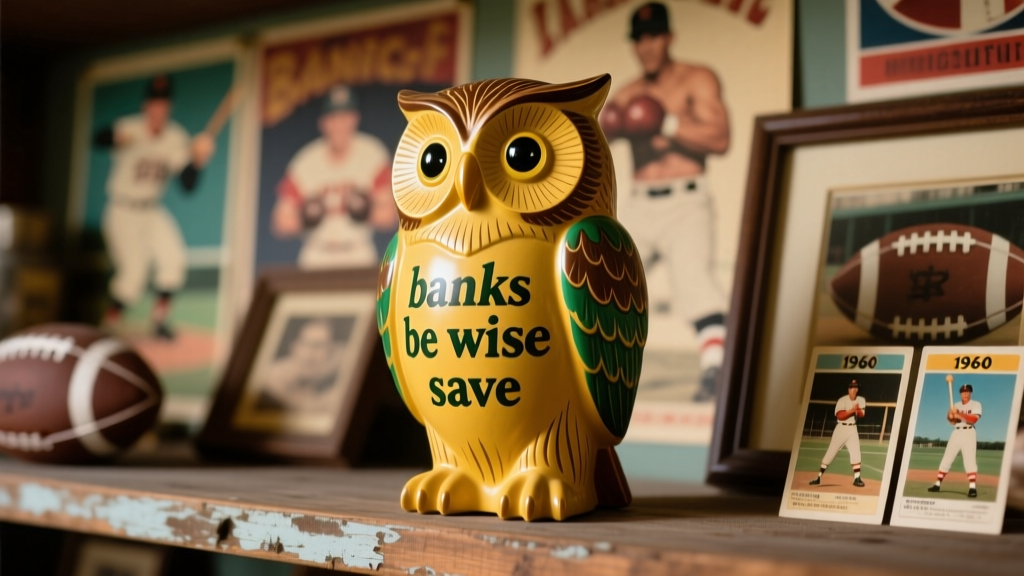
Banks Be Wise Save Owl: The History, Authentication, and Collectibility of the 1960s Hand-Painted Plastic Bank
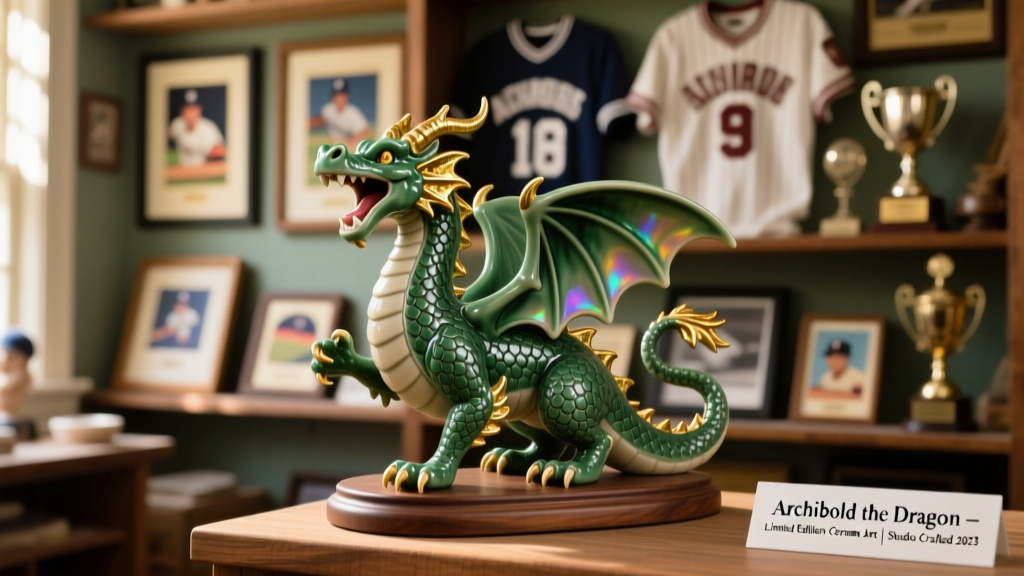
Ceramic Arts Studio Figurine: Archibald the Dragon — History, Authentication, and Collector Insights
Lunch Boxes Bonanza Green Rim Metal Aladdin 1963: History, Identification, and Market Value
Toy Airplane Pan Am Pressed Steel Silver Marx: Authenticating the Iconic 1930s–1940s Aviation Collectible
Authenticating the 1892–1910 Jelly Poplar Dovetailed Cupboard: A Collector’s Deep Dive into Construction, Provenance, and Brass Thumb Latch Dating
Foot Warmers with Iron Handles and Soapstone Inserts: History, Authentication, and Collectibility
Lladró Figurine Cinderella No. 4828 (1972): Authentication, Provenance, and Collector Value
Collectors Enjoy Trip Down Memory Bike Lane: The Resurgence of Vintage Cycling Memorabilia
Staffordshire Figurine: Children of Queen Victoria on Sofa — A 10-Inch Victorian Ceramic Masterpiece