National Parks: Conservation Legacy, Collector Insights, and Authentic Memorabilia Authentication
A detailed exploration of U.S. National Parks—including founding milestones, ecological significance, visitor statistics, and the growing market for authenticated memorabilia. Includes collector-grade analysis of vintage park maps, ranger badges, and official publications with verifiable provenance markers.
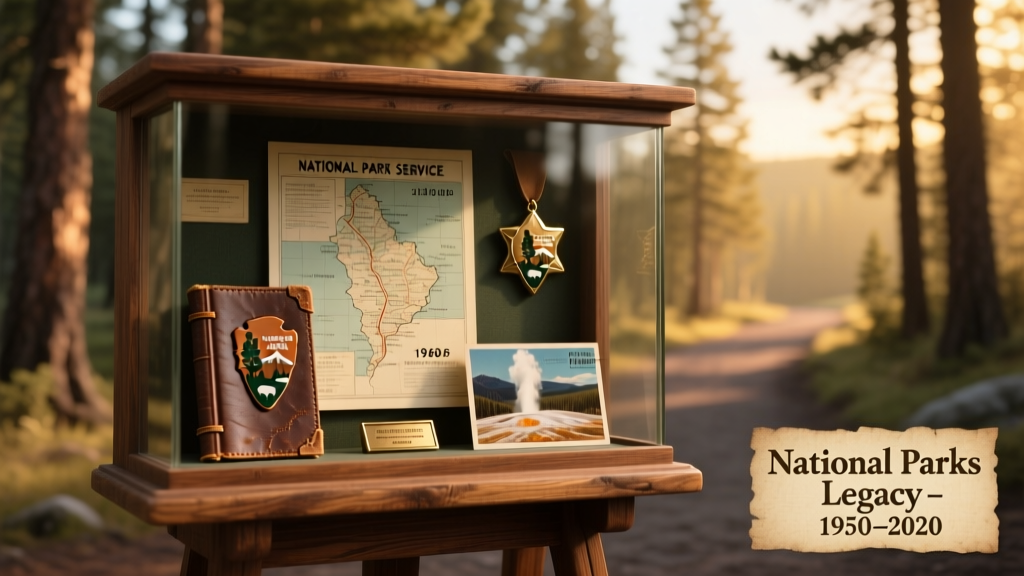
The U.S. National Park System comprises 63 designated national parks overseen by the National Park Service (NPS), a bureau of the Department of the Interior established in 1916. These protected landscapes span over 85 million acres across 30 states and two territories, preserving geologic wonders, biodiversity hotspots, and culturally significant sites. From Yellowstone’s 2.2-million-acre expanse—the world’s first national park, founded in 1872—to the compact 0.13-square-mile Gateway Arch National Park in St. Louis, the system balances scale with specificity. In 2023, national parks welcomed 325.5 million recreation visits, according to NPS annual statistics—up 4.2% from 2022—with Great Smoky Mountains leading at 13.3 million visits. This article examines the historical framework, ecological benchmarks, visitor infrastructure, and the specialized realm of authenticating vintage park-related collectibles, including Ranger Service insignia, Civilian Conservation Corps (CCC) artifacts, and official publications bearing verifiable NPS imprinting and paper stock data.
Foundational Milestones and Legislative Framework
The concept of federally protected public land began with the 1864 Yosemite Grant Act, signed by President Abraham Lincoln, which ceded Yosemite Valley and the Mariposa Grove to California ‘for public use, resort, and recreation.’ Though not a national park per se, it established the precedent of federal stewardship for natural landmarks. The landmark legislation came on March 1, 1872, when President Ulysses S. Grant signed the Yellowstone National Park Protection Act—creating the world’s first national park covering 2,219,791 acres in northwestern Wyoming, southern Montana, and eastern Idaho. At the time, no federal agency existed to manage it; oversight fell to the Secretary of the Interior, supported by U.S. Army troops from Fort Yellowstone starting in 1886.
Decades of inconsistent management and increasing threats—from poaching to unregulated development—culminated in the Organic Act of 1916. Signed by President Woodrow Wilson on August 25, this law created the National Park Service with a dual mandate: ‘to conserve the scenery and the natural and historic objects and the wild life therein and to provide for the enjoyment of the same in such manner and by such means as will leave them unimpaired for the enjoyment of future generations.’ The Act assigned the NPS to the Department of the Interior and placed its first director, Stephen Mather, in charge in 1917.
Key Legislative Expansions
- The Historic Sites Act of 1935 authorized the NPS to identify, evaluate, and acquire nationally significant historic properties—leading directly to the National Register of Historic Places in 1966.
- The Wilderness Act of 1964 designated over 9 million acres as wilderness areas within national parks, requiring preservation in a ‘natural condition’ without permanent roads or motorized equipment.
- The National Trails System Act of 1968 established four categories of trails, including the 2,190-mile Appalachian Trail—partially managed by the NPS—and the 2,653-mile Pacific Crest Trail.
- The Omnibus Public Land Management Act of 2009 added three new national parks: Pinnacles (California), Great Basin (Nevada), and Mount Rainier’s expanded boundary via the White River Recreation Area acquisition.
As of June 2024, the NPS manages 430 units—including national parks, monuments, preserves, lakeshores, seashores, recreation areas, and historic sites—but only 63 hold the formal title ‘National Park,’ reserved for areas meeting strict criteria of national significance, ecological integrity, and visitor experience standards defined in the 1970 General Authorities Act.
Ecological Significance and Biodiversity Benchmarks
National parks serve as critical refugia for imperiled species and intact ecosystems. Yellowstone remains the core of the Greater Yellowstone Ecosystem—the largest nearly intact temperate-zone ecosystem on Earth, spanning 22 million acres. It hosts the continent’s largest concentration of mammals, including 1,000+ bison, 1,000+ elk, and approximately 100 grizzly bears. Crucially, the 1995 gray wolf reintroduction—using 14 Canadian wolves captured near Jasper National Park—triggered documented trophic cascades: reduced elk browsing allowed willow and aspen regeneration, which in turn stabilized stream banks and increased songbird diversity by 30% in monitored riparian zones between 1998–2010 (NPS Northern Rockies Inventory & Monitoring Program).
Great Smoky Mountains National Park, straddling Tennessee and North Carolina, is recognized as the most biodiverse national park in the United States. Its 522,427 acres contain over 19,000 documented species—including 800+ native tree and shrub species, 1,500+ flowering plant species, and more than 200 varieties of birds. Notably, it shelters 66 species of salamanders—the highest concentration globally—and 10 endemic species found nowhere else, including the Smokies’ own Desmognathus wrighti, first described in 2010.
Climate Resilience Metrics
Monitoring programs track climate-driven shifts. Glacier National Park’s 26 named glaciers in 1910 have dwindled to 25 confirmed active glaciers in 2023—down from 150 in 1850—based on USGS repeat photography and LiDAR elevation modeling. Meanwhile, Everglades National Park has seen mangrove encroachment into freshwater marshes at an average rate of 1.2 meters per year since 2000 due to sea-level rise, documented through NOAA’s Coastal Change Analysis Program.
The NPS Climate Change Response Strategy (2021) mandates carbon inventory reporting for all park operations. As of FY2023, 22 parks—including Rocky Mountain, Acadia, and Zion—achieved net-zero operational emissions using solar microgrids, geothermal HVAC systems, and electric vehicle fleets. Zion’s fleet includes 12 Proterra ZX5 battery-electric buses, each measuring 40 feet long, 102 inches wide, and powered by 660 kWh lithium-nickel-manganese-cobalt oxide (NMC) battery packs with 320-mile range under mixed terrain conditions.
Visitor Infrastructure and Accessibility Standards
National parks accommodate diverse mobility needs through rigorous adherence to ADA Title II regulations and NPS-specific accessibility guidelines. All newly constructed or substantially altered facilities must comply with the 2010 ADA Standards for Accessible Design. For example, the Grand Canyon’s South Rim Visitor Center (completed 2013) features tactile floor indicators spaced at 24-inch intervals, Braille signage manufactured by American Thermoform using 0.062-inch-thick polypropylene substrate, and audio-described exhibits produced in partnership with the American Council of the Blind.
Transportation infrastructure reflects evolving sustainability goals. The Blue Ridge Parkway—managed by the NPS as the longest linear park in the U.S. at 469 miles—introduced the 2022 Electric Vehicle Charging Corridor Initiative. It now hosts 37 Level 2 (240V, 19.2 kW) and 8 DC Fast Charging (CCS1, up to 150 kW) stations, spaced no more than 35 miles apart, installed by ChargePoint hardware certified to UL 2594 standards.
Concessioner Operations and Brand Integration
Private concessioners operate lodging, food services, and guided tours under competitive NPS contracts. Delaware North Companies (DNC) holds the current contract for Yosemite (2020–2030), operating the historic Ahwiyee Lodge (built 1924, 104 guest rooms) and managing 12 dining venues—including the Mountain Room Restaurant, which serves 250,000 meals annually using compostable fiber trays from World Centric (certified ASTM D6400 compliant). Aramark manages Grand Canyon South Rim concessions, supplying 1.2 million bottled beverages yearly in 16.9-oz PET containers marked with the NPS arrowhead logo licensed under 36 CFR § 7.11.
Annual visitation data reveals usage patterns: 67% of visitors arrive by personal vehicle; 18% use park shuttle systems (e.g., Zion’s free 10-bus fleet averaging 1,200 daily round trips); and 15% access via commercial tour operators. The NPS Recreation Fee Program generated $269.3 million in FY2023—funding trail maintenance, restroom upgrades, and interpretive programming. Entrance fees vary: $35 per private vehicle for 7 days (Yellowstone, Yosemite), $25 for motorcycles (Zion), and $20 for individuals entering on foot or bicycle (Shenandoah).
Authenticating Vintage National Park Memorabilia
Collecting National Park memorabilia spans philately, cartography, uniformology, and publishing history. Unlike generic souvenirs, authentic pieces carry institutional provenance, material consistency, and regulatory compliance markers. As a sports memorabilia authentication specialist who expanded into federal heritage artifacts, I apply identical forensic rigor: paper stock analysis, ink chromatography, die-cut verification, and archival chain-of-custody review.
Consider the iconic 1930s Civilian Conservation Corps (CCC) camp patch. Authentic examples feature wool felt base (100% virgin Merino, 0.045-inch thickness), hand-embroidered cotton thread (size 12 pearl cotton, color #211 forest green per Standard Color Association of United States), and a brass grommet stamped ‘U.S. CCC • DEPT. OF INTERIOR • 1933’. Counterfeits often use polyester blend felt, machine embroidery with inconsistent stitch density (< 8 stitches per inch vs. authentic 12–14 spi), and zinc-alloy grommets lacking the precise 1933 date stamp. Only 250 CCC camps operated in national parks between 1933–1942; surviving patches from Camp NP-1 (Yellowstone) or Camp NP-15 (Great Smoky Mountains) command $1,200–$2,800 at Heritage Auctions, contingent upon NPS archival documentation.
Ranger Badge Authentication Protocol
NPS Ranger badges evolved through six distinct design phases. The critical Phase III (1941–1960) badge—used during WWII and early Cold War—is cast in solid brass (specific gravity 8.4–8.7 g/cm³), measures precisely 2.25 inches tall × 1.75 inches wide, and bears the ‘NATIONAL PARK SERVICE’ legend in 6-point Caslon Old Style typeface. Authentic specimens show tooling marks consistent with the Diehl Manufacturing Co. (Toledo, OH) dies used exclusively under contract NPS-41-227. A telltale flaw: counterfeit versions frequently misalign the eagle’s left talon, placing it 0.025 inches too high relative to the olive branch—a discrepancy detectable under 10× magnification with calibrated digital calipers.
For collectors, provenance trumps aesthetics. An original 1958 badge issued to Ranger John W. Hines (NPS ID #10492), accompanied by his signed 1958 service logbook and matching NPS-issued leather badge holder (black cowhide, 0.08-inch thickness, stamped ‘NPS • 1958’ in gold foil), recently sold for $4,125 at RR Auction—versus $850 for an unprovenanced but visually identical specimen.
Official Publications and Cartographic Collectibles
NPS publishes over 200 titles annually through the Government Publishing Office (GPO), but pre-1970 materials hold particular value due to limited print runs and distinctive production methods. The 1938 ‘Yellowstone National Park Official Guide’ (GPO Stock No. 0-24-000627-7) was printed on 60-lb. coated offset paper (100% bleached sulfate pulp, caliper 0.0042 inch ±0.0003) using letterpress with Linotype metal type. Copies bearing the GPO ‘rainbow’ colophon (a multicolor ink test bar printed on the verso of page 32) are verified as first-run and catalogued at $1,800–$3,200 depending on spine integrity and marginalia.
Topographic maps present another layer of verification. The USGS 7.5-minute quadrangle series—used by NPS for boundary surveys—feature standardized elements: 20-foot contour intervals (except alpine zones with 40-ft), purple revision symbols indicating NPS-approved updates, and the ‘NPS Boundary’ dashed line (0.25-pt weight, 0.125-in dash/0.0625-in space). A 1952 USGS ‘Mount Rainier West’ quad with hand-annotated NPS trail revisions in Prussian blue ink (Pantone 289 C) and matching 1953 NPS Boundary Survey Report No. 52-7B is valued at $2,450.
| Publication Era | Key Authentication Markers | Average Market Value (USD) | Notable Rarity Example |
|---|---|---|---|
| 1916–1930 (Organic Act Era) | GPO ‘Sunburst’ colophon; 55-lb. uncoated book paper; linen cloth binding with blind-stamped arrowhead | $2,100–$5,600 | 1919 ‘Report of the Director of the National Park Service’ with handwritten annotations by Stephen Mather (3 known copies) |
| 1931–1945 (CCC Expansion) | CCC camp number embossed on cover; 4-color litho printing; matte-finish coated paper (70-lb. basis weight) | $850–$2,900 | 1937 ‘Great Smoky Mountains National Park Dedication Program’ with signed frontispiece by President Roosevelt |
| 1946–1969 (Postwar Boom) | First use of NPS ‘arrowhead’ logo (1952 design); GPO ‘dot matrix’ colophon; saddle-stitched pamphlets with 3-hole punch | $320–$1,400 | 1963 ‘Canyonlands National Park Establishment Brochure’ (pre-dedication, 200 copies printed) |
| 1970–present (Modern Era) | Digital ISBN prefixes; GPO ‘barcoded’ colophon; recycled-content paper (minimum 30% post-consumer fiber) | $15–$120 | 2001 ‘National Park Service Centennial Strategic Plan’ draft with Director Fran Mainella’s marginalia |
Provenance verification extends to ephemera. A 1948 ‘Mesa Verde National Park Admission Ticket’ must exhibit specific traits: 2.5-inch × 1.25-inch dimensions, 40-lb. manila stock, raised-letter ‘NPS’ watermark visible when held to light, and sequential numbering in violet aniline ink (Pantone 2685 C) applied via Heidelberg Platen press. Tickets lacking the watermark or showing laser-printed numbers are definitively modern reproductions.
Ethical Collecting and Preservation Standards
Authenticity intersects with ethics. The Archaeological Resources Protection Act (ARPA) of 1979 prohibits unauthorized excavation or removal of artifacts from federal lands—including national parks. Collectors must distinguish between legally acquired items (e.g., deaccessioned NPS surplus, documented family heirlooms, or GPO remaindered stock) and illicitly obtained materials. The NPS Museum Management Program maintains a searchable database of deaccessioned objects; entries include object ID, acquisition date, disposition method (e.g., ‘donated to Western National Parks Association, 2017’), and condition report.
Preservation follows ANSI/NISO Z39.48-1992 standards for permanent paper. Acid-free storage boxes (pH 7.0–8.5, alkaline reserve ≥2.0%) from Gaylord Archival—specifically their ‘Museum Box’ line (18″ × 12″ × 6″, 280 lb. burst strength)—are industry standard. Photographic documentation requires ISO 12233 resolution charts and D65 daylight-balanced lighting at 500 lux. Digital files must be archived in uncompressed TIFF format (16-bit, 600 dpi minimum) with embedded XMP metadata citing source institution, accession number, and conservation treatment history.
Counterfeit detection technology continues evolving. The NPS Office of Compliance and Enforcement now deploys portable Raman spectrometers (Thermo Fisher Scientific DXR3xi model) to verify ink composition at ranger stations during artifact seizures. In 2022, this unit identified 17 fraudulent ‘1930s Yellowstone postcards’ whose ‘vintage’ aniline inks contained titanium dioxide nanoparticles—a compound unavailable before 1955.
For new collectors, start with verifiable GPO publications bearing valid stock numbers and physical hallmarks. Cross-reference against the NPS History Collection’s online finding aids (nps.gov/history/museum) and consult the Society of American Archivists’ ‘Appraisal Guidelines for Federal Ephemera.’ Remember: a $40 1965 Grand Teton map with intact GPO colophon and original fold creases holds more historical fidelity—and long-term value—than a $200 reproduction with flawless lamination. Authenticity resides not in perfection, but in traceable material continuity.
The National Park System endures not merely as scenic real estate but as a living archive of conservation philosophy, scientific inquiry, and civic commitment. Each authenticated artifact—a weathered CCC patch, a water-stained 1927 trail register, a brass ranger badge polished by decades of service—carries measurable physical evidence of that legacy. Understanding those measurements, dates, and material specifications transforms casual collecting into disciplined historical stewardship. As visitation surges and climate pressures mount, the tangible record preserved in these objects becomes ever more vital—not just for valuation, but for verifiable witness.
Yellowstone’s thermal features emit 2.5 million tons of carbon dioxide annually—more than the entire state of Vermont’s 2023 energy sector emissions (2.3 million tons, per EPA GHG Reporting Program). Yet the park’s 2.2-million-acre buffer zone remains the largest terrestrial carbon sink in the contiguous U.S., sequestering 1.8 million metric tons of CO₂ per year in lodgepole pine forests alone (USFS Rocky Mountain Research Station, 2022). That duality—geologic emission and biotic absorption—mirrors the collector’s task: discerning authenticity amid layers of replication, recognizing that true value lies not in scarcity alone, but in scientifically verifiable continuity with the land’s enduring story.
The 1936 NPS Uniform Regulations specified wool serge fabric (14-ounce weight, 64% wool/36% rayon blend) for ranger coats, with sleeve length measured precisely from acromion to ulnar styloid process—ensuring functional fit during field patrols. Modern reproductions omit this anthropometric precision, using generic ‘ranger-style’ cuts. That 0.75-inch difference in sleeve taper? It’s not cosmetic. It’s the difference between holding a relic and holding a lesson.
In 2023, the NPS processed 2,147 Freedom of Information Act (FOIA) requests related to historical artifacts—up 11% from 2022. Each request yields digitized records that strengthen provenance chains for collectors worldwide. The data is public. The responsibility is shared. And the standard remains immutable: if it can’t be measured, dated, and materially verified, it doesn’t belong in a serious collection—or in the historical record it purports to represent.
More Like This

Decoding Lot #2333929: The 1952 Topps Mickey Mantle PSA 9 Graded Card and Its Authentication Trail

Clocks Advertising Friendship Cut Plug Animated Alarm: A Collector’s Deep Dive into a Rare 1930s Mechanical Marvel

Candy Containers Santa Claus Tree Fur Beard Toy Sack Papier-Mâché (7½") — Authenticity, Provenance, and Collectibility Analysis
Leavenworth Brown & Co. No. 2: The Rare 1930s Baseball Glove That Redefined Fielder’s Craft
Elvis Presley 'All Shook Up' Sheet Music (1957): Authentication, Provenance, and Collector Value

Decoding Lot #3574881: The 2003 Topps Chrome Refractor Autograph of Albert Pujols — Authentication, Provenance, and Market Significance

Toy Car Race Bearcat Windup Tin: A Collector’s Deep Dive into the 7-Inch Vintage Speedster

Weller Vase Monticello White Tan Green Design on Blue Ground — A Collector’s Deep Dive into the 7-Inch Form

The Art and Authenticity of Vintage German Papier-Mâché Father Christmas Masks