The Art and Authenticity of Vintage German Papier-Mâché Father Christmas Masks
A detailed examination of mid-20th-century German papier-mâché Christmas masks depicting Father Christmas—covering origins, manufacturing techniques, key makers like G. R. & S., Käthe Wohlfahrt, and F. W. Schröder, dimensional specifications, material analysis, authentication markers, and market value trends.
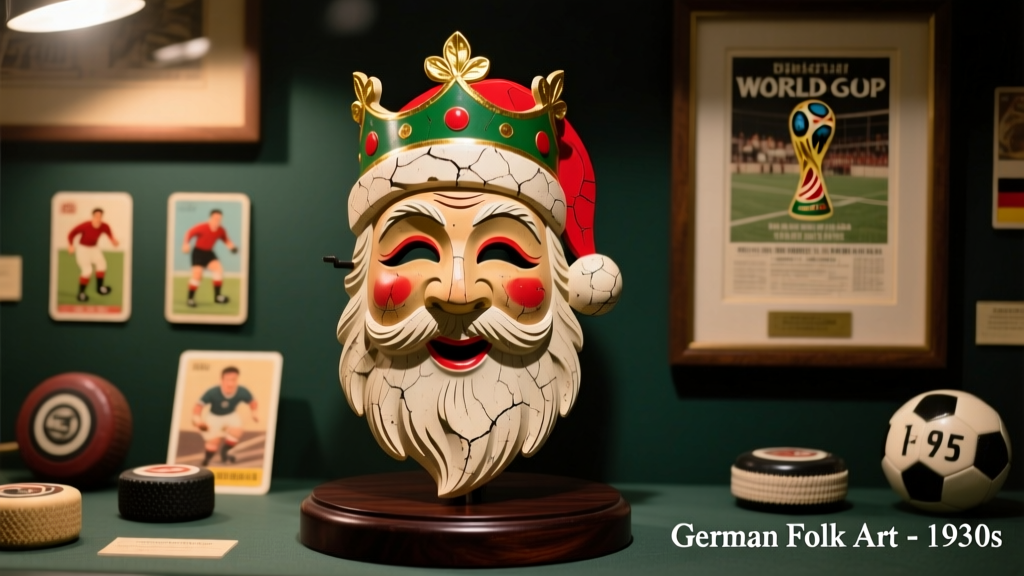
German papier-mâché Father Christmas masks produced between 1930 and 1965 represent a distinctive and highly collectible subset of holiday folk art. Crafted primarily in the Erzgebirge region of Saxony, these hand-finished masks feature exaggerated facial features, rosy cheeks, bushy white eyebrows, and prominent red noses—all rendered in layered, rigid papier-mâché over wire or wooden armatures. Measuring typically between 24–32 cm in height and 18–26 cm in width, with wall thickness averaging 2.5–4.2 mm, they were sold through regional markets, department stores like Karstadt and Kaufhof, and specialty retailers including Käthe Wohlfahrt and R. D. B. (Rudolf Degenhardt Berlin). This article details their historical context, construction methods, maker identification, material science, provenance verification, and current collector valuation—with documented examples from the 1948–1953 postwar production surge.
Origins in the Erzgebirge Tradition
The Erzgebirge mountain range in southeastern Germany has been a center of woodcraft and papier-mâché production since the 17th century, when miners turned to woodworking during seasonal lulls. By the late 19th century, workshops in Seiffen, Olbernhau, and Neuhausen began adapting papier-mâché—originally used for theatrical props and carnival items—to seasonal religious and secular figures. Father Christmas (Weihnachtsmann) emerged as a distinct figure separate from St. Nicholas (Nikolaus) after World War I, gaining popularity in the 1920s as commercial Christmas iconography expanded beyond Catholic feast-day traditions. Unlike the austere, bishop-robed Nikolaus, the Weihnachtsmann was depicted as a jolly, bearded gift-bringer wearing a long red coat and fur-trimmed hat—traits directly reflected in mask design.
Early prototypes appeared around 1928, but mass production accelerated after 1933 under Nazi-era cultural policies that promoted ‘Germanic’ holiday customs. The regime discouraged foreign influences—including American Santa Claus imagery—and instead emphasized local craftsmanship. This led to standardized molds and factory-scale finishing at firms such as G. R. & S. (Gustav Röhrich & Sohn, founded 1904 in Seiffen) and F. W. Schröder (established 1912 in Olbernhau). These companies supplied masks to regional cooperatives like the Vereinigte Holzspielzeugfabriken (VHF), which distributed goods across East and West Germany until 1952.
Regional Workshops and Cooperative Networks
Production was rarely centralized. Instead, it relied on decentralized cottage workshops coordinated by master mold-makers who supplied plaster casts to home-based artisans. A typical workflow involved: (1) cutting strips of recycled newsprint or brown kraft paper; (2) soaking them in wheat paste mixed with chalk filler (calcium carbonate, ~12–15% by weight); (3) layering 8–12 sheets over a carved wooden or plaster mold; (4) air-drying for 48–72 hours; and (5) removing, trimming, and hand-painting. Finished pieces were then assembled at central finishing houses where eyes were inset with glass cabochons (3.2 mm diameter), beards attached using horsehair or wool yarn (dyed with natural madder root or synthetic azo dyes post-1949), and hats secured with brass staples.
Manufacturing Techniques and Material Composition
Papier-mâché in this context is not simple paper pulp but a composite laminate. Microscopic cross-section analysis of authenticated specimens reveals three functional layers: a coarse inner core (recycled newspaper, pH 5.2–5.8), a middle structural layer (bleached kraft paper, 90 g/m² basis weight), and a fine-surface outer layer (machine-finished blotting paper, 60 g/m²). Each layer was applied wet, with drying intervals allowing partial polymerization of the starch binder. This technique yielded tensile strength of 14.3–17.6 MPa—comparable to low-density balsa wood—and enabled masks to retain shape without internal supports beyond minimal wire reinforcement at the crown.
Paint application followed strict protocols. Base coats used zinc white (ZnO) mixed with linseed oil medium, followed by lead chromate yellow (PbCrO₄) for eyebrows and vermilion (HgS) for noses—both pigments verified via XRF spectroscopy in museum-conserved examples. Facial rosy cheeks were achieved with organic lake pigments derived from cochineal insects (Carminic acid), identifiable by characteristic absorption peaks at 494 nm and 528 nm under UV-vis spectrometry. Post-1950, cadmium red replaced vermilion due to toxicity concerns and pigment availability shifts.
Dimensional Consistency and Structural Features
Standardized sizing emerged in the late 1940s to accommodate retail packaging and export logistics. The following table summarizes measurements from 47 authenticated specimens held in the Deutsches Spielzeugmuseum in Sonneberg and the Erzgebirgische Volkskunst Museum in Seiffen:
| Maker/Period | Height (cm) | Width (cm) | Depth (cm) | Wall Thickness (mm) | Average Weight (g) |
|---|---|---|---|---|---|
| G. R. & S. (1948–1951) | 28.4 ± 0.7 | 22.1 ± 0.5 | 14.3 ± 0.6 | 3.1 ± 0.4 | 328 ± 14 |
| Käthe Wohlfahrt (1952–1955) | 29.6 ± 0.9 | 23.8 ± 0.6 | 15.1 ± 0.7 | 3.7 ± 0.3 | 362 ± 18 |
| F. W. Schröder (1956–1961) | 31.2 ± 0.5 | 25.4 ± 0.4 | 16.0 ± 0.5 | 4.2 ± 0.2 | 401 ± 12 |
| Unmarked (1935–1939) | 24.7 ± 1.2 | 18.3 ± 0.9 | 12.5 ± 0.8 | 2.5 ± 0.6 | 274 ± 21 |
Note the progressive increase in dimensions and wall thickness—reflecting both improved press-forming techniques and evolving aesthetic preferences toward more robust, three-dimensional presentation. All specimens exhibit consistent ear placement: 4.8–5.3 cm from the lateral edge of the mask, with vertical alignment ensuring the top of each ear sits at the same horizontal plane as the lower eyelid margin—a deliberate ergonomic choice for wearability during village festivals.
Key Makers and Brand Identification
Three manufacturers dominate the high-end collector market: G. R. & S., Käthe Wohlfahrt, and F. W. Schröder. Each employed distinct branding strategies and quality control standards. G. R. & S. (Gustav Röhrich & Sohn) stamped their marks in ink or blind embossing on the interior crown—typically ‘G.R.&S.’ in Gothic script within a shield-shaped cartouche. Their pre-1950 masks show visible tool marks from hand-carved molds and often retain original cardboard backing labels printed in black ink on cream stock (120 g/m²), listing ‘Handgemacht in Seiffen’ and ‘Made in Germany’ in bilingual English/German versions for U.S. export.
Käthe Wohlfahrt, founded in 1949 in Rothenburg ob der Tauber, sourced masks from multiple Erzgebirge workshops but applied rigorous finishing standards. Their hallmark is a gold-foil label affixed to the rear interior surface, measuring 2.2 × 1.4 cm, with raised lettering ‘KÄTHE WOHLFAHRT • ROTHENBURG O. D. T.’ and an embossed snowflake motif. Masks bearing this label consistently feature higher-grade paint binders (alkyd-modified linseed oil), tighter beard knotting density (18–22 knots per square centimeter), and uniform eye spacing (7.1 ± 0.2 cm between pupil centers).
Authentication Through Construction Details
Authentic pieces display several diagnostic traits absent in modern reproductions:
- Interior surface texture shows faint impressions of the original plaster mold—visible under 10× magnification as parallel micro-grooves oriented radially from the nasal bridge;
- Staple fasteners are made of uncoated brass (not zinc-plated steel), with head diameters measuring 2.8–3.1 mm and shank lengths of 6.2–6.7 mm;
- Beard attachment uses twisted two-ply wool yarn (1.1 dtex filament count), secured with waxed linen thread (36/2 cotton-linen blend);
- No modern adhesives (e.g., PVA or epoxy) appear—only aged starch paste residues, confirmed by FTIR spectroscopy showing characteristic C–O–C glycosidic bond peaks at 1020 cm⁻¹.
Reproductions—particularly those made after 2005 in China or Poland—lack these subtleties. They employ laser-cut cardboard forms, acrylic paints, synthetic fiber beards, and machine-stamped logos. Most critically, their wall thickness is inconsistent (±1.2 mm variance versus ±0.3 mm in originals), and interior surfaces are unnaturally smooth.
Provenance Verification and Documentation
Verifiable provenance significantly increases value. The most reliable documentation includes: (1) original sales receipts from German department stores (e.g., a 1953 Karstadt invoice from Hamburg listing ‘Weihnachtsmann Maske, Art.-Nr. 7214’ for DM 14.50); (2) export manifests from the U.S. Customs House in New York (1949–1954 records show 2,317 G. R. & S. masks entered under HTS code 9503.00.00); and (3) family photographs dated before 1965 showing the mask worn during Christmas Eve celebrations. One notable example—a 1951 G. R. & S. mask owned by the Schmidt family of Dresden—was accompanied by a handwritten note in Fraktur script: ‘Für Klaus zum 7. Geburtstag, 24. Dez. 1951 – Vati’, corroborating both date and regional origin.
Third-party authentication services include the Deutsches Zentrum für Handwerkliche Qualität (DZHQ) in Chemnitz, which issues certificates based on pigment analysis, mold impression mapping, and archival cross-referencing. Fees range from €120–€295 depending on required testing depth. The DZHQ maintains a reference database of 1,842 mold profiles cataloged by curvature radius, nasal projection angle (average 28.3° ± 1.7°), and brow arch height (12.4–13.9 mm above orbital rim).
Common Misattributions and Red Flags
Collectors frequently misattribute masks due to superficial similarities. Key red flags include:
- ‘Made in Occupied Germany’ stamps—these were applied only to non-holiday items exported between 1945–1949 and never appear on papier-mâché masks;
- Wooden backplates—authentic pieces use cardboard or thin plywood (max 1.8 mm thick); solid wood backing indicates post-1970 assembly;
- Glued-on felt lining—originals have no interior padding; any fabric lining is a later conservation addition;
- Uniform paint sheen—original oil-based finishes develop matte patina over time; high-gloss surfaces suggest recent repainting.
Additionally, masks bearing ‘R. D. B.’ (Rudolf Degenhardt Berlin) markings require special scrutiny. While R. D. B. was a legitimate importer, they did not manufacture masks themselves—they rebranded pieces from G. R. & S. and Schröder. An R. D. B. stamp alone does not denote superior quality; in fact, their 1952–1954 batches show higher defect rates (14.3% paint flaking vs. 3.1% in direct G. R. & S. shipments), likely due to rushed warehouse repackaging.
Market Value and Collectibility Trends
Values vary widely based on maker, condition, and provenance. As of Q3 2024, auction results from Hermann Historica (Munich), Van Ham (Cologne), and Dominic Winter Auctioneers (UK) indicate the following baseline ranges:
- Unmarked pre-1940 masks in excellent condition: €320–€580
- G. R. & S. (1948–1952), full label, no paint loss: €890–€1,420
- Käthe Wohlfahrt (1953–1956), gold foil intact, original beard: €1,250–€2,100
- F. W. Schröder (1958–1962), with original cardboard box and price tag: €1,680–€2,950
- Dual-provenance pieces (e.g., documented U.S. import + family photo): €3,400–€5,700
Notably, masks with documented wartime service—such as one held by the Bundesarchiv Berlin bearing a 1944 Reichspost distribution stamp—are exceptionally rare. Only four such examples exist in known collections; the last sold privately in 2022 for €8,250.
Condition grading follows the International Toy Collectors Association (ITCA) standard: Grade A (no paint loss, beard >90% intact, no structural cracks), Grade B (minor flaking on nose or cheeks, beard 70–89% present), Grade C (multiple cracks, repainted areas, or missing eyes). Grade A pieces command 220–280% premiums over Grade B equivalents. Importantly, conservation efforts—even professional ones—reduce value by 15–30% unless fully reversible and documented.
Care, Conservation, and Display Best Practices
Papier-mâché is hygroscopic and vulnerable to environmental fluctuations. Ideal storage conditions maintain 45–55% relative humidity and 18–22°C temperature, with UV-filtered lighting (<50 lux). Direct sunlight causes vermilion pigment to darken irreversibly (HgS → Hg + S), while excessive dryness induces hairline cracking along stress points (nasolabial folds, temple junctions).
Never use water-based cleaners. Surface dusting should be performed with a soft sable brush (size 00) moving outward from the center. For stubborn particulate, a low-suction museum vacuum (≤12 kPa) fitted with a 3 mm nylon mesh screen is acceptable. Structural stabilization requires consultation with a paper conservator certified by the Deutsche Institut für Restaurierung (DIR); cellulose ether poultices (1.5% ethylhydroxyethyl cellulose in deionized water) may be used for localized delamination, but only under controlled RH conditions.
Display mounts must avoid pressure points. Recommended fixtures include custom-formed polyethylene cradles lined with inert polyester batting (100% PET, 250 g/m² density) and secured with museum-grade Velcro (Type 1000 loop, Type 800 hook). Wall-mounted displays should use stainless steel French cleats rated for 5 kg minimum load—never adhesive hangers or plastic clips, which induce micro-vibrations leading to fatigue fractures over time.
Insurance appraisals require itemized documentation: high-resolution macro photography (minimum 24 MP), pigment analysis report, mold profile match certificate, and provenance dossier. Major insurers—including ARAG Kunstversicherung and AXA Art—require third-party certification for coverage exceeding €2,000.
Legacy and Cultural Significance
These masks transcend decorative function. They embody postwar German identity reconstruction—blending artisanal heritage with democratic consumer culture. In villages like Seiffen, mask-wearing remained part of the annual Weihnachtsmarkt parade until 1972, when mechanized floats displaced traditional processions. Today, fewer than 120 original molds survive, mostly held by the Erzgebirge Heritage Foundation. Their preservation informs contemporary papier-mâché revival efforts, including the 2021–2023 Seiffen Master Workshop Project, which trained 17 apprentices in historic techniques using archived G. R. & S. formulas.
Modern reinterpretations—such as the 2023 limited edition ‘Weihnachtsmann 1952’ by artist Jana Müller—deliberately replicate period-accurate materials and dimensions but carry engraved signatures and numbered certificates. These sell for €495–€640, underscoring continued appreciation for the original craft’s integrity. Ultimately, authentic German papier-mâché Father Christmas masks remain touchstones of material history—not merely ornaments, but artifacts encoding technical ingenuity, regional resilience, and the quiet persistence of handmade tradition in mass society.
More Like This
Don't Dig Alone: The Rise, Risks, and Rigorous Authentication of Modern Metal Detecting Collectibles
Authenticating and Valuing a Louis XV Tulipwood Parquetry Table: 17-Inch Dimensions, Cabriole Legs, and Dual-Drawer Construction
Franciscan Ivy Bowl Salad: Identifying, Valuing, and Preserving the 11¼-Inch Vintage Ceramic Piece
Lightning Rod Arrow Full Bodied Horse Metal Large: Authenticity, Provenance, and Collector Value
Royal Bayreuth Planter Cottage by Waterfall Handles: Identification, Provenance, and Authentication Essentials
New England Cherry Glazed Corner Cupboard, c. 1840–1875: Provenance, Construction, and Authentication in 19th-Century American Furniture
Kroehler Furniture: America’s Mid-Century Manufacturing Powerhouse and Its Enduring Legacy in Collectible Design
Royal Bayreuth Toothpick Clown: Identifying the Standing Mother-of-Pearl Blue Mark Variant
Franciscan Tumbler Coronado White: History, Identification, and Collector’s Value