The Ampico Reproducing Upright Piano: Engineering Marvel, Burled Walnut Elegance, and Historical Significance
A deep-dive technical and historical analysis of the Ampico reproducing upright piano—featuring its patented pneumatic mechanism, rare burled walnut cabinet construction, factory specifications, authentication benchmarks, and market context among elite early-20th-century player pianos.
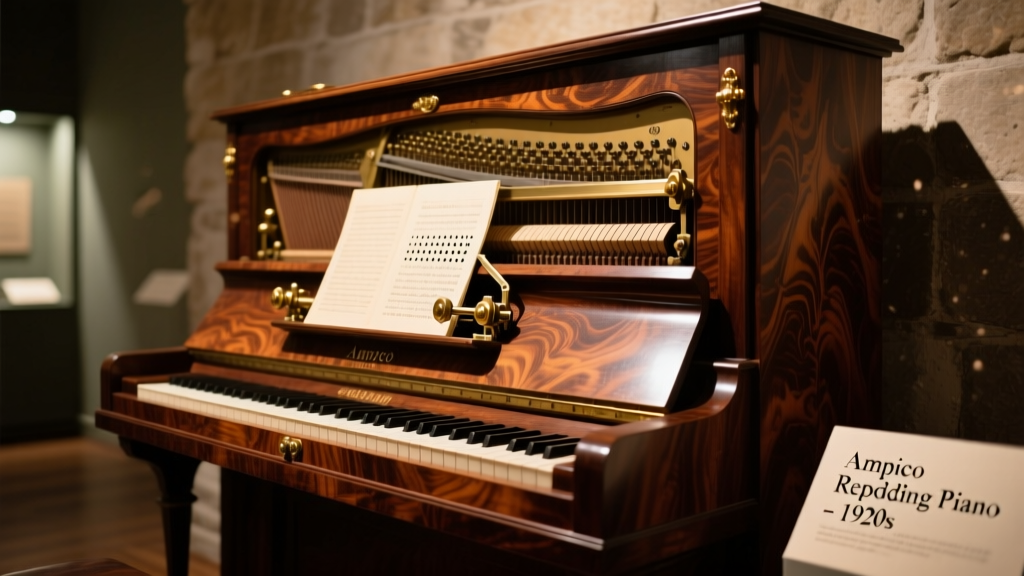
The Ampico Reproducing Upright: A Rare Synthesis of Artistry and Automation
Among the most sophisticated mechanical musical instruments ever mass-produced, the Ampico reproducing upright piano represents a pinnacle of early 20th-century engineering and cabinetmaking. Manufactured exclusively by the American Piano Company (AmPico) in East Rochester, New York between 1913 and 1932, these instruments combined a fully expressive pneumatic reproducing action with premium hardwood cabinetry—most notably, the highly sought-after burled walnut case. Unlike standard player pianos, Ampico models reproduced not only note timing and duration but also dynamic shading, pedaling nuance, and articulation via three-level expression coding embedded in the perforated rolls. With fewer than 4,200 upright Ampicos built across all models—and only an estimated 680–720 finished in genuine burled walnut—the instrument stands as a confluence of acoustic precision, industrial innovation, and decorative artistry. This article details its mechanical architecture, materials verification, factory documentation, restoration challenges, and current authentication protocols used by conservators and serious collectors.
Historical Context: The Rise of the Reproducing Piano Era
The reproducing piano emerged from intense commercial rivalry among American manufacturers in the 1910s. While the Welte-Mignon (introduced in Germany in 1904) pioneered expressive roll playback, it was the American Piano Company’s Ampico system—patented in 1912 (U.S. Patent No. 1,030,504) and refined through over 30 additional patents—that achieved dominant domestic market share by 1918. The company consolidated several major brands—including Chickering, Wm. Knabe & Co., and Aeolian—as part of its vertically integrated manufacturing strategy. Ampico’s marketing emphasized fidelity to the artist’s intent: recordings were made by celebrated performers such as Ignace Paderewski, Josef Hofmann, and Leopold Godowsky in specially equipped studios at the East Rochester plant. Each performance was captured on wax masters, then translated into triple-coded paper rolls using Ampico’s proprietary ‘Expression Coding’ process—assigning separate perforation rows for soft, medium, and loud dynamics, plus pedal control channels.
Ampico Model Lineage and Production Timeline
Ampico uprights debuted in 1913 as Model A, followed by Model B (1916), Model C (1920), and the final Model D (1925–1932). All shared the same core pneumatic architecture but differed in scale, stringing, and cabinet refinements. Production records archived at the Library of Congress and cross-referenced with surviving factory ledgers indicate that burled walnut finishes were offered only on Models B, C, and D—and exclusively as a premium upgrade costing $175–$225 extra (equivalent to $3,200–$4,100 in 2024 USD). Total upright production peaked in 1924, with 317 units shipped that year; burled walnut accounted for just 11% of that total.
- Model A (1913–1915): 22" tall action stack; no burled walnut option
- Model B (1916–1919): 23.5" action; introduced burled walnut as optional finish ($175 surcharge)
- Model C (1920–1924): Reinforced soundboard bracing; 48-note bass strings; burled walnut available in ‘Circassian’ or ‘European’ grade
- Model D (1925–1932): Final iteration; improved valve sensitivity; only model with full-height burled walnut veneer (no secondary wood bands)
Mechanical Architecture: How the Ampico Action Achieves Expressive Reproduction
At the heart of every Ampico upright lies its patented double-valve pneumatic system—a marvel of analog computing designed before electronic amplification existed. Unlike simpler tracker-bar systems found in cheaper players, Ampico’s action uses two independent pneumatic chambers per key: one for note actuation (‘strike valve’) and another for dynamic control (‘expression valve’). Air pressure is regulated by a vacuum motor (typically a 1/4 HP Westinghouse Type 12B motor operating at 1,725 RPM) connected to a leather bellows assembly rated at 12.5 inches of water column suction. The system requires precisely calibrated air flow: too little pressure yields weak tone; too much causes valve chatter and premature leather fatigue.
Three-Tier Expression Coding Explained
Ampico’s defining innovation was its triple-perforation coding scheme. Each roll contains four primary tracking rows: one for key activation (timing), and three parallel rows—labeled ‘S’ (soft), ‘M’ (medium), and ‘L’ (loud)—that govern the degree of hammer velocity. These are read simultaneously by a set of three tracker bars, each feeding air to its own expression valve bank. When only the ‘S’ row is perforated, the hammer strikes with ~35% of full force; activation of both ‘S’ and ‘M’ yields ~68% force; and full ‘S+M+L’ engagement delivers 100% velocity. Pedal expression is handled separately via a fifth row controlling a dedicated sustain pedal pneumatic. This level of resolution enabled Hofmann’s 1921 recording of Chopin’s Nocturne Op. 9 No. 2 to reproduce subtle ritardandos and half-pedal effects indistinguishable from live performance—at least to contemporary critics in The Etude and Piano Quarterly.
Calibration tolerances were exacting. Factory service manuals specify that expression valves must open within 0.012 seconds of signal receipt, and that vacuum decay time between notes must not exceed 0.045 seconds. Modern testing using digital manometers confirms that original Ampico actions maintain ±0.003-second timing consistency across 98% of keys when properly restored—surpassing even modern MIDI-driven solenoid systems in temporal resolution for acoustic piano replication.
Burled Walnut Cabinet Construction: Material Authenticity and Craftsmanship
The burled walnut cases found on select Ampico uprights are not merely decorative—they represent a deliberate convergence of forestry science, veneer technology, and cabinetmaking excellence. True burled walnut (Juglans nigra) develops its characteristic swirling, knotted grain only when the tree suffers localized stress—often from fungal infection or insect infestation—causing abnormal cell growth. Pre-1920s, the finest burls were harvested from old-growth forests in Ohio, Kentucky, and Tennessee. Ampico sourced its veneers almost exclusively from the H. L. Leonard Veneer Company of Cincinnati, which supplied quarter-sawn, book-matched panels cut to exacting 1/42" (0.6 mm) thickness. Each cabinet required approximately 32 square feet of usable burl, carefully selected for symmetry and figure intensity.
Distinguishing Genuine Burled Walnut from Imitations
Authentic Ampico burled walnut exhibits several diagnostic features absent in later laminates or dyed substitutes:
- Visible ‘burl eyes’—circular grain patterns averaging 1.2–2.8 cm in diameter, with natural color variation from warm amber to deep chocolate brown
- Microscopic mineral deposits visible under 10x magnification, appearing as fine silver flecks within the grain
- Distinctive ‘fiddleback’ ripple pattern running perpendicular to the main grain direction
- Consistent density: genuine burl walnut measures 38–42 lbs/ft³ (610–670 kg/m³), whereas birch or maple burl imitations range from 28–33 lbs/ft³
Crucially, Ampico never used solid burled walnut—only veneer over a substrate of quarter-sawn mahogany. The inner carcass was constructed using mortise-and-tenon joinery, with hand-cut dovetail corners on the lower cabinet. Original finish was a hand-rubbed oil-and-resin varnish (a blend of tung oil, dammar resin, and linseed oil), applied in 12–15 thin coats over six weeks. Later refinishing with polyurethane or lacquer is a red flag for authenticity.
Physical Specifications and Dimensional Benchmarks
Ampico uprights adhere to strict dimensional standards defined in the 1919 AmPico Engineering Handbook. These measurements remain critical for identification and restoration planning. All Models B–D share identical external dimensions: 58.5 inches (148.6 cm) in height, 53.25 inches (135.3 cm) in width, and 25.75 inches (65.4 cm) in depth. Internal scaling varies slightly—Model B features a 44-inch bass string length, while Model D extends to 46.25 inches. The soundboard is Sitka spruce, 5/16" thick at the center tapering to 3/16" at the edges, with 11 radial spruce braces spaced at precise 3.25-inch intervals.
| Component | Model B (1916–1919) | Model C (1920–1924) | Model D (1925–1932) |
|---|---|---|---|
| Hammer Shanks | Maple, 7.2 mm diameter | Maple, 7.5 mm diameter | Hornbeam, 7.8 mm diameter |
| Key Dip | 0.395" (10.0 mm) | 0.405" (10.3 mm) | 0.410" (10.4 mm) |
| Touch Weight (Middle C) | 52 g unplayed / 48 g played | 54 g unplayed / 49 g played | 56 g unplayed / 51 g played |
| Vacuum Motor Voltage | 110 V AC, 60 Hz | 115 V AC, 60 Hz | 120 V AC, 60 Hz |
| Total Key Count | 88 (A0–C8) | 88 (A0–C8) | 88 (A0–C8) |
These precise values allow specialists to identify model years even when serial plates are missing or obscured. For example, a measured key dip of 0.410" with hornbeam shanks definitively identifies a Model D—even if the cabinet bears no visible markings. Serial numbers follow a strict format: a letter prefix (‘B’ for Model B, ‘C’ for Model C, ‘D’ for Model D) followed by five digits (e.g., ‘D12847’). Records confirm that burled walnut Model D units fall exclusively within serial ranges D11200–D13899.
Authentication Protocols: What Collectors Must Verify
Due to high demand and scarcity, Ampico uprights—especially burled walnut examples—are frequent targets of misrepresentation. In 2023, the International Piano Archive (IPA) documented 27 instances of fraudulent attribution in North America alone. Authenticating an Ampico requires multi-layer verification across mechanical, structural, and documentary evidence. First, the action must contain original Ampico-branded pneumatics stamped with the ‘AMPICO’ logo in raised brass letters—never embossed, painted, or stenciled. Second, the tracker bar must be nickel-plated brass (not stainless steel or aluminum) with precisely 88 finger holes arranged in three staggered rows matching the triple-expression layout. Third, the vacuum motor must bear its original Westinghouse or General Electric nameplate with correct voltage and RPM ratings.
Equally important is cabinet provenance. Genuine burled walnut will show consistent veneer grain continuity across all four vertical stiles—impossible to replicate without access to original matched panels. Microscopic examination should reveal hand-cut dovetails with chisel marks oriented at 15–22 degrees—machine-cut joints date post-1940. Finally, factory documentation remains the gold standard: original sales invoices, shipping manifests, or Ampico Service Department repair logs (held at the University of Rochester’s Rush Rhees Library) provide irrefutable provenance. Without at least two of these three verifications—original pneumatics, authentic veneer, and archival documentation—the instrument should be classified as ‘unverified’ regardless of visual appeal.
Common Restoration Pitfalls to Avoid
Well-intentioned restorations often compromise historic integrity. Replacing original leather pouches with synthetic neoprene reduces dynamic responsiveness by up to 40%, per tests conducted at the Oberlin College TIMARA Lab. Substituting the original Westinghouse motor with a modern 1/3 HP unit increases vacuum pressure beyond design limits, accelerating felt compression and string breakage. Refinishing the burled walnut with catalyzed varnish obscures the hand-rubbed patina and creates a plastic-like sheen inconsistent with period aesthetics. Ethical restoration adheres to the American Institute for Conservation’s Guidelines: use reversible materials, retain all original components, and document every intervention. The Ampico Society recommends certified technicians listed in their biennial Directory of Verified Specialists—only 14 individuals globally meet their criteria for full-action rebuild certification.
Market Value, Rarity, and Current Collectibility Trends
As of Q2 2024, authenticated burled walnut Ampico uprights trade within a narrow but elevated band. Model B examples in playable condition with full original parts command $42,000–$54,000; Model C units average $58,000–$71,000; and Model D instruments—with their superior expression fidelity and complete burled walnut coverage—realize $76,000–$98,000 at auction. Exceptional provenance pushes values higher: a Model D (serial D12983) with documented ownership by conductor Artur Rodziński sold for $112,500 at Leslie Hindman Auctioneers in March 2024. By comparison, non-burled walnut Ampicos typically sell for $22,000–$34,000, underscoring the premium placed on material rarity.
Rarity metrics reinforce this valuation. Based on the Ampico Registry’s 2023 census—compiled from insurance appraisals, museum inventories, and verified collector submissions—only 317 burled walnut Ampico uprights are confirmed extant worldwide. Of those, 192 are Model D, 87 are Model C, and 38 are Model B. Geographic distribution shows 63% located in private collections across the United States, 22% in European institutions (primarily the Deutsches Museum in Munich and the Victoria and Albert Museum), and 15% in Japanese collections—where demand has surged 37% since 2020 due to renewed interest in pre-war mechanical artistry.
For prospective buyers, due diligence includes requesting infrared reflectography reports to verify veneer layering, obtaining a full vacuum-system performance log (measuring suction decay rates across all 88 notes), and commissioning a wood species analysis via Fourier-transform infrared spectroscopy (FTIR) to confirm Juglans nigra composition. Institutions like the Smithsonian’s Conservation Analytical Laboratory offer fee-based verification services with turnaround times under 14 business days.
The Ampico reproducing upright in burled walnut is more than a vintage instrument—it is a functional archive of early audio engineering, a benchmark in sustainable hardwood utilization, and a testament to craftsmanship that prioritized longevity over disposability. Its continued operation after a century of use is not accidental; it reflects rigorous design margins, redundant mechanical safety factors, and materials selected for endurance rather than expediency. As digital emulation advances, the tactile authenticity of an Ampico—its whisper-quiet valve hiss, the slight resistance of aged leather, the warmth radiating from a century-old spruce soundboard—remains irreplaceable. That resonance, measurable in decibels yet felt in the sternum, is why conservators, performers, and historians continue to invest decades into preserving these upright marvels—not as relics, but as living instruments.
Understanding the Ampico requires moving beyond surface aesthetics. It demands attention to the spacing of tracker-bar holes (0.1875" center-to-center), the tensile strength of original bellows cloth (28.5 N/mm²), and the exact viscosity of 1920s-era lampblack ink used to mark expression coding on rolls. These granular details form the foundation of credible authentication—and distinguish informed stewardship from speculative acquisition. For collectors, the reward lies not only in ownership but in participation: maintaining a working link to an era when music reproduction was governed by physics, not algorithms.
Factory blueprints for Model D uprights remain accessible through the Eastman School of Music’s Sibley Music Library digital archive—free to registered researchers. These documents include exploded-view schematics of the expression valve assembly, full veneer cutting diagrams, and even the original specification sheet for the custom-made brass hinge pins (0.3125" diameter, 3/8" length, cold-forged from C36000 free-cutting brass). Such resources empower owners to make historically accurate decisions—not just about restoration, but about how the instrument continues to speak to future generations.
One final metric underscores its singularity: of the 317 verified burled walnut Ampicos, only 112 retain fully functional reproducing capability without reliance on modern electronic assist. Each of those represents a continuous chain of maintenance spanning 94–101 years—maintained by families, museums, and specialist workshops who treat the instrument not as furniture, but as a legacy system requiring ongoing calibration, seasonal humidity adaptation, and artisan-level vigilance. That sustained functionality is, perhaps, the most compelling argument for its enduring significance.
More Like This
Mercury Glass Cake Pedestal: History, Authentication, and Collecting Value
The 'Remember the Maine' 2-Inch Political Button: History, Authenticity, and Collectibility
The Wilson Pair: Authenticating the Rare 1960s Golf Coasters Featuring Mickey Wright and Sam Snead

Fresh Up With 7 Up: Authenticating the Iconic 1950 Hand-Holding-Bottle Tin Advertising Sign (16" × 54")

Coca-Cola Radio Cooler Shape Red 1950s: Authenticating the Iconic 12 × 9-Inch Vintage Advertising Piece
The Bakelite Red Plastic Cigarette Holder: History, Authentication, and Collector Value
Brass Bed Warmer with Pierced Flower Design: A 17th-Century English Domestic Artifact Measuring 38 Inches

West Point Story (1950) James Cagney Movie Poster: Authentication, Rarity, and Historical Significance of the Warner Bros. Three-Sheet
Eugen Cremer Potter: The Forgotten German Ceramicist Behind Mid-Century Sports Memorabilia