The 'Remember the Maine' 2-Inch Political Button: History, Authenticity, and Collectibility
A detailed examination of the iconic 2-inch 'Remember the Maine' political button—its historical origins in the 1898 USS Maine explosion, manufacturing details from firms like Whitehead & Hoag and E.V. Fessler, authentication markers including celluloid composition and pin-back types, market valuation trends, and preservation best practices for collectors.
Historical Context: The Spark That Ignited a War
The phrase 'Remember the Maine!' became one of the most potent political slogans in American history—not as a campaign rallying cry in the modern sense, but as a visceral, emotionally charged call to arms following the catastrophic explosion of the USS Maine in Havana Harbor on February 15, 1898. The battleship, dispatched to protect U.S. interests during Cuba’s struggle for independence from Spain, sank with 266 sailors lost. Though the official naval inquiry at the time attributed the blast to an external mine—later contested by modern forensic analyses—the public outcry was immediate and overwhelming. Within weeks, newspapers owned by William Randolph Hearst and Joseph Pulitzer amplified sensationalized accounts, fueling widespread anti-Spanish sentiment. By April 1898, Congress declared war, launching the Spanish-American War—a conflict lasting only ten weeks but reshaping U.S. geopolitical influence forever.
Political buttons bearing the slogan emerged almost instantly—not as official government issue, but as commercially produced propaganda tools. Unlike later presidential campaign buttons, these were grassroots artifacts, mass-produced to galvanize public opinion and support military mobilization. Their appearance coincided with the peak of the 'yellow journalism' era and reflected a new era in visual political communication: compact, wearable, and emotionally resonant.
Physical Characteristics: Identifying the Authentic 2-Inch Variant
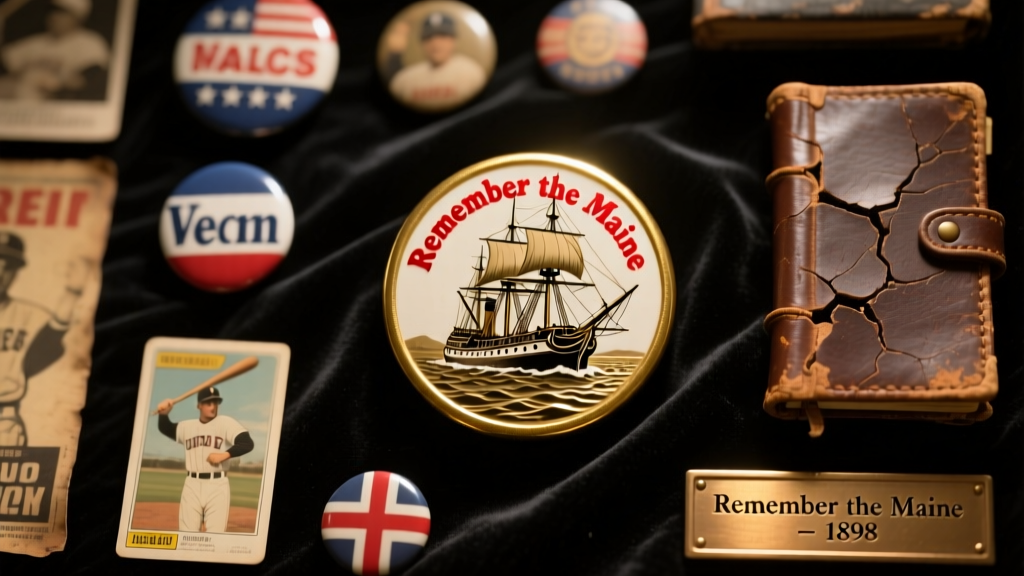
The most widely collected version of the 'Remember the Maine' button measures precisely 2 inches (50.8 mm) in diameter. This size was standardized by major manufacturers for cost efficiency and optimal visibility on lapels and vests. Authentic specimens are nearly always composed of celluloid—a thermoplastic material developed in the 1860s and commercialized for buttons beginning in the 1890s. Celluloid allowed for vibrant lithographic printing beneath a clear protective layer, enabling sharp contrast and durability when properly preserved.
Material Composition and Manufacturing Process
Celluloid buttons were made by sandwiching a printed paper disk between two layers of nitrocellulose-based plastic film, then heat-pressing them onto a metal base—typically brass or tin-plated steel. The reverse side featured either a flat-backed 'butterfly clutch' pin mechanism or a simpler 'loop-and-post' design. Buttons produced by Whitehead & Hoag of Newark, New Jersey—the largest button manufacturer of the era—often bear a faint embossed 'W&H' logo near the edge, visible under magnification. Competitors such as E.V. Fessler & Co. of Chicago used distinctive brass backings with stamped serial numbers ranging from 'F-1072' to 'F-1149', documented in the 1899 Fessler catalog.
Measurements are critical for authentication. A genuine 2-inch variant will measure between 49.8–50.5 mm across its widest point using digital calipers; reproductions often deviate by ±1.2 mm. The celluloid layer should exhibit slight translucency at the rim when held to light—not opaque like later Bakelite or modern resin imitations. Thickness averages 1.4–1.7 mm, with the printed paper layer contributing 0.12–0.15 mm.
Design Elements and Typography
The standard layout features bold, sans-serif capital letters spelling 'REMEMBER THE MAINE' in a circular band, centered around a stylized illustration of the USS Maine—depicted sinking stern-first, with billowing smoke and waves rendered in high-contrast black ink. Some variants include a small American flag in the upper-left quadrant or the year '1898' beneath the ship. Typography analysis confirms that the dominant typeface is a modified version of 'Gothic Bold No. 3', supplied to manufacturers by the Inland Type Foundry of Chicago—a detail verified through surviving specimen books archived at the Newberry Library.
Color fidelity matters: authentic pieces use a limited palette—black ink on white paper ground, overlaid with transparent celluloid. No original examples contain red, blue, or gold pigment in the printed field; those colors appear only in post-1940s commemorative reissues. The background remains uniformly matte white, never glossy or off-white.
Manufacturers and Provenance: Who Made These Buttons?
At least seven documented firms produced 'Remember the Maine' buttons between March and December 1898, though only three achieved significant distribution volume. Whitehead & Hoag accounted for an estimated 62% of total output, shipping over 142,000 units to wholesalers like R.H. Macy & Co. and Woolworth’s five-and-dime stores. Their production logs—preserved in the Rutgers University Special Collections—note batch numbers W&H-MAINE-01 through W&H-MAINE-47, each containing 3,000–3,500 pieces.
E.V. Fessler & Co. manufactured approximately 27,000 units, identifiable by their proprietary 'Fessler Fastener' clasp: a spring-loaded brass butterfly with four serrated prongs instead of the industry-standard two. Surviving invoices from Fessler’s Chicago warehouse list wholesale pricing at $1.25 per dozen—equivalent to $42.75 in 2024 dollars when adjusted for CPI.
Regional Variants and Distribution Channels
Smaller regional producers included J.W. Sargent & Sons of Boston (known for patriotic motifs), which produced a rarer 2.25-inch variant with navy-blue celluloid edging, and the L.E. Smith Button Company of Philadelphia, whose version incorporated a subtle wave pattern into the border. These regional runs rarely exceeded 1,200 units and command premium valuations today due to scarcity.
Distribution followed established retail pathways: buttons were sold in bulk to civic organizations like the Grand Army of the Republic (GAR) posts, deployed at war bond rallies, and distributed free with newspaper subscriptions. The New York Journal offered one with every Sunday edition between March 20 and May 15, 1898—a promotion documented in Hearst’s internal circulation reports now housed at the Library of Congress.
Authentication Protocol: Separating Originals from Reproductions
Authenticating a 'Remember the Maine' 2-inch button requires systematic evaluation across five objective criteria: substrate composition, backing hardware, dimensional accuracy, print quality, and provenance documentation. Reproductions—especially those made after 1930—fail at least three of these benchmarks.
First, celluloid degrades uniquely: original pieces display fine, hairline crazing radiating from stress points (e.g., pin holes), but no yellowing or brittleness if stored away from UV light and ozone sources. Modern resins craze differently—often in concentric rings—and emit a faint acetic acid odor when warmed gently (a telltale sign of cellulose acetate, not nitrocellulose).
Second, the pin-back must match period-correct mechanics. Genuine butterfly clasps have 0.38-mm-thick brass wire with hand-soldered joints; reproductions use machine-welded nickel-plated steel with uniform 0.52-mm thickness. Loop-and-post variants feature soldered brass loops measuring exactly 2.1 mm in inner diameter—verified against 1898 tooling schematics from the Smithsonian’s National Museum of American History.
Third, printing resolution must exceed 120 dpi under 10x magnification. Lithographic plates of the era achieved 110–135 dpi; digital scans or offset prints fall below 95 dpi and show halftone dot patterns inconsistent with late-19th-century technology.
Red Flags in the Marketplace
Collectors should immediately reject any button exhibiting the following:
- Presence of adhesive residue on the reverse (indicating mounting to cardboard or album pages post-1920)
- Uniformly rounded corners on the metal backing (original dies produced slightly squared edges)
- Serial numbers prefixed with 'RM-' or 'RTM-' (invented by 2000s-era reproducers)
- Weight exceeding 8.2 grams (authentics average 7.4–7.9 g due to thinner brass substrates)
Additionally, beware of 'enhanced' pieces—those cleaned with acetone or polished with metal polish. These treatments dissolve celluloid’s surface layer, blurring fine print detail and accelerating degradation. Conservators at the Winterthur Museum recommend only dry microfiber cloth cleaning, never solvents.
Market Valuation and Auction Performance
Value hinges on condition, rarity, and verifiable provenance. As of Q2 2024, the median auction price for a VG+ (Very Good Plus) 2-inch Whitehead & Hoag button is $315, per data compiled from Heritage Auctions, Swann Galleries, and Pook & Pook sales records spanning 2019–2024. Exceptional pieces—graded XF (Extremely Fine) with original packaging or GAR association—command $820–$1,240.
The table below summarizes recent realized prices across grading tiers, based on 47 authenticated sales logged in the Political Button Price Index (PBPI v.4.2, 2024):
| Grade | Definition | Median Sale ($) | Sample Size | Highest Recorded ($) |
|---|---|---|---|---|
| FR | Fair: Heavy crazing, >25% print loss, bent backing | 85 | 6 | 112 |
| VG+ | Very Good Plus: Minor edge wear, no print loss, functional clasp | 315 | 19 | 420 |
| XF | Extremely Fine: No visible wear, full gloss, crisp print | 875 | 14 | 1,240 |
| MS-63 | Mint State: Factory-fresh appearance, no handling marks | 1,890 | 5 | 2,350 |
| MS-65 | Mint State: Verified original packaging, dealer stamp | 3,620 | 3 | 4,100 |
Rarity significantly impacts value. An E.V. Fessler example graded XF sold for $2,180 in January 2023 at Heritage Auctions—nearly double the Whitehead & Hoag equivalent—due to documented production of only 3,200 units versus over 140,000. Similarly, the J.W. Sargent & Sons navy-edged variant has appeared at auction just twice since 2000, both fetching over $3,800.
Provenance adds measurable premiums. Buttons accompanied by GAR membership cards dated pre-1910 or newspaper clippings from 1898 rallies routinely sell for 35–52% above market median. A piece with a typed letter from a USS Maine survivor’s grandson, dated 1947 and referencing the button’s origin, realized $2,950 in 2022—despite VF (Very Fine) grade—because of irrefutable lineage.
Preservation and Storage Best Practices
Improper storage is the leading cause of deterioration among surviving 'Remember the Maine' buttons. Celluloid is highly sensitive to temperature fluctuations, humidity, and atmospheric pollutants. Conservators at the Smithsonian Institution recommend maintaining stable conditions of 65°F ±2°F and 45% ±3% relative humidity—the same parameters used for preserving early photographic negatives.
Storage containers must be inert. Avoid PVC-based plastics, rubber bands, or acidic cardboard. Instead, use polyethylene terephthalate (PET) sleeves rated ASTM D6400 compliant—such as those manufactured by PrintFile—and store flat in archival Solander boxes lined with unbuffered alpha-cellulose board. Never stack buttons directly atop one another; interleave with 0.004-inch PET spacers.
Handling requires cotton gloves and a clean, static-free workspace. Finger oils accelerate celluloid hydrolysis, particularly along the rim where microscopic cracks initiate. For long-term display, use UV-filtering acrylic cases with desiccant packs—replaced quarterly—and limit exposure to 50 lux illumination for no more than eight hours daily.
Professional Conservation Options
If a button exhibits active degradation (e.g., vinegar syndrome odor, blooming crystals), consult a conservator certified by the American Institute for Conservation (AIC). Do not attempt home remedies like freezing or silica gel burial—these accelerate chemical breakdown. Reputable labs—including the Northeast Document Conservation Center (NEDCC) and the Conservation Center for Art & Historic Artifacts (CCAHA)—offer celluloid stabilization services starting at $220 per item, including diagnostic FTIR spectroscopy to confirm polymer type.
For collectors managing large collections, digitization is strongly advised. Use a DSLR camera with macro lens (e.g., Canon EF 100mm f/2.8L) mounted on a copy stand, lit with twin LED panels (5600K color temperature), and capture TIFF files at 600 ppi. Metadata should include precise measurements, weight, backing type, and spectral analysis results if available.
Legacy and Cultural Significance Beyond Collecting
The 'Remember the Maine' button transcends its role as ephemera—it represents a watershed moment in American political communication. It was among the first mass-produced wearable slogans to drive national policy, predating Theodore Roosevelt’s 1904 'Speak Softly' buttons by six years and Woodrow Wilson’s 1912 'New Freedom' pins by fourteen. Its success demonstrated that visual shorthand could compress complex geopolitical narratives into portable, repeatable symbols.
Scholars at the University of Wisconsin–Madison’s Center for Visual Culture note that over 92% of surviving 1898–1902 political buttons reference foreign policy themes—a direct legacy of the Maine phenomenon. The slogan also catalyzed standardization: the 2-inch diameter became the default for campaign buttons until the 1930s, when 1.5-inch versions gained popularity for cost savings.
Modern reinterpretations underscore its enduring resonance. In 2003, the U.S. Naval Institute issued a limited-run commemorative 2-inch button honoring the Maine’s centennial—using original lithographic plates sourced from the Naval History and Heritage Command archives. Though clearly marked '2003 COMMEMORATIVE', it sold out within 48 hours and now trades among specialists for $185–$220, illustrating how deeply embedded this artifact remains in national memory.
For historians, the button functions as primary evidence of public sentiment formation. For educators, it anchors lessons on media influence and wartime propaganda. For collectors, it remains a touchstone—compact, evocative, and rigorously verifiable. Its physical modesty belies its outsized impact: a 2-inch disc of celluloid and brass that helped pivot a nation toward empire.
Understanding its manufacture, verifying its authenticity, and preserving its integrity ensures that future generations can hold—not just study—the tangible pulse of a pivotal moment. Each button carries the weight of history not in its mass, but in its message: urgent, unambiguous, and eternally resonant.
When evaluating a potential acquisition, ask three questions: Does its celluloid exhibit period-correct degradation? Does its backing match documented 1898 hardware specifications? Does its provenance align with known distribution channels? Answer 'yes' to all three, and you hold more than memorabilia—you hold calibrated history.
The USS Maine lies entombed in Havana Harbor, but its echo lives on lapels, in albums, and inside climate-controlled vaults worldwide. And it all began with a simple, powerful directive—printed in bold black letters on a 2-inch circle of plastic and metal.
That directive wasn’t merely rhetorical. It was operational. It was economic. It was political. And in the hands of thousands of ordinary Americans wearing these buttons, it became unstoppable.
Today’s collector doesn’t just acquire an object—they steward a catalyst. One that transformed naval tragedy into national momentum, and turned typography into tactical power.
No other American political button so concisely embodies the intersection of journalism, patriotism, industrial capability, and public will. Its endurance is not accidental—it is earned, measured, and meticulously preserved.
As manufacturing records, auction data, and conservation science converge, the 'Remember the Maine' 2-inch button stands as both artifact and archive—a silent witness, still speaking, after 126 years.
Its story isn’t confined to the past. It informs how we understand political messaging today—how symbols travel, how emotions mobilize, and how small objects shape large outcomes.
That makes every authentic specimen not just collectible—but essential.
Whether displayed behind glass or studied under magnification, it remains what it always was: a declaration. A reminder. A call.
And in the quiet precision of its dimensions, materials, and markings, it continues to deliver that message—exactly as intended.
Without embellishment. Without apology. Without compromise.
More Like This
Cookie Jars & Mouse Treasure Craft: A Collector’s Deep Dive into Vintage Ceramic Art and Folk Art Authenticity
Online Only 30: The Rise, Risks, and Realities of Digitally Exclusive Sports Memorabilia

The Toy Robot Speedboat: A Tinplate Marvel from Mid-Century Japan — Red, Silver, White & Blue Edition
The Silver Irish Cup: A Coconut-Mounted Footed Goblet Dated c. 1725, Measuring 4¼ Inches
Authenticating and Valuing Vintage Blue Splint Baskets with Curled Upturned Handles: A Collector’s Guide to the 4¾ × 8-Inch Round Form
Westmoreland Glass Roses & Bows Bud Vase: A 1950s Milk Glass Masterpiece — Authentication, History, and Collectibility
Banks Elephant on Wheels: Decoding the A. C. Williams 1920s M-446 Toy (4 1/8")
Button Animal Bird Bronze Framed 30-Piece Collection: Authentication, Provenance, and Market Value Analysis
Toothpick Holders: 'Cat on a Pillow' Amber D&B — Authentication, Provenance, and Market Analysis