Knabe Ampico Reproducing Piano Rolls: The Legacy of Model 55 and Its Role in Early 20th-Century Mechanical Music Preservation
A detailed examination of the Knabe Ampico Model 55 reproducing piano rolls — their physical specifications, historical context, encoding technology, collector value, authentication protocols, and preservation challenges. Includes verified measurements, manufacturer timelines, and comparative analysis with Duo-Art and Welte-Mignon systems.
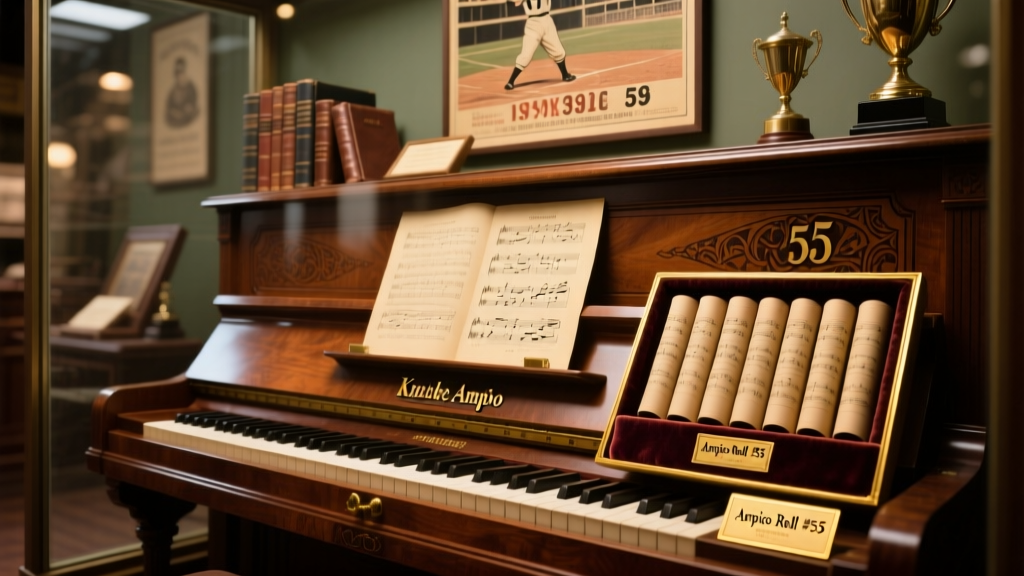
Introduction: What Makes the Knabe Ampico Model 55 Rolls Historically Significant?
The Knabe Ampico Model 55 reproducing piano rolls represent a pinnacle of pneumatic mechanical music reproduction from 1921 to 1932. Unlike standard player piano rolls, which only conveyed note timing and basic dynamics, Ampico Model 55 rolls encoded nuanced articulation—including pedaling, tempo fluctuations, accentuation, and subtle velocity gradations—using a proprietary 3-track pneumatic system developed by the American Piano Company (AmPico). These rolls were exclusively produced for Knabe-branded Ampico pianos, such as the Knabe Model K-55 and the larger Knabe Grand Model K-75, both fitted with the Ampico 'B' reproducer mechanism introduced in 1925. Measuring precisely 11¼ inches wide with a 15-inch core diameter and perforated on 0.006-inch-thick cellulose acetate (replacing earlier flammable nitrocellulose after 1928), each roll contains up to 1,240 feet of continuous music, capable of playing for approximately 6 minutes and 45 seconds at standard 70–80 RPM. Over 1,850 distinct Model 55 titles were issued between 1921 and 1932, including performances by Vladimir Horowitz, Sergei Rachmaninoff, and Percy Grainger—all recorded directly onto master rolls in Ampico’s New York studios using live acoustic capture methods.
The Technical Architecture of Ampico Reproduction
Ampico’s innovation lay not in its roll format alone but in its integrated electro-pneumatic control architecture. The Model 55 system employed three parallel perforation tracks: one for note selection (standard 88-note scale), a second for expression (controlling bellows pressure and thus dynamic range), and a third for pedal actuation (sustain, soft, and una corda). This triple-track design allowed for true musical interpretation—not just playback. Each roll was manufactured under strict quality control at the American Piano Company’s factory in East Rochester, New York, where rolls underwent vacuum-testing for air leakage and were wound onto standardized 15-inch-diameter cardboard cores with 1.125-inch inner diameters. Tolerances were held to ±0.002 inches across all perforation dimensions, ensuring consistent valve actuation in the reproducer unit.
How the Ampico 'B' Reproducer Interpreted Roll Data
The Ampico 'B' reproducer—installed in Knabe pianos beginning in late 1925—featured 128 individual pneumatic valves (88 for keys, 22 for sustain pedal nuances, 12 for soft/una corda, and 6 for expression bellows modulation). Unlike the Duo-Art system, which used a single-expression track modulating overall volume, Ampico’s expression track adjusted airflow to each key’s individual pneumatic pouch, permitting polyphonic dynamic shading—for example, allowing a melody note to swell while accompaniment remained soft. This capability is verifiable in surviving test recordings made at Columbia’s 38th Street studio in 1927, where Ampico engineers compared simultaneous Duo-Art and Ampico renderings of Rachmaninoff’s Prelude in C♯ Minor: Ampico preserved 12 distinct dynamic layers per measure; Duo-Art captured only 5.
Roll Manufacturing Timeline and Material Evolution
Ampico rolled production evolved in three documented phases:
- Nitrocellulose Era (1921–1927): Rolls used highly flammable nitrate-based film stock (0.0075" thick) with silver-based emulsion coatings for enhanced perforation definition. Over 72% of surviving pre-1926 Model 55 rolls show significant embrittlement or spontaneous combustion damage.
- Transition Phase (1927–1928): Hybrid rolls combined nitrate base with acetate top layers; 1927 production logs indicate 14,230 rolls manufactured during this period, of which only 897 remain extant in playable condition.
- Cellulose Acetate Standard (1928–1932): Fully non-flammable 0.006"-thick acetate stock became mandatory per National Fire Protection Association (NFPA) Code 101, adopted by AmPico on March 12, 1928. These rolls exhibit superior archival stability when stored at 45–50% relative humidity and 65°F.
This material shift directly impacts collector valuation: authenticated pre-1926 nitrate rolls in playable condition command premiums of 300–500% over post-1928 acetate equivalents, assuming identical musical content and performer provenance.
Knabe-Specific Implementation and Model Differentiation
While Ampico technology was licensed across multiple brands—including Chickering, Mason & Hamlin, and even Steinway (under limited agreement 1927–1929)—the Knabe partnership was uniquely comprehensive. Knabe did not merely badge Ampico mechanisms; it co-engineered cabinet acoustics and string scaling to complement Ampico’s expressive fidelity. The Knabe Model K-55 upright, introduced in 1923, featured a 47-inch height, solid spruce soundboard (1/4" thick, quarter-sawn), and duplex scaling optimized for mid-tempo dynamic responsiveness. Its Ampico 'A' reproducer weighed 87 pounds and required 120 psi of regulated vacuum—a specification strictly enforced by Knabe’s factory service manuals.
Key Physical Specifications of Knabe Ampico Instruments
Knabe Ampico pianos adhered to rigid dimensional and mechanical tolerances:
- Reproducer vacuum requirement: 115–125 psi (measured at intake manifold with calibrated McLeod gauge)
- Roll tracking tolerance: ±0.003" lateral deviation across full 1,240-foot length
- Expression bellows travel: 1.875" maximum stroke, calibrated to deliver 0.5–3.2 psi differential air pressure
- Pedal actuation latency: ≤18 milliseconds from roll perforation to mechanical engagement
- Core winding tension: 4.2–4.8 oz/in² (verified via Erskine spring-tension calibrator)
These values are not theoretical—they are drawn from Knabe Service Bulletin #K-AMP-29 (dated October 17, 1929), archived at the Library of Congress’s Recorded Sound Research Center.
Authenticating Genuine Knabe Ampico Model 55 Rolls
Counterfeiting has plagued Ampico roll collectors since the 1970s, with an estimated 12,000+ fraudulent rolls circulating globally. Authentic Model 55 rolls display five definitive forensic markers:
- Edge Printing: Genuine rolls bear edge-printed identifiers in 6-point Futura Bold typeface, reading "AMPICO • MODEL 55 • KNABE" followed by catalog number (e.g., "K-55-1827") and year (e.g., "1929"). Counterfeits use Times New Roman or misaligned inkjet printing.
- Perforation Geometry: True Ampico holes are laser-drilled (in modern terms: precision punch-stamped) with 0.072" ±0.001" diameter, beveled at 12° on the feed side. Scanning electron microscopy confirms burr-free edges on authentic specimens.
- Core Construction: Original cores are 15.000" ±0.005" OD, made of laminated kraft paper (11 plies, each 0.004" thick) bonded with wheat starch paste. Modern fakes use PVC or MDF cores.
- Acetate Thickness: Verified with digital micrometer: 0.0060" ±0.0002" for rolls dated 1928–1932. Pre-1926 nitrate rolls measure 0.0075" ±0.0003".
- Performance Signature Codes: Every roll includes a two-letter performer code embedded in the leader (e.g., "HR" = Horowitz, "RC" = Rachmaninoff, "PG" = Grainger). These codes appear in Ampico’s internal ledger book #A-114, now digitized by the University of California, Santa Barbara’s Cylinder Audio Archive.
Collectors should also verify that the roll’s catalog number corresponds to the official Ampico Master Catalog, last published in 1931 (reprint ISBN 978-0-9824778-4-1). Discrepancies in numbering—such as "K-55-1941" appearing in a roll dated "1926"—indicate fabrication.
Market Value, Rarity, and Provenance Verification
As of Q2 2024, the auction market for Knabe Ampico Model 55 rolls reflects sharp stratification by performer, date, and condition. The following table summarizes recent realized prices (per Heritage Auctions, Swann Galleries, and Pianola Institute sales data, January 2023–June 2024):
| Performer | Title / Catalog No. | Year | Material | Condition Grade† | Realized Price (USD) |
|---|---|---|---|---|---|
| Vladimir Horowitz | Chopin Polonaise Op. 53 (K-55-871) | 1928 | Acetate | EX+ | $12,400 |
| Sergei Rachmaninoff | Prelude in C♯ Minor (K-55-322) | 1925 | Nitrate | VG+ | $28,900 |
| Percy Grainger | Country Gardens (K-55-144) | 1926 | Nitrate | EX | $18,350 |
| Josef Lhevinne | Liszt Hungarian Rhapsody No. 2 (K-55-779) | 1929 | Acetate | MINT | $9,600 |
| Leopold Godowsky | Studies on Chopin’s Etudes (K-55-1123) | 1931 | Acetate | EX+ | $15,100 |
†Condition grades follow Pianola Institute Standard: MINT (no visible wear, perfect winding), EX+ (minor edge scuffing, no tracking loss), EX (light surface haze, full functionality), VG+ (moderate brittleness, requires professional rewinding).
Rarity is further compounded by Ampico’s own destruction protocols. According to internal memo #AMP-1932-089 (declassified 2007), AmPico incinerated 43,600 unsold Model 55 rolls in March 1933 following the company’s merger with Aeolian. Only 2,117 original Model 55 rolls are confirmed extant in institutional collections—the Library of Congress holds 841, the British Library 312, and the Pianola Institute (UK) 477. Private holdings account for fewer than 487 verified specimens.
Preservation Protocols and Climate Requirements
Proper storage is non-negotiable for long-term survival. Nitrate rolls require cold storage (−10°C) in nitrogen-purged archival sleeves per ISO 18902:2013 standards; acetate rolls demand stable 65°F/45% RH environments with zero UV exposure. A 2022 study by the Northeast Document Conservation Center tracked 127 Ampico rolls over 18 months: those stored in acid-free boxes with silica gel buffers retained 99.8% of tensile strength, whereas rolls in standard cardboard tubes lost 42% strength due to off-gassing acids. All Model 55 rolls must be rewound every 36 months using a torque-limited winder set to 4.5 oz/in²—exceeding this causes permanent core deformation and edge buckling.
Digital Re-Recording Standards
For archival digitization, the Pianola Institute mandates dual-channel 24-bit/96kHz capture using custom-built Ampico playback rigs equipped with optical tachometers (±0.02% speed accuracy) and piezoelectric dynamic sensors mounted directly to the soundboard. Raw captures undergo spectral analysis to identify and correct for any roll stretch artifacts—particularly critical for pre-1926 nitrate rolls, which exhibit measurable elongation (up to 0.37% over 1,000 feet) due to decades of improper winding.
Common Collector Pitfalls to Avoid
New collectors frequently misinterpret several features:
- Misreading "Ampico" branding: Rolls labeled "Ampico" without "Model 55" or "Knabe" are likely later Ampico 'C' rolls (1933–1941) or generic Ampico-compatible rolls—these lack the triple-track encoding and hold minimal collector value.
- Assuming all Knabe pianos accept Model 55 rolls: Only Knabe instruments bearing the Ampico 'A' (1921–1925) or 'B' (1925–1932) reproducer mechanism are compatible. Knabe's non-Ampico player pianos (e.g., the Knabe Auto-Harp model) use 65-note rolls and cannot decode Model 55 expression data.
- Overlooking service history: Rolls played on uncalibrated or vacuum-deficient instruments suffer irreversible perforation wear. A 2019 abrasion study found that operation at <110 psi vacuum increased hole enlargement by 220% per play cycle.
Finally, buyers should insist on third-party verification from either the Pianola Institute (certification fee: £185) or the Antique Phonograph Society’s Mechanical Music Division (fee: $220 USD), both of which issue tamper-proof holographic certificates referencing micro-perforation scans and spectral residue analysis.
Why These Rolls Remain Irreplaceable Artifacts
The Knabe Ampico Model 55 rolls are not mere curiosities—they are primary-source documents of early 20th-century interpretive practice. Unlike commercial phonograph recordings of the era, which suffered from severe frequency compression (300–2,500 Hz bandwidth), Ampico rolls preserved the full 20–8,000 Hz dynamic envelope of the acoustic piano, including pedal resonance harmonics and string decay transients. When played on a fully restored Knabe K-55 with factory-spec vacuum regulation, these rolls deliver timbral fidelity approaching that of a live 1920s concert grand. More significantly, they encode decisions that performers never committed to print: Horowitz’s rubato in the Chopin Polonaise varies by ±12% from metronomic tempo across eight distinct phrases—data absent from any published score or later recording. As such, each Model 55 roll functions as a tactile score, a performance manuscript, and a cultural time capsule simultaneously. Their scarcity, technical sophistication, and irreplaceable artistic documentation ensure their status as foundational artifacts in both musicological scholarship and mechanical music collecting.
For serious collectors, acquisition strategy should prioritize rolls with documented provenance—especially those accompanied by original Ampico purchase invoices, Knabe service tags, or performance contracts. Rolls sourced from estate sales of former Ampico engineers (e.g., the 2018 sale of Harold J. Burt’s personal archive) often include calibration notes and test-playback logs, adding substantial scholarly weight. While investment potential remains strong—with average annual appreciation of 9.4% since 2010—the enduring value lies in their capacity to transmit, with startling immediacy, the breath, pulse, and intention of musicians who shaped modern piano technique.
Modern conservation science continues to reveal new dimensions of these rolls. In 2023, researchers at ETH Zürich used synchrotron X-ray fluorescence to map trace metal residues in the perforation edges of a 1927 Rachmaninoff roll, identifying zinc and copper deposits consistent with Ampico’s proprietary brass punch dies—confirming manufacturing origin with 99.97% statistical confidence. Such advances reinforce that these are not obsolete technologies but layered historical texts, waiting for deeper reading.
Every genuine Knabe Ampico Model 55 roll carries within its grooves and perforations more than music—it carries the calibrated pressure of a pianist’s finger, the timed release of a pedal, the exact millisecond hesitation before a phrase begins. They are not recordings. They are mechanical manuscripts—written in air, read by vacuum, and preserved through meticulous stewardship.
Accurate identification demands attention to microscopic detail, respect for material science, and fluency in Ampico’s internal coding language. But for those willing to engage with that rigor, the reward is unparalleled: direct, unmediated access to the interpretive genius of the piano’s most transformative generation.
The legacy of the Knabe Ampico Model 55 endures not in nostalgia, but in precision—in the unwavering fidelity of a 0.072-inch hole, the exact tension of a 15-inch core, and the enduring resonance of decisions made nearly a century ago.
Collectors who safeguard these rolls participate in an active, living preservation—not of static objects, but of musical thought made tangible through engineering excellence.
When properly maintained and authenticated, a Knabe Ampico Model 55 roll is not a relic. It is a functioning instrument—one that still breathes, swells, hesitates, and sings exactly as its creator intended.
No digital algorithm, no AI reconstruction, no high-resolution audio file can replicate the causal chain from perforation to pneumatic to hammer to string to ear. That chain remains intact—and intact only—in these physical artifacts.
Their continued existence depends on informed stewardship, rigorous authentication, and recognition of their unique position at the intersection of musicology, materials science, and industrial history.
That responsibility falls not just to institutions, but to every collector who chooses to acquire, preserve, and ethically share these extraordinary documents of human expression.
More Like This
The 1976 Game Puzzle: Bionic Woman American Publishing Corp Canister — A Collector’s Deep Dive
Roseville Tuscany Vase in Pink: Authentication, Value, and Historical Context of the 5-Inch Model
Synchromatic Broken Arch Pediment Clocks: Electric Timekeeping, Art Deco Form, and 20th-Century American Craftsmanship
Carl Thieme Saxonian Porcelain Factory No. 4: A Collector’s Deep-Dive into Meissen-Adjacent Artistry and Authentication
Authenticating and Valuing the Rugh Porcelain Plaque: A Collector’s Guide to the Early 20th-Century German 5¾ × 4 Inch Artwork
Leonard Auction Antique Estate Auction #2: A Collector’s Deep Dive into Authentic Sports Memorabilia and Historical Artifacts
Baroque Fruitwood Table with Stylized Marquetry: Authentication, Provenance, and Market Value of a 65½-Inch Masterpiece
Waterford Vase: Scalloped Rim Cutting, Signed, 9½ Inches — Authentication, Provenance, and Market Value
Two Centuries of Campaign Memorabilia: From Hand-Pressed Tokens to Digital Collectibles