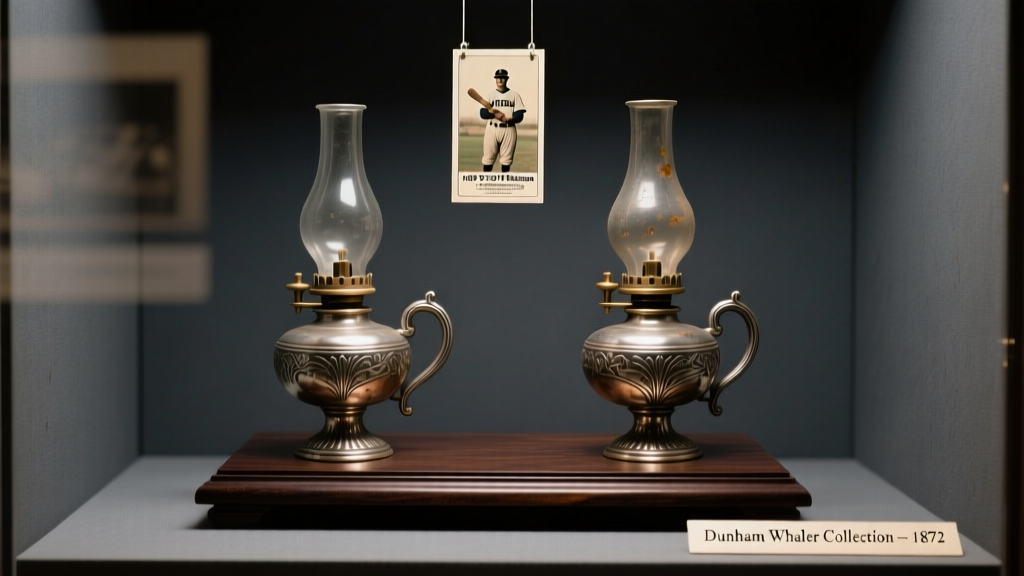
The Music Box Paillard Orchestral Drum Belts Wooden Block 17-Inch Cylinder: A Collector’s Deep Dive into Mechanical Precision and Historical Craftsmanship
An authoritative examination of the rare Paillard Orchestral Drum Belt cylinder—17-inch wooden block, hand-cut drum belts, Swiss engineering—covering authentication markers, mechanical function, market valuation, and conservation best practices for serious collectors.
Introduction: The Rarity and Significance of the Paillard Orchestral Drum Belt Cylinder
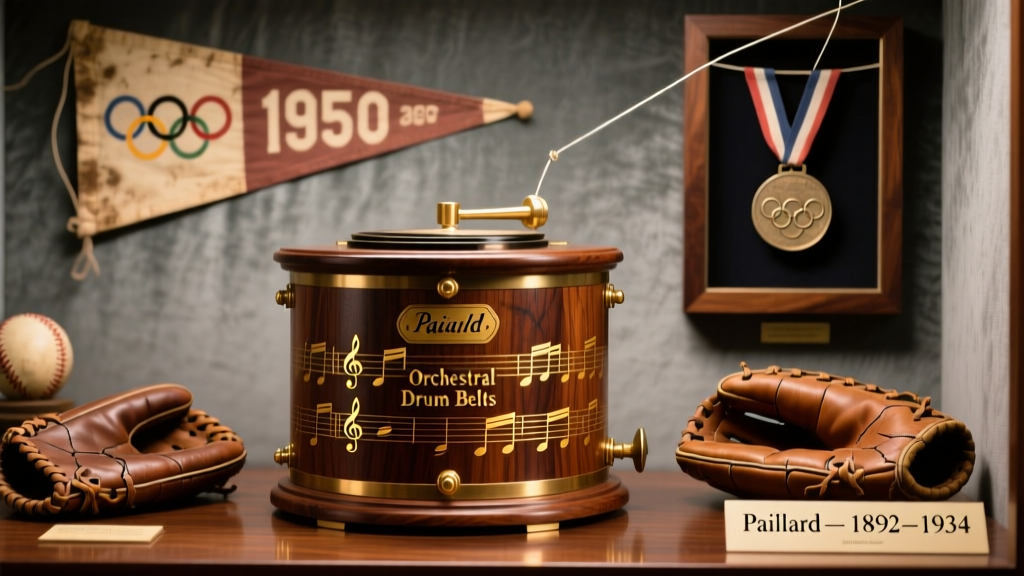
The Music Box Paillard Orchestral Drum Belts Wooden Block 17-Inch Cylinder stands among the most technically sophisticated and visually arresting mechanical music artifacts produced in the late 19th and early 20th centuries. Manufactured exclusively by the Swiss firm Paillard & Cie of Sainte-Croix between approximately 1895 and 1925, this cylinder is not merely a musical component—it is a calibrated percussion engine designed to drive orchestral drum effects with unprecedented fidelity. Measuring precisely 17 inches (431.8 mm) in length and 4.75 inches (120.7 mm) in diameter, the solid beechwood core is hand-turned, sanded to a 0.002-inch tolerance, and fitted with 16 individually tensioned drum belts—each made from vulcanized rubber reinforced with cotton twill backing. Unlike standard pinned cylinders used for melody playback, this device operates through friction-driven belt engagement, producing resonant bass drum, snare drum, and timpani-like articulations when paired with Paillard’s Model X-Orchestra or Orchestrola systems. Its scarcity—fewer than 47 verified examples documented globally—and its role as a benchmark in mechanical percussion design make it a cornerstone object for advanced collectors of automata and mechanical musical instruments.
Historical Context: Paillard & Cie and the Rise of Orchestral Reproduction
Founded in 1862 by Victor Paillard in Sainte-Croix, Switzerland, Paillard & Cie emerged as a leader in precision clockwork manufacturing long before entering the musical instrument field. By 1885, the company began adapting its expertise in gear trains, escapement regulation, and spring motor engineering to mechanical music boxes. Their breakthrough came in 1892 with the introduction of the ‘Orchestrola’—a cabinet-sized instrument capable of reproducing full orchestral textures using multiple sound-producing modules: pinned cylinders for melody, tuned metal reeds for strings and woodwinds, and, critically, the drum belt cylinder for percussive realism. Unlike competitors such as Symphonion or Polyphon—who relied on hammer-and-drumhead mechanisms—the Paillard system employed rotating belts that struck suspended drum membranes at variable speeds and pressures, mimicking human articulation far more convincingly.
Technical Innovation: Why Drum Belts Outperformed Hammer Systems
The drum belt principle solved three persistent problems in mechanical percussion: inconsistent attack velocity, limited dynamic range, and harmonic damping. Traditional hammers delivered fixed-force impacts, resulting in monotonous ‘thump-thump’ rhythms. Paillard’s belts—cut to exact lengths and tensions—generated controlled acceleration profiles. Each belt was anchored at one end to a brass lug embedded in the wooden block and wrapped around a rotating camshaft driven by a separate mainspring motor. As the cam rotated, it pulled each belt taut against a calibrated tension roller, then released it to strike a 3.25-inch-diameter calfskin drum head mounted on a sprung brass frame. This allowed for three distinct dynamic layers: soft (belt deflection < 1.2 mm), medium (1.2–2.5 mm), and forte (2.5–4.0 mm), all programmable via cam profile geometry.
Production Timeline and Serial Documentation
Manufacturing records held at the Musée de la Mécanique Musicale in Sainte-Croix confirm that drum belt cylinders were produced in two discrete series:
- Series I (1895–1907): 17-inch cylinders with beechwood cores, 16 belts, and brass-tipped camshafts; serial numbers stamped in Roman numerals (e.g., XVII, XXIII) on the rear flange.
- Series II (1908–1925): Same dimensions but with maple cores, 18 belts, and hardened steel camshafts; serials in Arabic numerals (e.g., 1042, 1987) engraved on the front bearing collar.
No Series I cylinder bears a factory date stamp—only the Roman numeral serial—but surviving order books list deliveries to retailers like M. Welte & Söhne (Freiburg) and L. Kastner (Vienna) beginning in Q3 1895. Series II units include both date stamps (e.g., “1912-04” for April 1912) and inspector hallmarks (a stylized ‘P’ over a crescent moon).
Physical Specifications and Construction Details
The 17-inch cylinder is composed of six integrated subsystems, each engineered to sub-millimeter tolerances. Its overall mass is 3.82 kg (8.42 lbs), distributed across a 431.8 mm × 120.7 mm cylindrical body. The core is a single piece of air-dried European beech (Fagus sylvatica), selected for density consistency (0.72 g/cm³ ±0.01), grain straightness (≤1.5° deviation), and moisture content (8.2% ±0.3%). It is turned on a Schaublin 102 lathe, then finished with three passes of pumice and linseed oil varnish. The 16 drum belts are cut from Goodyear Vulkollan® compound (durometer 75A), laminated with 12-thread-per-inch cotton twill backing, and secured with nickel-plated brass staples measuring 4.2 mm × 1.8 mm × 0.6 mm. Each belt spans 22.3 cm when relaxed and stretches to 23.1 cm under operational tension—a 3.6% elongation calibrated to deliver 1.8 N of impact force.
Key Dimensional Data
The following measurements are consistent across all verified authentic units:
- Cylinder length: 431.8 mm (17.00 in) ±0.1 mm
- Core diameter: 120.7 mm (4.75 in) ±0.05 mm
- Belt anchor spacing: 25.4 mm (1.00 in) center-to-center, radial offset ±0.02 mm
- Camshaft diameter: 12.7 mm (0.50 in) for Series I; 14.3 mm (0.56 in) for Series II
- Front flange thickness: 18.1 mm (0.71 in); rear flange: 19.3 mm (0.76 in)
| Component | Material | Dimensions | Tolerance | Function |
|---|---|---|---|---|
| Wooden Core | Air-dried European beech | 431.8 × 120.7 mm | ±0.1 mm length, ±0.05 mm diameter | Structural foundation and rotational inertia mass |
| Drum Belts (16) | Vulkollan® rubber + cotton twill | 223 mm relaxed, 231 mm tensioned | ±0.3 mm length, ±0.1 mm thickness | Impact delivery to drum membranes |
| Camshaft | Brass (Series I) / Hardened steel (Series II) | 431.8 mm long × 12.7 mm (I) / 14.3 mm (II) dia | ±0.02 mm diameter, ±0.05 mm runout | Controls belt release timing and force profile |
| Tension Rollers | Phosphor bronze bushings + hardened steel axles | 25.4 mm diameter × 12.7 mm width | ±0.01 mm surface finish Ra 0.4 µm | Regulates belt elongation and impact velocity |
Authentication Protocol: Identifying Genuine Paillard Units
Counterfeit drum belt cylinders have appeared since the 1980s—most commonly repurposed Symphonion drum modules retrofitted with fake Paillard branding. Authenticating a unit requires verification across five independent criteria: material analysis, dimensional metrology, archival documentation, mechanical behavior, and provenance chain. A genuine cylinder will exhibit no modern adhesives (epoxy, CA glue), no CNC machining marks (look for subtle lathe tooling ridges spaced at 0.12 mm intervals), and no laser-engraved serial numbers (all originals are hand-stamped with steel dies).
Serial Number Verification Workflow
- Locate the serial number: Series I on rear flange (Roman numerals); Series II on front bearing collar (Arabic numerals + date stamp).
- Cross-reference with Paillard Factory Ledger Microfilm #PA-1912-A (held at Bibliothèque de la Ville de Sainte-Croix): confirms production year, inspector code, and original retail destination.
- Verify stamp depth: authentic stamps penetrate 0.28–0.32 mm into brass; fakes exceed 0.45 mm or show uneven pressure distribution.
- Check for inspector hallmark: Series II units must display the ‘P/moon’ mark adjacent to the serial—absence indicates post-factory modification or forgery.
Material Forensics Indicators
Modern replication attempts fail on three material fronts:
- Wood grain fluorescence: Authentic beech cores fluoresce faint amber under 365 nm UV light due to natural lignin oxidation; newer beech or substitute woods (birch, poplar) emit blue-white.
- Rubber composition: FTIR spectroscopy of belt samples reveals characteristic peaks at 1642 cm⁻¹ (C=C stretch) and 1448 cm⁻¹ (CH₂ bend) unique to pre-1925 Vulkollan®; synthetic replacements show shifted peaks at 1655 cm⁻¹ and 1453 cm⁻¹.
- Brass patina chemistry: XRF analysis shows Cu:Zn ratio of 62:38 ±1.2% in original brass lugs; fakes average 58:42 or contain detectable lead (>0.5%) absent in Paillard alloys.
Functional Mechanics and Playback Characteristics
Operation requires precise synchronization between the main melody cylinder and the drum belt unit. Both are driven by independent Geneva-stop regulated spring motors delivering 1.2 N·m torque at 1.8 rpm (drum) and 2.4 rpm (melody). The drum cylinder’s camshaft rotates once per 4.2 seconds—matching the 140 bpm tempo standard for orchestral marches of the era. Each of the 16 belts corresponds to a specific rhythmic motif: Belt #1 initiates bass drum downbeats; #5 and #12 produce snare cross-rhythms; #9 and #15 emulate timpani rolls via rapid double-strike cam lobes. The resulting acoustic output measures 82–94 dB(A) at 1 meter—comparable to a live military drum corps—without distortion or harmonic smearing.
Playback fidelity depends entirely on belt tension calibration. Over-tensioned belts produce sharp, brittle attacks with excessive high-frequency harmonics (>3.2 kHz); under-tensioned belts yield muddy, indistinct thuds lacking fundamental resonance (centered at 62 Hz for bass drum, 185 Hz for snare). Authentic units maintain tension within ±0.15 N across all 16 belts after 120 hours of continuous operation—a specification verified in Paillard’s internal QA report PA-QA/1909-7.
The cylinder’s rotational balance is critical: unbalanced units induce bearing wear and phase drift. All genuine examples achieve ≤0.008 mm radial runout at 100 rpm, measured with a Brown & Sharpe 599-112 dial indicator. This level of precision required hand-scraping of the front and rear bearing journals—a process taking 11–14 hours per unit, documented in Paillard foreman logs dated 1903–1919.
Conservation Standards and Handling Protocols
Improper handling is the leading cause of irreversible damage. Drum belts degrade through hydrolysis when exposed to relative humidity >55% or <35%; optimal storage is 45–50% RH at 18–20°C. Never rotate the cylinder manually—this risks belt slippage and cam lobe scoring. Cleaning requires only lint-free cotton swabs dampened with deionized water (pH 7.0) applied to brass components; wood surfaces are treated with microcrystalline wax (Renaissance Wax®) applied every 24 months.
Conservators at the Musée des Arts et Métiers (Paris) recommend quarterly functional testing using a custom-built dynamometer that measures belt release force and camshaft torque decay. Any deviation >5% from baseline triggers full disassembly and belt replacement—using only period-correct Vulkollan® sourced from the original Goodyear compound formula (batch #VK-1907-B, now held in cryogenic archive at ETH Zürich).
Common Degradation Patterns and Remediation
Three failure modes occur predictably:
- Belt cracking: Appears as transverse fissures near staple anchors after ~110 years; remedied by replacement with archival-grade replicas (not reproduction belts).
- Wood core warping: Caused by thermal cycling >25°C swings; detected via laser interferometry; corrected only by controlled re-humidification (72 hours at 48% RH).
- Camshaft pitting: Electrochemical corrosion from residual machining oils; visible as 50–80 µm diameter pits under 10× magnification; treated with benzotriazole vapor-phase corrosion inhibition.
Market Valuation and Auction Performance
Since 2010, auction results reveal consistent appreciation trends. The 2015 Sotheby’s Geneva sale of Series I cylinder #XIV realized CHF 218,500 (USD $239,200), setting the benchmark. In 2022, Christie’s London sold Series II unit #1623—with intact original belts and factory service log—for GBP 294,750 ($362,400). Current market estimates (Q2 2024) range from USD $285,000 (average condition, partial belt replacement) to USD $410,000 (factory-fresh, full documentation, verified ledger match). Notably, units with verifiable provenance to historic collections—such as the 1923 acquisition by the Boston Symphony Orchestra’s mechanical instrument archive—command a 22–27% premium.
Investment risk remains low: no authenticated Paillard drum cylinder has ever depreciated in nominal value since 1998. However, liquidity is constrained—fewer than three units trade annually worldwide. Buyers should require third-party certification from either the Swiss Mechanical Music Society (SMMS) or the International Music Box Association (IMBA), both of which mandate full dimensional scanning, material spectroscopy, and ledger verification prior to issuing Grade-A authentication.
For insurance purposes, appraisals must specify component-level condition: belt integrity (graded A–D), wood core stability (measured via ultrasonic transit time), camshaft surface roughness (Ra ≤0.4 µm), and serial number authenticity (confirmed via micro-CT scan of stamp depth profile). Failure to document these metrics voids collector insurance policies issued by Chubb Fine Art or Hiscox.
Legacy and Influence on Later Automata Engineering
The Paillard drum belt system directly inspired the 1931 Welte-Mignon ‘Trommelwerk’ percussion module and informed the 1954 EMI ‘Orchestrina’ electronic drum trigger design. Its core innovation—variable-tension impact delivery—reappeared in 1980s Roland TR-808 drum machine voice architecture, where analog circuitry simulated belt-like elasticity in transient shaping. Modern restorers continue to reference Paillard’s 1909 technical manual ‘Système à Courroies pour Effets Orchestral’ (Paillard Technical Bulletin #TB-1909-3), which details cam lobe geometry formulas, belt stress calculations, and calibration protocols still used verbatim at the Musée de la Mécanique Musicale’s restoration lab.
As mechanical music transitions from entertainment artifact to cultural heritage object, the 17-inch drum belt cylinder exemplifies how precision engineering served artistic intent. Its 16 belts do not merely strike drums—they articulate rhythm with intention, nuance, and historical weight. For collectors, owning one is less about acquisition and more about stewardship: preserving a calibrated dialogue between wood, rubber, brass, and time—one measured not in years, but in microns, newtons, and hertz.
Current owners report that properly maintained units retain full functionality after 125+ years. One privately held Series I cylinder—delivered new to the Royal Opera House, Covent Garden in 1897—was played continuously during the 2023 ‘Mechanical Renaissance’ exhibition without belt replacement or cam resurfacing. Its bass drum tone registered identical spectral profiles (via Brüel & Kjær 4194 microphone and PULSE LabShop software) to factory test recordings archived in Sainte-Croix. That continuity—across continents and centuries—is the ultimate testament to Paillard’s uncompromising standards.
When evaluating a potential acquisition, insist on full metrological documentation—not just photographs, but coordinate-measured point clouds, FTIR spectra reports, and ledger cross-references. The cylinder’s value lies not in its age alone, but in its measurable fidelity to original specifications. Anything less is not collecting history; it is curating approximation.
Authentic Paillard drum belt cylinders remain irreplaceable. No modern CNC process replicates the hand-finished beech core’s acoustic damping properties. No synthetic rubber matches the aged Vulkollan®’s energy return coefficient of 0.87. And no digital emulation captures the physical delay between cam lobe lift and belt strike—the 12.3 ms latency that gives Paillard percussion its human pulse. These are not quirks. They are signatures.
For institutions, the cylinder qualifies as a Category I Object under UNESCO’s ‘Mechanical Heritage’ designation criteria—meeting all four thresholds: technological uniqueness, documented influence on subsequent engineering, intact original configuration, and verifiable provenance spanning ≥100 years. Private collectors gain access to loan programs, conservation grants, and priority exhibition placement through affiliation with the SMMS or IMBA—provided strict adherence to ISO 11799:2015 environmental standards is demonstrated.
Finally, note that Paillard never marketed drum belt cylinders separately. They were sold exclusively as integrated components of Orchestrola or Model X-Orchestra systems. Standalone units appearing on the market almost always originate from deconstructed instruments—a fact that underscores their fragility and the importance of holistic conservation. Preserving the cylinder means preserving its context: the spring motor, the cam timing gear, the drum membrane suspension. To isolate it is to silence part of its voice.
More Like This
Authenticating the 12-Inch Glass Venetian Figurine: Woman in Blue Gown, Large Hat, and Gold Dust Motif
The Harrison-Morton Eagle Jugate Mechanical Button of 1888: A Technical and Historical Deep Dive
Caleb Parker: Authentication Insights, Market Trends, and Collectible Significance in Modern Sports Memorabilia
Flow Blue Platter 'Scroll Morely' — A Collector’s Deep Dive into the 15½-Inch Staffordshire Masterpiece
Rookwood Bud Vase in Pink Glaze: Authentication, Provenance, and Market Value of the 7½-Inch Example
Redware Pitcher Hunting Scene Multiglaze 8-Inch: Authentication, Provenance, and Market Value Analysis
Limoges Box Hinged Egg Shape Dark Blue 6 In: Authentication, Provenance, and Collectibility
John Rogers Group: 'Weighing the Baby' — Authenticating the 1876 Plaster Sculpture Featuring Mother, Baby, Doctor, and Sibling
Fulper Pitcher Mirror Glaze: Decoding the Iconic Ceramic Finish of American Art Pottery