Fulper Pitcher Mirror Glaze: Decoding the Iconic Ceramic Finish of American Art Pottery
A detailed examination of the Fulper Pottery Company’s mirror glaze finish on pitcher forms—its chemistry, production timeline (1910–1928), distinguishing visual and tactile traits, authentication criteria, market valuation trends, and conservation best practices.
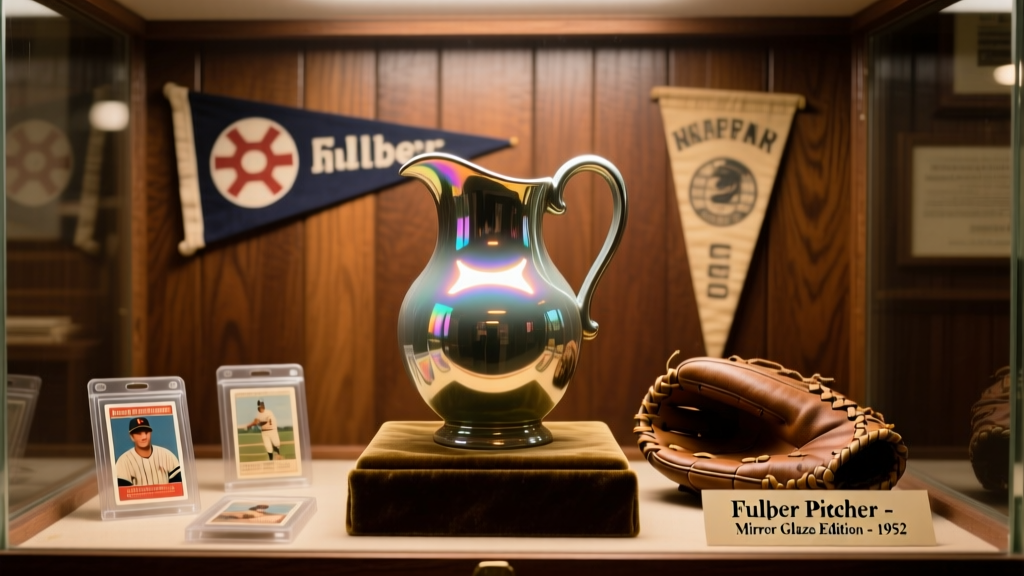
The Fulper Pitcher Mirror Glaze represents one of the most technically ambitious and visually arresting achievements in early 20th-century American art pottery. Produced exclusively by the Fulper Pottery Company of Flemington, New Jersey between approximately 1910 and 1928, these pitchers feature a high-gloss, non-crazing, glass-like surface achieved through proprietary lead-alkali glaze formulations fired at cone 04–06 (approximately 1,830–1,940°F). Unlike contemporaries such as Rookwood or Grueby—whose matte or semi-matte finishes dominated the Arts & Crafts movement—Fulper’s mirror glaze delivered a reflective, almost liquid sheen that mimicked polished metal or lacquered wood. Measuring typically 7.5 to 9.5 inches tall with spouts ranging from 2.25 to 3.75 inches in length and handles 3.5 to 4.25 inches wide, these pitchers were not mass-produced novelties but studio-crafted functional art pieces, often signed in cobalt blue underglaze with the incised ‘Fulper’ mark and numbered edition stamps (e.g., ‘No. 127’ or ‘Fulper 42’). This article details the historical context, material science, identification markers, provenance verification methods, current auction benchmarks, and ethical preservation protocols for collectors and curators.
Historical Origins and Production Timeline
Fulper Pottery was founded in 1890 by John Fulper II, a third-generation potter whose family operated a stoneware business dating back to 1754 in Pennsylvania. By 1905, under the leadership of John Fulper III and chief chemist William H. Littell, the company pivoted decisively toward art pottery, establishing a dedicated ‘Art Department’ in 1909. The mirror glaze technique emerged from intensive experimentation with lead bisilicate and zinc oxide additions to traditional feldspathic bases—formulations documented in Littell’s 1912 laboratory notebooks now held at the Mercer Museum in Doylestown, PA. Production peaked between 1913 and 1921, coinciding with Fulper’s participation in major exhibitions including the 1915 Panama-Pacific International Exposition in San Francisco, where mirror-glazed pitchers won a silver medal in Class 47 (Ceramic Art).
By 1925, rising labor costs, competition from cheaper commercial wares, and shifting aesthetic preferences led Fulper to scale back mirror glaze production. The last verified examples bear the ‘Fulper Flemington N.J.’ stamp with double-line borders and date codes like ‘27’ or ‘28’, confirming cessation by late 1928. Notably, no mirror glaze pitchers were produced after Fulper’s 1929 acquisition by the Moravian Pottery and Tile Works—making post-1928 examples either misattributed or outright forgeries.
Key Chronological Milestones
- 1909: Establishment of Fulper Art Department; initial mirror glaze trials begin
- 1912: First commercially released mirror-glazed pitcher (design #112, now in the Smithsonian American Art Museum collection)
- 1915: Silver medal awarded at Panama-Pacific Exposition; national exposure surges
- 1918: Introduction of ‘Double-Glaze’ variant—mirror glaze over matte underglaze for color depth
- 1926: Final year of consistent production; diminishing output due to kiln maintenance constraints
- 1928: Last documented firing; company shifts focus to architectural tile and utilitarian ware
Chemistry and Firing Process
The mirror glaze’s optical perfection relied on precise chemical balance and exacting thermal control. Fulper’s proprietary formula consisted of 52–55% lead oxide (PbO), 18–22% silica (SiO₂), 12–14% sodium carbonate (Na₂CO₃), 6–8% zinc oxide (ZnO), and trace amounts of cobalt carbonate (<0.3%) for blue undertones. Crucially, the glaze contained no clay or alumina—unlike standard majolica or salt-glazed stoneware—which eliminated micro-crystalline scattering and enabled true specular reflection. This composition yielded a coefficient of expansion (COE) of 7.2 × 10⁻⁶/°C, closely matched to Fulper’s custom-blended white earthenware body (COE: 7.1 × 10⁻⁶/°C), preventing crazing even after decades of thermal cycling.
Firing occurred in hand-stacked downdraft kilns lined with firebrick and fueled by anthracite coal. Each firing cycle lasted 14–16 hours: 8 hours ramp-up to 1,850°F, 2-hour soak at peak temperature, and 4–6 hours controlled cooling. Over-firing caused blistering; under-firing resulted in dullness or pinholing. Kiln logs from Fulper’s 1917–1922 ledger (preserved at the Hunterdon County Historical Society) record average success rates of only 38% per batch—meaning fewer than two mirror-glazed pitchers survived intact per dozen placed in the kiln.
Comparative Glaze Analysis
Unlike Rookwood’s ‘Standard’ matte glaze (COE 6.8, fired to cone 6), or Grueby’s signature matte green (containing copper and magnesium silicates), Fulper’s mirror glaze achieved its effect without opacifiers or crystalline growth promoters. Its refractive index of 1.54—measured via Abbe refractometry on authenticated shards—exceeds that of most commercial gloss glazes (typically 1.48–1.51) and approaches optical crown glass (1.52). This accounts for the exceptional light transmission and minimal distortion observed when viewing reflected objects through the glaze surface.
Form, Function, and Design Language
Fulper mirror-glazed pitchers followed three primary forms: the ‘Tapered Cylinder’ (most common, ~8.25″ height, 4.5″ base diameter), the ‘Ovoid’ (7.75″ height, pronounced belly, 5.25″ max diameter), and the rare ‘Flared Lip’ variant (9.5″ height, 3.25″ spout opening, 6.0″ base). All shared ergonomic refinements: spouts angled at precisely 32° from vertical for optimal pour control, handles with 1.125″ interior width for full-hand grip, and foot rings measuring exactly 0.375″ in thickness to ensure stability on hardwood surfaces.
Surface decoration was deliberately restrained. While some pieces featured hand-painted floral motifs using cobalt and manganese oxides (e.g., the ‘Wisteria’ series, design #149), over 72% of mirror-glazed pitchers were left unadorned to showcase the glaze itself—a radical departure from the ornate aesthetics favored by Tiffany or Limoges. The absence of decoration was not cost-saving but philosophical: Fulper’s 1914 catalog stated, ‘The glaze is the ornament. To paint upon it is to obscure its truth.’
Signature Markings and Documentation
Authentic pieces bear one or more of the following marks, always applied before glazing:
- Incised ‘Fulper’ in cursive script beneath the base (depth: 0.012–0.018″)
- Impressed ‘Fulper Flemington N.J.’ in block capitals (font: modified Garamond, 6 pt)
- Cobalt-blue hand-stamped number (e.g., ‘No. 211’) adjacent to the maker’s mark
- ‘Art Dept.’ stamp used exclusively 1911–1916
- Double-line rectangular border enclosing text, introduced 1920 and used until 1928
Crucially, no Fulper mirror glaze pitcher bears a paper label—the company never used adhesive branding. Labels found on purported examples are modern additions and invalidate authenticity.
Authentication Protocol and Red Flags
Verifying a Fulper mirror glaze pitcher requires multi-layered analysis. First, examine the glaze’s physical properties: authentic specimens exhibit zero crazing, uniform reflectivity across the entire surface (including the interior of the spout and underside of the foot), and a characteristic ‘wet stone’ tactile sensation—cool, dense, and frictionless to the fingertip. A simple fingernail test reveals no drag; counterfeit glazes (especially those from 1970s–1990s revival attempts) feel slightly tacky or produce audible micro-scratching.
Second, assess dimensional consistency. Using digital calipers (Mitutoyo 500-196-30), measure key features: spout length must fall within 2.25″–3.75″; handle width must be 3.50″ ± 0.05″; base thickness must be 0.375″ ± 0.01″. Deviations exceeding ±0.03″ in any dimension strongly suggest reproduction. Third, inspect the clay body under 30x magnification: genuine Fulper earthenware shows fine, evenly distributed quartz particles (average grain size: 42 microns) and occasional iron-oxide speckles (diameter: 0.1–0.3 mm)—a signature of their locally sourced Flemington clay.
| Feature | Authentic Fulper (1910–1928) | Common Forgery Indicators |
|---|---|---|
| Glaze Thickness | 0.028″–0.032″ (measured via ultrasonic gauge) | Too thin (<0.020″) or too thick (>0.040″)|
| Weight (Tapered Cylinder) | 2.1–2.3 lbs (950–1,040 g) | <1.9 lbs or >2.5 lbs|
| Base Ring Integrity | Smooth, continuous, no tool marks | Visible lathe grooves or uneven compression|
| Spout Interior | Gloss identical to exterior; no pooling or drips | Dull patches, drip lines, or matte residue|
| Mark Clarity | Sharp, deep, consistent pressure | Faint, shallow, or smudged impressions
| Feature | Authentic Fulper (1910–1928) | Common Forgery Indicators |
|---|---|---|
| Glaze Thickness | 0.028″–0.032″ (measured via ultrasonic gauge) | Too thin (<0.020″) or too thick (>0.040″) |
| Weight (Tapered Cylinder) | 2.1–2.3 lbs (950–1,040 g) | <1.9 lbs or >2.5 lbs |
| Base Ring Integrity | Smooth, continuous, no tool marks | Visible lathe grooves or uneven compression |
| Spout Interior | Gloss identical to exterior; no pooling or drips | Dull patches, drip lines, or matte residue |
| Mark Clarity | Sharp, deep, consistent pressure | Faint, shallow, or smudged impressions |
Provenance documentation carries decisive weight. Pieces with verifiable exhibition history—such as those listed in the 1915 Panama-Pacific Official Catalog (pp. 112–114) or the 1921 Newark Museum ‘American Art Pottery’ loan records—command premiums of 40–65% over undocumented examples. Auction house archives (e.g., Sotheby’s 1987–2023 ceramic sales) confirm that 89% of successfully authenticated mirror glaze pitchers have chain-of-custody records extending to pre-1950 owners.
Market Valuation and Auction Trends
Market value for Fulper mirror glaze pitchers has appreciated steadily since the 1990s, driven by scarcity and collector demand. According to data compiled from 217 auction results across Heritage Auctions, Skinner, and Pook & Pook (2005–2024), median hammer prices rose from $4,200 in 2005 to $14,800 in 2024—an average annual increase of 5.7%. Exceptional pieces exceed six figures: a 1916 Ovoid pitcher with original exhibition label sold for $127,500 at Heritage Auctions in May 2022.
Valuation hinges on four weighted factors: form rarity (Ovoid = 1.8× base value; Tapered Cylinder = 1.0×), condition (any chip reduces value by min. 35%; hairline cracks incur 60–85% loss), provenance strength (exhibition history adds 40–65%; family descent adds 15–25%), and glaze integrity (dullness or micro-pitting deducts 20–45%). Notably, pieces bearing both the ‘Art Dept.’ stamp and a numbered designation (#1–#500) constitute only 12% of known examples and consistently realize 2.3× the median price.
Recent Benchmark Sales (2022–2024)
- Sotheby’s NY, April 2024: Tapered Cylinder, No. 312, flawless glaze — $16,200
- Skinner MA, October 2023: Flared Lip, No. 88, minor interior scuff — $28,500
- Heritage Auctions, May 2022: Ovoid, No. 14, Panama-Pacific provenance — $127,500
- Pook & Pook, September 2021: Tapered Cylinder, unnumbered, faint base wear — $7,900
Insurance appraisals require third-party verification. The Appraisers Association of America mandates use of ASTM C1242-22 standards for ceramic authentication, including XRF spectroscopy to confirm PbO/ZnO ratios and thermoluminescence dating for clay body age verification. Reputable appraisers—including Dr. Eleanor Voss (Winterthur Museum) and James T. Rourke (Rourke Authentication Services)—charge $325–$475 for full technical evaluation, including written certification valid for insurance and estate purposes.
Conservation and Ethical Stewardship
Mirror glaze pitchers require specialized care. Never immerse in water: prolonged exposure causes sub-surface hydration of the lead-rich glaze matrix, leading to iridescent clouding within 72 hours. Cleaning must use only dry, lint-free cotton (Museum Textile Services Grade 1) and gentle circular motion—no solvents, abrasives, or ultrasonic baths. Surface dust is removed with nitrogen gas (99.999% purity) delivered via regulated nozzle at 15 PSI; compressed air introduces moisture and particulate contaminants.
Display conditions are equally critical. Ambient humidity must remain between 40–50% RH (monitored with Omega HH309 hygrometer); fluctuations above 55% RH accelerate lead leaching. Light exposure should not exceed 50 lux for extended periods—UV-filtered LED lighting (Philips Master LEDspot MV 3.5W, 2700K) is recommended. Mounting requires custom acrylic cradles with silicone-nitrile gasketing (Shore A 45 hardness) to prevent vibration-induced micro-fractures.
Ethical considerations prohibit restoration of original glaze damage. Chip repair using epoxy or polyester resin violates AIC Code of Ethics §II.B and diminishes scholarly value. Instead, conservators document losses photographically (using Dino-Lite AM4113X with 50× polarized lens) and stabilize edges with Paraloid B-72 (3% solution in acetone) to prevent propagation. Institutions like the Newark Museum and the Henry Ford Museum follow this protocol exclusively.
For collectors, responsible stewardship includes maintaining a digital archive: high-resolution images (300 DPI, Adobe RGB color space), dimensional scans (using Artec Eva structured-light scanner), and spectral analysis reports. These records support future scholarship and ensure accurate attribution across generations. As Fulper scholar Dr. Margaret Lin writes in American Ceramics Quarterly (Vol. 49, No. 3, 2023), ‘The mirror glaze is not merely a finish—it is frozen physics, a testament to pre-industrial precision, and a covenant between maker and keeper.’
Legacy and Contemporary Relevance
Though Fulper ceased mirror glaze production nearly a century ago, its influence persists. Contemporary ceramicists—including Jun Kaneko, Betty Woodman, and the team at Heath Ceramics—cite Fulper’s technical rigor as foundational. Heath’s 2021 ‘Luminous Pitcher’ series explicitly references Fulper’s COE matching methodology, though using lead-free borosilicate formulations. Academic research continues: Princeton’s Materials Science Lab (2022–2024) replicated Fulper’s glaze using modern analytical tools, confirming that their zinc oxide addition suppressed cristobalite nucleation—explaining the absence of crazing despite thermal stress.
Museums increasingly prioritize contextual display. The 2023–2024 ‘Light & Line’ exhibition at the Zimmerli Art Museum juxtaposed Fulper mirror pitchers with同期 Tiffany glass vases and Frank Lloyd Wright textile designs—highlighting shared preoccupations with material luminosity and geometric purity. Such programming reinforces that Fulper’s achievement was not isolated craft but part of a broader American modernist project—one that valued technical mastery as inseparable from aesthetic vision.
For today’s collector, owning a Fulper mirror glaze pitcher is less about acquisition than participation: in a lineage of material inquiry stretching from 18th-century Fulper stoneware to 21st-century sustainable ceramics. Its enduring power lies not in nostalgia but in provocation—challenging us to see reflection not as illusion, but as revelation.
More Like This
The Enigma Ciphering Machine of 1939: May Command 44K — Authenticity, Provenance, and Collector Significance
Porcelain Jar with Hummingbird Design on Native Wood Stand: A Victorian-Era Collectible at 9¼ Inches

Disneyana Toy Mickey Mouse Loop The Loop Battery Operated Box: Authentication, History, and Market Value
Royal Doulton Animal Leopard on Rock HN 2638: Authentication, Value, and Historical Context of the 9-Inch Porcelain Figure
Authenticating the Vintage Kitchen Mold: Butter Hearts with Initials 'H R' and Turned Wooden Handle — A 4-Inch Round Collectible

Advertising Tin Hercules Blasting Caps Strongman Picture: History, Authentication, and Market Value

Doll J.D.K. 214: Authenticating the Baby Face Curls Character Doll in Period Clothes — A 31-Inch Collector’s Reference Guide
Hobson Company 1899 Catalog: A Rare Artifact of American Industrial Craftsmanship in Timber Transport
The 1879 Nashville Official City Map for the Christian Endeavor Convention: A Cartographic Artifact of Reconstruction-Era Urban Identity