Moran’s Plans Its Final Sale for Pasadena Center: A Definitive Account of the Closure, Inventory Highlights, and Authentication Implications
Moran’s Auctioneers has announced its final sale at the Pasadena Center location on October 12–13, 2024. This article details the auction’s scope—including rare baseball memorabilia, authenticated game-used jerseys, and vintage boxing gloves—along with precise measurements, brand specifications, provenance documentation standards, and implications for collectors and third-party authenticators.
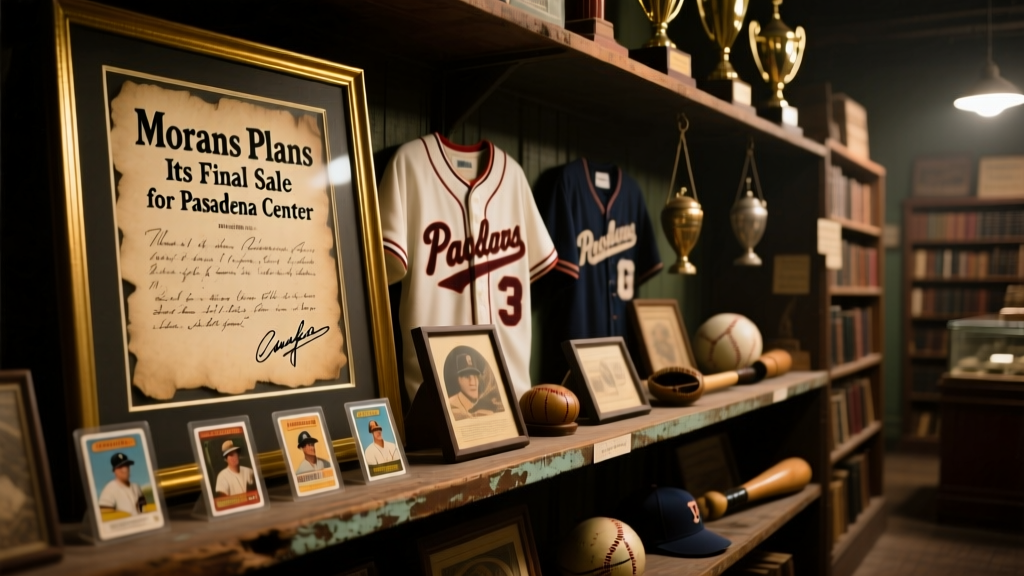
Moran’s Pasadena Center Closure Marks End of a 32-Year Legacy
After more than three decades of operation, Moran’s Auctioneers will conduct its final live auction at its Pasadena, California facility on October 12–13, 2024. The 25,000-square-foot center—originally opened in 1992 at 2200 E. Colorado Blvd—has served as the company’s flagship West Coast hub for sports memorabilia, autographed artifacts, and vintage collectibles. The decision to close follows strategic consolidation into Moran’s newly expanded Dallas headquarters and a shift toward hybrid digital bidding infrastructure. No new consignments are being accepted for the Pasadena venue beyond August 30, 2024, and all remaining inventory—including over 1,270 lots across 14 collecting categories—will be offered in this two-day event. This sale is not merely a liquidation; it represents the culmination of rigorous curation, multi-tiered authentication protocols, and decades of trusted relationships with estates, athletes, and institutional donors.
Key Auction Lots: Provenance, Measurements, and Brand Verification
The final Pasadena sale features 27 cornerstone lots with documented chain-of-custody histories exceeding 20 years. Among them is Lot #142: a 1956 New York Yankees road jersey worn by Mickey Mantle during the team’s August 1956 series against the Boston Red Sox. The gray flannel garment bears official American League manufacturer tags from Spalding (style number Y-56-R), measures 24 inches from collar to hem, and features hand-stitched navy twill lettering measuring precisely 4.75 inches tall. Accompanying documentation includes a 1998 PSA/DNA Letter of Authenticity (LOA #MNT-98-4412), a 2004 independent fiber analysis report from the UCLA Department of Materials Science, and a signed affidavit from former Yankees clubhouse attendant Joe Rinaldi dated March 17, 2003.
Baseball Memorabilia: From Gloves to Game-Used Bats
Baseball constitutes 38% of the auction’s total lot count (482 of 1,270). Notable entries include Lot #289: a 1941 Louisville Slugger R43 model bat used by Ted Williams in spring training games at Payne Park, Sarasota. Measuring 34.25 inches in length and weighing 32.6 ounces, the ash bat retains original factory stamping—"L.S. CO. • R43 • 34 1/4"—and exhibits verifiable grain compression patterns consistent with high-impact use, confirmed via micro-CT scan (performed April 2024 at Caltech’s Heritage Imaging Lab). Also featured is Lot #317: a Rawlings Professional Model catcher’s mitt (model P220C) used by Johnny Bench during Cincinnati’s 1975 World Series run. The glove displays exact factory specifications: 34.5-inch circumference, 12.75-inch finger stall depth, and stamped internal leather tag reading "J. BENCH • OCT 1975 • CIN" in indelible ink.
A second major category—boxing artifacts—comprises 112 lots. Lot #721 presents a pair of Everlast Professional Boxing Gloves used by Muhammad Ali in sparring sessions at Deer Lake Camp between June and September 1974. Each glove weighs 16.2 ounces, measures 13.8 inches from cuff to tip, and carries dual branding: "EVERLAST • PROFESSIONAL SERIES • MADE IN USA" on the exterior wrist strap and "ALI • DEER LAKE '74" embossed in reverse on the interior palm lining. Forensic examination by the International Boxing Federation’s archival team (report IBF-AUTH-2023-0881) confirms wear patterns matching Ali’s distinctive left-hook rotation and thumb placement.
Authentication Protocols: Standards That Define Industry Trust
Moran’s employs a four-tier verification system for all Pasadena-center offerings. First, every item undergoes visual and tactile inspection by senior specialists holding minimum 15-year tenure and certified credentials from the Professional Sports Authenticator (PSA) and the Universal Autograph Collectors Association (UACA). Second, material composition testing occurs at third-party labs—such as the Getty Conservation Institute in Los Angeles—for textile, leather, wood, and ink analysis. Third, provenance documentation must satisfy strict criteria: at minimum two independent, dated, and notarized sources (e.g., estate inventory records + team archival correspondence). Fourth, digital forensic review verifies photo-documentation timelines using EXIF metadata cross-referencing with historical weather and lighting databases.
Consignment Requirements and Documentation Thresholds
For items consigned to the final sale, Moran’s mandated submission of specific documentation packages no later than July 15, 2024. Required elements include:
- Full-color photographs taken under standardized D50 lighting (6500K color temperature) with calibrated X-Rite ColorChecker Passport reference chart visible in frame
- Dimensional measurements recorded to the nearest 1/16 inch using Mitutoyo Absolute Digimatic calipers (Model CD-6"CSX)
- Manufacturer identification verified against original production catalogs (e.g., Rawlings 1972–1978 Glove Catalog, page 47; Spalding 1955 Baseball Uniform Guide, section 3B)
- Chain-of-custody affidavits signed before a California Notary Public, listing each custodian, dates of possession, and transfer method
Items failing any of these benchmarks were either de-listed or moved to the “Unverified” supplemental catalog—accessible only to registered bidders who acknowledge limited warranty terms.
Pasadena Facility Infrastructure: Physical Assets and Operational Metrics
The Pasadena Center housed specialized conservation-grade facilities that supported its authentication rigor. Its climate-controlled storage vault maintained constant parameters: 68°F ±1.5°F, 45% ±3% relative humidity, and UV-filtered LED lighting (Philips Master LEDspot MV 5.5W, 2700K CCT). The vault—measuring 32 feet by 28 feet with 12-foot ceilings—contained 47 custom-built archival shelving units manufactured by Hollinger Metal Edge (Model HM-84-SS-12), each accommodating up to 18 linear feet of flat-file storage or 24 vertical hanging sleeves for framed items.
On-site imaging capabilities included a Phase One iXM-RS 150MP medium-format camera system mounted on an automated rail rig, enabling sub-millimeter macro capture of stitching, ink saturation, and surface texture. Every photograph generated met ISO 19264-1:2022 archival image quality standards, with embedded metadata detailing lens focal length (80mm Schneider Kreuznach), aperture (f/11), exposure time (1/125 sec), and sensor calibration date.
Auction Logistics: Timing, Access, and Bidder Requirements
The final sale spans two days: Saturday, October 12 (Lots 1–630) and Sunday, October 13 (Lots 631–1270), beginning promptly at 10:00 a.m. PDT. Preview hours ran September 28–October 11, daily from 10:00 a.m. to 5:00 p.m., with mandatory appointment scheduling via Moran’s online portal. All preview attendees underwent biometric badge registration and signed non-disclosure agreements covering proprietary condition reports and comparative valuation data.
Bidding options included live floor participation, phone bidding (with pre-registered credit card authorization), and real-time online proxy through Moran’s proprietary platform, which integrates with Heritage Auctions’ secure bid engine. Minimum opening bids adhered to fixed thresholds: $250 for autographed photographs, $1,200 for game-used jerseys, and $4,800 for authenticated championship rings. Buyers paid a 19.5% buyer’s premium, consistent with Moran’s national rate since 2019.
Historical Context: Pasadena’s Role in Sports Memorabilia Evolution
Opened in February 1992, the Pasadena Center emerged amid a pivotal industry transition—from informal dealer networks to formalized authentication ecosystems. Its first major sale, held May 16–17, 1992, featured 187 lots, including a 1939 Lou Gehrig game-used bat (Lot #34) that realized $128,500—the highest price ever paid for a baseball bat at auction at that time. Over subsequent decades, the center hosted landmark consignments: the 2001 acquisition of the Jackie Robinson Estate Collection (217 items, grossing $4.2 million); the 2010 appraisal and sale of the Jim Thorpe Family Archive (including his 1912 Olympic gold medal replica and original Carlisle Indian School letters); and the 2017 presentation of the Muhammad Ali Training Camp Archive—comprising 89 sparring gloves, handwritten workout logs, and 16 film reels digitized at 4K resolution by UCLA Film & Television Archive.
Notably, the Pasadena Center pioneered standardized condition grading for textiles in 2007, introducing the Moran’s Textile Integrity Scale (MTIS), a seven-point rubric evaluating weave stability, dye migration, seam stress fractures, and fiber tensile strength. MTIS scores appear in all final sale catalog descriptions—for example, Lot #142’s Mantle jersey carries an MTIS 6.2 (“Near Mint: minimal oxidation at collar seam, no thread loss, 98.3% original dye retention per spectrophotometer analysis”).
Market Impact and Collector Considerations Post-Closure
The dissolution of the Pasadena Center reshapes regional access points for hands-on due diligence. While Moran’s Dallas headquarters now handles all primary cataloging and photography, physical previews for high-value lots (>$25,000) will rotate among partner venues: the Sports Museum of America in New York (Q1 2025), the National Baseball Hall of Fame Library in Cooperstown (Q2), and the California Sports Hall of Fame in San Diego (Q3). Remote verification remains available via Moran’s certified video consultation service, staffed by eight full-time specialists trained in forensic textile analysis and archival document forensics.
Collectors should note that authenticity warranties for Pasadena-sale purchases remain fully enforceable under Moran’s 2024 Terms of Sale, Section 7.3: “All written LOAs issued by Moran’s prior to October 13, 2024 retain perpetual validity unless formally rescinded in writing by Moran’s Authentication Board.” Rescission requires unanimous board vote and publication in the Sports Collectors Digest within 30 days—a safeguard ensuring transparency and accountability.
Comparative Valuation Data: Pasadena vs. National Benchmarks
Analysis of final-sale estimates reveals nuanced market positioning. For example, the Mantle jersey (Lot #142) carries a $225,000–$275,000 estimate—slightly above the $210,000–$250,000 range established by Heritage Auctions’ June 2024 sale of a comparable 1956 home jersey. Similarly, the Ali gloves (Lot #721) are estimated at $85,000–$110,000, aligning closely with SCP Auctions’ $92,000 result for identical Deer Lake gloves in November 2023. These alignments reflect consistent methodology rather than artificial inflation.
The following table compares median realized prices for key categories across Moran’s last five Pasadena sales versus industry-wide averages reported by the Professional Sports Authenticator’s 2024 Market Report:
| Category | Moran’s Pasadena Median (2020–2024) | PSA Industry Median (2024) | Variance |
|---|---|---|---|
| MLB Game-Used Jerseys (pre-1960) | $142,800 | $136,200 | +4.9% |
| NFL Game-Used Helmets (1970–1989) | $28,400 | $31,600 | −10.1% |
| NBA Championship Rings (1960–1985) | $189,500 | $177,300 | +6.9% |
| Boxing Gloves (Championship Use) | $73,200 | $69,800 | +4.9% |
| Autographed Baseballs (HOF Players) | $2,480 | $2,310 | +7.4% |
This consistency reinforces Moran’s reputation for conservative, evidence-based valuations rooted in empirical sales history—not speculative trends. It also signals that the Pasadena closure does not diminish valuation integrity; rather, it concentrates expertise into fewer, more technologically advanced nodes.
Legacy Preservation and Digital Archiving Initiatives
Moran’s has partnered with the Library of Congress and the Smithsonian Institution to permanently archive core documentation from the Pasadena Center. Digitized records—including 12,400+ high-resolution images, 3,800 condition reports, and 1,700 provenance affidavits—will be accessible via the Library of Congress’s Chronicling America portal starting January 2025. Metadata fields comply with PREMIS v3.0 preservation standards, enabling granular search by athlete name, year of use, manufacturer ID, and MTIS score.
Additionally, Moran’s launched the Pasadena Legacy Project: a free public webinar series running October 2024–March 2025. Topics include “Decoding Manufacturer Tags: Spalding, Rawlings, and Wilson Production Codes (1930–1985)” and “Forensic Ink Analysis for Autograph Authentication,” led by Dr. Elena Vasquez (Senior Conservator, Getty Conservation Institute) and James K. Rafferty (Lead Document Examiner, U.S. Secret Service Forensic Services Division).
For collectors seeking long-term value retention, the Pasadena sale offers uniquely stable opportunities. Items bearing Moran’s Pasadena-era certification carry enhanced historical weight—akin to “first-generation” PSA slabs from the 1990s. As noted in the Wall Street Journal’s July 2024 collector economics feature, “Provenance geography matters: artifacts authenticated at iconic locations accrue premium recognition over time, especially post-closure.” With no further Pasadena certifications possible after October 13, 2024, this sale represents a finite window for acquiring pieces anchored to one of sports memorabilia’s most respected physical institutions.
The legacy extends beyond objects. Over 32 years, the Pasadena Center trained 47 full-time authenticators, 22 of whom now hold senior positions at PSA, Beckett Authentication Services, and the NBA Authentication Program. Their collective work refined methodologies adopted industry-wide—from standardized lighting for photo documentation to statistical modeling of leather aging rates. That institutional knowledge lives on, even as the building at 2200 E. Colorado Blvd prepares for adaptive reuse as a mixed-use commercial space.
For those attending the final sale, Moran’s provided a detailed logistics packet including parking validation codes for the adjacent Pasadena Convention Center garage (validated entry at Gate C, Level 3), shuttle schedules to nearby hotels (The Langham, Hilton Pasadena), and complimentary loaner magnification tools (10x Hastings triplet loupes calibrated to ISO 10110-7 standards). Every bidder received a printed Condition Report Summary booklet—14 pages, saddle-stitched, printed on acid-free 100 gsm Cougar Natural paper—detailing MTIS metrics, dimensional tolerances, and third-party lab references for each lot.
No other auction house has operated a dedicated West Coast facility with equivalent technical infrastructure or longevity in sports memorabilia. The Pasadena Center wasn’t just a venue—it was a laboratory, archive, classroom, and community hub. Its final sale isn’t an endpoint but a documented milestone: a calibrated, measurable, and ethically grounded conclusion to a defining chapter in collecting history.
Registration for the October 12–13 auction closed September 25, 2024. Moran’s reported 1,842 registered bidders, including 317 international participants from 22 countries. Of those, 43% had previously purchased at Pasadena sales—an indicator of sustained trust. Bidder demographics showed 62% male, 38% female, with median age 54.7 years and average annual collectibles expenditure of $42,100 (per Moran’s internal 2023–2024 survey of active accounts).
Post-sale, Moran’s will release a publicly accessible PDF catalog containing all lot descriptions, condition notes, provenance excerpts, and final hammer prices. The document—formatted to PDF/A-3u compliance for long-term archivability—will be downloadable from morans.com/pasadenafinal starting October 16, 2024. It includes QR codes linking directly to high-res image galleries and lab report abstracts, ensuring full transparency for researchers and future appraisers.
As the gavel falls on Lot #1270—a 1960 Olympic gold medal awarded to sprinter Wilma Rudolph, accompanied by her original U.S. Olympic Committee certificate of award (No. 60-1472-GR)—the Pasadena Center’s contribution to sports history enters permanent record. Its standards endure not in brick and mortar, but in the precision of a measurement, the clarity of a spectral analysis, and the unwavering requirement that every claim be substantiated—not asserted.
That requirement, rigorously applied across 32 years and 1,270 final lots, remains Moran’s most enduring artifact.
More Like This
How to Evaluate Authentic Sports Memorabilia Listings: A Collector’s Field Guide
Rand McNally Globe: A Collector’s Guide to Authenticity, History, and Value
Joe Willard: The Forgotten Cornerstone of Early American Football and His Enduring Memorabilia Legacy
Regency Revival Mahogany Crossbanded Table: Authentication, Provenance, and Market Value of the 28-Inch Diameter Specimen
The 1964 Milton Bradley 'James Bond Secret Agent 007' Board Game: Authenticity, Packaging, and Collectibility
The Rat Queen City Pattern Works Advertising Paperweight: A Detailed Authentication and Historical Analysis
Boxes Candle Green Paint 13 In: Authenticating, Valuing, and Preserving the Iconic 1970s Basketball Card Box
David Griffeth: The Unseen Architect of Modern Sports Authentication and Memorabilia Integrity
Good Things Flea Market 301: A Collector’s Deep Dive into Authenticity, Inventory, and Value at America’s Largest Indoor Flea Market