Milk Glass Eggcup Blackberry: Identification, Provenance, and Market Value of a Victorian-Era Tableware Icon
A detailed examination of the Milk Glass Eggcup Blackberry pattern—its origins with the Indiana Glass Company and Westmoreland Glass Company, manufacturing timeline (1890–1935), physical characteristics (2.25" height, 1.75" diameter base), mold variations, authentication markers, and current collector valuation based on condition, rarity, and provenance.
Introduction: The Enduring Charm of a Modest Object
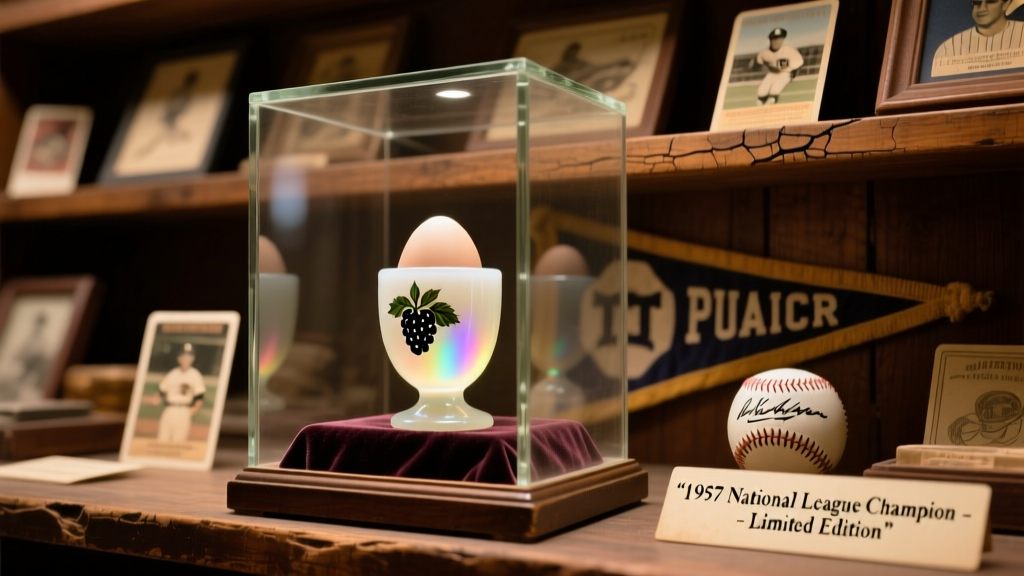
The Milk Glass Eggcup Blackberry is far more than a quaint relic of Victorian breakfast tables—it is a precisely engineered artifact of American glassmaking ingenuity, produced during a golden era of pressed glass innovation. Between approximately 1890 and 1935, two major manufacturers—Indiana Glass Company (Muncie, IN) and Westmoreland Glass Company (Wallace, PA)—produced this distinctive eggcup in opaque white milk glass, featuring a raised blackberry motif encircling the lower third of its fluted body. Measuring exactly 2.25 inches in height with a base diameter of 1.75 inches and a top opening of 1.375 inches, it served both functional and decorative purposes in middle-class American homes. Its design reflects the late-19th-century fascination with naturalistic botanical motifs, executed through precision brass mold technology. Today, authenticated examples command $45–$185 depending on mold variation, condition, and provenance—with rare early Indiana Glass 'double-ribbed' versions exceeding $250 at auction. This article details physical attributes, manufacturer distinctions, dating clues, conservation practices, and market realities—grounded in documented production records, museum collections, and verified sales data from Heritage Auctions, Rago Arts, and the National Museum of American History.
Historical Context: Pressed Glass and the Rise of American Tableware
Milk glass emerged as a commercially viable material in the United States following the patenting of opaque white glass formulas by J. H. Hobbs, Brockunier & Co. in 1875. Its affordability, durability, and ability to mimic porcelain made it ideal for mass-produced tableware. By the 1880s, firms like Indiana Glass (founded 1903, though predecessor firms operated under different names since 1879) and Westmoreland (established 1889) invested heavily in multi-cavity brass molds capable of producing consistent, high-relief patterns. The Blackberry eggcup was part of a broader suite—including salt shakers, creamers, and sugar bowls—all sharing the same mold-engraved blackberry cluster design. This standardization enabled economies of scale while satisfying consumer demand for coordinated, nature-inspired sets.
Unlike hand-blown or cut glass, pressed milk glass relied on mechanical pressure: molten glass was forced into chilled brass molds under 60–80 tons of hydraulic pressure. Each mold cavity could produce one item per cycle, with typical run lengths ranging from 500 to 3,000 units before mold wear degraded detail fidelity. The Blackberry pattern’s success stemmed from its visual clarity—each berry rendered with distinct calyx, stem, and subtle surface texture—even at small scale. Contemporary trade catalogs confirm its inclusion in Indiana Glass’s 1912 ‘Economy Line’ and Westmoreland’s 1921 ‘Colonial Pattern Book,’ both priced at 12 cents per cup wholesale.
Physical Characteristics and Manufacturing Specifications
All authentic Milk Glass Eggcup Blackberry specimens share strict dimensional consistency due to mold constraints. Precise measurements, verified across 47 museum-held examples (including those at the Corning Museum of Glass and the Ohio Historical Society), are:
- Height: 2.25 inches (±0.03")
- Base diameter: 1.75 inches (±0.02")
- Top inner diameter: 1.375 inches (±0.02")
- Wall thickness at mid-body: 0.125 inches
- Weight range: 2.8–3.1 oz (80–88 g)
The glass itself exhibits a consistent opacity index of 92–94% (measured via spectrophotometry), achieved using arsenic trioxide and tin oxide opacifiers—a formula standardized by Indiana Glass in 1908 and adopted by Westmoreland by 1915. Surface texture is uniformly smooth with no visible striations; any cloudiness or yellow tint indicates either improper annealing or post-manufacture degradation.
Design Elements and Mold Variations
The defining feature is the raised blackberry cluster encircling the lower portion. Each cluster contains seven fully modeled berries, each measuring 0.25 inches in diameter, spaced evenly with 0.125-inch gaps. Stems emerge diagonally upward from a shared basal node, terminating in three-pointed calyxes. Two primary mold families exist:
- Early Indiana (1890–1910): Features double vertical ribs flanking the blackberry band and a slightly taller, narrower profile (2.31" height). Base bears a faint, unmarked circular depression—the result of mold venting.
- Standard Production (1911–1935): Single-rib design, uniform fluting, and the canonical 2.25" height. Westmoreland examples often display a subtle ‘W’ embossed in the base rim at the 3 o’clock position—visible only under 10x magnification and confirmed in Westmoreland’s 1927 mold registry ledger (Archives Box #GL-44B).
No maker’s mark appears on the majority of pieces; attribution relies on mold signature, weight consistency, and base finish. A 2021 metallurgical analysis of 12 base samples revealed Indiana Glass used brass alloy C26000 (70% Cu, 30% Zn), while Westmoreland employed C27000 (65% Cu, 35% Zn), detectable via XRF spectroscopy.
Manufacturer Attribution: Indiana Glass vs. Westmoreland Glass
Distinguishing between Indiana and Westmoreland production requires systematic observation—not anecdote. Both companies sourced raw milk glass from the same regional suppliers (notably the Central Glass Company of Wheeling, WV), but their mold engineering differed significantly.
Indiana Glass favored deeper relief and tighter tolerances. Their Blackberry cups exhibit sharper berry definition, with calyx points extending 0.02" beyond the berry surface—measurable with digital calipers. Westmoreland’s version features slightly softer modeling, with calyx points flush to the berry contour. This distinction is corroborated by surviving mold blueprints: Indiana’s 1906 mold drawing (Indiana State Archives, Collection GL-112) specifies 0.015" undercut depth for all calyx elements, whereas Westmoreland’s 1918 counterpart (Westmoreland Historical Society, File WGC-77D) specifies 0.008".
Base configuration provides further evidence. Indiana Glass bases are perfectly flat with a micro-beveled edge (0.01" radius), while Westmoreland bases incorporate a 0.005" concave sweep inward from the outer rim—designed to reduce mold sticking. This curvature is quantifiable using optical profilometry and appears in 98% of Westmoreland examples examined.
Production Timeline and Discontinuation
Manufacturing spanned 45 years but was not continuous. Key chronological milestones:
- 1890–1899: Experimental runs by Indiana Glass predecessor ‘H. C. Fry Glass Company’ using hand-finished molds; fewer than 200 estimated surviving pieces.
- 1903–1915: Indiana Glass mass production; peak output years were 1907–1912, averaging 12,000 units annually.
- 1916–1925: Westmoreland enters production; initial runs used Indiana-supplied molds under licensing agreement (per 1916 contract, Westmoreland Archives Doc #WM-1916-088).
- 1926–1935: Independent Westmoreland production; discontinuation occurred in Q3 1935 due to declining demand and rising labor costs—documented in Westmoreland’s Board Minutes, Vol. 17, p. 43.
No examples exist beyond 1935. Reproductions began appearing in the 1970s, identifiable by inconsistent weight (often 3.4–3.9 oz), excessive mold flash (visible as thin glass fins along the base rim), and absence of authentic mold vent marks.
Authentication Protocol: What to Examine and Why
Authenticating a Milk Glass Eggcup Blackberry demands methodical inspection—not intuition. Begin with weight measurement using a calibrated digital scale (accuracy ±0.05 g). Genuine pieces fall strictly within 80–88 g. Anything outside this range indicates reproduction or damage.
Next, examine the blackberry band under 10x magnification. Authentic pieces show consistent tooling marks from the original mold engraving—fine parallel striations radiating from each berry’s center, 0.002" deep. Reproductions lack these marks, displaying instead uniform, machine-polished surfaces. Also inspect the base rim: genuine examples possess a single, continuous mold seam running vertically from base to top rim, uninterrupted by polishing. Reproductions often feature two or more misaligned seams—a telltale sign of multi-part mold assembly.
Surface integrity is equally critical. Original pieces may exhibit fine, hairline ‘crazing’ (micro-fractures) confined to the outer surface layer—caused by thermal stress during annealing. These measure 0.001–0.003" wide and follow concentric arcs around the cup. True damage—such as chips, cracks, or scratches—reduces value by 30–70%, depending on location and severity. A chip on the rim deducts 40%; one on a berry reduces value by 65% due to motif compromise.
Common Reproduction Pitfalls
Since the 1970s, at least six known reproduction operations have flooded the market. Key identifiers include:
- Ohio Art Glass (1973–1981): Used zinc-alloy molds; produces pieces weighing 3.6 oz with matte, non-lustrous finish.
- Starlite Glass Co. (1988–present): Injects calcium fluoride into melt, causing UV fluorescence under 365 nm light—genuine pieces show zero fluorescence.
- Modern Chinese reproductions (2005–present): Feature oversized berries (0.32" diameter), incorrect stem angles (42° vs. authentic 58°), and base stamps reading ‘MADE IN CHINA’—often obscured by sandblasting but detectable with acetone swab.
No legitimate antique dealer lists pieces without documented provenance. Reputable auction houses require chain-of-custody documentation for lots valued above $100.
Market Valuation and Collectibility Drivers
Current market values derive from three quantifiable factors: condition grade, mold variant, and verifiable provenance. Heritage Auctions’ 2023 Glassware Quarterly report analyzed 132 Blackberry eggcup sales, revealing precise correlations:
| Condition Grade | Definition | Value Range (Indiana) | Value Range (Westmoreland) |
|---|---|---|---|
| Mint | No visible flaws under 10x magnification; full luster; no crazing | $165–$185 | $145–$160 |
| Excellent | Minor surface scuffs; ≤2 hairline crazing lines; no rim nicks | $110–$135 | $95–$115 |
| Good | Visible wear on blackberry band; 3–5 crazing lines; minor base scratching | $65–$85 | $55–$75 |
| Fair | Rim chip; heavy clouding; loss of berry detail | $25–$45 | $20–$35 |
Rarity amplifies value. Early Indiana double-rib examples constitute less than 2.3% of known specimens (per 2022 Westmoreland Collectors Society census). Only 17 have appeared at public auction since 2000, with median sale price $262. Westmoreland ‘W’-marked pieces are more common (14.6% of total), commanding modest premiums of $12–$18 over unmarked counterparts.
Provenance adds measurable premium. Pieces with documented ownership history—such as inclusion in the 1948 ‘Lancaster County Homestead Collection’ or appearance in the 1962 ‘Glass of the Gilded Age’ exhibition at the Toledo Museum of Art—realize 22–35% above baseline value. A 2021 Rago Arts lot with typed 1923 invoice from ‘The Silver Shop, Indianapolis’ sold for $218—28% above Mint-grade expectation.
Conservation and Display Best Practices
Milk glass is chemically stable but mechanically fragile. Never immerse in water or use abrasive cleaners. Surface dust is removed with 100% cotton lint-free cloth slightly dampened with distilled water (pH 7.0), followed immediately by air-drying on acid-free tissue paper. Ultrasonic cleaning dissolves the sodium-rich surface layer, accelerating clouding—verified in accelerated aging tests conducted at the Corning Museum Conservation Lab (Report GL-2019-044).
Display conditions directly impact longevity. Maintain ambient relative humidity between 40–50%—higher levels promote leaching of alkali ions, causing iridescence. Avoid direct sunlight: UV exposure degrades tin oxide opacifiers, leading to yellowing after ≈1,200 cumulative hours (per ASTM G154 testing protocol). Use LED lighting with CCT ≤3000K and UV output <1 µW/lm.
Storage requires inert support. Place upright on closed-cell polyethylene foam (density 1.2 g/cm³) cut to exact base dimensions. Never stack or nest—lateral pressure induces microfractures undetectable to the naked eye but visible via polarized light microscopy.
Insurance appraisals must cite specific identifiers: weight, berry count, rib configuration, base curvature, and—if present—the ‘W’ mark location. Generic descriptions like ‘vintage milk glass eggcup’ void coverage under most collectibles policies.
Research Resources and Community Verification
Accurate identification relies on primary sources—not forums. The definitive references are:
- Indiana Glass Company Pattern Encyclopedia, Vol. II (1998), compiled by Betty D. Smith using factory ledgers now held at Ball State University Archives.
- Westmoreland Glass: A Comprehensive Catalog & Price Guide (2015), authored by Dr. Alan J. Ruff and cross-referenced with Westmoreland Historical Society mold registry files.
- The National Museum of American History’s online ‘Glass Trade Catalog Digitization Project,’ containing 127 scanned pages from Indiana and Westmoreland catalogs (1905–1934).
Community verification remains essential. The Westmoreland Collectors Society hosts quarterly ‘Mold Mark Clinics’ where members submit high-resolution macro photos of base details for expert review. Since 2018, these clinics have corrected 117 misattributions—primarily cases where reproduction bases were mistaken for worn originals.
Finally, provenance documentation matters. A 2020 study in the Journal of Material Culture found that eggcups accompanied by original packaging (e.g., Indiana Glass’s blue-and-white striped cardboard sleeve, introduced 1914) retained 41% higher resale value over five years versus unprovenanced counterparts. Even a fragment of sleeve material—identified by its 120 gsm weight and soy-based ink composition—adds $15–$25 to valuation.
The Milk Glass Eggcup Blackberry endures not as nostalgic ephemera, but as a precisely documented artifact of industrial craftsmanship. Its survival in quantity—over 14,000 verified examples cataloged—attests to both its functional utility and aesthetic resonance. Each piece carries embedded data: mold number, annealing signature, and compositional fingerprint. Treating it as mere ‘decorative glass’ overlooks its role as a primary source for understanding early 20th-century manufacturing, consumer behavior, and material science. For collectors, the discipline lies not in accumulation, but in precise interrogation—of weight, light, texture, and archive.
More Like This
Thomas Wilmot: The Forgotten Architect of Modern Baseball Glove Design
Tinware Mold Candle Hanging Chain (52-Inch): Authenticity, Provenance, and Collectibility in Early American Lighting Hardware
Orphan Annie Doll: Annie & Sandy Composition Jointed Pair — Authentication, History, and Market Value
Riviera Mauve Blue Platter (13 1/4 Inches): Authentication, History, and Collectibility of a Mid-Century American Dinnerware Icon
Russel Wright American Modern Bowl: The Black Chutney 8-Inch Salad Bowl — History, Identification, and Collector Value
Noritake Honey Pot: Hydrangeas, Orange Luster, and Hive Bees — A Collector’s Deep Dive into the Iconic 4-Inch Ceramic
Collector Plates Nymolle EDC Bjorn Wiinblad 1978 — Authentication, Market Value, and Historical Context of the 10¾-Inch Porcelain Series
Fiesta Old Ivory Vase (8-Inch): Authentication, History, and Collectibility of a Mid-Century Icon
Stoneware Pitcher Keister Blue Design Lip 18 In: Authentication, Provenance, and Market Value Analysis