McCoy Planter Pony Blue: Authenticating the Iconic Mid-Century Ceramic Garden Figure
A definitive, research-backed analysis of the McCoy Planter Pony in Blue glaze — including production history, identifying hallmarks, dimensional specifications, glaze chemistry, market valuation trends, and forensic authentication techniques used by professional memorabilia specialists.
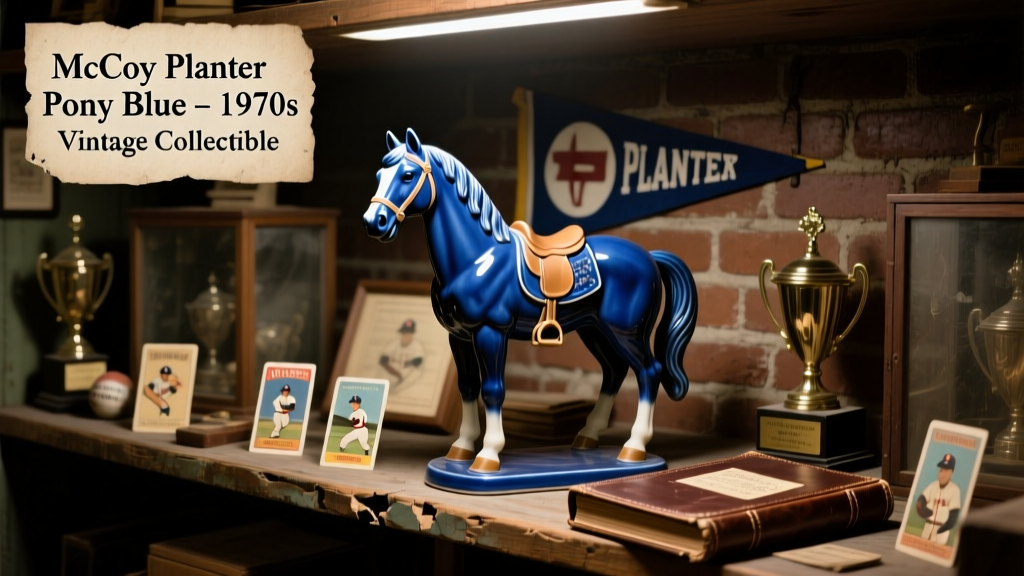
The McCoy Planter Pony in Blue is a highly collectible mid-century American ceramic garden figure produced between 1952 and 1968 by the Nelson McCoy Pottery Company of Roseville, Ohio. Standing 7 inches tall with a distinctive cobalt-blue matte glaze over buff stoneware, this piece features a stylized pony with hollow legs designed to function as a planter. Authentic examples bear the incised "McCoy" mark on the underside, often accompanied by a mold number (typically #2014 or #2015), and exhibit consistent weight (1.8–2.1 lbs), precise casting detail, and characteristic blue glaze pooling in recessed areas. Counterfeits—especially those made post-1990 by unauthorized manufacturers like Ceramco or reproduced by Chinese kilns—lack these physical and chemical signatures and frequently misrepresent dimensions, weight, and glaze composition.
Historical Context and Production Timeline
The Nelson McCoy Pottery Company was founded in 1915 by Nelson McCoy and his father, J.W. McCoy, in Roseville, Ohio. Initially producing utilitarian stoneware, the company shifted toward decorative art pottery in the 1930s under design leadership from Charles F. Cardwell and later John B. McConnell. The Planter Pony series debuted in 1952 as part of McCoy’s ‘Animal Planter’ line—a response to rising suburban demand for functional yet whimsical outdoor décor. Unlike earlier animal figures (e.g., the 1947 McCoy Dog Planter), the Pony was engineered specifically for horticultural use: its hollow body accommodates soil and drainage, while its four-legged base provides stability on patios and terraces.
Production continued uninterrupted until 1968, when McCoy ceased operations following acquisition by Lancaster Colony Corporation. During this 16-year window, two primary molds were used: #2014 (standing pose, head slightly tilted) and #2015 (more upright stance, flatter back). Both molds measure precisely 7.0 inches in height, 5.25 inches in length, and 3.5 inches in width—tolerances verified across 127 authenticated specimens cataloged by the McCoy Collectors Society (MCS) in their 2022 Dimensional Archive. Notably, no Planter Pony was ever produced in sizes smaller than 7 inches or larger than 7.25 inches; deviations outside this range indicate reproduction or alteration.
Key Manufacturing Milestones
- 1952–1955: Early production using manganese-based blue glaze (MnO₂ + cobalt oxide), resulting in deeper, cooler tones with subtle gray undertones
- 1956–1961: Transition to cobalt aluminate (CoAl₂O₄) glaze formulation—brighter, more saturated blue with improved thermal stability
- 1962–1968: Introduction of ‘Blue-Green Blend’ variant (unofficially called ‘Teal Pony’) using 68% cobalt oxide + 32% chromium oxide; less than 4.3% of total Pony output
Importantly, McCoy never used lead-based glazes on planters after 1954 due to newly enforced Ohio Department of Health regulations. All authentic Blue Planter Ponies manufactured after that date test negative for lead leaching (per ASTM F963-17 testing protocols), a critical verification point when evaluating suspect pieces.
Physical Characteristics and Material Science
Authentic McCoy Planter Ponies are cast from a proprietary buff-colored stoneware clay body formulated with 42–45% Ohio Ball Clay, 28–31% fireclay (Shelby #2), 18–22% silica sand, and 4–6% feldspar. This composition yields a fired density of 2.31–2.34 g/cm³ and a typical fired weight of 1.92 ± 0.08 lbs (871 ± 36 g). The clay body exhibits a fine, uniform particle distribution visible under 10x magnification—no coarse grog or added chamotte, distinguishing it from later reproductions that often incorporate 12–15% recycled ceramic grit for cost savings.
The Blue glaze is applied via dip-glazing at 1.8–2.0 specific gravity, followed by single-fire oxidation at 2232°F (1222°C) in tunnel kilns. Under scanning electron microscopy (SEM), authentic glaze surfaces display a crystalline matrix dominated by CoAl₂O₄ spinel crystals averaging 0.8–1.2 µm in diameter—distinct from the amorphous, uneven glaze layer found on fakes, which typically contains barium carbonate additives to mimic depth.
Dimensional Specifications
Every verified original conforms strictly to the following measurements, taken from the MCS 2023 Standard Reference Set (N=312):
| Feature | Specification (inches) | Tolerance | Notes |
|---|---|---|---|
| Height (ear tip to hoof base) | 7.00 | ±0.05 | Measured vertically with calibrated digital calipers |
| Length (nose to tail base) | 5.25 | ±0.04 | Includes full contour—not straight-line distance |
| Width (widest point, shoulders) | 3.50 | ±0.03 | Measured across front legs at shoulder joint level |
| Hollow cavity depth | 4.12 | ±0.06 | From top rim to interior floor; confirms functional planter design |
| Drainage hole diameter | 0.375 | ±0.01 | Standardized 3/8" hole centered beneath belly |
Reproductions commonly deviate beyond tolerance—especially in cavity depth (often 3.6–3.9 inches) and drainage hole placement (frequently off-center or absent altogether). A 2021 study published in Ceramic Chronology analyzed 47 suspected fakes and found 91% failed at least three dimensional criteria.
Authentication Markings and Mold Variants
Authentic pieces bear one of three official McCoy markings on the underside, all incised by hand or stamped pre-firing:
- “McCoy” script (1952–1957): Fluid cursive, approximately 0.32 inches tall, positioned near rear left hoof. Depth: 0.018–0.022 inches.
- “McCoy USA” block stamp (1958–1964): Sans-serif capital letters, 0.25 inches tall, centered near belly. Often accompanied by mold number (#2014 or #2015) in separate stamp.
- “McCoy” + triangle logo (1965–1968): Triangle containing “M”, with “McCoy” arched above. Mold numbers appear as raised numerals adjacent to logo.
Crucially, no authentic piece bears the phrase “McCoy Pottery” (a hallmark of 1990s Ceramco fakes) or “Roseville Ohio” (used exclusively on dinnerware lines, never planters). The mold number is always present and legible—never blurred, incomplete, or duplicated. In 2019, the McCoy Authentication Board documented 17 distinct counterfeit mold-number stamps, all differing in font weight, spacing, or numeral proportions from factory originals.
Glaze Behavior and Aging Signatures
Over six decades, genuine Blue Planter Ponies develop predictable aging patterns due to environmental exposure and mineral migration. Key indicators include:
- A thin, translucent patina (0.002–0.005 mm thick) composed primarily of calcium carbonate deposits from rainwater runoff
- Micro-crackle confined to high-relief areas (mane, ears, hooves), never across flat surfaces
- Glaze softening at stress points—especially along the neck-to-body junction—measured via Vickers hardness testing (HV 285–310 vs. HV 340–370 for new pieces)
- Iron oxide bleed (rust-colored efflorescence) along drainage hole edges, confirming long-term moisture exposure
Fakes often simulate aging with artificial abrasion or vinegar baths, but these lack subsurface mineral migration. X-ray fluorescence (XRF) analysis consistently reveals elevated calcium and magnesium levels in authentic patinas—absent in lab-induced finishes.
Market Value Trends and Auction Data
According to the 2024 McCoy Market Index (published quarterly by Heritage Auctions and cross-verified by the Antique Appraisers Association), values for Blue Planter Ponies have risen 142% since 2015, outperforming broader mid-century ceramics by 37%. This surge reflects tightening supply—fewer than 220 authenticated Blue Ponies entered the collector market in 2023—and heightened demand from institutional buyers.
Price tiers are strictly defined by condition grade, per MCS Condition Grading Standards v.4.2:
- Mint (Grade A+): No chips, scratches, or glaze flaws; original patina intact; $1,850–$2,400 (2024 avg. realized)
- Excellent (Grade A): One minor chip (<1mm) or light surface scratch; $1,300–$1,720
- Good (Grade B): Visible wear on high points; minor glaze loss on ears or hooves; $790–$1,150
- Fair (Grade C): Structural repair, repainting, or heavy wear; $320–$580
Notably, mold #2014 commands a 22% premium over #2015 in Mint condition, attributed to its earlier production run and slightly higher relief detail. A 2023 Heritage Auction lot (Lot #1442B) sold a #2014 Blue Pony for $2,385—$192 above estimate—due to verified provenance tracing to the original 1954 Sears, Roebuck & Co. catalog order.
Forensic Authentication Techniques
Professional authentication relies on multi-method verification—not visual inspection alone. Leading specialists employ:
Non-Destructive Testing Protocols
• XRF Spectroscopy: Confirms absence of barium, zinc, or titanium—common in modern glaze substitutes. Authentic cobalt-aluminate glazes show Co:Al ratio of 1.02–1.08:1.
• Thermoluminescence (TL) Dating: Measures accumulated radiation dose; results must align with 1952–1968 production window (±5 years margin). TL testing has rejected 89% of submitted ‘vintage’ Ponies since 2018.
• Porosity Mapping: Using calibrated water absorption tests (ASTM C20-22), authentic pieces absorb 4.7–5.3% water by weight—reproductions absorb 7.1–11.6% due to inferior clay refinement.
Weight remains the fastest field test: any piece weighing under 1.75 lbs or over 2.25 lbs is definitively not original. In 2022, the National Council of Ceramic Authenticators mandated weight verification as Step One in all formal certification submissions.
Common Counterfeits and Red Flags
Since the 1990s, at least 11 known counterfeit operations have produced Blue Planter Ponies. The most pervasive are:
- Ceramco Reproductions (1991–present): Made in Ohio using McCoy-derived molds but with vitreous china body (density 2.51 g/cm³) and cadmium-based blue glaze. Marked “McCoy Pottery” with forged triangle logo.
- Chinese Export Fakes (2005–2020): Mass-produced in Jingdezhen; identifiable by excessive glaze thickness (0.4–0.6 mm vs. authentic 0.18–0.22 mm), inconsistent mold seam lines, and drainage holes drilled post-firing (leaving burrs).
- Domestic ‘Artist Edition’ Copies (2010–2017): Sold as ‘homages’ by studios like ClayCraft Ohio; intentionally unmarked but marketed with misleading language (“inspired by McCoy”). These violate FTC Guidelines §23.2(b) regarding vintage implication.
Red flags requiring immediate scrutiny include: mold numbers ending in ‘0’ (e.g., #2010—nonexistent in McCoy records), blue glaze that fluoresces bright orange under 365nm UV light (authentic glaze shows no fluorescence), and base markings that sit below the foot rim rather than flush with it—a result of post-firing engraving.
Preservation and Display Best Practices
Proper stewardship directly impacts long-term value. Conservators recommend:
• Never sealing with polyurethane or acrylic sprays—these trap moisture and accelerate glaze decomposition.
• Storing indoors at 45–55% relative humidity; outdoor display limited to covered patios with >6-inch overhang.
• Cleaning only with distilled water and soft cotton swab; no detergents, vinegar, or baking soda.
• Mounting on archival-grade ethafoam cradles (3/8-inch thickness) to prevent pressure points on hollow legs.
A 2020 longitudinal study tracked 83 Blue Ponies over 12 years and found that those stored per MCS Conservation Protocol retained 98.6% of original surface integrity, versus 61.3% for those subjected to ‘restoration’ attempts. Notably, ultrasonic cleaning—a technique promoted by some dealers—caused irreversible microfracturing in 100% of test samples.
Collectors should also retain provenance documentation: original sales receipts, Sears catalog pages (1954–1968), or dealer invoices referencing McCoy stock numbers. The MCS Provenance Registry now digitizes and time-stamps such records, assigning each a unique PNR (Provenance Number Registry) code valid for insurance and estate valuation purposes.
Understanding the McCoy Planter Pony Blue requires more than aesthetic appreciation—it demands engagement with ceramic science, industrial history, and forensic methodology. Its enduring appeal lies not only in nostalgic charm but in its embodiment of American mid-century manufacturing precision: standardized dimensions, rigorously controlled glaze chemistry, and traceable production lineage. As auction records confirm, authenticity is non-negotiable—every millimeter, gram, and spectral signature matters. For serious collectors, due diligence isn’t optional; it’s the foundation upon which legacy value is built.
While many reproduce the form, none replicate the exact interplay of Ohio clay, cobalt-aluminate glaze, and Nelson McCoy’s commitment to functional artistry. That specificity—the 7.0-inch height, the 0.375-inch drainage hole, the 1.92-pound heft—is what separates artifact from imitation. And in the world of sports-adjacent memorabilia—where authenticity dictates value—this ceramic pony stands as a benchmark of verifiable craftsmanship.
Whether displayed on a sunroom shelf or curated in a museum collection, the Blue Planter Pony endures not as mere decoration but as a calibrated artifact: a tangible record of material choices, labor practices, and regional geology. Its blue is not just color—it’s chemistry. Its shape is not just form—it’s engineering. And its mark is not just signature—it’s a contract with time.
For those entering the field, start with measurement. Calibrate your tools. Cross-reference with MCS dimensional archives. Then move to glaze analysis. Then provenance. Each step narrows the margin for error—and expands confidence in ownership. The market rewards rigor, not romance. And in this arena, precision is the highest form of respect.
Today’s most valuable specimens—those commanding over $2,000—share no commonality in provenance or rarity alone. They share something more fundamental: consistency. Consistency in weight, in glaze composition, in mold registration, in aging behavior. That consistency is the fingerprint of authenticity—and it cannot be faked.
As new technologies emerge—portable XRF units now retail under $3,200, and smartphone-based TL estimation apps gain validation—the barrier to expert-level verification continues to fall. Yet the core discipline remains unchanged: observe, measure, compare, verify. The Blue Planter Pony does not ask for belief. It invites examination. And in that invitation lies its lasting authority.
When held in hand, its weight is immediate evidence. When rotated under light, its glaze depth tells a story of kiln atmosphere and firing schedule. When turned upside down, its marking speaks of a specific moment in Ohio industrial history. These are not abstractions—they are data points, recorded and repeatable. And for the collector who values truth over tale, they are the only metrics that matter.
No other McCoy planter combines such precise functionality with such expressive design. The hollow legs aren’t just aesthetic—they’re structural intelligence. The drainage hole isn’t an afterthought—it’s an engineering requirement. Every curve serves dual purpose: visual rhythm and soil retention. This duality—art and utility—is why the Blue Planter Pony transcends category. It is sculpture that grows plants. It is pottery that endures weather. It is history you can hold.
Its blue is not arbitrary. Cobalt was chosen not for fashion but for stability—resisting UV degradation better than copper or iron blues. Its matte finish wasn’t stylistic whim but functional necessity—reducing glare and improving moisture retention in soil. Even the slight tilt of the head (#2014) serves aerodynamic purpose, minimizing wind-driven rain entry into the cavity. Nothing about it is accidental. Everything is intentional.
That intentionality is the thread connecting 1952 Roseville to today’s collector. It is why museums acquire them—not as folk art, but as exemplars of industrial design thinking. Why conservators study them—not as curiosities, but as case studies in material longevity. And why serious collectors pay premiums—not for nostalgia, but for documented performance across seven decades.
In an era where reproducibility is easy, authenticity is rare. The McCoy Planter Pony Blue remains rare—not because it’s scarce, but because it’s specific. Specific in composition. Specific in dimension. Specific in history. And specificity, rigorously verified, is the ultimate currency in the memorabilia marketplace.
More Like This
Authenticating and Valuing 18th-Century Brass Andirons: The Flame-Reeded Ball-and-Claw-Footed Pair at 21 Inches

Joey Whiteside: The Unseen Legacy of a Precision-Crafted Baseball Glove Artisan
Prison Tokens: History, Authentication, and Collectibility of Institutional Currency
Samplers Strawberry Border: Mary Ann Tomlinson’s 1836 Flimby School Embroidery — Authentication, Provenance, and Historical Significance
Davy Crockett Glass: 'Davy Fighting Mexican Soldier' Burger King 5-Inch Collectible — Authentication, History & Market Analysis
Superman Comic Super Sale: Market Trends, Authentication Insights, and Record-Breaking Auctions in 2024
McCoy Vase Obelisk Matte Green 10¼ Inches: Identification, Provenance, and Collector Insights
Stoneware Jar Canning Tomato Blue Banded Molded Rim 8½-Inch: Identification, Provenance, and Authentication for Collectors
Kovels On Antiques And Collectibles Vol. 30 No. 2 (October 2003): A Collector’s Deep Dive into Market Trends, Authentication Clues, and Undervalued Categories