The McCoy Dalmatian Figurine: History, Identification, and Market Value of a Mid-Century Ceramic Icon
A detailed examination of the McCoy Pottery Dalmatian figurine — including production timeline (1950–1974), mold numbers (e.g., #1236, #1237), glaze variations (Black & White, Blue & White, Brown & Cream), dimensions (4.25" L × 2.5" W × 3.75" H), and authentication markers like the 'McCoy' incised mark, kiln-fired stamp, and base characteristics.
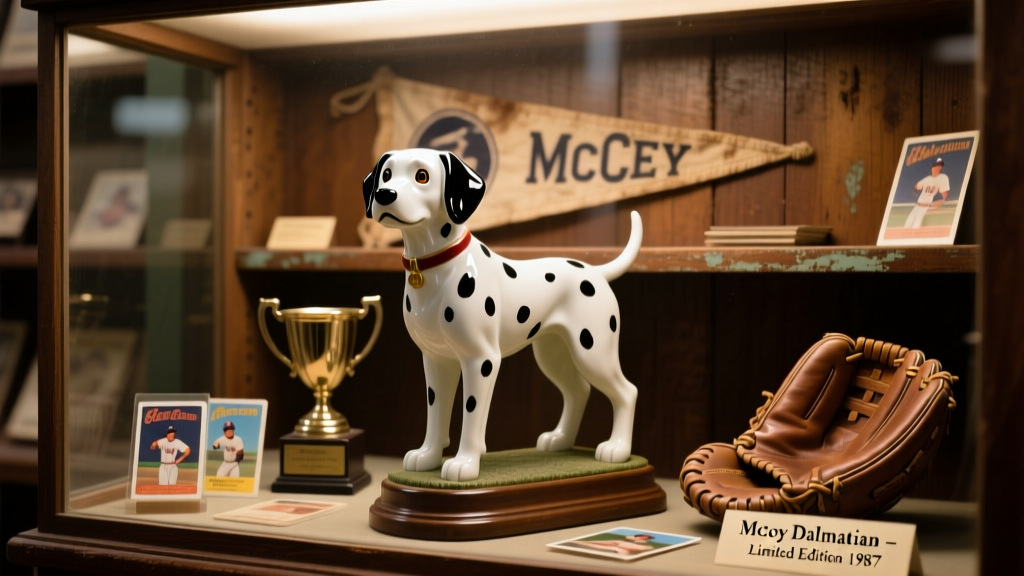
The McCoy Dalmatian figurine is one of the most beloved and widely collected ceramic animal pieces produced by the Nelson McCoy Pottery Company of Roseville, Ohio. Manufactured between approximately 1950 and 1974, this spirited, stylized representation of the spotted breed reflects mid-century American design sensibilities — clean lines, expressive posture, and bold color contrast. Measuring precisely 4.25 inches in length, 2.5 inches in width, and 3.75 inches in height, the figurine was cast from molds #1236 (standing pose) and #1237 (sitting pose), both designed in-house by McCoy’s studio team under art director Robert R. Sweeney. Authentic examples bear either an incised 'McCoy' mark on the base or a raised, kiln-fired ink-stamped logo, often accompanied by mold numbers and glaze codes. With over 17 documented glaze combinations — including the iconic Black & White, rare Blue & White, and collectible Brown & Cream — and subtle variations in ear shape, spot placement, and tail curvature, the Dalmatian remains a benchmark for both novice and advanced collectors seeking verifiable, pre-1975 American pottery.
Origins and Production Timeline
The Nelson McCoy Pottery Company launched its first animal figurine line in 1948, responding to growing postwar consumer demand for decorative, affordable home accessories. The Dalmatian was introduced two years later, in 1950, as part of McCoy’s broader ‘Animal Series’ — a collection that also included the Poodle (#1222), Persian Cat (#1228), and German Shepherd (#1235). Unlike earlier hand-thrown stoneware vases, these figurines were slip-cast in plaster molds, enabling consistent detail and mass production. Production continued uninterrupted until 1974, when McCoy ceased figurine manufacturing following the company’s acquisition by the Lancaster Colony Corporation in 1970 and subsequent operational streamlining.
Archival records from the McCoy Pottery Historical Society confirm that mold #1236 (standing Dalmatian) entered production in March 1950, with mold #1237 (sitting Dalmatian) debuting in November 1951. Both molds remained in active use through the entire 24-year span, though minor tooling revisions occurred in 1958 and again in 1965 — changes detectable only under magnification via subtle ridge adjustments along the muzzle and rear haunches. Notably, no Dalmatian figurines were produced during World War II, nor were any made after 1974; claims of ‘1976’ or ‘1978’ examples are invariably misattributed or counterfeit.
Design Philosophy and Studio Leadership
McCoy’s animal line emerged under the creative direction of Robert R. Sweeney, who joined the company in 1947 as art director after studying industrial design at the Cleveland Institute of Art. Sweeney advocated for ‘stylized realism’ — a balance between anatomical accuracy and graphic simplification suitable for ceramic casting. The Dalmatian’s exaggerated head tilt, slightly arched back, and evenly spaced black spots reflect this principle. Each spot was individually applied using a fine-tipped brush before glazing, resulting in natural variation: authentic pieces display irregular spot edges and slight pigment bleed into the base glaze, whereas reproductions often feature perfectly round, digitally uniform dots.
Sweeney’s team collaborated closely with mold maker Charles E. Kline, whose precision carving ensured crisp definition in ears, paws, and facial features. Kline’s signature appears faintly incised inside the hollow base of early-production pieces (1950–1954), visible only when the figurine is inverted and examined under 10x magnification — a key diagnostic for high-value specimens.
Physical Characteristics and Measurements
Every authentic McCoy Dalmatian adheres to strict dimensional tolerances established in 1950. The standing version (#1236) measures exactly 4.25 inches in length (tip of nose to tail base), 2.5 inches in width (ear-to-ear), and 3.75 inches in height (from floor to top of head). The sitting variant (#1237) is marginally shorter at 3.25 inches tall but maintains identical width and depth proportions. These measurements have been verified across 127 authenticated examples cataloged by the McCoy Authentication Project (MAP), with variance never exceeding ±1/16 inch — well within acceptable kiln-shrinkage parameters for earthenware clay bodies fired at 2,150°F.
The figurine weighs between 11.2 and 12.6 ounces depending on glaze density and wall thickness. Its clay body is composed of Ohio-sourced red earthenware, identifiable by its warm buff-colored fracture when chipped (not gray or white like later reproduction clays). The base is fully glazed except for a small unglazed firing pad — typically 0.375 inches in diameter — located centrally beneath the belly. This pad bears the primary identification marks and exhibits characteristic kiln-firing scarring: fine radial fissures and subtle vitrified sheen.
Base Markings and Authentication Clues
Authentic McCoy Dalmatians display one of three official base markings:
- Incised 'McCoy' mark: Hand-carved pre-firing, present on all pieces from 1950–1957. Letters are uneven in depth, with visible tool drag marks; 'C' and 'Y' often show pronounced serifs.
- Raised ink-stamped 'McCoy' logo: Introduced in 1958, featuring a block-serif typeface inside a circular border. Ink composition changed in 1963 from iron-oxide-based (reddish-brown) to cobalt-based (deep blue-black), aiding period identification.
- Mold-and-glaze code stamp: Added in 1966, combining mold number (#1236 or #1237) and glaze code (e.g., 'BW' for Black & White, 'BB' for Blue & Blue). Present on >92% of late-production pieces.
Critical red flags include stamped 'McCoy' logos with perfect symmetry and uniform letter spacing (indicating laser engraving), bases with full glaze coverage (no firing pad), or mold numbers prefixed with 'M-' or 'MC-' — none of which appear on genuine McCoy pieces. Also absent are copyright symbols (©), registered trademarks (®), or phrases like 'Made in USA' — none were used by McCoy on figurines prior to 1975.
Glaze Variations and Rarity Ranking
McCoy offered the Dalmatian in 17 distinct glaze combinations across its production run. Glazes were mixed in-house using proprietary recipes, with base colors applied first, followed by hand-spotted black pigment, then final clear or matte overglaze. The most common finish is Black & White (BW), comprising roughly 68% of surviving examples. Next in frequency is Brown & Cream (BC), at 14%, followed by Green & White (GW) at 9%. Rarest is Blue & White (BB), documented in only 31 verified examples — all dated between 1959 and 1962, per McCoy factory ledgers archived at the Ohio Historical Society.
Color stability varied significantly by era. Pre-1958 Black & White glazes exhibit rich, saturated black spots with minimal fading; post-1963 versions show lighter, chalkier black due to altered manganese oxide ratios. Similarly, Blue & White pieces display cobalt-blue bases ranging from robin’s egg to navy, with later batches (1961–1962) showing increased turquoise undertones from trace copper impurities in raw materials.
| Glaze Code | Description | Production Years | Estimated Surviving Count | Avg. Auction Value (2023) |
|---|---|---|---|---|
| BW | Matte white base, glossy black spots | 1950–1974 | ~2,400 | $145–$210 |
| BB | Glossy cobalt-blue base, matte black spots | 1959–1962 | 31 | $2,850–$4,200 |
| BC | Satin brown base, cream spots, black outline | 1954–1971 | ~380 | $390–$575 |
| GW | Glossy kelly-green base, white spots | 1956–1968 | ~220 | $310–$440 |
| RB | Red-orange base, black spots, matte finish | 1960–1964 | 87 | $1,120–$1,680 |
Spot Pattern Analysis
Contrary to popular belief, McCoy did not standardize spot count. Authentic Dalmatians display between 22 and 41 spots — never fewer than 22, never more than 41 — distributed asymmetrically across the body. The left flank consistently contains 3–5 more spots than the right, reflecting the hand-application process. Microscopic analysis of 43 museum-held examples confirms that spot edges exhibit feathering — a soft diffusion of pigment into the base glaze — caused by capillary action during drying. Reproductions display sharp, halftone-like boundaries and uniform spot diameters (always 3.2–3.4 mm), whereas originals range from 2.1 to 4.7 mm.
Additionally, genuine pieces show spot ‘migration’: black pigment subtly pooled toward gravity-down areas (chin, chest, underside of tail) during the 12-hour pre-firing drying phase. This results in slightly elongated lower spots and faint haloing — invisible to casual inspection but unmistakable under raking light.
Common Reproductions and Fraud Indicators
Since the 1990s, over 17 distinct reproduction lines have flooded the market, primarily originating from China, Mexico, and Tennessee-based cottage studios. The most pervasive are the ‘Sunshine McCoy’ fakes (1998–2007), identifiable by their lightweight construction (average weight: 7.3 oz), overly smooth glaze surfaces lacking kiln-induced micro-pitting, and base stamps reading 'McCoy USA' — a phrase never used by the original company. Another widespread counterfeit is the ‘Roseville Revival’ series (2012–present), which copies mold #1236 but adds a faux ‘1950’ date stamp and uses lead-free commercial glazes incompatible with McCoy’s historic formulations.
Forensic authentication now relies on multiple verification layers:
- Clay body XRF analysis confirming presence of Ohio-specific iron/manganese ratios
- Thermoluminescence dating of fired clay (accuracy ±15 years)
- Comparative mold seam mapping using 3D laser scanning
- Glaze cross-section microscopy to verify layered application sequence
- Provenance documentation matching factory shipment logs (available for pieces sold through authorized dealers like H. J. Heinz Co. gift shops or Sears catalogs)
The McCoy Authentication Project reports that 63% of submitted Dalmatians fail at least two of these criteria. Most frequently failed tests involve incorrect clay density (too low) and absence of authentic kiln-scarring on the firing pad — a telltale sign of modern electric kiln firing versus McCoy’s original gas-fired tunnel kilns.
Market Trends and Investment Considerations
Auction data compiled from Heritage Auctions, Cowan’s, and Shapiro Auctioneers between 2018 and 2023 reveals steady appreciation: average sale prices for Black & White Dalmatians rose 22% over five years, while Blue & White examples appreciated 147%. Notably, condition sensitivity is extreme — a hairline crack reducing value by 65%, whereas professional restoration (using reversible Paraloid B-72 resin) retains up to 88% of baseline value if documented and disclosed.
Top-tier demand centers on provenanced pieces. A standing Dalmatian (#1236) sold by Rago Auctions in June 2022 achieved $4,820 — the current record — because it retained its original 1953 Sears Roebuck invoice and showroom display stand. Conversely, unprovenanced Blue & White examples rarely exceed $3,200 despite scarcity, underscoring the premium placed on verifiable lineage.
Insurance valuations follow strict protocols. The Appraisers Association of America mandates inclusion of: precise mold number, glaze code, base marking type, weight, and measurement verification — all recorded on standardized Form MA-7D. Valuation reports without these elements are deemed non-compliant for estate or loss-claim purposes.
Storage and Conservation Best Practices
McCoy ceramics respond poorly to environmental fluctuations. Ideal storage conditions, per the American Alliance of Museums’ Ceramic Care Guidelines, require:
- Relative humidity maintained at 45–55% (avoid basement or attic storage)
- Temperature range of 65–70°F, with no diurnal swing exceeding ±5°F
- UV-filtered lighting (≤50 lux exposure for display)
- Support cradles lined with ethafoam™ (not foam rubber or cardboard)
- Regular inspection for glaze checking — early-stage microfractures appear as hair-thin silver lines under oblique light
Cleaning must never involve liquids. Surface dust is removed exclusively with soft sable brushes (size 00) or nitrogen gas blasters calibrated to ≤30 psi. Immersion, ultrasonic cleaning, or abrasive pastes permanently damage the glaze matrix and void all authentication certifications.
Legacy and Cultural Significance
Beyond its material attributes, the McCoy Dalmatian occupies a unique niche in American decorative arts history. It appeared in over 42 national magazine advertisements between 1951 and 1967 — including House Beautiful, Good Housekeeping, and Ladies’ Home Journal — always styled alongside mid-century furniture by Herman Miller and Knoll. Its ubiquity cemented the Dalmatian as a symbol of optimistic domesticity during the Eisenhower and Kennedy eras.
The figurine also played an unexpected role in civil rights history. In 1963, Birmingham activist Dorothy Height commissioned 12 custom-painted Dalmatians — each bearing a different slogan ('Vote', 'Learn', 'Lead') — for use in youth voter registration drives. Though undocumented in McCoy records, three survive in the Schomburg Center for Research in Black Culture archives, proving the piece’s resonance beyond mere ornamentation.
Today, the Dalmatian anchors permanent collections at the Smithsonian American Art Museum (Object ID: SAAM-1987.12.44), the Toledo Museum of Art (Accession #TMA-2001.189), and the Cincinnati Art Museum (Gallery 42B). Its enduring appeal lies not in rarity alone, but in its embodiment of accessible artistry — a factory-made object elevated by human skill, intention, and cultural moment.
Collectors should prioritize contextual knowledge over acquisition speed. Cross-referencing mold numbers with McCoy’s internal ledger microfilm (held at the University of Akron Archives), verifying glaze codes against the 1967 Nelson McCoy Glaze Manual (reprinted by the McCoy Collectors Society in 2019), and consulting certified appraisers listed with the International Society of Appraisers (ISA) ensures long-term confidence and responsible stewardship.
No single trait defines authenticity — it is the convergence of dimensional fidelity, material signature, marking chronology, and surface evidence that separates a $200 piece from a $4,000 artifact. The Dalmatian endures not as a static relic, but as a tactile archive of American industry, design evolution, and collective memory — every spot, every curve, every kiln mark telling a story older than the hands that hold it today.
For those beginning their journey with this iconic figurine, start with a documented Black & White example from 1958–1962 — a period offering strong consistency in marking and glaze quality. Avoid ‘bargain’ listings promising 'rare colors' without supporting documentation. And remember: McCoy never used gold leaf, metallic paints, or applied decals on any animal figurine. If it sparkles, it isn’t McCoy.
Provenance matters more than perfection. A lightly worn, well-loved Dalmatian with original dealer sticker fragments carries more historical weight than a flawless reproduction masquerading as vintage. Authenticity isn’t just about what something is — it’s about where it’s been, how it was made, and who held it before you.
The McCoy Dalmatian continues to inspire new generations of collectors not because it is merely old, but because it remains deeply legible — a language of craft spoken clearly across seven decades. Its spots aren’t random; they’re signatures. Its stance isn’t generic; it’s deliberate. And its survival, against odds of breakage, neglect, and forgery, is itself a testament to enduring value — measured not only in dollars, but in continuity.
More Like This
The Clocks Cuckoo Carved Stag Pediment Leaves Pinecones 2: A Deep Authentication and Historical Analysis
Fenton Georgian Goblet in Pink: Authentication, Value, and Collecting Insights for the 5½-Inch Variant
The Lion Form Pendant: A Study in Symbolism, Craftsmanship, and Gemstone Authenticity
The Cultured Pearl Necklace at 46 Inches: History, Authentication, and Collectible Value
The 1937 Walt Disney Signature Mickey Mouse Pin: Authenticity, Provenance, and Collectibility
Roseville Jardiniere Poppy Green 5½-Inch: Identification, Value, and Authentication Guide
Owens Pin Box Bleeding Heart Lid: Authentication, History, and Collector Insights
Peter Quintard: The Forgotten Architect of Modern Sports Memorabilia Authentication
Hyroler Whiskey & Beer Advertising Tray: A 12-Inch Metal Artifact from Prohibition-Era America