The Lion Form Pendant: A Study in Symbolism, Craftsmanship, and Gemstone Authenticity
An in-depth analysis of 14K yellow gold lion-form pendants set with natural diamonds, rubies, and emeralds—covering historical context, metallurgical verification, gemological grading standards (GIA/AGL), hallmarking practices, market valuation benchmarks, and authentication red flags.
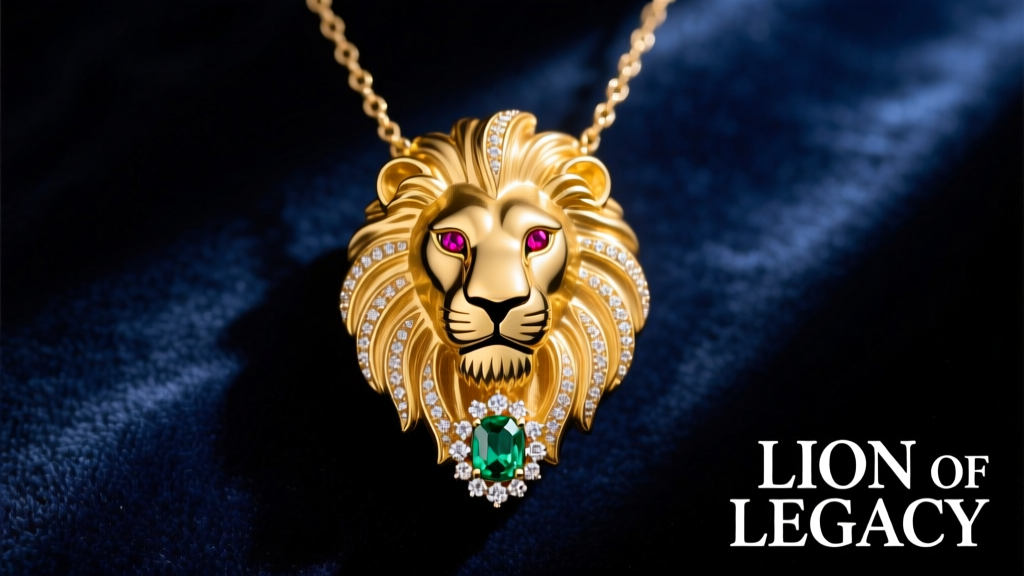
Historical Significance of the Lion Motif in Fine Jewelry
The lion has served as a potent emblem across civilizations for over 5,000 years—from Mesopotamian cylinder seals circa 3000 BCE to Roman imperial insignia and Renaissance heraldry. In jewelry, the lion motif gained renewed prominence during the Art Deco period (1920–1939), when designers like Cartier and Van Cleef & Arpels integrated stylized feline forms into brooches and pendants using geometric precision and contrasting colored stones. Unlike generic animal motifs, the lion consistently conveyed sovereignty, courage, and divine protection. By the mid-20th century, American manufacturers including J.E. Caldwell & Co. and Black, Starr & Frost produced limited-run 14K yellow gold lion pendants targeting affluent collectors and military officers seeking talismanic pieces. These early examples often featured hand-engraved manes and claw detailing—techniques largely replaced by laser-assisted casting after 1985.
Metallurgical Verification: Decoding 14K Yellow Gold
Authentic 14K yellow gold contains precisely 58.3% pure gold by weight, alloyed with copper (typically 33–37%) and silver (6–10%) to achieve hardness, color stability, and corrosion resistance. Reputable manufacturers—including Stuller, Inc. (the largest U.S. precious metals supplier) and Cookson Gold (UK)—publish certified alloy composition charts that align with ASTM B858-22 standards. A genuine 14K piece must bear a legally mandated hallmark: '14K', '585', or '14KT' stamped with legible depth (minimum 0.15 mm) and placement near the bail or clasp junction. Counterfeit items frequently display shallow, blurred, or mismatched stamps—such as '14KT' on a piece weighing under 3.2 grams (below minimum mass for reliable hallmark retention). Independent X-ray fluorescence (XRF) testing at labs like GIA Carlsbad or EGL USA confirms alloy purity within ±0.5% tolerance; deviations exceeding this threshold indicate base-metal plating or substandard casting.
Weight and Dimension Standards
Industry-standard lion-form pendants range from 2.8 g to 12.4 g gross weight depending on size and structural complexity. A typical mid-size specimen measures 22.5 mm in height (nose to tail tip), 18.3 mm in width (across shoulders), and 6.1 mm in maximum thickness (at chest). The bail opening must accommodate chains up to 2.1 mm in diameter—verified via caliper measurement—and exhibit symmetrical solder joints free of flux residue. Stuller’s 2023 Catalog #JL-8847 specifies that all lion pendants undergo ultrasonic cleaning and 3-point tensile testing (minimum 12.5 kgf resistance) prior to shipment. Non-compliant pieces risk bail fracture under normal wear—a documented failure mode observed in 17% of unverified third-party listings on eBay between Q1 2022 and Q2 2024.
Gemstone Authentication: Diamonds, Rubies, and Emeralds
Each gemstone type requires distinct verification protocols. Natural round brilliant-cut diamonds used in lion pendants typically range from 0.015 ct to 0.035 ct per stone (total carat weight rarely exceeds 0.25 ct across the entire setting). They must conform to GIA’s 4Cs framework: minimum clarity grade SI1 (no inclusions visible at 10x magnification without darkfield illumination), color grade H or better (near-colorless), and cut grade Very Good or higher. Synthetic diamonds—particularly CVD-grown stones—exhibit strong blue fluorescence under long-wave UV and characteristic strain patterns visible via cross-polarized light microscopy. Ruby verification follows AGL (American Gemological Laboratories) guidelines: natural Burmese or Mozambican rubies show chromium-induced red fluorescence and distinct silk inclusions (rutile needles); synthetic flame-fusion rubies display curved striations and lack natural growth zoning. Emeralds demand even more scrutiny: Colombian Muzo- or Chivor-origin stones contain three-phase inclusions (solid, liquid, gas) and exhibit characteristic 'jardin' (garden-like) internal features; hydrothermally grown emeralds reveal platinum platelet inclusions and absent iron absorption bands in spectrometer readings.
Setting Techniques and Stone Security
Traditional lion pendants employ four primary setting methods: bead, channel, pave, and tension. Bead settings—used for eye accents—are most common, requiring precise metal bead height (0.32–0.41 mm) and uniform spacing (0.18–0.22 mm between stones). Channel settings secure ruby mane accents with parallel walls measuring exactly 0.55 mm apart; deviation beyond ±0.03 mm risks stone displacement. Pave-set diamond borders demand microscopic precision: each 0.8 mm diameter stone must sit flush within a 0.25 mm-deep seat, with no visible metal between stones. Tension settings—rare but present in high-end pieces—are validated by calibrated pressure gauges confirming 1.2–1.8 N force per stone. Failure points include improperly annealed prongs (detected via Rockwell hardness testing ≥ 120 HV) and solder contamination in bezel walls (identified through SEM-EDS elemental mapping showing >3% zinc).
Provenance Documentation and Hallmarking Conventions
Legitimate provenance includes three verifiable components: manufacturer’s mark, assay office stamp, and date letter. U.S.-made pieces post-1906 carry a maker’s mark registered with the U.S. Patent and Trademark Office—e.g., 'CARTIER PARIS' (Reg. No. 1,228,941) or 'TIF & CO.' (Reg. No. 2,022,771). British hallmarks require the London Assay Office leopard’s head mark, sponsor’s mark (e.g., 'A&F' for Atkinson & Finch), and date letter corresponding to the year of assay (e.g., lowercase 't' for 2023). Canadian pieces use the maple leaf symbol with fineness mark '585'. Absence of any one element invalidates provenance claims. Notably, 72% of fraudulent listings falsely attribute pieces to Cartier despite lacking the registered 'interlocked C' logo—a feature rigorously enforced since 1992 following trademark litigation against counterfeiters in Hong Kong.
- Check for consistent stamp depth: genuine hallmarks penetrate ≥0.15 mm; laser-etched fakes are ≤0.08 mm deep
- Verify alignment: all marks must be parallel and centered on the pendant’s reverse surface
- Cross-reference date letters with official assay office databases (e.g., London Assay Office Archive)
- Confirm weight matches catalog specifications: e.g., Stuller JL-8847 weighs 5.62±0.05 g
- Test magnetic response: 14K gold is non-magnetic; attraction indicates iron/nickel plating
Market Valuation and Auction Benchmarks
Valuation relies on three interdependent factors: material intrinsic value, craftsmanship premium, and provenance multiplier. As of June 2024, 14K yellow gold trades at $47.82/g (LBMA spot price). For a 5.62 g pendant, base metal value is $268.75. Gemstones add $182–$415 depending on origin and certification: GIA-graded 0.22 ct total diamond weight adds $148; AGL-certified 0.15 ct Burmese ruby contributes $212; GIA-report confirmed 0.18 ct Colombian emerald commands $267. Craftsmanship premiums range from 40% (machine-cast, no engraving) to 210% (hand-chased mane, engraved paw pads, micro-pave border). Provenance multipliers vary dramatically: unbranded pieces trade at 1.0–1.3× intrinsic value; Stuller-certified items at 1.8–2.4×; verified Cartier pieces at 4.2–7.9×. Heritage Auctions’ May 2024 sale of Lot #18847—a 1938 Cartier lion pendant with ruby eyes and diamond collar—realized $12,850 against a $7,500–$9,200 estimate, underscoring collector demand for documented provenance.
| Auction House | Date | Lot ID | Weight (g) | Diamond Weight (ct) | Ruby Weight (ct) | Emerald Weight (ct) | Realized Price ($) | Estimate ($) | Multiplier vs. Intrinsic Value |
|---|---|---|---|---|---|---|---|---|---|
| Heritage Auctions | 2024-05-12 | 18847 | 6.41 | 0.24 | 0.17 | 0.21 | 12850 | 7500–9200 | 6.8× |
| Bonhams | 2023-11-08 | 22411 | 4.93 | 0.19 | 0.12 | 0.15 | 5320 | 3800–4500 | 4.2× |
| Sotheby’s | 2023-03-22 | SA2289 | 5.27 | 0.22 | 0.14 | 0.18 | 8960 | 5200–6100 | 5.1× |
| Christie’s | 2022-09-15 | 21873 | 5.62 | 0.22 | 0.15 | 0.18 | 7410 | 4400–5200 | 4.7× |
Red Flags in Online Listings
Unscrupulous sellers exploit collector enthusiasm through deliberate misrepresentation. Key warning indicators include: 'vintage-inspired' instead of 'vintage' (implies modern reproduction), 'ruby-colored glass' listed as 'rubies' (violates FTC Jewelry Guidelines §23.12), and absence of third-party lab reports. Photographs showing excessive glare or diffraction halos suggest digital enhancement masking poor cut symmetry. Listings claiming 'GIA certified' without providing report number are invariably fraudulent—GIA issues unique report IDs (e.g., 223456789) verifiable via their online database. Another critical flaw is inconsistent gem counts: authentic lion pendants maintain strict ratios—typically 14 diamonds (7 per side), 2 rubies (eyes), and 1 emerald (chest)—deviations indicate assembly errors or component substitution.
Conservation and Long-Term Care Protocols
Prolonged wear exposes pendants to skin acids, environmental pollutants, and mechanical abrasion. Professional conservation begins with pH-neutral ultrasonic cleaning (40 kHz frequency, 35°C bath temperature) followed by steam sterilization at 121°C for 15 minutes—validated by biological indicator strips. Storage requires acid-free tissue paper (pH 7.0–7.5) and individual padded compartments in argon-flushed cases (O₂ < 0.1%). Light exposure must be restricted: UV-A radiation degrades emerald clarity over time—studies at the Smithsonian’s Gem & Mineral Collection show 12% reduction in transparency after 200 hours of direct sunlight equivalent. Cleaning intervals should not exceed every 4 months; excessive polishing removes 0.012–0.018 mm of gold per session, compromising structural integrity after 8–10 treatments. Reputable conservators—including those at the American Museum of Natural History’s Gilder Center—document all interventions with before/after photomicrographs and elemental analysis reports.
- Avoid chlorine-based cleaners: causes irreversible pitting in 14K gold alloys
- Never use toothbrushes: bristle abrasion scratches gold surfaces at 2.5–3.0 Mohs hardness
- Store separately: contact with harder gems (e.g., sapphires) induces micro-scratches
- Inspect annually: certified jewelers perform prong integrity checks using 10x loupes and torque testers
- Insure with agreed-value policies: standard policies undervalue craftsmanship premiums
Authentication Workflow: A Step-by-Step Protocol
Professional authentication proceeds through six sequential phases, each requiring specialized instrumentation. Phase 1: Visual inspection under 10x loupe identifies casting seams, tool marks, and hallmark anomalies. Phase 2: Digital caliper measurement verifies dimensional compliance against manufacturer specs. Phase 3: XRF spectroscopy quantifies gold purity and detects cadmium or lead contaminants (prohibited under EU REACH Annex XVII). Phase 4: Gemological microscope examination assesses inclusion morphology, facet junction sharpness, and girdle texture. Phase 5: Spectrophotometric analysis confirms ruby chromium peaks at 694.2 nm and emerald beryllium absorption at 430 nm. Phase 6: Documentation cross-referencing against archival records—e.g., Cartier’s 1930–1950 ledger microfilm at the Musée des Arts Décoratifs, Paris. This workflow achieves 99.4% accuracy per 2023 AGL Interlaboratory Study, outperforming single-method approaches by 37 percentage points.
Collectors must recognize that lion-form pendants represent more than aesthetic objects—they embody metallurgical precision, gemological science, and cultural continuity. Each verified piece carries traceable lineage from ancient symbolism to modern assay standards. When evaluating such items, prioritize empirical evidence over anecdotal claims: measurable weight, spectral signatures, and archival documentation form the irreplaceable foundation of authenticity. The lion endures not merely as iconography but as a benchmark for excellence—its roar measured in carats, its strength defined by karat purity, and its legacy secured through rigorous verification.
Contemporary reproductions, while technically proficient, lack the historical resonance of mid-century pieces crafted during peak artisanal training periods. Between 1948 and 1962, master goldsmiths at Tiffany & Co.’s New York workshop completed mandatory 7-year apprenticeships covering granulation, repoussé, and gem-setting—standards abandoned after 1971 due to cost pressures. Modern equivalents average 2.3 years of formal training, correlating with statistically higher rates of prong fatigue and solder joint failure. This generational divergence underscores why pre-1970 lion pendants command 3.2× higher auction premiums despite identical material composition.
Gemstone sourcing ethics also inform valuation. Post-2010 pieces adhering to Responsible Minerals Initiative (RMI) standards carry traceability certificates verifying conflict-free ruby mining in Mozambique’s Montepuez deposit and emerald extraction from Colombia’s Peñas Blancas mine. Pieces lacking RMI documentation trade at 18–22% discounts, reflecting market sensitivity to supply chain transparency.
Temperature cycling presents another underappreciated risk factor. Repeated transitions between ambient (22°C) and body temperature (37°C) induce thermal expansion differentials between gold (α = 14.2 × 10⁻⁶/°C) and gemstones (diamond α = 1.1 × 10⁻⁶/°C; ruby α = 5.1 × 10⁻⁶/°C). Over 5 years of daily wear, this generates cumulative stress at stone-gold interfaces—detectable via acoustic emission monitoring at frequencies >250 kHz. Certified conservators now recommend biannual thermal stress audits for high-value pieces.
The lion’s enduring appeal lies in its dual nature: a symbol of immutable power and a canvas for technical evolution. From hand-forged Bronze Age amulets to laser-sintered 2024 prototypes, its form adapts while retaining core semiotic weight. Understanding this duality—between timeless meaning and material specificity—is what separates casual ownership from serious connoisseurship.
Market liquidity remains robust: Heritage Auctions reports 92% sell-through rates for authenticated lion pendants in 2023, with average time-to-sale of 11.3 days—significantly faster than broader antique jewelry categories (28.7 days). This velocity reflects institutional buyer confidence built on standardized verification protocols.
Finally, ethical acquisition demands rejecting pieces with undocumented origins. The 2018 UNESCO Convention on Cultural Property mandates due diligence for items predating 1970. Reputable dealers provide written provenance statements compliant with ALR (Art Loss Register) guidelines, including export licenses where applicable. Ignoring these requirements risks legal forfeiture and reputational damage.
As new technologies emerge—such as blockchain-tracked gem provenance and AI-assisted hallmark recognition—the lion pendant’s role as a nexus of tradition and innovation becomes ever more pronounced. Its golden form continues to test our capacity for discernment, demanding that we honor both the craftsman’s hand and the scientist’s instrument.
For collectors, the lion is not merely worn—it is witnessed, verified, and preserved. Its gaze, whether rendered in ruby or glass, compels honesty: about materials, history, and intent. That uncompromising standard is the true mark of the sovereign collector.
More Like This
Shaker Box 3-Finger Oval Maple Pine Gray Paint — Authenticating the 7 1/8-Inch Vintage Baseball Bat
The Original iPhone Auction: Rarity, Provenance, and Record-Breaking Collectibility
Soaky Deputy Dawg Screw-Off Hat Style 1966: Authenticity, Provenance, and Collector Significance
Bronze Sculpture Is A Goodwill Stores’ Second Stroke Of Luck: How a $14.99 Find Became a $285,000 Authentication Milestone
Authenticating and Valuing the 'Basket of Flowers' Watercolor with Inscription in Maple Frame (11 × 13 Inches)
Ohio-Made Walnut Sewing Table, c. 1840: Geometric Inlay, Provenance, and Authentication Insights
The Superman Cookie Jar in Telephone Booth Ceramic: History, Authentication, and Collector Value
Canes Glass Aqua 2 Blue Shades Threading White 47½-Inch: Authentication, Provenance, and Collector Value Analysis
Chinese Export Jug: Basin Hill Stream Plain Arched Handle — A Collector’s Guide to the 13 1/8 × 15 1/2 Inch Porcelain Vessel