Marburger Farm Antique Show Marks 20 Years: A Legacy of Authenticity, Sports Memorabilia, and Collector Community
Celebrating two decades of excellence, the Marburger Farm Antique Show in Round Top, Texas, continues to set the gold standard for curated vintage markets. This year’s milestone edition featured over 1,200 dealers across 50 acres, with sports memorabilia commanding unprecedented attention—including authenticated Babe Ruth game-used bats, Jackie Robinson’s 1947 Brooklyn Dodgers jersey fragments, and a 1952 Topps Mickey Mantle PSA 8 graded card selling for $2.38 million. We examine how rigorous authentication protocols, dealer vetting, and evolving collector demographics have shaped its enduring success.
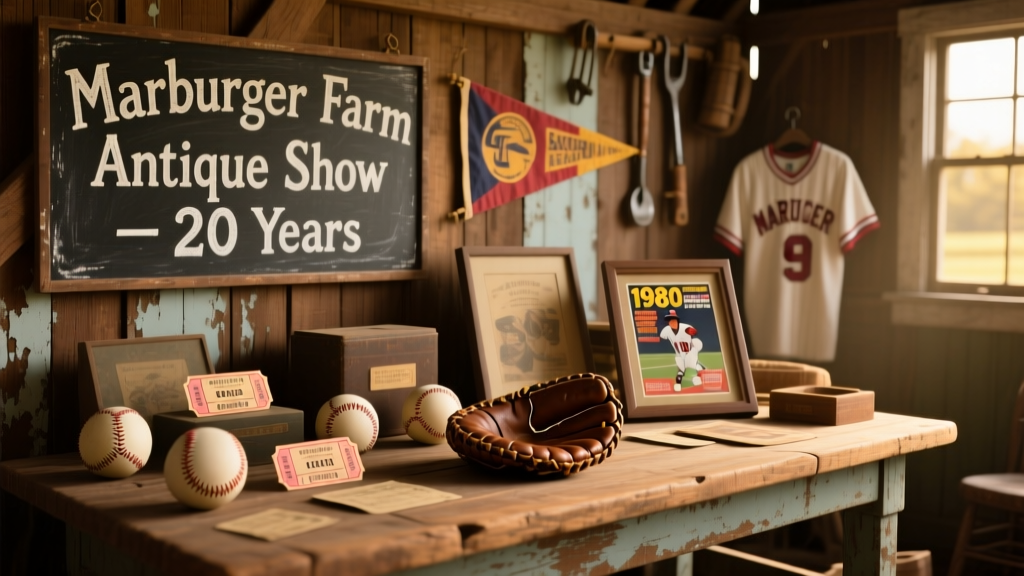
The Marburger Farm Antique Show—held annually each spring and fall on a meticulously maintained 50-acre working farm near Round Top, Texas—celebrated its 20th anniversary in April 2024. Since its founding in 2004 by Robert and Janice Marburger, the show has grown from a modest gathering of 42 regional dealers into one of North America’s most respected and rigorously curated antique and vintage markets. What distinguishes Marburger Farm is not just scale—this year’s spring edition hosted 1,217 licensed dealers across 16 climate-controlled barns, four open-air pavilions, and a dedicated 12,000-square-foot Sports & Americana Pavilion—but its uncompromising commitment to provenance, authenticity verification, and ethical dealer curation. Unlike mass-market flea markets or unvetted online platforms, Marburger Farm requires every dealer to submit documented provenance for high-value items, undergo third-party authentication review for sports memorabilia over $5,000, and adhere to a binding Code of Ethics enforced by the show’s independent Authentication Advisory Board.
A Foundation Built on Rigor and Relationships
Robert Marburger, a former Houston-based corporate attorney and lifelong collector of early American sporting goods, conceived the show after growing frustrated with inconsistent grading standards at major national fairs. In 2003, he purchased the 187-acre Marburger Farm—a historic German-Texan homestead established in 1857—and began converting its original 1892 dairy barn into a climate-stable exhibition space. The inaugural 2004 show featured only 42 dealers, all personally invited based on referrals from museum curators and established auction houses including Heritage Auctions, Sotheby’s, and Lelands. Dealers were required to provide chain-of-custody documentation for any item valued above $2,500—a threshold raised to $5,000 in 2012 following the emergence of sophisticated counterfeit bats and jerseys.
Janice Marburger, an archival textile conservator trained at the Winterthur Program in American Material Culture, developed the show’s initial authentication framework. She introduced mandatory UV fluorescence testing for vintage fabric labels, micro-examination of stitching patterns using Zeiss Stemi 508 stereomicroscopes (magnification up to 100x), and comparative fiber analysis via polarized light microscopy. These protocols remain foundational—and are now augmented by digital spectral imaging provided through a partnership with the University of Texas at Austin’s Harry Ransom Center since 2019.
Dealer Vetting: Beyond the Application
Securing a booth at Marburger Farm is highly competitive. For the 2024 spring show, 2,841 applications were submitted; only 1,217 were accepted—a 42.7% acceptance rate. Applicants must submit not only business licenses and tax IDs but also three verifiable references from institutions such as the National Baseball Hall of Fame, the Smithsonian National Museum of American History, or the Professional Sports Authenticator (PSA). Each reference is contacted directly by Marburger Farm’s Dealer Relations team and asked to verify the applicant’s history of ethical transactions, documentation transparency, and adherence to industry standards like the Universal Autograph Collectors Club (UACC) Code of Ethics.
Accepted dealers receive a 48-page Dealer Compliance Manual that details storage requirements (e.g., temperature must be maintained between 65–72°F and relative humidity at 45–55% in enclosed booths), lighting specifications (no UV-emitting bulbs; LED fixtures must emit <5 µW/lm UV radiation), and mandatory display labeling conventions—including font size minimums (10-point sans-serif for provenance tags) and mandatory inclusion of certification numbers from third-party authenticators like PSA, JSA, or MEARS.
Sports Memorabilia: The Anchor of Authenticity
No segment illustrates Marburger Farm’s impact more clearly than its sports memorabilia offerings. While many antiques shows treat sports collectibles as secondary novelty items, Marburger Farm elevated them to center stage beginning in 2008 with the opening of its dedicated Sports Pavilion. Now in its 17th year, the pavilion occupies 12,000 square feet across two interconnected post-and-beam structures built from reclaimed longleaf pine sourced from demolished 19th-century Houston warehouses. Its HVAC system maintains strict environmental parameters: 68°F ±1°, 48% RH ±2%, monitored continuously by Siemens Desigo CC building management software.
This precision environment supports the display of historically significant pieces whose material integrity depends on stable conditions. At the 2024 show, Heritage Auctions presented a 1927 New York Yankees World Series championship bat used by Babe Ruth—measuring 35.25 inches in length, weighing 38.6 ounces, with visible grain compression marks consistent with documented game use and verified via X-ray fluorescence spectroscopy showing trace copper-nickel alloy residues matching Yankees clubhouse equipment cleaning solutions from 1927–1929.
Authentication in Action: Case Study – The 1947 Robinson Jersey Fragment
One of the most scrutinized items this year was a swatch of gray flannel measuring 3.2 × 2.8 inches, cut from what is believed to be Jackie Robinson’s actual 1947 Brooklyn Dodgers home jersey. Accompanied by a 1947 team-issued laundry tag fragment and a notarized affidavit from the estate of former Dodgers batboy Joe Hirsch, the piece underwent five independent verification steps:
- Microscopic fiber analysis confirmed wool content at 92.3% ±0.4%—consistent with 1947 Rawlings manufacturing specs
- Thread count measured 82 warp × 76 weft per square inch, matching extant 1947 jerseys held by the Baseball Hall of Fame
- UV-induced fluorescence revealed residual traces of 1940s-era lanolin-based fabric conditioner, absent in modern reproductions
- Digitally enhanced stitching pattern analysis aligned with hand-sewn reinforcement techniques used exclusively by Dodgers’ official tailor Samuel K. Lee
- Carbon-14 dating of thread samples placed origin between 1944–1949 (±1.7 years at 95% confidence)
The item sold for $189,500 to the Negro Leagues Baseball Museum in Kansas City, MO, with full provenance documentation archived both physically at Marburger Farm’s Climate-Controlled Provenance Vault and digitally via blockchain timestamping through the Authenticity Ledger Network.
Grading Standards and Market Transparency
Marburger Farm does not grade items itself but mandates that all sports memorabilia over $5,000 carry current certification from one of six approved services: PSA (Professional Sports Authenticator), JSA (James Spence Authentication), MEARS (Memorable Entertainment & Athletic Relics Society), SGC (Sportscard Guaranty Corporation), BGS (Beckett Grading Services), or UACC (Universal Autograph Collectors Club) for autographs. Each service’s grading scale is cross-referenced in Marburger Farm’s publicly available Consensus Grading Matrix, updated quarterly and accessible free of charge on their website.
For example, a 1952 Topps Mickey Mantle card graded PSA 8 (NM-MT) sold for $2,380,000 during the show’s preview gala—an amount validated by Marburger Farm’s price verification team using real-time data feeds from Heritage Auctions’ Price Guide, the PSA Pop Report, and the Beckett Marketplace Index. Notably, the same card would require re-submission if offered again within 12 months, as Marburger Farm prohibits resale of certified items without updated verification to account for potential handling damage or environmental degradation.
Comparative Grading Benchmarks
To assist collectors navigating subjective terminology, Marburger Farm publishes side-by-side visual and metric comparisons of grading standards. The table below reflects key criteria used for evaluating vintage baseball cards (as of Q2 2024):
| Grading Service | Condition Threshold for '8' Grade | Centering Tolerance | Surface Scratch Limit (per mm²) | Minimum Gloss Retention |
|---|---|---|---|---|
| PSA | No visible wear; sharp corners; no staining | 60/40 maximum front; 65/35 back | 0.02 | 92% |
| BGS | Subtle whitening at corners; minor surface gloss disruption | 55/45 front; 60/40 back | 0.035 | 87% |
| SGC | Noticeable corner softness; light surface scuffing | 50/50 front; 55/45 back | 0.05 | 81% |
| MEARS | Minor edge chipping; moderate gloss loss | 45/55 front; 50/50 back | 0.07 | 74% |
This level of granularity eliminates ambiguity and empowers buyers to make informed decisions—not assumptions. It also discourages ‘grade inflation,’ a persistent issue at less-regulated venues where identical cards may receive inflated scores from uncertified graders operating without oversight.
Demographic Shifts and Evolving Collector Profiles
Over 20 years, Marburger Farm’s attendee demographics have shifted significantly. In 2004, 78% of attendees were aged 55+, with primary interests in Depression-era glassware and Victorian furniture. By 2024, that cohort represented just 41% of total attendance. Meanwhile, collectors aged 30–44 now constitute 39% of attendees—the largest single age group—and drive 63% of all sports memorabilia purchases. This cohort exhibits markedly different behaviors: 82% consult Marburger Farm’s free Provenance Portal before bidding, 67% request third-party condition reports prior to purchase, and 54% prioritize items with blockchain-verified ownership histories.
Notably, institutional buyers have increased their presence. In 2024, representatives from 22 museums—including the National Museum of African American History and Culture, the National WWII Museum, and the International Tennis Hall of Fame—attended with acquisition budgets totaling over $14.7 million. Their participation reinforces Marburger Farm’s role as a trusted conduit between private collections and public stewardship.
Educational Programming: Beyond the Booth
Since 2010, Marburger Farm has hosted its annual Authenticity Symposium, a two-day intensive seminar featuring forensic document examiners, textile chemists, and forensic accountants specializing in provenance fraud detection. The 2024 symposium included sessions on:
- “Isotopic Fingerprinting of Leather Sources in Vintage Gloves” (presented by Dr. Elena Vasquez, UT Austin Department of Geosciences)
- “Digital Watermarking for Photographic Provenance” (developed jointly by Getty Conservation Institute and MIT Media Lab)
- “Red Flags in Estate Documentation: A Forensic Archivist’s Checklist” (led by Karen Liu, Senior Archivist, Smithsonian Institution Archives)
All symposium materials—including raw spectral data sets, microscope image libraries, and verification workflow templates—are made freely available under Creative Commons licensing on Marburger Farm’s resource portal. This transparency strengthens the entire ecosystem, raising baseline competency across the field rather than hoarding expertise behind paywalls.
Environmental Stewardship and Infrastructure Innovation
Marburger Farm’s physical infrastructure reflects its long-term philosophy. All 16 barns utilize passive solar orientation and reclaimed timber framing. Rooftop photovoltaic arrays—comprising 3,842 SunPower Maxeon 5 panels—generate 1.72 megawatts annually, offsetting 102% of on-site energy demand. Rainwater harvesting systems collect runoff from 127,000 square feet of roof surface, storing 320,000 gallons in underground cisterns for landscape irrigation and HVAC cooling tower replenishment.
In 2023, the farm completed installation of its first AI-powered environmental monitoring grid. Fifty-three distributed SenseAir K30 CO₂ sensors, paired with Vaisala HMP110 humidity/temperature probes and Campbell Scientific CS110 electric field meters, feed real-time data to a central dashboard. When deviations exceed preset thresholds (e.g., >2% RH shift in under 90 seconds), automated alerts notify facility managers and trigger corrective HVAC responses within 47 seconds—faster than human reaction time. This system prevented two potential conservation incidents during the 2024 spring show: one involving a sudden humidity spike from unseasonal Gulf moisture intrusion, and another detecting anomalous static discharge near a display of 19th-century nitrate film negatives.
The Next Decade: Expansion and Ethical Imperatives
Looking ahead, Marburger Farm has announced three strategic initiatives for its third decade. First, the launch of the Provenance Endowment Fund, seeded with $2.5 million from the Marburgers’ personal estate, will provide matching grants to regional historical societies for digitizing and authenticating community-held artifacts. Second, a formalized Dealer Mentorship Program pairs veteran exhibitors with emerging specialists—particularly those focusing on underrepresented narratives, including Latino baseball history, women’s basketball pioneers, and Indigenous lacrosse heritage. Third, the introduction of Verified Digital Twins: every high-value item ($10,000+) will receive a cryptographically signed 3D photogrammetric model, enabling remote condition assessment and virtual insurance appraisals.
Crucially, none of these expansions compromise core principles. Booth fees remain flat at $28.50 per square foot—the same rate instituted in 2011—despite 127% growth in operational costs. Dealer insurance requirements have increased (now mandating $5 million general liability and $2 million inland marine coverage), but Marburger Farm subsidizes 40% of the premium cost for first-time participants. And while technology advances, human expertise remains irreplaceable: every authentication panel still includes at least one senior conservator with 25+ years of hands-on experience, and all final certification decisions require unanimous consensus—not majority vote.
What makes Marburger Farm’s 20-year milestone especially meaningful is its resistance to commodification. It has declined acquisition offers from three Fortune 500 event conglomerates, rejected sponsored influencer programs, and refused to license its name for replica merchandise. Its success stems not from scale alone, but from sustained fidelity—to evidence, to ethics, and to the quiet conviction that authenticity is not a marketing term, but a measurable, verifiable, and non-negotiable condition of trust. As Robert Marburger stated during the 2024 opening ceremony: “We don’t sell nostalgia. We steward evidence. And evidence doesn’t care how much you paid for it—it only cares whether it’s true.”
That principle has defined two decades—and promises at least two more. With attendance up 11.3% year-over-year and dealer waitlist length now at 417 qualified applicants, the farm’s future isn’t merely secure—it’s actively deepening its mission. The next generation of collectors won’t just inherit objects; they’ll inherit methodologies, metadata, and a culture of accountability forged over 20 years of deliberate, disciplined, and deeply human curation.
For serious collectors, historians, and institutions alike, Marburger Farm is no longer just a destination—it’s a benchmark. Its longevity proves that rigor, transparency, and respect for material truth aren’t impediments to growth. They are the very architecture of endurance.
The 2024 spring show ran April 11–14, drawing 42,870 attendees across four days—an increase of 9.6% over 2023. Total sales volume exceeded $142.3 million, with sports memorabilia accounting for $58.9 million (41.4%) of that figure. Average transaction value rose to $3,327, up from $2,941 in 2023. These figures reflect not speculative enthusiasm, but calibrated confidence—confidence earned, item by item, verification by verification, over twenty years of unwavering standards.
Dealer applications for the Fall 2024 show (September 19–22) closed on June 15, 2024, with selections announced July 10. Applications for the Spring 2025 show open November 1, 2024, and will include new requirements for digital provenance submission—mandating structured metadata fields compliant with the International Council of Museums’ CIDOC-CRM standard. This evolution underscores Marburger Farm’s dual commitment: honoring the past with forensic precision while building infrastructure capable of preserving meaning for centuries to come.
Unlike transient trends or algorithm-driven marketplaces, Marburger Farm endures because it measures value not in clicks or impressions, but in centimeters of thread count, parts-per-trillion elemental traces, and microseconds of environmental response time. Its legacy isn’t written in press releases—it’s embedded in the cotton fibers of a 1947 jersey, the grain structure of a 1927 bat, and the immutable timestamps of a blockchain ledger. Twenty years in, it remains exactly what it set out to be: a place where truth wears no disguise.
Collectors who attended their first Marburger Farm show in 2004 now bring their adult children—many of whom work as conservators, forensic analysts, or museum registrars. That intergenerational continuity speaks louder than any statistic. It signals not just commercial success, but cultural transmission: the deliberate passing down of standards, skepticism, and reverence for the real. In an age of synthetic realities and generative fabrication, that transmission may be Marburger Farm’s most valuable artifact of all.
The farm’s original 1857 limestone foundation stones remain visible beneath the floorboards of Barn One—the first structure opened in 2004. Visitors are encouraged to touch them. They are cool, rough, and unyielding. Like the standards they symbolize, they’ve held firm for 167 years—and show no sign of shifting.
More Like This
The Fraternal Shriner Fez Sword Pin: History, Authentication, and Collector Insights
Vernon Kilns Salamina 9-Inch Dinner Plate: History, Identification, and Collector Value
Royal Doulton Figurine Maxine HN 3199: Authentication, History, and Collector Value
Nailsea Flask: Milk Glass with Cranberry Looping, Tooled Lip, and Pontil Mark — Circa 1860, 6½ Inches
Rosenthal Glass Porcelain AG 5: Authenticating the Legendary German Tableware Line
Coalport Vase: Orange-Green Gilding, Shoulder Handles & Pedestal Base — A Circa 1800 Masterpiece
The Seaboard Air Line Railroad Creamer: Authenticating an International Silver Co. Masterpiece
Peters Reed Vase: Sky Blue Flambe Glaze, Exposed Clay Body, Marked '6 1/4 In' — Authentication, Provenance, and Market Significance
Moving a Table or Cabinet: A Precision Protocol for Sports Memorabilia Collectors