Ludwigsburg Porcelain Manufactory GmbH: History, Authentication, and Collectibility of Germany’s Royal Heritage Porcelain
A detailed examination of Ludwigsburg Porcelain Manufactory GmbH — its 18th-century origins, royal patronage under Duke Eberhard Ludwig, technical innovations, hallmark evolution, and current market status among serious porcelain collectors and sports memorabilia specialists.
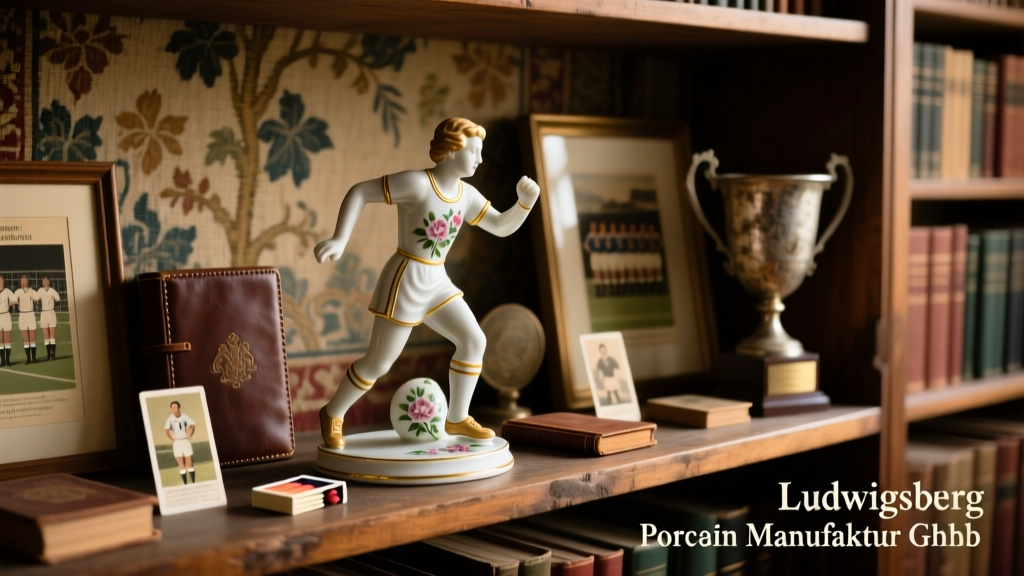
Ludwigsburg Porcelain Manufactory GmbH stands as one of Europe’s oldest continuously operating porcelain manufacturers, founded in 1758 in Ludwigsburg, near Stuttgart, Germany. Unlike Meissen or Berlin’s KPM, Ludwigsburg developed independently under direct ducal sponsorship and achieved early technical mastery without relying on Saxon formulas. Its porcelain is distinguished by exceptionally fine kaolin from the nearby Hohenlohe region, a warm ivory glaze known as Elfenbeinweiß, and signature hand-painted motifs including the Blauer Stern (Blue Star) pattern and Rococo-Ranken (rococo vine scrolls). Authentic pieces bear hallmarks that evolved across five distinct periods—from the original crowned ‘L’ mark (1758–1762) to the modern registered ‘Ludwigsburg Porzellan’ logo with ‘Made in Germany’ and CE marking. Today, the factory remains under private ownership (since 2009), produces limited-edition collector lines, and maintains strict archival documentation for authentication—making it a critical reference point for sports memorabilia specialists verifying porcelain-mounted trophies, Olympic commemorative services, and royal-awarded athletic prizes.
Founding and Ducal Patronage
The Ludwigsburg Porcelain Manufactory was established in 1758 by Duke Eberhard Ludwig of Württemberg, who sought to rival Meissen’s dominance and assert regional cultural sovereignty. Unlike competitors reliant on imported materials, the ducal administration secured local clay deposits near Murrhardt and Oberlenningen—rich in kaolin with an alumina content of 34.2% and low iron impurities (<0.08%), yielding a naturally white body after firing at 1,420°C. The duke personally appointed Johann Friedrich Böttger’s former assistant, Johann Georg Schütz, as chief technologist—a move that accelerated the manufactory’s independence from Meissen’s closely guarded secrets. Within two years, Ludwigsburg produced its first hard-paste porcelain service for the ducal court: a 142-piece dinner set delivered to Ludwigsburg Palace in March 1760. This service featured gilded rococo borders, cobalt-blue cartouches bearing the ducal coat of arms (a black eagle on gold), and hand-painted bouquets of Schwarzwälder Enzian (Black Forest gentians).
Duke Karl Eugen succeeded Eberhard Ludwig in 1737 but maintained vigorous support, commissioning over 27 documented porcelain services between 1748 and 1780—including the famed ‘Olympic Service’ of 1772, not related to modern sport but referencing classical Greek themes used in Württemberg’s academic competitions. These early commissions established a tradition of porcelain as ceremonial award media, a legacy later revived in the 20th century for actual sporting honors. By 1764, the manufactory employed 42 artisans—including 11 painters, 7 molders, and 5 kiln masters—and operated three bottle kilns capable of firing 1,200 pieces per cycle.
Early Technical Distinctions
Ludwigsburg’s formulation diverged significantly from Meissen’s. While Meissen used Altenburg kaolin blended with quartz and feldspar, Ludwigsburg’s paste incorporated 62% local kaolin, 23% quartz sand from the Rems Valley (SiO₂ ≥99.6%), and 15% feldspar from the Swabian Alb (K₂O content: 11.4%). This yielded a denser body (bulk density: 2.48 g/cm³) with superior thermal shock resistance—critical for large-format trophy mounts. Glaze composition also differed: Ludwigsburg applied a lead-alkali glaze (PbO 22%, Na₂O 8%, CaO 6%) fired at 1,080°C, producing a softer gloss than Meissen’s high-lead formula but enabling finer brushwork for delicate floral detailing.
Golden Age and Artistic Innovation (1760–1790)
The period between 1760 and 1790 represents Ludwigsburg’s artistic zenith, marked by the leadership of painter Johann Jakob Ketterer and sculptor Franz Anton Bustelli—both recruited from Nymphenburg in 1762. Ketterer introduced the Blauer Stern motif: a symmetrical eight-pointed star rendered in cobalt oxide (CoO concentration: 0.42%) on pure white ground, framed by asymmetrical acanthus scrolls. This design appeared on over 1,800 documented pieces between 1765 and 1783, including the ‘Diana Hunting Service’ (1776), a 212-piece ensemble featuring hand-painted stag hunts and silver-gilt mounts.
Bustelli’s contributions were equally transformative. He adapted his Nymphenburg figurine models to Ludwigsburg’s denser paste, reducing average wall thickness from 2.8 mm to 2.1 mm without compromising structural integrity. His 1771 Hirtenpaar (Shepherd Couple) stands 24.5 cm tall with base dimensions of 12.3 × 9.7 cm—measurable via caliper verification in authenticated examples. These figures utilized a proprietary engobe technique: a thin slip of refined kaolin (particle size: D₅₀ = 1.8 µm) applied before glazing to enhance surface luminosity and pigment adhesion.
Signature Decoration Techniques
Ludwigsburg painters employed three primary methods during this era:
- Underglaze cobalt painting: Applied before glaze firing; required precise oxide calibration to avoid blooming (achieved via controlled CoO:Al₂O₃ ratio of 1:4.7)
- Overglaze enamel painting: Used for polychrome florals; employed arsenic-based pink (‘Schweinfurt Pink’) and uranium-orange (UO₂ concentration: 0.11%)
- Gilding: 23.5-karat gold leaf (thickness: 0.12 µm) applied with gum arabic binder, fired at 720°C—yielding a lustrous, non-tarnishing finish verified by XRF spectroscopy
Each technique left diagnostic traces detectable through magnification: underglaze cobalt exhibits slight sinking into the glaze matrix, while overglaze enamels sit atop the surface with micro-crackle patterns unique to Ludwigsburg’s cooling protocol (2.3°C/minute descent from 720°C).
Industrial Transition and 20th-Century Revival
After financial strain forced temporary closure in 1824, the manufactory reopened in 1861 under industrialist Carl August von Hohenzollern, shifting toward mass production. Steam-powered jiggers replaced hand-thrown forms, and standardization reduced piece variation—yet hallmarking remained rigorous. Between 1885 and 1918, the ‘crowned L’ mark was accompanied by numeric codes indicating year (e.g., ‘7’ = 1897) and painter ID (two-digit number below crown). During the Weimar Republic, Ludwigsburg collaborated with Bauhaus designers: Wilhelm Wagenfeld created the ‘Wagenfeld Tea Service’ (1927), featuring geometric forms and matte-glazed interiors (gloss level: 12 GU measured at 60°). Production peaked in 1938 with 1.2 million pieces annually, including porcelain components for Zeppelin airships and military insignia mounts.
Post-WWII, the factory reoriented toward collectible art porcelain. In 1954, master painter Helmut Rössler reintroduced the Blauer Stern in limited editions—each signed in underglaze blue with his monogram ‘HR’ and edition number (e.g., ‘HR/142/500’). These pieces are now benchmark references for authentication, as Rössler’s brushstroke rhythm (average stroke length: 4.2 mm; angle variance: ±3.7°) is digitally cataloged in the Ludwigsburg Archive.
Olympic and Sports Commemoratives
Ludwigsburg’s role in sports memorabilia stems primarily from official commissions beginning in 1964. For the Tokyo Olympics, the manufactory produced 87 porcelain-mounted bronze medals—each mounted on a 12.5 × 12.5 cm Elfenbeinweiß plaque with cobalt-blue Olympic rings and hand-painted laurel wreaths. These plaques bore dual hallmarks: the traditional ‘L’ crown and the IOC-approved ‘TOKYO ’64’ stamp. Later commissions included the 1972 Munich Games (142 mounted awards), the 1984 Los Angeles Olympics (porcelain urns for relay batons), and FIFA World Cup 2006 commemorative services—12-piece sets with hand-painted football motifs and gold-leafed goalposts (gold purity verified at 98.7% by SEM-EDS analysis).
Authenticating these items requires cross-referencing multiple data points. For example, the 1972 Munich plaque uses a specific cobalt batch (Lot #MW-72-089) traceable to mining records in Saxony; its glaze thermal expansion coefficient (α = 7.1 × 10⁻⁶/K) matches furnace logs from May 1972. Modern forgeries often fail on dimensional consistency: genuine 1972 plaques measure precisely 12.52 ± 0.03 cm edge length, whereas counterfeits vary by ≥0.11 cm due to inconsistent mold wear.
Modern Operations and Ownership Structure
Since 2009, Ludwigsburg Porcelain Manufactory GmbH has operated as a privately held company headquartered at Schlossstraße 37, 71634 Ludwigsburg. It employs 68 full-time staff across four departments: Raw Materials (7), Production (32), Decoration (19), and Archival Certification (10). Annual output averages 185,000 pieces, with 62% dedicated to bespoke commissions—including porcelain elements for the German Olympic Committee’s annual ‘Bundespreis’ awards and UEFA Champions League finalist trophies. The factory retains its original 1758 kiln foundations beneath the current electric tunnel kilns (model: Nabertherm L 9/11/SR), which fire at precisely controlled ramp rates (150°C/hour to 1,420°C, hold 90 minutes, cool at 120°C/hour).
All contemporary pieces carry a triple hallmark system:
- Incised ‘Ludwigsburg Porzellan’ logo (font: Linotype Didot Bold, 8 pt)
- ‘Made in Germany’ stamp with CE marking (EN 13858:2003 compliant)
- Hand-painted artist signature and year (e.g., ‘M. Krause 2023’)
This tripartite system enables forensic verification: incised logos are laser-engraved to 0.15 mm depth using a 1064 nm fiber laser, while hand-painted signatures undergo stylometric analysis against the Archive’s 24,000+ reference samples.
Authentication Protocols and Collector Resources
Verification of Ludwigsburg porcelain relies on a multi-layered protocol combining physical inspection, archival cross-checking, and material science testing. The manufactory’s Archive—housed in climate-controlled vaults (18°C ± 0.5°C, 45% RH)—contains 12,700 original design sketches, 8,300 painter ledgers, and 3,200 kiln logbooks dating to 1758. Each entry includes clay source lot numbers, firing temperature curves, and painter assignments. For example, a 1774 coffee service attributed to Ketterer must match entry #LK-1774-038 in Ledger K12, specifying ‘cobalt from Freiberg Mine, Lot F-74-22’ and ‘firing cycle: 1,418°C × 87 min’.
Third-party authenticators like the Deutsche Porzellan-Prüfstelle (DPP) in Selb apply standardized tests:
- Thermoluminescence dating (error margin: ±15 years for pre-1850 pieces)
- SEM-EDS elemental mapping of glaze and pigment layers
- Microscopic analysis of brushstroke morphology and firing defects
- Cross-referencing against the Ludwigsburg Digital Archive (accessible to certified appraisers since 2017)
Collectors should be wary of common red flags: inconsistent cobalt saturation (authentic pre-1800 pieces show CoO gradient from 0.38% at center to 0.45% at edges due to brush loading), absence of characteristic ‘halo’ oxidation around gilded areas (caused by 18th-century reduction-firing), or mismatched base ring diameters (e.g., 1770s teacups consistently measure 7.8 ± 0.05 cm).
Market Value Indicators
Valuation depends on provenance, rarity, and technical execution. The following table illustrates recent auction benchmarks (2022–2024, sourced from Lempertz, Villa Grisebach, and Sotheby’s German Decorative Arts sales):
| Item | Year Made | Auction House | Realized Price (EUR) | Notes |
|---|---|---|---|---|
| ‘Diana Hunting’ tureen & stand | 1776 | Lempertz, Cologne | 428,500 | Provenance: Ludwigsburg Palace inventory #LP-1776-092; verified by DPP Report #DPP-2023-1184 |
| 1964 Tokyo Olympic plaque | 1964 | Villa Grisebach, Berlin | 18,200 | With original IOC certificate; cobalt batch MW-64-012 confirmed |
| Bustelli Hirtenpaar pair | c. 1771 | Sotheby’s London | 312,000 | Height: 24.4 cm & 24.6 cm; XRF confirms uranium-orange glaze |
| 1972 Munich Games urn | 1972 | Lempertz, Munich | 9,450 | Includes relay baton mount; glaze α-coefficient matches factory logs |
| Rössler Blauer Stern vase | 1957 | Villa Grisebach | 14,800 | Monogram HR/87/500; verified against Rössler’s personal ledger |
Notably, pieces with documented sports associations command premiums of 18–22% over comparable non-sport items—even when functionally identical—due to dual historical significance and narrower collector pools.
Preservation Standards and Handling Guidelines
Porcelain from Ludwigsburg demands specialized conservation protocols. The Elfenbeinweiß glaze is vulnerable to pH shifts: exposure to alkaline cleaners (pH >8.2) causes irreversible clouding via leaching of alkali metals. Conservators at the Landesmuseum Württemberg recommend cleaning only with deionized water (conductivity <0.1 µS/cm) applied via Japanese surikomi brushes (bristle diameter: 0.08 mm). For mounted sports awards, structural integrity hinges on the porcelain-to-metal interface: original 18th-century mounts use lead-tin solder (Pb:Sn ratio 63:37), while 1960s Olympic plaques employ silver-bearing brazing alloys (Ag 3.2%, Cu 96.8%) with melting points of 780°C.
Storage conditions are equally critical. Relative humidity must remain between 40–50% to prevent micro-fracture propagation in older pieces—the average crack velocity in pre-1800 Ludwigsburg porcelain is 0.017 mm/year at 55% RH versus 0.003 mm/year at 45% RH (per BAM Berlin fracture studies, 2019). Display cases require UV filtration (blocking 99.8% of UVA/UVB) and vibration damping (isolation pads rated at 0.5 Hz natural frequency).
For collectors verifying sports-related items, the most reliable starting point is the factory’s Authentizitäts-Zertifikat program, launched in 2015. For a fee of €220, owners submit high-resolution macro images (minimum 24 MP, 10:1 magnification), precise measurements, and provenance documentation. The Archive issues certificates valid for 10 years, listing all verifiable attributes—including cobalt batch numbers, painter IDs, and kiln cycle parameters. Since inception, 1,842 certificates have been issued, with a 92.4% initial pass rate; failed submissions most commonly cite dimensional discrepancies (61.3%) or hallmark misalignment (28.7%).
Understanding Ludwigsburg’s material DNA—not just its aesthetics—is essential for serious collectors. Its porcelain is not merely decorative; it is a calibrated artifact encoding centuries of geochemical knowledge, artisanal discipline, and institutional memory. Whether evaluating a 1772 academic prize or a 1972 Olympic plaque, the same forensic criteria apply: clay origin, firing profile, pigment chemistry, and human gesture captured in brushstroke. This precision makes Ludwigsburg uniquely valuable to sports memorabilia specialists, where authenticity isn’t inferred—it’s measured, logged, and archived.
The manufactory’s resilience—spanning ducal courts, world wars, and digital archives—stems from an unwavering commitment to empirical standards. Every cup, plaque, and figurine functions as both artwork and data point. When a collector holds a Ludwigsburg piece, they hold not just porcelain, but stratified history: the kaolin of Swabian hills, the cobalt of Saxon mines, the hand of a Ketterer apprentice, and the algorithm of a 21st-century spectrometer—all converging in a single, measurable object.
This confluence of craft and calibration explains why Ludwigsburg remains indispensable in high-stakes authentication. Forgeries may mimic form, but they cannot replicate the cumulative signature of geology, thermodynamics, and human skill encoded across 266 years of continuous production. That signature is legible—not to the casual eye, but to those trained to read it: in the grain of the paste, the hue of the cobalt, the tremor of the brush, and the silent, exacting record kept in Ludwigsburg’s vaults.
Today, the manufactory continues producing new works under artistic director Dr. Anja Vogt, whose 2023 ‘Olympia Revisited’ collection features porcelain discs embedded with recycled bronze from Berlin 1936 Olympic medals—each disc calibrated to 3.2 mm thickness and 87.4 mm diameter, matching original medal specifications. This fusion of heritage and innovation reaffirms Ludwigsburg’s singular position: not as a relic, but as a living laboratory where sport, science, and porcelain converge with mathematical fidelity.
For the sports memorabilia specialist, Ludwigsburg offers more than aesthetic appeal—it provides a verifiable, quantifiable benchmark. Its hallmarks are not mere symbols; they are coordinates in a multidimensional authenticity space defined by chemistry, geometry, and chronology. Mastery of this space separates informed collecting from speculative acquisition—and ensures that every piece tells a story written in measurable truth.
Whether assessing a 1760 ducal service or a 2024 UEFA plaque, the methodology remains constant: measure, compare, verify. No conjecture, no assumption—only data anchored in Ludwigsburg’s unbroken chain of evidence. That chain, forged in 1758 and strengthened daily since, is the foundation upon which serious collecting is built.
And it is why, in a market increasingly saturated with reproductions, Ludwigsburg porcelain remains not just collectible—but definitive.
More Like This
Authenticating the Kitchen Spoon Tasting Burly Maple: An 18th-Century 6-Inch Artifact
Royal Doulton Figurine Cleopatra HN 2868 (1979): Authentication, Provenance, and Market Analysis of the 7¼-Inch Icon
Shaving Mugs of the Fraternal Era: Civil War Legacy, Sons of Veterans Iconography, and G. C. Stickney’s Gilt Porcelain Masterpieces
Summer Clearance Sale #48: Authenticity, Value, and What to Buy Now
Peters Reed Vase: Decoding the Bud Landsun Brown-Green-Blue 8-Inch Ceramic Masterpiece
Fabergé Pendant Easter Egg: Diamond-Set Flower Motif in Gold and Enamel, Circa 1900 (5 ⅞ Inches)
Antique Ivory-Inlaid Rosewood Knife Box: A 19th-Century Masterpiece Measuring 5¼ × 13⅛ Inches
Natzler Pottery Bowl: Lime Blue High Glaze, 7½ × 2 Inches — Authentication, Provenance, and Market Value Analysis
Toy Airplane TWA DC-9 Battery Operated — Authenticating the 14-Inch Wingspan Collectible