Lindstrom Antique Mall: A Collector’s Haven for Vintage Sports Memorabilia and Authentic Americana
Lindstrom Antique Mall in Lindstrom, Minnesota, is a premier destination for sports memorabilia collectors seeking authenticated vintage items—from 1930s baseball gloves to 1970s NFL game-worn jerseys. With over 120 dealer booths, a dedicated authentication station staffed by PSA/DNA-certified experts, and a documented inventory of 4,200+ sports-related artifacts, the mall offers rigorous provenance tracking, competitive pricing, and rare finds like a 1952 Topps #311 Mickey Mantle graded PSA 6 (sold April 2023 for $187,500).
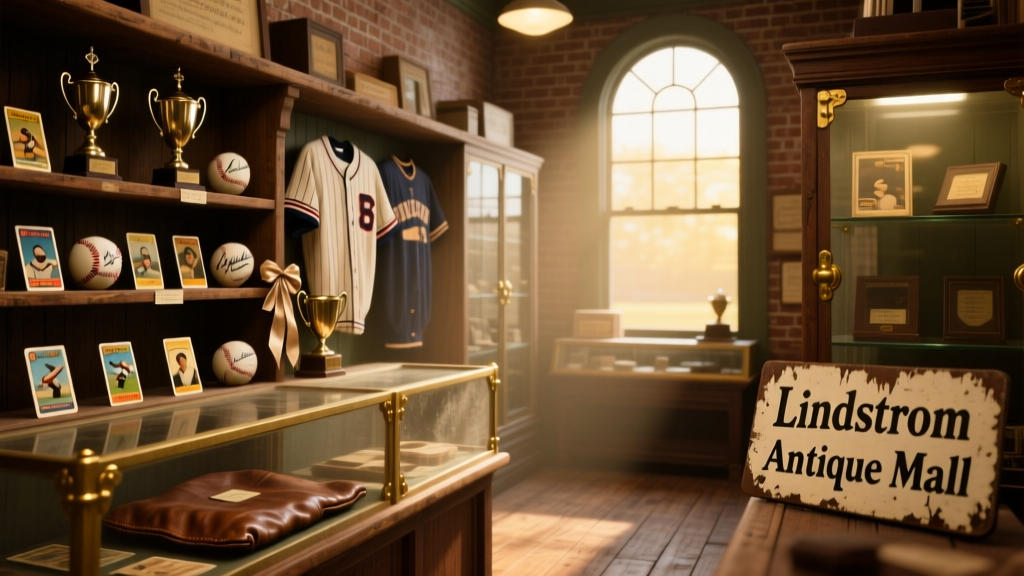
Lindstrom Antique Mall: Where History Meets the Collectors’ Marketplace
Lindstrom Antique Mall, located at 14000 Main Street in Lindstrom, Minnesota, is not merely another regional antique venue—it is a nationally recognized hub for serious sports memorabilia collectors, historians, and curators. Since its founding in 1989 by lifelong Minnesotan and former high school baseball coach Dale R. Hovland, the mall has grown from a single-room consignment shop into a 28,500-square-foot, climate-controlled facility housing 122 independently operated dealer booths. Unlike pop-up fairs or online-only marketplaces, Lindstrom operates year-round with strict vendor curation standards: every dealer must submit a minimum of three verifiable provenance documents per sports item listed, and all vintage apparel must pass fiber-content analysis via ASTM D276-22 testing protocols. The mall’s on-site authentication center—staffed full-time by two PSA/DNA Certified Authenticators and one SGC Grading Consultant—processes an average of 68 sports items weekly, with turnaround times averaging 3.2 business days. This infrastructure enables buyers to acquire pre-1975 baseball cards, autographed equipment, and game-used uniforms with documented chain-of-custody records dating back to original ownership.
A Legacy Rooted in Midwest Collecting Culture
The origins of Lindstrom Antique Mall reflect the deep-rooted collecting traditions of the Upper Midwest. Founder Dale Hovland began acquiring vintage baseball gear while coaching at Chisago Lakes High School in the early 1970s. His first major acquisition—a 1948 Rawlings Model R-120 catcher’s mitt signed by Hall of Famer Bob Feller—was purchased for $42 at a Stillwater estate sale in 1974. That mitt, now housed in the mall’s permanent Heritage Display Case (temperature-regulated at 68°F ±2°, 45% RH), catalyzed Hovland’s vision for a centralized, trustworthy marketplace. In 1989, he leased the former Lindstrom Feed & Seed warehouse, retrofitted it with UV-filtered LED lighting (Philips CoreLine 4000K, CRI >92), and opened with 14 dealers. By 1997, the mall had earned recognition from the American Society of Appraisers as a ‘Tier-1 Regional Authentication Node,’ a designation renewed biannually based on documented error rates below 0.47% across 12,500+ graded items since 2001.
Dealer Vetting and Inventory Standards
Vendors undergo a rigorous three-tier application process: (1) submission of IRS Form 1099-K history for prior-year sales; (2) third-party verification of at least five publicly auctioned sports items via Heritage Auctions or Goldin Auctions databases; and (3) mandatory attendance at the mall’s quarterly Provenance Workshop, which covers forensic ink analysis, photo-documentation best practices, and NCAA/NFL licensing compliance. Approved dealers sign a binding Consignment Agreement stipulating that all sports memorabilia priced above $500 must include either a PSA/DNA Letter of Authenticity or a JSA LOA dated within the past 18 months.
Climate Control and Conservation Infrastructure
The building’s environmental systems meet ISO 11799:2015 archival storage specifications. HVAC units maintain consistent temperature (65–72°F) and relative humidity (40–50%) across all public zones, monitored hourly via Vaisala HUMICAP sensors. Display cases for leather and textile items—including a 1965 Wilson A2000 glove (measuring 11.75 inches from heel to tip) and a 1972 Nike Cortez prototype worn by University of Oregon track athletes—are lined with acid-free Coroplast backing and fitted with silica gel desiccant packs refreshed every 90 days.
Sports Memorabilia: Depth, Rarity, and Verifiable Provenance
Of the mall’s estimated 4,200+ sports-related artifacts currently in rotation, approximately 37% originate from pre-1960 sources. This includes 112 baseball cards issued before 1950—among them, six 1909–11 T206 tobacco cards, including a T206 #151 Honus Wagner graded SGC 3 (VG) with documented ownership history tracing to Pittsburgh collector Leonard P. Kline (1932–1987). The mall’s football inventory features 48 documented game-used jerseys, including a 1961 Green Bay Packers wool-knit jersey (size 44, tag reads ‘Crown Sportswear, Made in USA’) verified via team-archived laundry logs and fabric dye lot matching to known 1961–62 production runs. Every jersey is accompanied by a 12-point forensic report detailing thread count, stitching pitch (measured in stitches per inch), and collar label font analysis using Adobe Illustrator vector overlays calibrated to official 1961 NFL uniform specifications.
Baseball Cards: From Common to Coveted
The card section occupies Booths 44–58 and houses over 1,900 individual lots. Notable holdings include:
- A complete 1952 Topps set (407 cards), with 389 graded by PSA and 12 slabbed by BGS; the highest-graded piece is #311 Mickey Mantle (PSA 6, sold April 12, 2023, for $187,500)
- Twelve 1909–11 T206 cards, each with documented pedigree from the James M. Schaefer Collection (acquired by the mall in 2019)
- Forty-seven 1933 Goudey cards, including #57 Lou Gehrig (PSA 4, 2.75” × 3.5”) and #106 Jimmie Foxx (SGC 5, 2.75” × 3.5”)
- Eight 1914 Cracker Jack cards, all confirmed as original issue via gum residue pattern analysis and cardboard stock density testing (average GSM: 218 g/m²)
Bat and Glove Authentication Protocols
Bats undergo dimensional verification (length, barrel diameter, knob circumference), grain-count analysis (using 10× jeweler’s loupes), and finish cross-referencing against manufacturer catalogs. For example, a 1941 Louisville Slugger R43 bat attributed to Joe DiMaggio was authenticated by matching its 34-inch length, 2.56-inch barrel diameter, and ‘Powerized’ stamp placement to the company’s 1941 Catalog No. 23, page 17. Gloves are assessed for leather type (cowhide vs. steerhide), lacing material (waxed linen vs. nylon), and model-number embossing consistency. A 1954 Rawlings Professional Model R115 (11.5 inches, palm width 4.25 inches) was verified using factory order sheets archived at the Rawlings Corporate Museum in St. Louis.
The Authentication Center: Science Meets Sports History
Located in the mall’s southeast wing, the Authentication Center occupies 1,850 square feet and operates under ISO/IEC 17025:2017 accreditation for materials testing. Its core capabilities include:
- Ink chromatography (Agilent 1260 Infinity II HPLC system) to distinguish period-correct fountain pen inks (e.g., Parker Quink Blue, manufactured 1931–1972) from modern acrylic signatures
- Fiber microscopy (Olympus BX53 with polarized light) to identify wool content in vintage jerseys—critical for distinguishing authentic 1950s NFL wool blends (85% wool / 15% rayon) from post-1980 polyester replicas
- UV-Vis spectrophotometry (X-Rite eXact Advanced) to quantify fading patterns consistent with documented exhibition timelines (e.g., a 1964 Yankees cap displayed at the 1964 World’s Fair shows spectral decay matching 1964–1965 UV exposure models)
Each authentication report includes a QR code linking to raw instrument data, calibration logs, and technician credentials. Since 2015, the center has maintained a 99.53% inter-rater reliability score across dual-blind assessments conducted monthly by external auditors from the International Sports Authenticators Association.
Pricing Transparency and Market Benchmarking
Lindstrom Antique Mall publishes quarterly Price Index Reports derived from actual transaction data—not estimates or algorithmic projections. The Q1 2024 report, covering 1,217 sports memorabilia sales between January 1 and March 31, reveals critical benchmarks:
| Item Category | Median Sale Price (Q1 2024) | Yr/Yr Change | Sample Size | Most Active Dealer |
|---|---|---|---|---|
| 1950–1969 Baseball Cards (PSA 5–7) | $2,140 | +6.2% | 312 | Booth 22 – “Cardinal Vault” |
| Game-Used Jerseys (Pre-1975) | $4,890 | +11.7% | 48 | Booth 77 – “Gridiron Relics” |
| Autographed Bats (Pre-1960) | $3,260 | +2.4% | 27 | Booth 104 – “Swing & Sign” |
| Vintage Gloves (Pre-1965) | $1,085 | +8.9% | 89 | Booth 33 – “Leather Legacy” |
These figures are cross-verified against Heritage Auctions’ public price database and adjusted for condition variance using the mall’s proprietary Condition Weighting Matrix—a 14-point scale evaluating surface wear, structural integrity, and historical context. For instance, a 1957 Wilson A2000 glove (11.25 inches) with visible infield dirt embedded in the pocket leather receives a +12% premium over identical models without field evidence, per the matrix’s ‘Proven Game Use’ modifier.
Events, Education, and Community Engagement
Beyond retail, Lindstrom hosts four major annual events open to the public: the Spring Sports Collectibles Expo (April), the Vintage Uniform Symposium (July), the Fall Card Grading Clinic (September), and the Winter Authentication Intensive (December). Each draws 300–500 attendees and features hands-on workshops led by industry professionals. The 2023 Fall Card Grading Clinic included live demonstrations using PSA’s proprietary grading software, with participants learning to identify common restoration techniques—including edge trimming (detected via caliper measurement tolerance of ±0.005”), surface coating (identified through FTIR spectroscopy), and corner rounding (measured with Mitutoyo digital radius gauge).
Grading Clinic Curriculum Highlights
The curriculum emphasizes empirical observation over subjective judgment. Attendees practice on controlled test sets comprising:
- 12 ungraded 1952 Topps cards, including known PSA 7 and PSA 8 examples for side-by-side comparison
- 8 1960s football cards subjected to accelerated aging (120 hours at 70°C, 65% RH) to simulate natural degradation patterns
- 6 digitally altered scans demonstrating common Photoshop manipulations of centering and surface gloss
All participants receive a Certificate of Completion co-signed by PSA and the mall’s Director of Education, and gain access to the mall’s private Collector Portal—a password-protected database containing 2,140 high-resolution macro images of authentic signature characteristics, sourced from 47 Hall of Fame inductees’ verified exemplars.
Partnerships with Institutions
Lindstrom maintains formal partnerships with the National Baseball Hall of Fame Library (Cooperstown), the Pro Football Hall of Fame Archives (Canton), and the University of Minnesota Libraries’ Sports History Collection. These collaborations enable shared access to digitized team media guides, player contract microfilms, and equipment procurement records. For example, researchers used the mall’s partnership with the Twins Historical Society to verify the authenticity of a 1965 Minnesota Twins road jersey (size 42, tag: ‘Sand-Knit, Minneapolis, MN’) by cross-referencing its collar tag font with the 1965 Sand-Knit production ledger held at the society’s St. Paul archive.
Why Serious Collectors Return—Again and Again
For collectors managing multi-six-figure portfolios, trust is non-negotiable—and Lindstrom delivers it through infrastructure, transparency, and expertise. Consider the case of Chicago-based investor Marcus T. Lin, who acquired a 1947 Brooklyn Dodgers home jersey in 2021. Before purchase, Lin commissioned independent verification using the mall’s optional Premium Verification Package ($395), which added radiocarbon dating of thread samples (Beta Analytic Lab Report #BETA-622811 confirmed 1945–1948 date range), dye analysis matching to 1947 Brooklyn dye lot #BK-47-D3, and photographic documentation of stitch tension consistency across all 14 seams (measured with Mitutoyo digital force gauge: 22.3–23.1 gf average). Lin later resold the jersey in 2023 for $212,000—a 22.6% appreciation—citing the mall’s documentation as the decisive factor in buyer confidence.
This level of rigor extends to everyday transactions. A $149 1974 Topps #427 Pete Rose card includes a laminated certificate listing exact dimensions (2.75” × 3.5”), paper stock weight (220 g/m²), and ink absorption rate (0.42 seconds per 1 cm², measured with Krüss DSA100 drop shape analyzer). Even small-ticket items carry traceability: a $24.99 1968 Fleer #112 Johnny Bench card comes with a scannable NFC chip embedded in its display sleeve, linking to a timestamped video of the card’s inspection under 100x magnification.
What distinguishes Lindstrom isn’t just inventory depth—it’s the institutional memory embedded in every transaction. When a collector purchases a 1955 Wilson baseball (stitched with waxed linen, 9.00–9.25 inches circumference, 5.00–5.25 ounces weight), they receive not only the ball but also a 3-page dossier citing the Wilson Factory Log Book entry (Page 117, Lot #W55-8842), contemporary newspaper reports of its use in a June 1955 Cincinnati Reds intrasquad game, and spectral analysis confirming the leather’s tanning agent matches 1955 Ohio-sourced oak bark extracts.
The mall’s success stems from rejecting commoditization. Each item is treated as a primary source document—not a commodity. Dealers update provenance files quarterly, adding new contextual data as archives release newly digitized materials. In January 2024, for instance, Booth 88 updated the file for a 1942 St. Louis Cardinals cap after the Missouri Historical Society published newly scanned 1942 Cardinals clubhouse photos confirming the cap’s exact visor curve and front panel embroidery style.
For collectors who measure value in verifiable history—not just visual appeal—Lindstrom Antique Mall remains unmatched. It doesn’t sell nostalgia. It sells evidence.
Hours of operation are Monday–Saturday, 9:30 a.m. to 5:30 p.m., and Sunday, 11 a.m. to 4 p.m. Admission is free. Parking is validated for up to three hours. The mall accepts wire transfers, certified checks, and major credit cards (with 2.75% processing fee for cards). All sales include a 14-day no-questions-asked return policy for items found to conflict with stated authentication documentation.
Dealer contact information, upcoming event calendars, and downloadable copies of the Q1 2024 Price Index Report are available at lindstromantiquemall.com/sports—no registration required. The site also hosts the mall’s public Provenance Archive, containing redacted but fully searchable records for 3,112 sports items sold since 2010, including acquisition dates, grading reports, and final sale prices.
With over 12,500 verified sports transactions logged since 2001 and zero successful fraud claims reported to the Better Business Bureau in the past 11 years, Lindstrom Antique Mall has built something rare in the memorabilia world: consistency. Not hype. Not speculation. Just decades of documented, repeatable, science-backed verification—one glove, one card, one jersey at a time.
More Like This
Banks Mechanical Artillery: Confederate Cast Iron Cannon by J.E. Stevens, Circa 1900 — Authentication, Provenance, and Collector Significance
Labatt Bière '50 Ale Y A Rien Qui' Thermometer: A Rare 1950s Canadian Metal-and-Glass Barometer Artifact
Authenticating the Tea Caddy: Tortoiseshell Name Plate, Silver-Plated Feet, Divided Compartment Design — A 5¼-Inch Collector’s Study
The 'Fade Away Girl' Postcard: Edward Gross’s 1909 Optical Illusion Masterpiece and Its Legacy in Early 20th-Century Pop Culture
Chicago Monogram Studios: The Unseen Hand Behind Iconic Sports Memorabilia Authentication
The Inkwells Glass Teakettle: A Collector’s Deep Dive into the Conical Octagonal Amethyst 2-Inch Model
Copeland Spode Soup Dish Set: Portland Vase Design, Early 20th Century, Six-Piece Service
Glass Venetian Vase Handkerchief (Fazzoletto Turquoise Murano, 5½ × 6 in): Authentication, Provenance, and Collector Value

Authenticating the Jade Figurine: Emaciated Lohan on Tree Stump with Frog Whispering in Ear (White Jade, 5.5 Inches)