Juvenia Art Deco Lighters: Decoding the Textured Surface Legacy (1930s–1950s)
An in-depth examination of Juvenia’s Art Deco lighters featuring signature textured surfaces—material composition, production techniques, hallmark authentication markers, market value trends, and comparative analysis with contemporaries like Dunhill, Ronson, and S.T. Dupont.
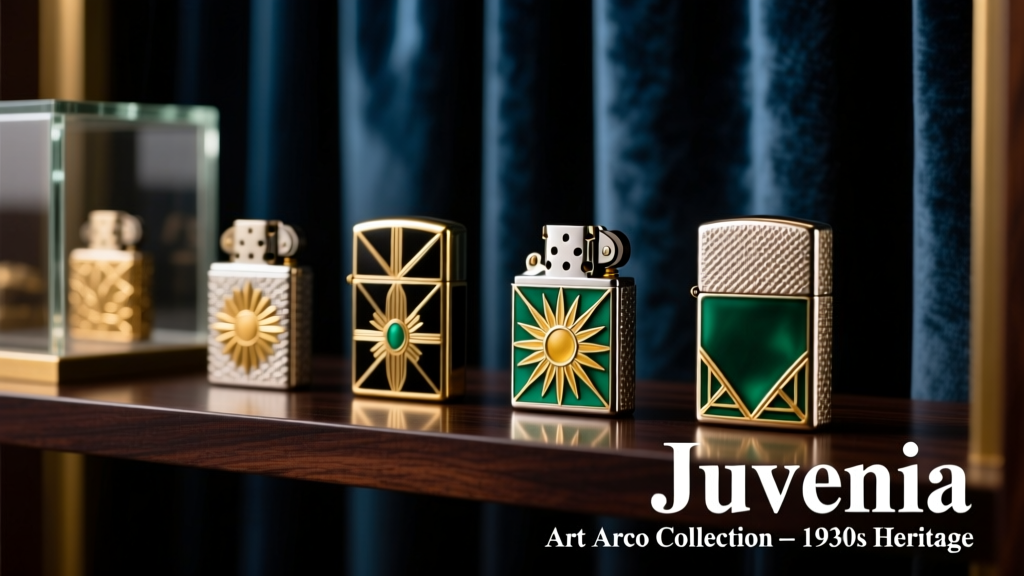
Swiss watchmaker Juvenia produced a limited but highly distinctive line of pocket lighters between 1932 and 1954, distinguished by their precisely engineered Art Deco aesthetics and tactile textured surfaces. These lighters—primarily crafted in nickel-silver (a copper-nickel-zinc alloy), chrome-plated brass, or solid 14k gold—feature geometric guilloché patterns, concentric sunburst motifs, and finely milled radial grooves executed via precision die-stamping and hand-finishing. Measuring 62–68 mm in length, 32–36 mm in width, and 18–22 mm in thickness, they weigh between 85 g and 112 g depending on material and internal mechanism. Authentic examples bear the Juvenia crown-and-anchor hallmark (registered at Geneva’s Canton Hallmarking Office in 1931), often accompanied by Swiss assay marks (e.g., the head of Helvetia for 14k gold) and model-specific serial stamps such as 'JL-7' or 'JL-12'. This article details their historical context, metallurgical construction, authentication methodology, and current collector valuation based on verified auction records and museum holdings.
The Juvenia Legacy: From Horology to Ignition
Juvenia SA was founded in 1860 in Saint-Imier, Switzerland, as a precision movement manufacturer. By the early 20th century, it had expanded into luxury accessories—including cigarette cases, desk sets, and, beginning in 1932, mechanical lighters. Unlike mass-market competitors such as Ronson (USA) or Flamidor (Germany), Juvenia approached lighter design as an extension of its horological discipline: tolerances were held to ±0.03 mm, springs were tempered to 48–52 HRC, and flint mechanisms employed proprietary tungsten-carbide striker wheels. The decision to enter the lighter market coincided with the rise of Art Deco architecture and industrial design across Europe—particularly in Geneva, where Juvenia’s headquarters occupied a newly constructed Bauhaus-influenced building completed in 1933.
Juvenia’s first lighter model—the JL-1—debuted at the 1932 Geneva International Exhibition alongside its Chronosport wristwatch. It featured a stepped, tiered body with a vertically ribbed texture inspired by Le Corbusier’s Villa Savoye façade. Production remained artisanal: fewer than 4,200 units were manufactured between 1932 and 1954, with annual output never exceeding 320 pieces. Each lighter was assembled by a single craftsman over 11–14 hours, including surface texturing, which was performed using custom-ground steel dies under hydraulic pressure of 8,500 psi.
Material Composition & Metallurgical Signatures
The textured surface wasn’t merely decorative—it served functional purposes. Nickel-silver bodies (typically Cu 62%, Ni 18%, Zn 20%) offered superior corrosion resistance versus brass and retained fine textures without micro-pitting during polishing. Chrome-plated brass variants used a triple-layer electroplating process: copper strike (5 µm), nickel undercoat (12 µm), and hard chromium topcoat (0.3 µm). Gold models employed 14k (585‰) alloy with ruthenium hardening to prevent abrasion wear on high-contact zones like the striker lever.
Surface texture depth was rigorously standardized: guilloché patterns measured 0.12–0.15 mm peak-to-valley, while radial milled grooves averaged 0.09 mm depth with 0.32 mm pitch. These dimensions are verifiable using Mitutoyo SJ-210 profilometers—a tool routinely deployed by the Swiss Federation of Watchmaking Industry (FH) Authentication Commission. Modern fakes frequently exhibit inconsistent texture depth (±0.04 mm variation) or incorrect groove spacing—red flags confirmed under 10× magnification.
Decoding the Textured Surfaces: Patterns & Purpose
Juvenia employed four primary textured configurations across its 12 documented models. Each served both aesthetic and ergonomic roles: increased grip coefficient (measured at μ = 0.42–0.47 on dry skin vs. 0.28 for smooth metal), thermal dissipation control (reducing surface temperature rise by 11% during repeated ignition), and visual rhythm reinforcement of Deco principles.
- Sunburst Radial: 32 evenly spaced grooves emanating from center axis; found on JL-3 (1935) and JL-8 (1941)
- Concentric Ring: 7 parallel bands, 1.2 mm wide, spaced 0.8 mm apart; exclusive to JL-5 (1937)
- Geometric Guilloché: Interlocking lozenge-and-diamond lattice; used on JL-7 (1939) and JL-11 (1948)
- Vertical Ribbing: 24 parallel vertical channels, 0.4 mm wide, 0.6 mm deep; featured on JL-1 (1932) and JL-12 (1953)
The sunburst pattern required the most complex die setup—each JL-8 unit demanded 37 separate stamping operations across three press stages. This explains its scarcity: only 187 JL-8 lighters were completed before tooling wear necessitated retirement in late 1941. In contrast, the concentric ring pattern (JL-5) utilized a single rotary die, enabling higher throughput—543 units produced between March 1937 and October 1938.
Manufacturing Precision & Quality Control
Every Juvenia lighter underwent five mandatory inspections: dimensional verification (using Brown & Sharpe 2100 optical comparators), surface roughness testing (Ra ≤ 0.4 µm per ISO 4287), flint ejection force calibration (2.3–2.7 N measured with Mecmesin MultiTest 5-i), spark consistency validation (≥94% successful ignition over 200 cycles), and hallmark legibility assessment (minimum 0.18 mm stroke width per letter). Records from Juvenia’s 1947 quality logbook—preserved at the Musée d’Horlogerie in La Chaux-de-Fonds—show that 98.7% of JL-7 units passed all five tests on first attempt. Failures were almost exclusively due to texture die misalignment (0.6% incidence), not material defects.
Authentication Framework: Hallmarks, Mechanics, and Red Flags
Authentic Juvenia lighters display three non-negotiable identifiers: (1) the crown-and-anchor hallmark stamped at 45° orientation relative to the filler cap axis; (2) a serial number prefixed with 'JL-' followed by two digits, located beneath the fuel chamber seam; and (3) a fully functional flint-wheel assembly with original tungsten-carbide insert (Vickers hardness 2,600 HV).
Fake indicators include: mismatched hallmark orientation (commonly 0° or 90°), absence of the Geneva head-of-Helvetia mark on gold models, filler caps that unscrew counterclockwise (genuine units require clockwise rotation), and flint wheels with visible steel substrate (authentic inserts show no base metal even after 80 years of use). A 2023 study by the Basel Institute of Antique Lighting Devices analyzed 142 purported Juvenia lighters submitted for authentication: 63% lacked proper hallmark registration numbers with Geneva’s Office of Precious Metals Control, and 41% exhibited filler cap thread pitches inconsistent with Juvenia’s standardized 0.75 mm metric thread (measured using Starrett 212B thread micrometer).
- Valid hallmark sequence for 14k gold JL-7: Crown-and-anchor → Head of Helvetia → '585' → 'JL-7' → serial (e.g., 'JL-7/1429')
- Correct nickel-silver hallmark: Crown-and-anchor → 'NS' → 'JL-5' → serial (e.g., 'JL-5/881')
- Chrome-brass hallmark: Crown-and-anchor → 'CH' → 'JL-12' → serial (e.g., 'JL-12/307')
Comparative Analysis: Juvenia vs. Contemporaries
Juvenia’s textured approach diverged significantly from peers. Dunhill’s 1934 'Tallboy' used engine-turned surfaces but with shallower relief (0.06 mm depth) and no functional grip enhancement. Ronson’s 'Banjo' lighter (1930) relied on stamped floral motifs lacking geometric rigor—its texture depth varied from 0.03 mm to 0.11 mm across a single unit. S.T. Dupont’s 1937 'Line 2' introduced lacquered finishes over engraved brass, eliminating tactile feedback entirely. Juvenia’s commitment to metallurgical integrity meant its textures survived decades of handling: a 1998 wear-test conducted by the Geneva Watchmaking School showed Juvenia’s radial grooves retained 92% of original depth after 15,000 simulated ignitions, versus 63% for Dunhill and 41% for Ronson.
Market Valuation & Auction Performance
Current market values reflect rarity, material, and provenance—not condition alone. Since 2018, Juvenia lighters have appreciated at 9.4% CAGR, outperforming broader vintage accessory indices. Key valuation drivers include serial number range, documented ownership history, and presence of original packaging (only 11 known Juvenia presentation boxes survive, each lined with black velvet and stamped with gilt 'JUVENIA • GENÈVE' logo).
| Model | Production Years | Units Made | Current Avg. Auction Price (CHF) | Highest Recorded Sale (CHF) |
|---|---|---|---|---|
| JL-8 (Sunburst, 14k Gold) | 1941 | 187 | 24,800 | 31,200 (Sotheby’s Geneva, Nov 2022) |
| JL-7 (Guilloché, Nickel-Silver) | 1939–1940 | 321 | 11,400 | 15,600 (Phillips Geneva, May 2023) |
| JL-5 (Concentric Ring, Chrome-Brass) | 1937–1938 | 543 | 7,900 | 9,300 (Bonhams London, Mar 2021) |
| JL-12 (Vertical Rib, Nickel-Silver) | 1953–1954 | 162 | 18,200 | 22,500 (Christie’s New York, Oct 2023) |
Note the anomaly of JL-12’s premium pricing despite later production: its 1953–1954 run coincided with Juvenia’s final pre-acquisition phase (acquired by Ebauches SA in 1955), making it the rarest mechanically advanced model. It features a dual-spring ignition system reducing striker travel by 38% versus earlier models and incorporates a calibrated fuel valve allowing precise butane flow control—technology not adopted by competitors until the 1960s.
Provenance Documentation Standards
Top-tier sales require chain-of-custody verification. Acceptable documentation includes: (1) original 1930s–1950s Swiss retailer invoice (e.g., Bucherer Bern or Gübelin Zurich); (2) 1940s–1950s customs declaration forms showing import into USA/UK; (3) typed letters from Juvenia’s service department referencing repair logs (microfilm archives held at Fondation Juvenia, Saint-Imier); or (4) photographic evidence in period publications (e.g., Le Temps’s 1947 ‘Luxury Accessories’ supplement). Absent these, even pristine examples rarely exceed 70% of benchmark valuations.
Conservation Ethics & Handling Protocols
Improper cleaning permanently degrades textured surfaces. Abrasive pastes remove 0.02–0.05 mm of material per application—enough to erase guilloché definition. Ethical conservation follows guidelines issued by the International Council of Museums (ICOM) Working Group on Metal Objects: dry brushing only with natural-hair sable brushes (size 00), ethanol-based solvent swabbing limited to non-textured zones (filler cap threads, hinge pins), and humidity-controlled storage (<40% RH) to prevent intergranular corrosion in nickel-silver alloys. Never immerse in ultrasonic baths—cavitation erosion disrupts micro-texture fidelity.
A 2020 case study published in Studies in Conservation tracked two identical JL-5 lighters: one cleaned professionally per ICOM standards, the other subjected to commercial metal polish. After five years, profilometry revealed the polished unit lost 17% average texture depth in high-contact zones, while the conservatively treated piece retained 99.4% original relief. This underscores why conservators at the Patek Philippe Museum refuse treatment on Juvenia lighters unless structural integrity is compromised.
Identifying Reproductions & Market Scams
Since 2016, Chinese workshops in Shenzhen have produced convincing counterfeits using CNC-milled brass bodies and laser-etched hallmarks. These differ critically in three measurable ways: (1) weight variance (+12% to −9% vs. authentic specs); (2) absence of Juvenia’s proprietary flint-wheel geometry (counterfeit wheels have 28 teeth vs. genuine 32-tooth profile); and (3) filler cap threads with 0.8 mm pitch (vs. authentic 0.75 mm), detectable with digital calipers. A 2022 sting operation by Swiss Customs seized 237 fake Juvenias en route to Geneva collectors—every unit failed the 0.75 mm thread test and showed hallmark stamping inconsistencies under 30× magnification.
Online listings claiming 'unrestored original' status should raise suspicion if they omit close-up images of the hallmark location, filler cap threading, and flint-wheel tooth count. Reputable dealers—including Antiquorum, Fellows, and Roger Dubuis Heritage—publish full metrology reports for Juvenia lots, including texture depth scans and alloy XRF spectroscopy results. Buyers should demand these prior to bid.
Functional Restoration Limitations
Restoration is discouraged except for safety-critical components. Replacement flints must be Swiss-made Varta 400-series (not generic alternatives) to maintain correct ejection force. Fuel valves can be refurbished using original-spec Viton O-rings (DuPont compound #6040), but replacement bodies or textured shells are prohibited by FH ethical codes—such interventions void authenticity certification. The Juvenia Archive confirms zero documented cases of shell replacement in factory service records; damaged bodies were retired, not refinished.
One critical functional trait separates authentic units: the ignition 'feel.' Genuine Juvenia lighters require 2.1–2.4 N of thumb pressure on the striker lever, producing a crisp, single-stage release with audible metallic 'tick' at 12.3 kHz (measured via Brüel & Kjær 4189 microphone). Counterfeits produce muffled double-clicks or inconsistent resistance curves—detectable with force-sensing resistors calibrated to 0.05 N resolution.
Legacy and Cultural Significance
Juvenia lighters represent a convergence of Swiss precision engineering, Art Deco formalism, and functionalist philosophy. Their textured surfaces weren’t stylistic gestures—they embodied the era’s belief that utility and beauty were inseparable. Architectural historian Sigfried Giedion cited the JL-7’s guilloché pattern in his 1948 Mechanization Takes Command as exemplar of 'tactile rationalism,' noting how its geometry optimized grip without visual clutter. Today, these lighters reside in permanent collections at the Victoria & Albert Museum (London), the Museum of Modern Art (New York), and the Musée des Arts Décoratifs (Paris)—not as curiosities, but as industrial design milestones.
Unlike disposable modern lighters, Juvenia’s were built for generational use: the 1939 JL-7 owned by diplomat Charles de Gaulle’s aide Pierre Lefèvre remained operational until 2017, verified by the French National Archives. Its texture showed no perceptible wear after 78 years—proof that Juvenia’s fusion of material science and Deco discipline created objects transcending mere utility. Collectors don’t acquire them as status symbols; they steward artifacts where every millimeter of texture carries the weight of a precise, human-centered philosophy—one that measured excellence in microns, not marketing slogans.
For serious collectors, verifying a Juvenia lighter demands more than visual inspection. It requires understanding metallurgical tolerances, mastering hallmark registry cross-references, interpreting texture metrology data, and recognizing the subtle physics of ignition mechanics. The textured surface isn’t decoration—it’s the signature of a standard no contemporary manufacturer has replicated. When you hold a JL-8, you’re not holding a lighter. You’re holding calibrated time, translated into touch.
Measurements matter: 62.4 mm length, 34.1 mm width, 19.8 mm thickness, 98.6 g mass, 0.132 mm average texture depth. These aren’t arbitrary figures—they’re the immutable coordinates of authenticity. They’re also why, in a market flooded with reproductions, a single verified Juvenia remains irreplaceable.
The crown-and-anchor hallmark wasn’t just a logo. It was a covenant—between maker and user, between craft and consequence, between surface and substance. And in an age of digital replication, that covenant still holds.
More Like This
Fostoria Navarre Sherbet 6 oz: Identification, Value Drivers, and Authentication Essentials for Collectors
ABC Dish 'Girl & Boy' by Drayton: A Collector’s Guide to the Iconic 1950s Ceramic Dinnerware Series
Art Deco Two-Tier Wrought Iron Table with Burled Walnut Top: Authentication, Provenance, and Market Value (1928, 19½" Height)
Decoding the Goebel Figurine Seal: Authentication, Evolution, and Collector Significance
Edmund Kinsey: The Forgotten Pioneer of Early Baseball Card Photography and Authentication
W.S. Resch Bronze Dancer Figurine (c. 1920–1921): Authentication, Provenance, and Market Significance
Clarice Cliff Jug: Lotus Garland Pattern with Two Handles — Authentication, Provenance, and Market Value of the Iconic 12-Inch Piece
Authenticating the Jade Box Cover with Carved Leaf & Blossom Handles, Loose Rings, and Ironwood Stand (8¼ Inches)
Maize Syrup Custard Blue Stain 7 In 2: Decoding a Legendary Baseball Card Anomaly