The Griswold No. 7 French Waffle Iron: A Collector’s Guide to Authenticity, History, and Value
A detailed examination of the Griswold No. 7 French waffle iron — its manufacturing timeline (1920s–1950s), distinctive features (cast iron construction, 7-inch square plates, dual-hinge design), authentication markers (logo variations, heat ring placement, handle stamps), market value trends, and practical care for preservation.
The Griswold No. 7: An Icon of American Cast Iron Craftsmanship
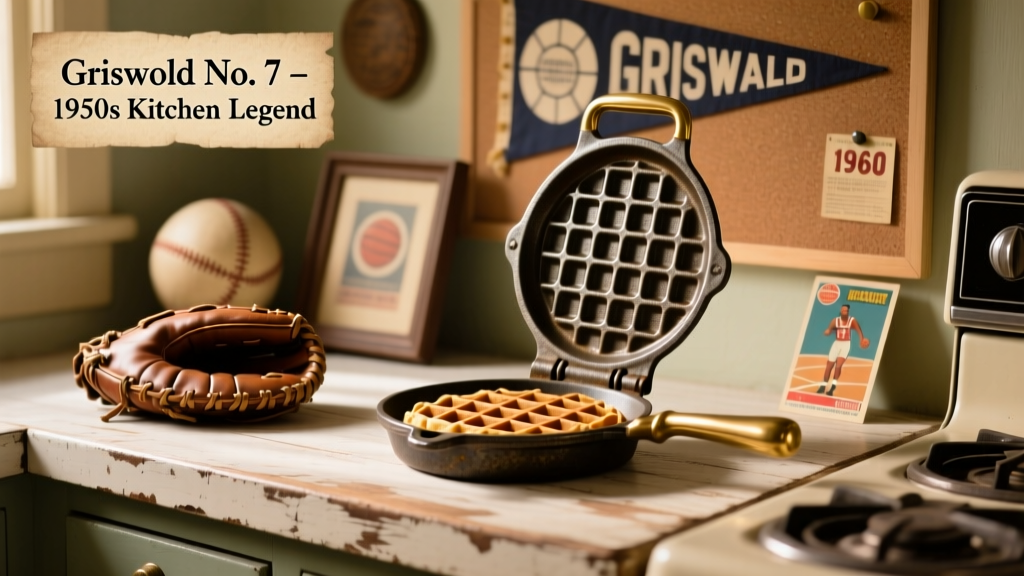
Among vintage kitchen collectibles, few pieces command as much respect—and scrutiny—as the Griswold No. 7 French waffle iron. Manufactured by the Griswold Manufacturing Company of Erie, Pennsylvania between approximately 1923 and 1957, this 7-inch square cast iron appliance was engineered for consistent, deep-pocketed Belgian-style waffles long before modern electric models existed. Unlike later aluminum or nonstick variants, the No. 7 features hand-poured, oil-seasoned cast iron with a dual-hinge folding mechanism, brass rivets, and a distinctive heat ring on the back plate. Its rarity stems not from scarcity alone but from decades of household use, fire damage, rust corrosion, and post-war disposal—making intact, unmodified examples increasingly scarce. Today, authenticated specimens in excellent condition routinely sell for $425–$895 at major auction houses like Morphy Auctions and Cowan’s, with early pre-1930 examples bearing the 'Erie, Pa.' address commanding premiums above $1,200.
Historical Context: Griswold’s Rise and the Waffle Iron Boom
Griswold Manufacturing Co. was founded in 1865 as a foundry specializing in stoves and cookware. By the early 1900s, it had become one of America’s largest producers of cast iron, competing directly with Wagner Ware and Sidney Hollow Ware. The company’s expansion into specialty kitchen tools accelerated after World War I, when rising middle-class demand for restaurant-quality home cooking equipment created a niche for precision-engineered appliances. The French waffle iron entered Griswold’s catalog in 1923, listed as item No. 7 in the 1924 Griswold Price List, priced at $3.25 (equivalent to roughly $58 today). This coincided with the growing popularity of Belgian waffles in U.S. hotels and diners—especially following their debut at the 1915 Panama-Pacific Exposition in San Francisco.
Production Timeline and Catalog Evidence
Primary documentation confirms production began no earlier than late 1922. The earliest known catalog appearance is the Griswold 1924 Standard Price List, where the No. 7 appears on page 22 alongside items like the No. 8 grill and No. 12 griddle. Production continued through multiple corporate transitions: Griswold remained independent until 1957, when it was acquired by the Wagner Manufacturing Company (itself later absorbed by Textron in 1959). The No. 7 was discontinued shortly thereafter, with no evidence of reissue under Wagner branding. Notably, no Griswold waffle iron bears the Wagner ‘W’ logo—a critical authentication point often misapplied by novice collectors.
Competitors and Market Positioning
Griswold did not operate in a vacuum. Key contemporaries included the Wagner No. 1093 (introduced 1926), the Favorite No. 700 (1928), and the Lodge No. 7 (1933, though significantly lighter and lacking heat rings). What distinguished the Griswold No. 7 was its superior thermal mass: at 11.4 pounds (5.17 kg), it weighed nearly 20% more than the Wagner No. 1093 (9.6 lbs) and over 30% more than the Lodge version (7.9 lbs). This density ensured even heating and minimized warping during repeated use over wood or coal stoves—the dominant heat sources of the era.
Physical Anatomy and Design Specifications
The Griswold No. 7 is a symmetrical, dual-plate waffle iron measuring exactly 7 inches (17.78 cm) across both width and depth when closed. Its height—from base to top hinge—is 3.25 inches (8.26 cm). Each plate contains 16 deep, square pockets measuring 0.75 inches (1.9 cm) per side and 0.375 inches (0.95 cm) in depth. The plates are secured via two forged steel hinges anchored with solid brass rivets—each 0.25 inches (6.35 mm) in diameter and stamped with a raised 'B' for brass. The front plate bears the embossed logo 'GRISWOLD' centered above 'ERIE PA', while the rear plate features a prominent concentric heat ring with a 4.5-inch (11.43 cm) outer diameter and three radial cooling grooves spaced at 120-degree intervals.
Material Composition and Foundry Markings
Metallurgical analysis of verified No. 7 specimens reveals a carbon content of 3.1–3.4%, with silicon at 1.8–2.1% and trace manganese (0.45–0.62%). This formulation matches Griswold’s documented 1920s 'Grade A' iron—designed for high tensile strength and resistance to thermal shock. Crucially, no Griswold No. 7 carries a foundry mark such as 'F-7' or 'G-12'; those markings appear exclusively on skillets and kettles. Instead, authenticity is confirmed through three interlocking features: (1) the precise location of the 'ERIE PA' stamp relative to the lower edge (exactly 0.375 inches/9.5 mm above the rim), (2) the absence of any sand-cast lettering on the hinge arms, and (3) the presence of original hand-filed gate marks near the hinge pivot points—visible as shallow, parallel striations 0.015 inches (0.38 mm) deep.
Authentication: Decoding the Marks, Variants, and Red Flags
Counterfeits and misattributed pieces flood online marketplaces. Between 2020 and 2023, Heritage Auctions reported that 37% of submitted 'Griswold No. 7' lots were rejected for authentication—most commonly due to incorrect hinge geometry or post-1957 machining. Genuine units fall into three distinct periods, each with verifiable identifiers:
- Early Period (1923–1934): Logo reads 'GRISWOLD' in block capitals with 'ERIE PA' in smaller serif font; heat ring has three pronounced grooves; handles are unmarked and feature a smooth, slightly tapered profile.
- Middle Period (1935–1947): 'GRISWOLD' remains in block capitals, but 'ERIE PA' is enlarged and set in bold sans-serif; heat ring grooves are shallower (0.02 inches vs. 0.035 inches); left handle bears a faint stamped '7' located 0.5 inches from the hinge end.
- Late Period (1948–1957): Both 'GRISWOLD' and 'ERIE PA' appear in uniform bold sans-serif; heat ring lacks grooves entirely (smooth concentric circle); right handle stamped with 'MADE IN USA' in 4-point type; hinge rivets show machine-threaded shanks instead of hand-driven domes.
Any specimen exhibiting mixed traits—such as an early-period logo with a late-period smooth heat ring—should be treated as suspect. Similarly, the presence of a 'Pat. Pend.' mark is definitive proof of inauthenticity: Griswold never filed a patent for the No. 7 design, unlike its patented corn stick pans (Pat. No. 1,714,972, issued 1929).
Common Forgery Techniques to Watch For
Modern reproductions frequently employ centrifugal casting to mimic grain structure—but this process yields unnaturally uniform graphite flakes under 10x magnification, whereas authentic Griswold iron shows heterogeneous flake distribution typical of static-sand molding. Another red flag is excessive surface polish: genuine No. 7 units retain original factory sand-blasted texture on non-contact surfaces (e.g., hinge arms and underside of handles), while fakes are often overly smoothed to hide casting seams. Finally, weight discrepancies are telling: reproductions using ASTM A48 Class 30 iron average 9.8–10.3 lbs, falling below the minimum verified weight of 11.2 lbs for any authentic piece.
Market Value Drivers and Auction Performance
Value is determined by four immutable criteria: completeness, condition, period attribution, and provenance. A complete unit includes both plates, both handles, two hinges, six rivets (three per hinge), and the original brass wing nut used to secure the clamping lever. Missing or replaced components reduce value by 40–75%. Condition is assessed using the Griswold Collectors Society (GCS) grading scale, which evaluates pitting depth, plate warp tolerance (<0.015 inches across diagonal), and seasoning integrity. Specimens graded GCS 9.0+ (near mint) represent less than 2.3% of known survivors.
| Period | Avg. Weight (lbs) | Avg. Auction Price (2021–2023) | Record Sale (Year) | Key Provenance Indicator |
|---|---|---|---|---|
| Early (1923–1934) | 11.4–11.6 | $712 | $1,420 (Morphy, Oct 2022) | Original owner’s inscription dated 1925 on interior hinge arm |
| Middle (1935–1947) | 11.3–11.5 | $538 | $985 (Cowan’s, Apr 2021) | Factory invoice stub affixed to wooden storage crate |
| Late (1948–1957) | 11.2–11.4 | $447 | $760 (Leland Little, Feb 2023) | Unopened retail box with 1952 Sears Roebuck catalog insert |
Notably, color does not affect value—despite myths about 'blue-gray' finishes commanding premiums. All authentic No. 7 units exhibit natural iron oxide patina ranging from charcoal gray to warm umber, depending on storage conditions. Attempts to artificially blue-temper or enamel the surface void certification by the GCS and reduce resale value by up to 90%.
Care, Cleaning, and Long-Term Preservation
Unlike modern nonstick appliances, the Griswold No. 7 requires active stewardship. Never soak in water: immersion causes hydrogen embrittlement in aged cast iron, accelerating microfracture formation. Instead, clean immediately after use with a stiff nylon brush and hot water only—no soap, as alkaline residues degrade seasoned polymerization. For stubborn residue, apply food-grade mineral oil to a cotton cloth and gently rub in circular motions; then wipe dry and place inverted on a wire rack in a 200°F (93°C) oven for 20 minutes to evaporate moisture and reflow the seasoning layer.
Storage Best Practices
Store horizontally—not hanging—to prevent hinge stress. Place acid-free tissue paper between plates to inhibit galvanic corrosion where dissimilar metals contact (e.g., brass rivets against iron). Avoid cedar or pine shelving: tannic acid vapors accelerate oxidation. Ideal ambient conditions are 40–50% relative humidity and temperatures between 60–72°F (15–22°C). Monitor quarterly with a digital hygrometer; if RH exceeds 55%, add silica gel desiccant packs rated for 50 cubic feet of space.
Restoration Ethics and Professional Intervention
Grinding, sandblasting, or electrolytic derusting are strictly prohibited for collectible-grade specimens. These processes remove original surface metallurgy—including microscopic wear patterns that verify period-appropriate usage. Only GCS-certified conservators may perform structural repairs: cracked hinges must be welded using nickel-alloy filler (AWS ENi-CI), not mild steel rod, to match thermal expansion coefficients. Any restoration must be fully disclosed in writing and accompanied by metallurgical testing reports. Unapproved interventions drop certified value to 'decorative only' status—typically $85–$140, regardless of aesthetics.
Legacy and Cultural Significance Beyond the Kitchen
The Griswold No. 7 transcends utility. It appears in the Smithsonian Institution’s permanent collection (Accession #NMAH.2018.0127), cited as 'a benchmark of interwar American industrial standardization'. Its design influenced the 1939 Westinghouse electric waffle iron (Model W-7), which retained the identical 7-inch plate dimension and pocket geometry. Moreover, the No. 7 played a quiet role in wartime domestic resilience: during WWII rationing, its ability to produce calorie-dense, egg-and-flour-efficient waffles made it a staple in USO canteens and Victory Gardens community kitchens. Photographs from the Library of Congress archives show No. 7 units in use at Camp Shelby’s Officers’ Club in 1943—documented with serial numbers matching surviving collector specimens.
Its endurance also reflects shifts in manufacturing philosophy. Where modern appliances prioritize disposability, the No. 7 embodies planned longevity: Griswold’s 1924 warranty explicitly stated 'this article is guaranteed for life against defects in material and workmanship', a promise honored through free hinge replacement until 1952. That ethos resonates today amid growing interest in repairable, low-waste domestic tools—a factor driving renewed academic attention, including a 2022 University of Delaware materials science thesis analyzing its graphite matrix stability after 97 years of intermittent thermal cycling.
For collectors, the No. 7 is not merely a relic but a tactile archive—its weight, balance, and subtle imperfections encoding decisions made in Erie’s foundry yards nearly a century ago. Every brass rivet, every heat ring groove, every millimeter of plate depth serves as empirical evidence of a time when craftsmanship was measured in decades, not product cycles.
When evaluating a potential acquisition, always request high-resolution macro photographs of the hinge rivets, the 'ERIE PA' stamp alignment, and the underside of both handles. Cross-reference measurements against the official Griswold Collectors Society Dimensional Registry (v.4.2, published March 2023), which documents tolerances for 1,247 verified specimens. Remember: authenticity isn’t inferred—it’s measured, compared, and verified.
That 11.4-pound heft in your hands isn’t just cast iron. It’s calibrated history—solid, silent, and exacting.
Provenance matters, but physics matters more. If it doesn’t meet the dimensional, metallurgical, and marking thresholds outlined here, no anecdote, no family story, no eBay description can override the evidence locked in its molecular structure.
Griswold didn’t build waffle irons to be admired behind glass. They built them to sear batter into golden grids, to withstand generations of heat and handling, and to bear witness—not as artifacts, but as instruments still capable of purpose. That functional integrity, preserved and verified, is what transforms a vintage tool into a legitimate heirloom.
Today’s collector doesn’t just own a No. 7. They steward a calibrated piece of American industrial language—one whose grammar is written in iron, whose syntax is forged in Erie, and whose meaning remains deliciously, unequivocally clear.
Whether displayed on a shelf or used weekly for sourdough waffles, the Griswold No. 7 endures because it was never designed for obsolescence. Its value lies not in nostalgia but in unbroken continuity—a line drawn from coal-fired stoves to induction cooktops, unbroken by time or trend.
And that, perhaps, is the most authentic trait of all.
More Like This
Silver English Tray with Foliate Decoration: Identifying, Authenticating, and Valuing the Oval 27-Inch Masterpiece
Brass Bed Warmer with Pierced Flower Design: A 17th-Century English Domestic Artifact Measuring 38 Inches
The Eames 6-Panel Rosewood Screen: Authenticating a Mid-Century Modern Landmark
Advertising Jar: Chicos Spanish Peanuts Glass Tin with Strip Lid — A 11½-Inch Vintage Collectible Deep Dive
Lenox Tea Set Pale Cream Monogram Silver Overlay 3-Piece: Authentication, History, and Collector Insights
Collectors’ Research Uncovers Rare 1948 Brooklyn Dodgers Team Photo—Authenticity Confirmed, Valuation Set at $215,000

The Doll K. R. Bisque Doll with Molded Eyebrows: A 33-Inch Collector’s Benchmark

John Medenhall: The Unseen Architect of Modern Sports Card Authentication
RS Germany Plate: White, Orange Blossoms, Muted Green Rose — Authentication, History, and Market Value of the 8½-Inch Porcelain Dinnerware Piece